Category: Slow Trader Hedge Fund

  • This is boring but its important

    There are so many ways to trade it can take you years to figure out what is right for you. However, we can put all of them into three simple categories.

    Firstly, there is day-trading. Self explanatory. You are in a trade sometime during the day and you are out of the trade before the day ends. Great fun. But few make a profit doing this.

    Secondly, there is short term trading (often referred to as swing trading). My preferred trading style. You follow the rhythm of the share price and try to catch the most lucrative part. You’re in for a few days to a few weeks. Using this style you may miss the big up, but you have a fair chance of missing the big down too!

    Thirdly, longer term trading. This is what most of you have through your mutual fund investments and pension funds. Recall that over the longer period, every 1 percent in charges results in you giving back to the fund some 20 percent of your final amount. So if your fund was worth £100,000 after 40 years of investing the average mutual fund would have cost you between £40,000 to £60,000. Thats a large chunk. Few people realise this and this is why mutual fund managers remain in the top echelons of earners.

    The younger investor would be better placed choosing a low cost index tracker fund. It will win hands down over most mutual or managed funds.

    The mature investor should always consider fixed index annuities – Read Tony Robbins, money master the game. Its only 616 pages! or take my word for it.

    We should consider another problem with the mutual fund (and there are several more) is the equity crash that seems to come around now and again. If you were financially retiring in 2008, your long term investment would be half of what you expected. If you had more than 15 years to retirement your fund could recover if it were in US stocks. Most UK shares have not even yet recovered to the high of 2008.

    Discuss with your independent financial advisor fixed index annuities such as (from Tony Robbins): Barclays Dynamic Balance Index (a mix of stocks and bonds) and Morgan Stanley Dynamic Allocation Index (a mix of 12 different sectors). Your IFA should find you UK index equivalents if you prefer.

    B

  • Shares traded this week

    Non of our shares reached their price targets this week.

    We usually only trade shares long (unlike the FX market which we trade long and short).

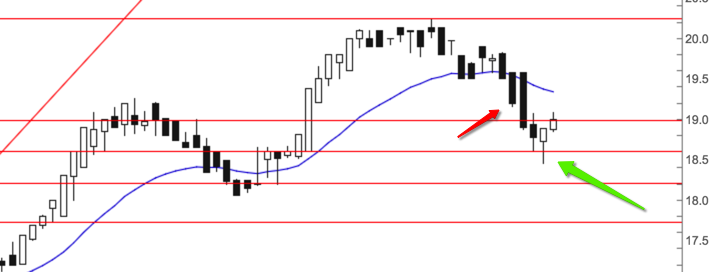
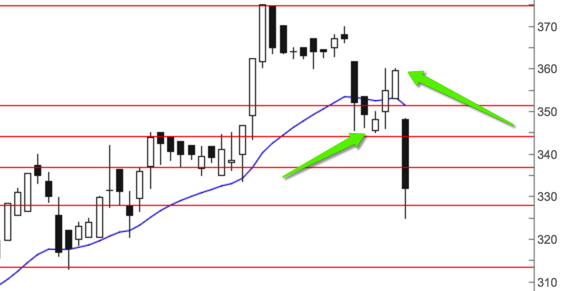
    The FTSE 350 and S&P 500 markets were generally down this week. Certain sectors like Home Construction had a good week.

    However, the general down periods in the market present us with buy signals.

    The one I got wrong was Southwestern Energy Co. A higher risk share for us as it was early in an up cycle following a large down cycle. It retraced more than I wanted.

    On the plus side, we entered:

    Arm Holdings which we got for a good price and is up a few points.

    BT Group, this is a weak growth share but a positive growth non the less. We are at even on this.

    Halliburton Co, we had a buy limit set on this company for most of the week. We recently got it and it immediately moved nicely up. An oil equipment company but very much dependent on the oil commodity price.

    Monster Beverage had a good buy signal but has moved lower. We are still in this share although my stop position will not allow it to move much lower. Hopefully we’ll get a nice recover in the market and Monster next week.

    Under Armour Inc. was bought early in the week and stayed low throughout. Yesterday however it moved very sharply up in our favour – still some way to go to our sell target.

    A reminder not to use this as recommendations as the buy time on most has probably passed. You would end up buying as I’m selling!

    You can get early information via WhatsApp – more on this later.

    Regards

    B

  • How we are doing, June 2015

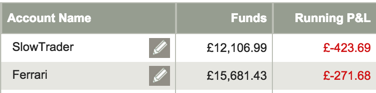
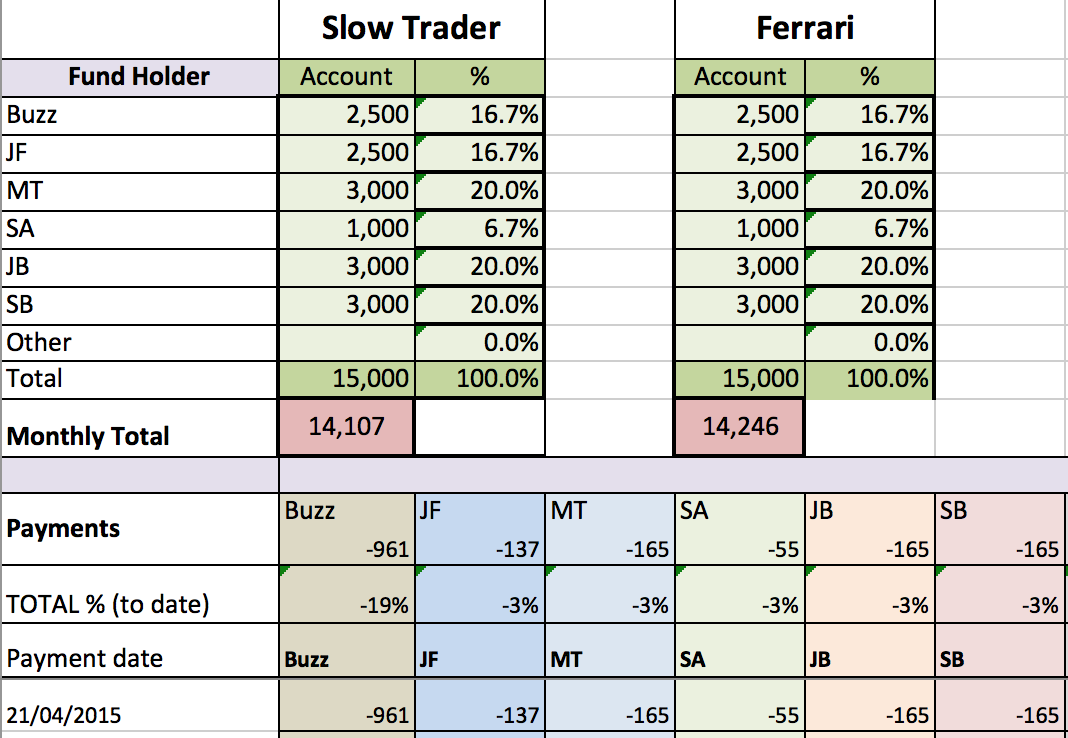
    Here are our funds as we stand. As you can see, Ferrari, which shows share trading, is up. However, Slow Trader, which shows FX (foreign exchange) trading is down.

    Snip20150603_4

    I am not concerned about Slow Trader’s position as the FX market is a difficult beast with great volatility. We are simply learning how to tame it.

    That’s not meant to be flippant. I regularly trade the FX now with over a thousand pounds a day gain. The secret is learning how not to give it all back in small chunks. That is, improving the win loss ratio.

    Our strategies are maturing and I’m confident we’ll see the FX benefits very soon.

    With regard to Ferrari, I am delighted with its progress. We were well over £16K a few days ago. The recent down trend in the market hit us but that, in turn, provides buying opportunities.

    Snip20150603_6

    Going forward, I have spoken to most of you and I get the feeling that there is no great excitement about an income fund at this stage.

    Therefore, although I will still treat the fund as income, I propose that we grow the higher investors to £9,000 each and review the situation.

    One reason to keep the fund lighter, and remember it is a leveraged fund, is my own confidence in trading a larger (leveraged) fund. You may not consider the size of the fund to be large. But because the fund is leveraged (and with the associated risks that imposes on me) – and if you compare what we are doing with a traditional fund – we are talking short term trading with the equivalent of over £100,000.

    Having said that, I feel that as we grow in experience, I am happy to expand the trading fund.

    Going forward, I will now report on the fund as early as possible at the beginning of each month.

    Regards

    B

    P.S. For those who wish to trade for themselves in shares, my next blog will explain my real time share buy information via whatsApp.

  • Sorry, maximum of £6,000 is per individual ….not fund.

    From my last blog, maximum of £6,000 should have said per individual not fund. At the moment your monies are split equally between SlowTrader and Ferrari. Those with £3,000 in each fund are at the maximum and will receive profit as monthly income. Hope that makes more sense.

    Here’s a quote I like:

    “The trading game is designed to trap you, to trick you and to test your nerve. If trading were easy, we would all be rich. This is why the simple text book strategies don’t work, and why narrow-minded traders who can’t adapt to new ideas and changing market conditions fail over and over.”

    You get my point I’m sure…

    B

  • How are the funds doing?

    As I’ve said, our trading approach has changed a lot. Your funds are now income rather than growth. But we still have two funds:

    1. SlowTrader – trades the FX (foreign exchange pairings) gold, silver, WTI (light crude oil) and S&P index. This fund takes short term trades both long and short using daily, 4-hour and 1-hour charts.

    2. Ferrari – trades Nick’s top shares in FT 350 and S&P 500. This fund also takes short term trades but is primarily long using daily charts only.

    Your monies have been split equally between each fund. If you have an overriding preference on a certain fund just let me know.

    Here’s a snap shot of the funds:

    Screen Shot 2015-04-21 at 07.49.51

    The running P&L still has a share in both funds from my old system. The share is down and expires mid May. I’m hoping between now and then this share will come back up.

    Remember this is a snap shot only. The running P&L could be in the green this afternoon.

    Even – for both funds – is £15,000. Anything over this amount, at this time each month, you will get half your percentage profit. Those that have the maximum of £6,000 in their fund will receive the profit as tax free income. Those with a fund that is less than £6,000 will have their profit reinvested until their fund is at £6,000.

    Here’s how it stands:

    Screen Shot 2015-04-21 at 08.32.55


    What I can now do in my short term trading has taken hard work, (dedication to the point of obsession really!) money and time. Anyone that tries to sell you a trading system and tells you its easy don’t believe them!

    Anyone can withdraw their funds at any time. But please don’t miss on the good time, you’ve come this far.

    Talk soon – B


  • A surfing analogy that helps us trade

    There are a few different ways people approach the ocean (trading).

    Some dive right in.

    Others inch in slowly, testing the temperature of the water until they feel comfortable to wade in all the way.

    A few like to stand there and get pummeled by the water’s force.

    And of course there are those that avoid going to the beach entirely.

    The most daring and remarkable of all are the surfers (what we refer to as long and short board trading).

    The surfer (trader) harnesses the ocean’s (market’s) power, gliding above the surface, zigzagging their way to the shore. Of course, sometimes they fall off their board. But the good ones understand this is just part of the process and hop right back on. They know that through practice they will navigate the inevitable ebbs and flows, the unexpected surge, the occasional fellow competitor that gets too close. Over time, they spend more time up on the board, reaching the shore faster with far more grace and power then when they started.

    They understand and accept a few things we all should.

    Avoiding turbulent water is impossible.

    Fighting the power of the ocean is an exercise in futility.

    Waves are inevitable.

    We’re going to have to learn how to surf.

    (taken from Steve Dennis’ Blog)


  • How is the change over to short term trading going?

    Hi everyone

    Let me try to put the trading change – from what we were doing to what we are doing now – in terms of athletics. At least something we all know. If 100 meters represents one day of trading (i.e. day trading) then we have gone from running the 10,000 meter race to the 400 meter race. A completely different discipline.

    As a 400 meter athlete we are also reasonable at both the 200 meter and 800 meter races. And that is how we are now with trading, we specialise in holding trades for 4-days but we are also comfortable with holding trades a few days either side of this. And as with the athletics analogy, the work, discipline and mindset between what we were doing (10,000 meter running) and now (400 meter running) is totally different.

    So why have I made this change?

    I think its for the potential reward and control this trading method brings.

    An Increase in your fund is all well and good if you’re an investor. But if you’re full-time with a leveraged fund then I feel results need to be dynamic. A small increase or even doubling the fund isn’t good enough. As conceited as that sounds, I am looking for a regular monthly income for us, not a fund.

    I got hit by last years late September early December dip in the market. Both times! We were the 10,000 meter runners – we had the longer term market view. With a normal fund a market dip is no problem because if your, lets say, £5,000 fund dips 10% and comes back up in a few weeks then big deal. However, with a leveraged fund where your £5,000 invested money represents £100,000 leveraged money then any unconsidered dip is unsustainable. You have to come out early and take the loss.

    With regard to trading time:

    You may see, in some promotional writings on trading, statements like “earn millions in only 15 minutes a day”. The old saying ‘if its too good to be true…’ comes to mind. My experience is part time effort gives you part time results. Recently I have gone from part-time to this Monday to Friday:

    IMG_5904

    6am to 8am – trading study (clear emails and anything else)

    travel to office for 9am

    9am to 11am live trade

    Review trades, maybe tennis and lunch

    1pm to 4pm live trade

    Review trades then travel home

    9pm (most evenings) review end of day close signals

    Being full-time brings its own issues of course such as the temptation to overtrade. Patience we have learnt is key. However, we are now there to catch the early signals.

    What are we trading?

    Ten financial currency pairings; four of the major indices, plus gold, silver and oil; and about ten of Nick’s top companies. That seems light but its more than enough. We specialise. Over the last couple of weeks of starting this routine we have found that the currency pairings are all we have been able to manage.

    Your initial capital is safe. I’ve spent my own money with the dips I mentioned. And my own money in the few weeks learning by mistakes the new method. Paper trading only goes so far, you learn by your mistakes through trading real money!

    I appreciate that this trading is different to what we originally considered. As we go forward your income is a percentage, all plugged into a spread sheet, of your input. You can however withdraw all or part of your initial input in any month.

    My aim is to provide a monthly amount of income for us all, regularly.

    B

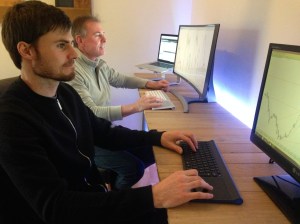
    P.S. the photo is of James and myself in our office. James has joined me full-time with his own trading money. As a web designer (which he still does in the evenings) he has a great mindset for this method of trading and we discuss each and every chart and trade.


  • Fund Update

    Hi

    Good progress this month. Still slightly down but a good move to neutral.

    Done with little time available for trading. Most time was taken up with a trading course in London, the completion of a detailed Australian on-line trading course and a weeks skiing in Austria!

    My review of my trading has made it more specific. More focused. Rather than hundreds of charts I now concentrate on a dozen foreign exchange pairings, a similar number of company shares and half a dozen or so commodities. What a change.

    Each of the above have to be traded with an advantage. With something that gives me a better than good chance of winning. I’m also trading shorter term than before. Rarely day trading, but taking trades for only a few days or a week or so. The exception being the commodities which can still be over a few weeks.

    Soon, I will be set to trade full time – the lodge is becoming the office.

    As your funds are leveraged there is little point in going for capital growth. I can’t trade more (because it is leveraged) than I have already. Therefore, I propose that as soon as we are neutral I send you a monthly cheque from any profits.

    An annual review is therefore not needed. As you are monthly you can withdraw part or all funds whenever your fund account is neutral or better.

    Distribution of profits is done on your share percentage of the fund you are in. Cheques are tax free.

    Talk to you soon.

    Regards

    B


  • Go Back to Basics

    Some of you have asked recently for thoughts on what/when to invest next.

    Before that, lets go back to basics.

    Something I got from Tony Robbins’ last book, the most important thing is to firstly sort out our income, growth and fun.

    I’ll run a blog or two sometime later to expand on these but for now: income is stuff that generates you cash without having to get out of bed; growth is mostly what we talk about when we refer to share investment; and finally, fun is shorter term high risk and reward.

    All of us dismiss this as either too simplistic or we think we have done it. When actually we haven’t. Honestly, its key.

    Now, take your growth part and decide what to do with it.

    I recently enquired after a few internet trading systems and took a look at some of the more popular trading magazines. Wow, you quickly get inundated. If its all that good why are they not billionaires?

    The point is, most of the magazines and probably all of the trading systems are not for your growth but for your fun. they are mostly short term and reactionary. So, back to the beginning, lets not get confused and put our growth stuff into short term, high risk by mistake.

    Growth is a nine month view, and a few years reviewed six monthly is best.

    Trying to judge your growth fund from the popular magazines is almost like trying to judge the long term weather forecast from the front page headlines of the Daily Express. Its reactionary. It will at best get you in when you should really be getting out and at worst make you procrastinate with headline information overload.

    Take your allocated growth pot of money and divide it into investment portions. (You are looking for growth here. If from your popular magazine you have the company with the latest oil exploration technique then this is not growth but the high risk fun part).

    With your growth portions: less is more. Look for solid companies that are in areas that you think will continue to grow. One of my portions would be an index tracker of the FTSE 100 and/or S&P 500 (e-mini if I could get it). I would also save one of these portions to put into gold but not until mid February. The same timing for an oil or oil associated company like Petrofac.

    Shares will trend up this year. That is, the index will finish higher. But there will be a bit of ‘fun’ in-between.

    B


  • Hedge Funds Update

    We remain down:

    Sorry, that is how it is. How much down I’m going to keep to myself for a while. I know we’ll be even by the next report, 23rd February. After that, based on patterns, I say that we’ll be up 40% by 23rd April. And after that, until the annual report of Slow Trader Hedge we’ll gain a further 10%. (Ferrari Hedge started later and will fare slightly better).

    We will therefore have a total gain in Slow Trader Hedge of only 50%. Somewhat short of my double prediction.

    What went wrong? Encouragement from you possibly did it, and I have to say good natured encouragement at that. The problem was me. My inexperience of dealing with other peoples money. I tried too hard.

    I could have tried to edge some back over the early New Year but decided against it. When you take a hit, at least in the trading sense, its sometimes best to take a ‘review’ time out.

    Slow Trader and Ferrari Hedge, and my own funds, have been completely out of the market for a few weeks.

    We have only just trickled back in. Building slowly over the next few weeks as buy patterns present themselves and as my indicators suggest.

    I often knock the managed funds, because they fail most of the time. I still have no support for managed funds but I do now appreciate what they have to do. Unlike me, they have additional pressure from share holders, bosses etc; they cannot simply take time out to regroup.

    I continually read that 94% of people that do what I do fail to make the grade. In the case of managed funds, fail to beat the index – in my case, fail to stay profitable, or worse.

    I need to learn from this experience and do my thing – not the thing that is encouraged of me. If that makes sense!

    As a Slow Trader or Ferrari Hedge investor you have no downside this first investment year. Original invested amounts can be returned whenever wanted, and with no detriment to remaining investors.

    But over the next few months…. I think its going to be positively exciting.

  • Eve’s share list – what do you think?

    Eve (not actual name) has this share list.  Through an ISA so LSE only.

    There are a mixture of FTSE 100, 250, AIM and small cap here. As we only calculate FTSE 100 and 250 (Grouped as FTSE 350) and S&P 500 shares I’ll show this based just on medium term chart signals rather than Nick’s company numbers.

    Aggreko – trending down but medium term is a hold.

    Barclays – choppy recently. Short term (a possible) hold. Medium term, sell.

    Centamin – short term a slight drop. Medium term hold. Moreover, gold to increase this year.

    Delling Group – unless you know something! sell.

    Glencore – copper to rise. I’d say hold.

    HSBC – banks more difficult to judge. Simply by the signals its a sell, and has been since late September.

    Petrofac – oil industry has taken a hit. However, Petrofac is one of our ‘top buy tips’ based on company numbers. Crude oil to increase again in March. Hold.

    Premier foods – short term is a probable dip. Medium term difficult. Unless you know something! again consider a sell.

    Quindell – recently increased nicely. If you need the cash, sell. If not, and you like a bet, then hold.

    Wetherspoon – neutral with a slight trend upwards. Could equally go up or down! It is going to do something based simply on the length of time it has done nothing! Probably to continue its current drop to 780p, but a climb is possible. Tentative hold.

    Any spare cash and nothing in the ‘top buy tips’ takes your interest consider an index tracker in FTSE 100 or S&P 500 e-mini or even a gold ETF. However, if holding Centamin (gold) then consider diversification and exposure to too much in one commodity. You also have copper and oil, in some regard, through Glencore and Petrofac respectively.

    All the best

    B


  • My S&P 500 top buy tips 2015

    Again, from Nick’s spreadsheet, I have selected a few S&P 500 shares to buy as part of your go-get-em portion of your money.

    Google Inc (either GOOG or GOOGL), Priceline Group Inc, Green Mountain Coffee Roasters Inc, Michael Kors Holdings Ltd, Qualcomm Incorporated.

    These are based on the company showing above 80% consistency of growth, a present value that Nick has as less than 55% of potential, and no, or insignificant, debt. P/E has to be representative of the companies sector and certainly not above 40. There are lots of other criteria, but these cover the main ones.

    They are also based on a medium term buy signal about to show. Probably within a couple of weeks.

    Be aware, however, that you need to understand the company too. Blackberry, for example, would have qualified for a few years in the above category – but at that point Blackberry also had no future market.

    B

  • A bit more about top buy tips for 2015

    You will notice that my buy suggestions yesterday are mostly expensive by UK share prices. These are not shares that you will hope to double your money with in a few months. That is a different approach altogether.

    I found that suggesting such volatile shares didn’t work because to buy volatile shares, unless you are really in the know about such a share, is trading rather than investing. A difference between trading and investing is that timing is everything. And unless you have my indicators or similar and watch your volatile share regularly you can miss it.

    The shares I have pointed you to are part of your go-get-em or growth fund. This is not your fun fund. That is something entirely different. How you divide your total account into: Annuity (or pension), go-get-em (or growth) and fun is up to you. I think it is not that difficult as the only areas that should alter are the annuity and fun. The go-get-em should, to my mind, always stay the same.

    In other words, if your age is 25 your fun fund is bigger than your annuity. Probably much bigger! Later in life the proportion of these funds equal each other and then later still in life they switch places. However, the go-get-em portion can stay the same throughout. And these are the shares I gave you yesterday. It is important to regularly adjust the proportions. Lets say you have particular success in your fun fund then this has to be redistributed back to an overall fund balance that is right for you. This should be done regularly and certainly annually.

    In the next day or two I will provide the US growth shares.

    B


  • My FTSE 350 top buy tips 2015

    Nick’s spreadsheet shows us the true value of a company and measures a companies consistency of growth: here are my picks from Nick’s FTSE 350 spreadsheet. These companies show wonderful potential future values and all with better than 80% consistency of grown.

    I would look at buying within the next couple of weeks. You have, coincidently, good sub sector diversification here too.

    Hargreaves Landsdown PLC, Rotork PLC, Intertek Group PLC, Weir Group PLC, Aggreko PLC, Premier Oil PLC, Playtech PLC, Randgold Resources Ltd, Rightmove PLC, Petrofac Ltd, Fisher (James) and Sons PLC, Aberdeen Asset Management PLC and Nostrum Oil & Gas PLC.

    …energy companies, namely crude oil, will have a hesitant start to 2015 but then recover much of recent lost price.

    In addition to the above companies, consider a simple index tracker of the FTSE 100, FTSE 250 and/or S&P 500. They will do well this year. Remember, the secret is attention to cost. Ongoing cost is more important than entry cost. Vanguard FTSE UK Equity Index have an entry of 0.4% of fund but a low 0.08% ongoing cost. Shop around.

    Consider a ETFS Gold (LSE: Epic Bull). Gold will have a good 2015. Based on cycles we could see a gold high near the end of March, then a drop followed by a similar high end of October. For those that bought Centamin PLC look for a sell at one of these dates. Preferably the end of March.

    Diversification through Treasury Bonds and Gilts are excellent for the longer term investor. If you don’t have these yet then leave until next year. It is a fair assumption that interest rates will remain for a while and therefore Treasury Bonds will stay level or decrease slightly this year.

    If you hold Domino’s Pizza, Burberry, Easy Jet or Hikma Pharmaceuticals – all previous recommendations – you could consider taking profits now. 

    My next blog will be from Nick’s S&P 500 spreadsheet – for those that can invest in the US.

    Warm regards

    B

  • How to get the most from my retirement pot

    First of all, because of the holidays, the next fund report (Slow Trader and Ferrari Funds) will be about 23rd January 2015. With Slow Trader, we took a hit in the last report and we had 2 or 3 trades that were still to come off. These took us a good 10% lower than my last report. However, on the plus side we currently have several trades that are running and these are in profit. Let us see.

    I’ve made simple but significant changes to our trading technique. In terms of timeline, I’ve come out more – now taking a broader view. To that end we will use the ‘futures style’ purchasing rather than the relatively expensive Daily Fund Bet. This will help to reduce our fund operational costs.

    I’ve back tested weeks worth of trades to find the best timelines for our indicators. There is never a sure bet, if it were that easy…

    However, I am confident that we have something that suits the current market. These things need regular review as what worked a while back might not necessarily work as well today.

    I’ve titled this article – how to get the most from my retirement pot – because that is what I’ve been looking at recently. Primarily to find the best pension scheme for my small company and employees. The one I have chosen is http://bandce.co.uk/ the peoples pension.

    Other than it being internet based, so no middle man, the pension is clear and easy to use and provides some great funds to choose from. More importantly, it only charges 0.5% with no other costs. The low charge over a 20 years or more is significant.

    One of the problems with mutual or managed funds (including banks) is the high management cost of their funds. This is a secret the big funds have kept for decades. For every percentage charged in management you can deduct at least 20% from your final lump sum. If you’re keeping a fund for 40 plus years the percentage is higher than this. Therefore, a managed fund that is costing you say 2.5% will reduce your final award by some 50%. If your fund was due to pay out £100,000 then you would only get £50,000 – maybe as little as £35,000. You’re giving the fund managers potentially £65,000 – and for what!

    How is this possible? Its all to do with that magical reason: compound interest. Probably the most powerful tool you can financially teach your kids, grand kids etc. If you want more proof of this read Tony Robbins recent book Money: Master the Game. Its a mammoth read but well worth it. Obviously the book uses American terminology, but the UK is similar with different names.

    If not managed or mutual funds then how do I invest my money? Simple, self-managed index or tracker funds. This is something that will track a bunch of companies – say the FTSE 100 or S&P 500 – and will cost you very little to do so. In compound terms you keep that £65,000 rather than, as in the example above, give it to a bank or fund manager. Also, don’t let your broker suggest that a managed fund will get you more return over time for your money – your broker is not your friend. Over the last 20 years the stock or share market has gone up almost 10%. The average for managed funds has been about 2.5%. What a difference. Indeed, some 98% of managed funds do not beat the market – or, in other words, do not beat your self-invested index or tracker fund.

    Diversification in funds is important. In our hedge funds, for example, I look carefully at sectors in turn. Careful not to overload in any one sector. An index fund, by its nature, invests through all sectors. How you distribute your money is individual depending on age, retirement goals, health. However, with 15 years to go before retirement be very cautious of being overly exposed to the share market. The reason is that, historically, the share market has taken belly churning drops twice in any 12 year period. The suggestion, therefore, of 15 years gives you a buffer. If you cashed in your fund in late 2008 you would have got nearly 50% less than a few months prior. Not good.

    They don’t get a great press, but fixed annuities are a great way to go. Do not, however, go with the first suggestion from your pension fund if they provide an annuity. Shop around and get the lowest cost. Is a low cost annuity safe? After 2008 throughout the USA hundreds of banks went bust but not one insurance company (an annuity provider) went under.

    I would split my retirement money as:

    • Annuity
    • Go-get-em or growth fund
    • Fun fund

    I would consider 60% of my funds with an annuity. Again, depending on personal funds and circumstance. That is your safe fund. Your income to live on and hopefully help pay the bills. Most of the remainder I would put in a growth fund or a ‘go-get-em’ fund. But of this I would put as much as 50% in gilts or bonds (with a mix of treasury and corporate and the bigger mix being long-term gilts or treasury bonds). Of the remainder of the go-get-em amount, I would put 30% in a cheap to run tracker or index fund: of the small remainder I would split between commodities and gold. My final, now small, chunk of my overall amount would be my fun fund. You might consider the hedge you have with me as your fun fund. The beauty of a hedge is that this fund loves it if the market goes up or down. Both are good. What it does not like is a flat market.

    There you go, I hope that has generated some thought.

    I recommend this 30 minute animation ‘How the Economic Machine Works’ – well worth 30 minutes of anyones time. http://www.economicprinciples.org/

    Also, if you need to check out your state pension statement go to https://www.gov.uk/state-pension-statement

    Have a wonderful Christmas and see you back here in the New Year.

    B