Author: Buzz Lightyear

  • Control the losses

    To lose only as much as we win is a good thing.

    Not being able to control losses is one of the reasons many traders have a reducing account; it’s all about controlling losses.

    We’ve day traded a single currency pair (GBP USD) this week. We traded well all week but took a loss yesterday afternoon. We allowed emotion rather than strategy to influence us. There are lessons and reasons why we allowed the emotion to happen but the important thing is that the loss was measured. That is, it was in proportion to our gains.  All too often with inexperienced traders losses are disproportionate to the gains. Constant awareness of probability, risk, reward and therefore the traders equation is the most vital skill in the traders tool bag.

    Why just trade the one market? it is possible to day-trade multiple markets but by doing so the trader can only employ a limited number of trading strategies. We are not computers and therefore we need to compromise. The balance is markets traded to strategies employed: more markets equals fewer strategies and vise versa.

    Personally, we prefer to day-trade a single market with multiple strategies. This, on average provides us with 4 or 5 trades per day. Within those trades we will take swing and/or scalp trades depending on market cycle and context. (A swing is a trade on our chosen chart that allows for a pull-back. A scalp, once the trade has taken, will not allow a pullback).

    (I have left the commodities for the time being to work on day-trading GBP USD. As an aside: gold and silver have done what we said. I would not trade the interim climb in gold and silver as it goes against the principle direction of the COT report.)

    Our issue with day trading the fund is “spread” relative to the size of the trade. The spread, the difference between the ‘buy’ and the ‘sell’ price, becomes an issue with day traded larger accounts. Let me explain from a trade we took yesterday morning.
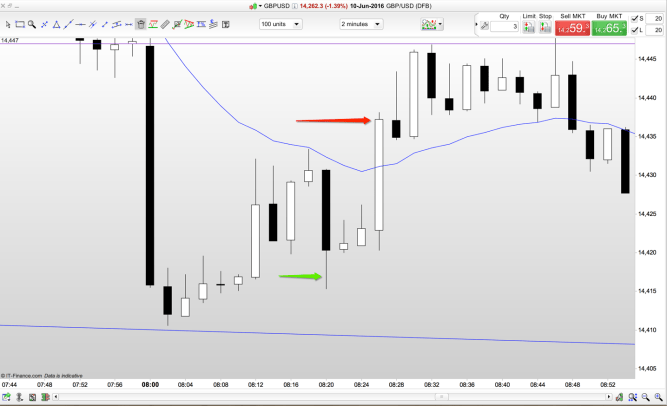
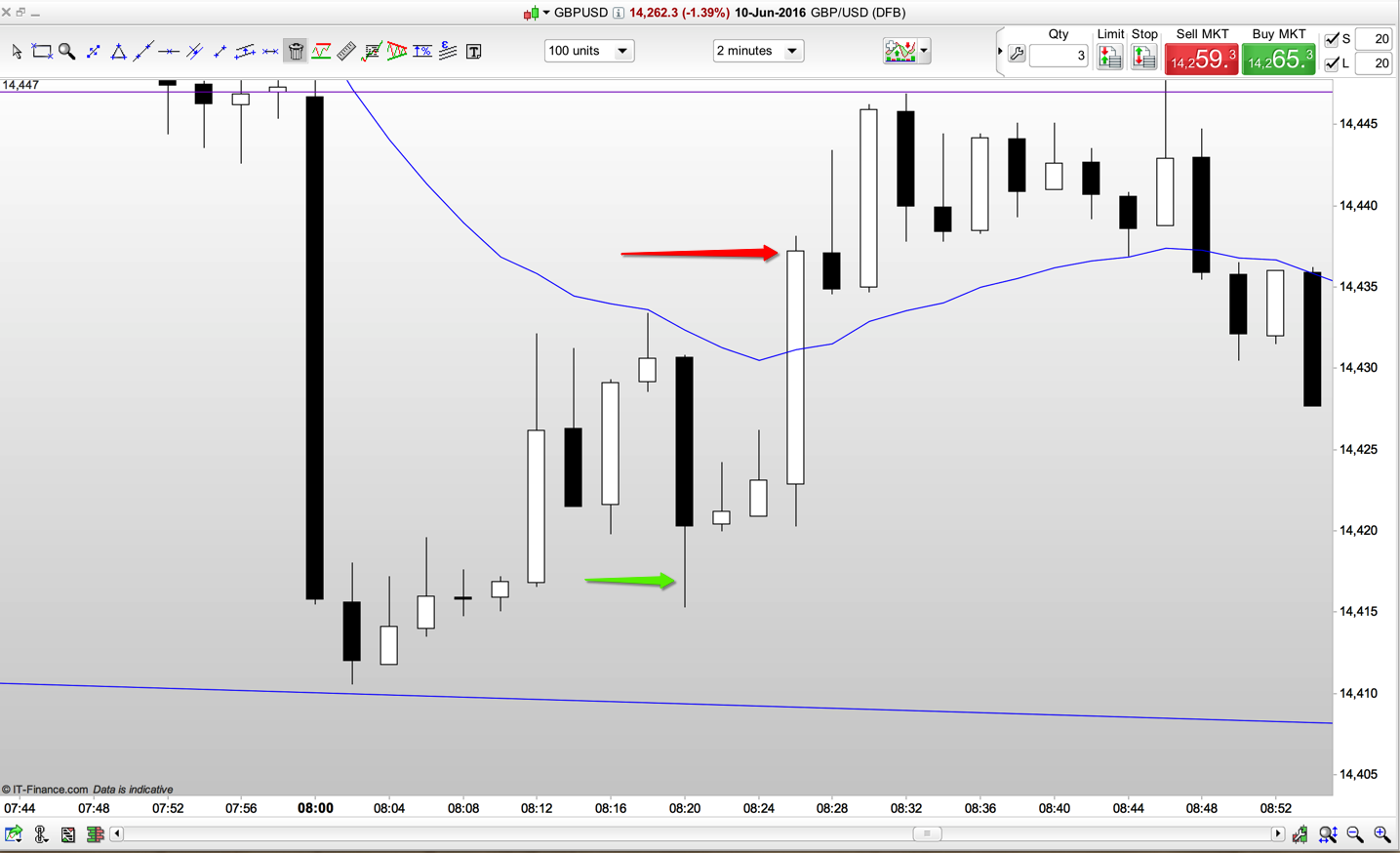
    Snip20160611_4

    This is a 2-minute chart for clarity. We entered the trade (long) at the green arrow. We exited the trade a few minutes later on a scalp at the red arrow. Okay, here’s the issue. We mentioned last week about spreads. When we bought at the green arrow the spread was one pip so our green arrow was placed 0.5 pips higher than our ‘buy’ position. When we sold, at the red arrow, the spread was 2 pips so we got an exit price that was one pip below our actual exit. The actual trade was 21.5 pips to us. The spread accounted for 1.5 pips leaving us with 20 pips of profit.

    At £6 a pip the trade gave us £120 worth of profit. Our broker took the 1.5 pips difference (or £9 in this instance) for themselves. Coincidently, this trade provided a one to one reward. Our risk was £120 or 20 pips. This is the minimum scalp that we can take to make the traders equation work in relation to the broker’s spread size.

    Only taking swings, and therefore aiming for a greater number of pips, proportionally helps the spread dilemma. However, with our fund size we need to build our risk and to do so makes the spread even more so of a consideration. Let’s take a full trading risk per trade of say £480. In this instance, with the same trade above, the broker’s spread fee would have reduced our profit by £36. And that is expensive.

    For the larger account, financial spread betting is not ideal. However, balanced against the leverage, flexibility and the tax (being free) benefits it is still the best trading vehicle for us.

    How to improve our lot? As our risk size increases (and probably not until after the Brexit vote) we will change brokers to a pro account. This involves moving to a different chart set-up which will need time for familiarization. However, the spread benefits are worth it. In the £480 risk example above. In the pro account that we are considering the trade could have cost us £16 for the spread, plus £4.50 for each trade, making a total cost of £20.5. Still not cheap, but better than we presently have.

    The pro account only benefits the higher volume trades.
     

  • Brexit, are we going to trade it?

    Before Brexit here’s gold and silver last week.

    You will recall that we are only looking for short positions in gold and silver. We took profits in both nearly 2-weeks ago and have been looking for an opportunity to take a short since then. Although both gold and silver crept down and tempted everyone to jump on board, this would have been hopefulness.

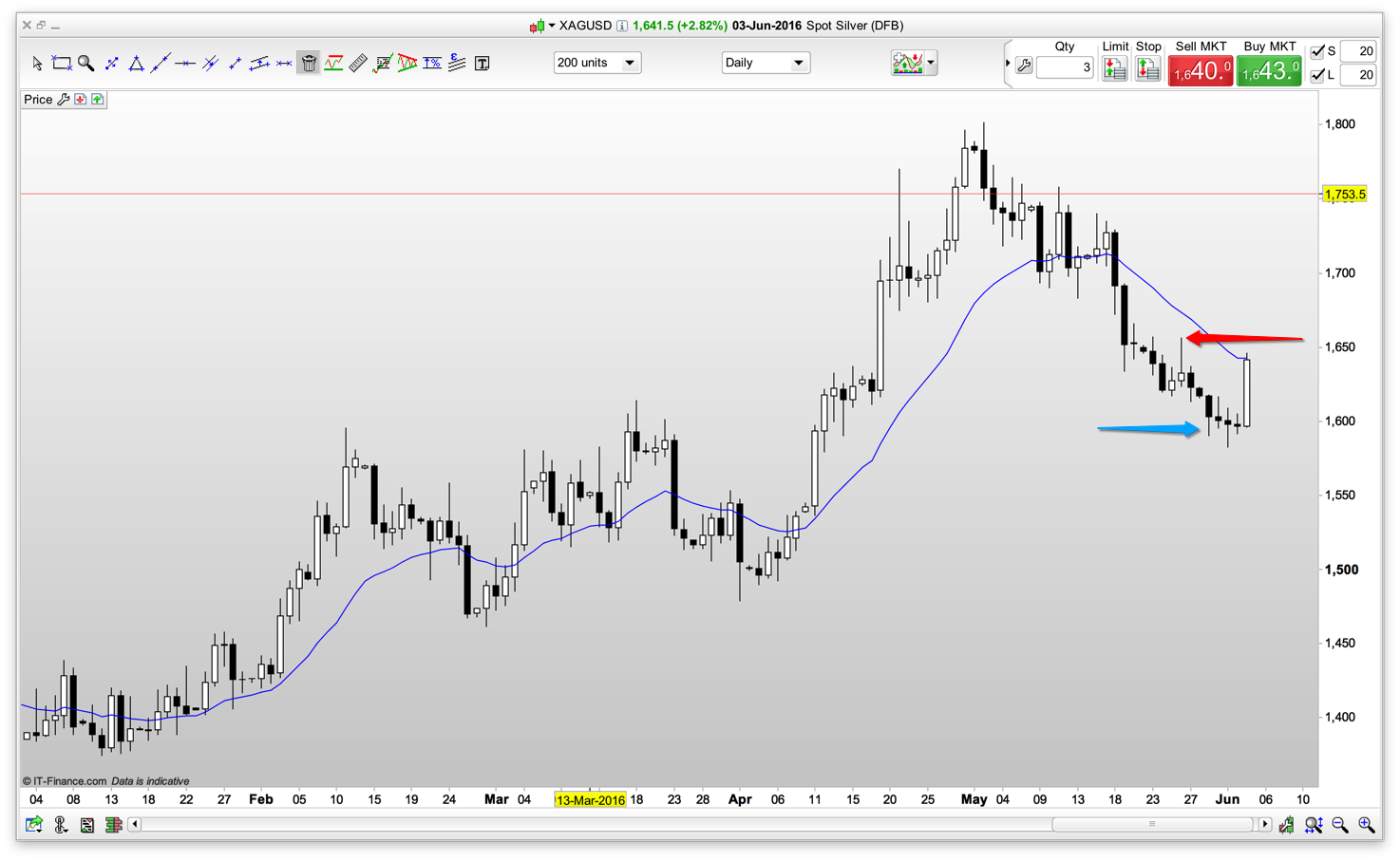
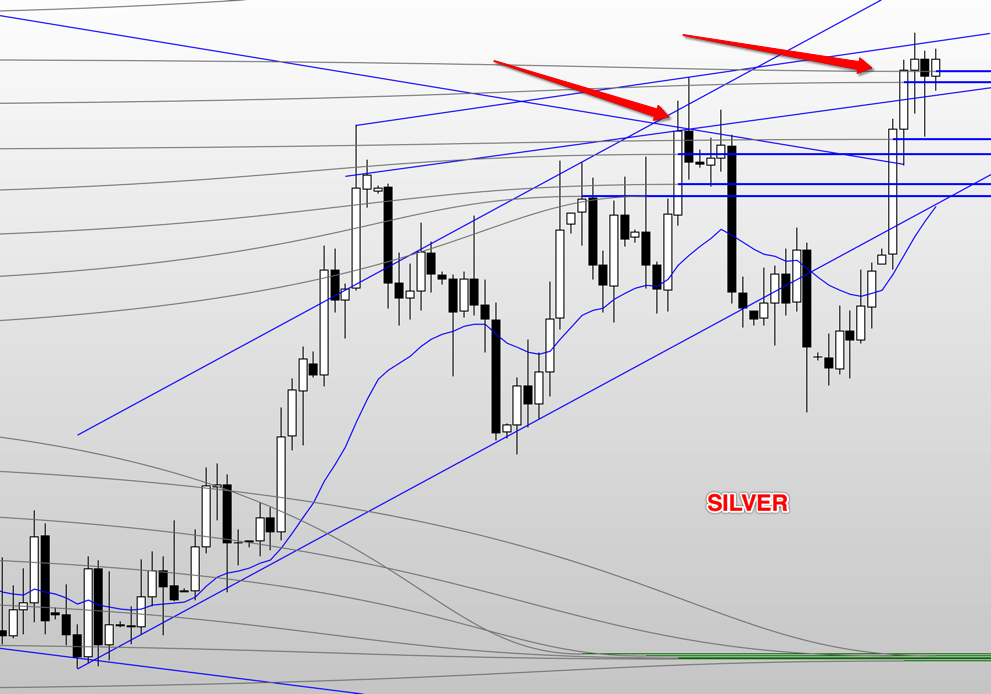
    Here’s silver: silver provided a short signal which I missed, and mentioned last week. That would have given us a profitable move down and exit at the blue arrow. However, without a clear ‘short’ context the danger was always the strong pullback, which happened yesterday, and that is why it was correct to not hold our original short too long. The pull back may just be to the moving average, shown by the blue line, or a move to equal the previous high at 1,800; or, significantly higher with a measured move of the previous leg. We will need more information before acting.

    Snip20160604_1

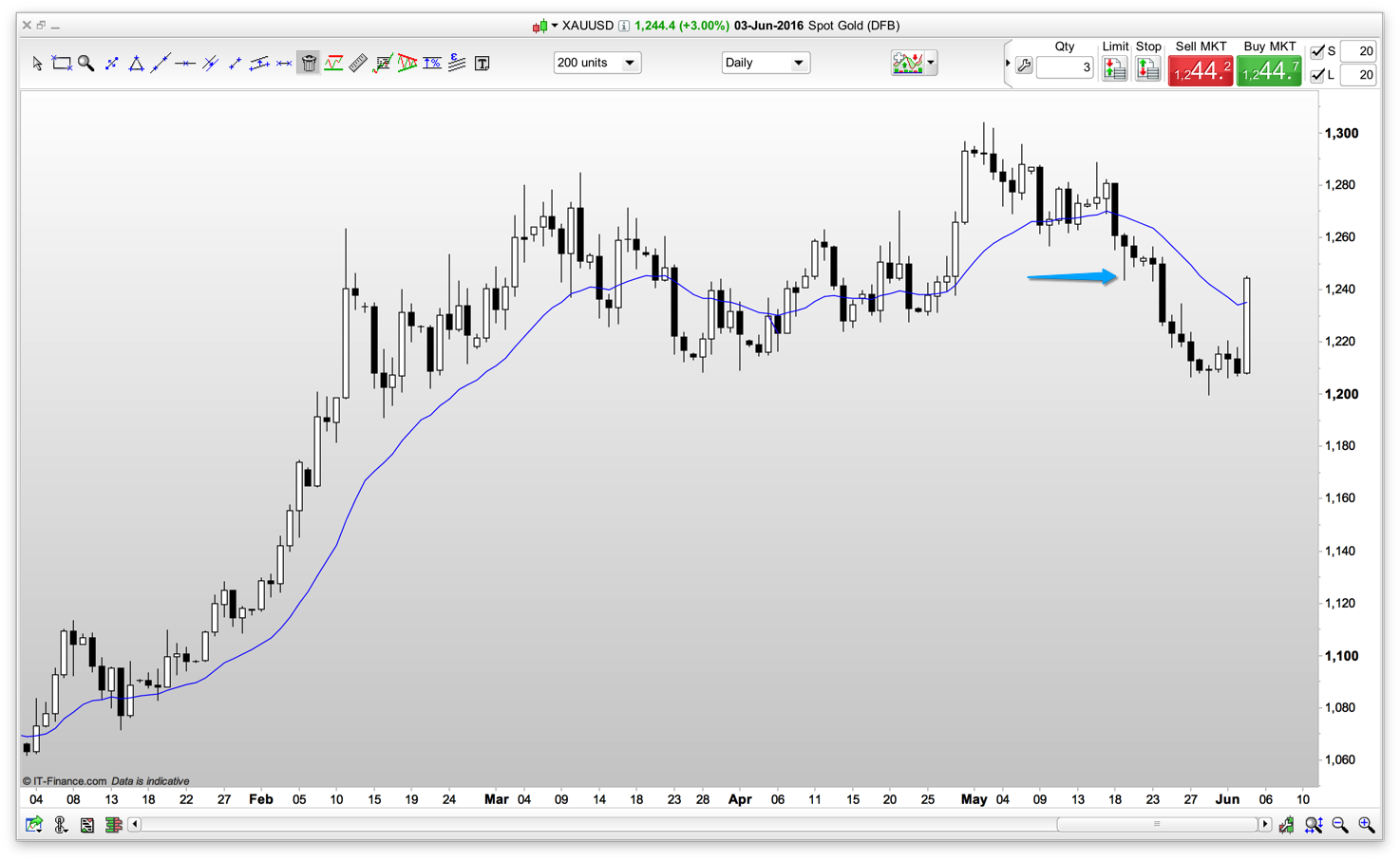
    Gold below shows the short that we exited on 19th May. I was somewhat quick as the second leg down would have doubled our profit. However, the move up yesterday (similar to silver) has brought the price back to our ‘buy back’ position on the 19th. As the climb yesterday has closed above the moving average I’d expect more upwards movement next week before providing a short opportunity.

    Snip20160604_2

    How will Brexit affect our trading? As an aside, one issue we have with trading gold and silver, particularly with a reasonable sized fund, is the size of the average bars (potential movement of price on average over a certain time period) in respect to spread. If you have bought shares in a SIPP before you will know that your broker charges you anything from £5 to £14 per trade. That is why you need to buy a certain amount of shares otherwise your broker’s fee represents too high a percentage against you. The same is true in reverse with spread betting.

    Silver, for example, has a spread of 3 pips. That is, for your buy/sell you will pay 3 pips at whatever price per pip you trade. If you trade £1 per pip, then, from the broker’s perspective, you are charged £3. (Not actually £3, you will notice that your entry line on your chart is 1.5 pips to the negative as will be your eventual exit line – with both together equalling 3 pips). That’s fine at £1 per pip, and actually a good deal. However, you ain’t going to retire soon on £1 per pip in silver. Our fund trades more in the region of £10 to £20 per pip; and that represents a high broker’s fee if the trade goes against us.

    Far more representative of average bar size – when compared to spread, and also compared to the amount we wish to trade – is the currency pairings GBP USD and GBP JPY. The spread on these are about 2 pips and 3 pips respectively (I say ‘about’ because they do fluctuate, particularly in times of high volatility). However, typical corresponding bar sizes of the above currency pairings (GBP JPY being the biggest) are 10 to 20 times bigger than say gold or silver. And that is why we need to move most of our fund trades to the currency pairings.

    That brings me to the initial question, how will Brexit affect our trading? Clearly we all know that it will be a time of high volatility in GBP and anything in association with GBP. To that end, the spread will increase significantly. This will need to be carefully monitored. But spread increase is okay if average bar size increases in unison. Brexit could provide a lot of barbed wire (bars that bounce up and down but close fairly tight and don’t actually go anywhere) or, of course, it could set-up a great trend. My own thought is that it is going to be a bit of both and we need to read the movement well to take advantage. So are we going to trade during Brexit? probably not on the 23rd June, but for the run up – most certainly we are.

  • A neutral few days

    A neutral period looking for re-entry opportunities, but nothing taken this week.

    USD CAD seemed to take-off only to pull back to the weekly support line. A good buy opportunity now – or a few pips lower.

    Brent crude oil is at a position – that we projected a few weeks ago – that is ready to short. We will take shorts from the hourly chart (rather than the daily) as we feel oil is more easily managed from the hourly (rather than the daily) chart.

    Silver provided a reasonable re-entry short opportunity on Thursday. Missed that, but a second chance may present itself again this week.

    Gold has dropped just over 30 pips from where we took profits at the end of last week. Now likely to drop a further 20 pips before meeting a monthly resistance line. If we get a retrace we will take a short as gold has the potential to drop a further 70 to 150 pips over the next few weeks.

    We have listed a new page called strategies. This is written (and added to and changed most days) in a short format – as if we are preparing the ground for a computer algorithm. Therefore of little meaning to a non trader. However, it provides an idea of the precision involved.

  • Profitable gold and silver – missed USD CAD

    A good week with profitable trades in gold and silver. The week did come with a small loss and missed opportunity in the currency pairing USD CAD. Also, we were out of the money for much of the week in crude oil only to grab a brief break-even buy back moment. Overall, a good week.

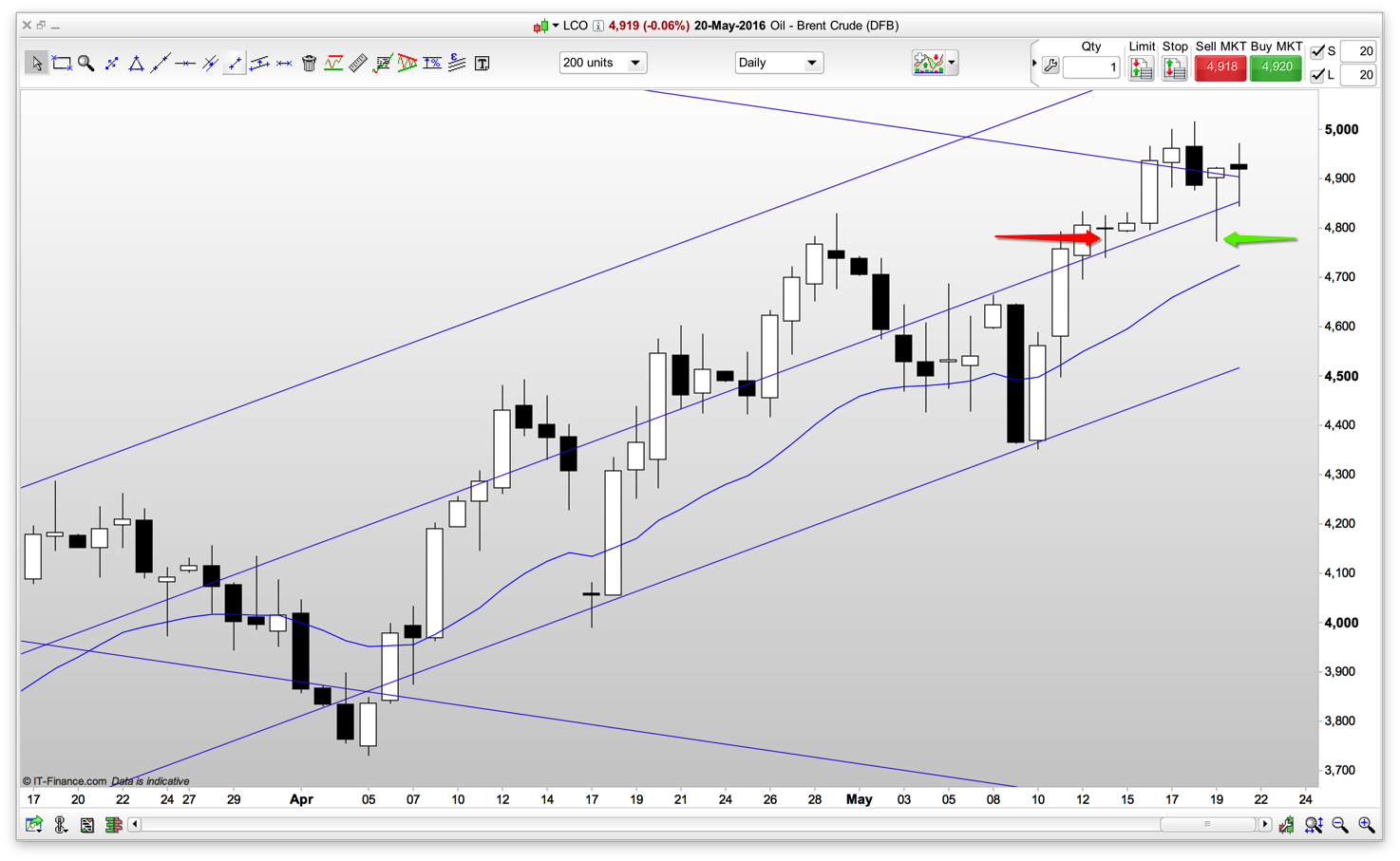
    Silver daily chart: each bar represents one day’s worth of trading. A black bar means the price closed lower than the open. Each candle (as they are called) shows the open and close price and the wick (either top or bottom) shows how high or how low the price actually went between the open and close times.

    Snip20160521_1

    We shorted silver at the red arrow and we bought back that short at the green arrow. Just over 80 pips of profit for us; a pip is the smallest upwards or downwards movement. (In stocks and shares it is called a tick.)

    Gold daily chart:

    Snip20160521_2

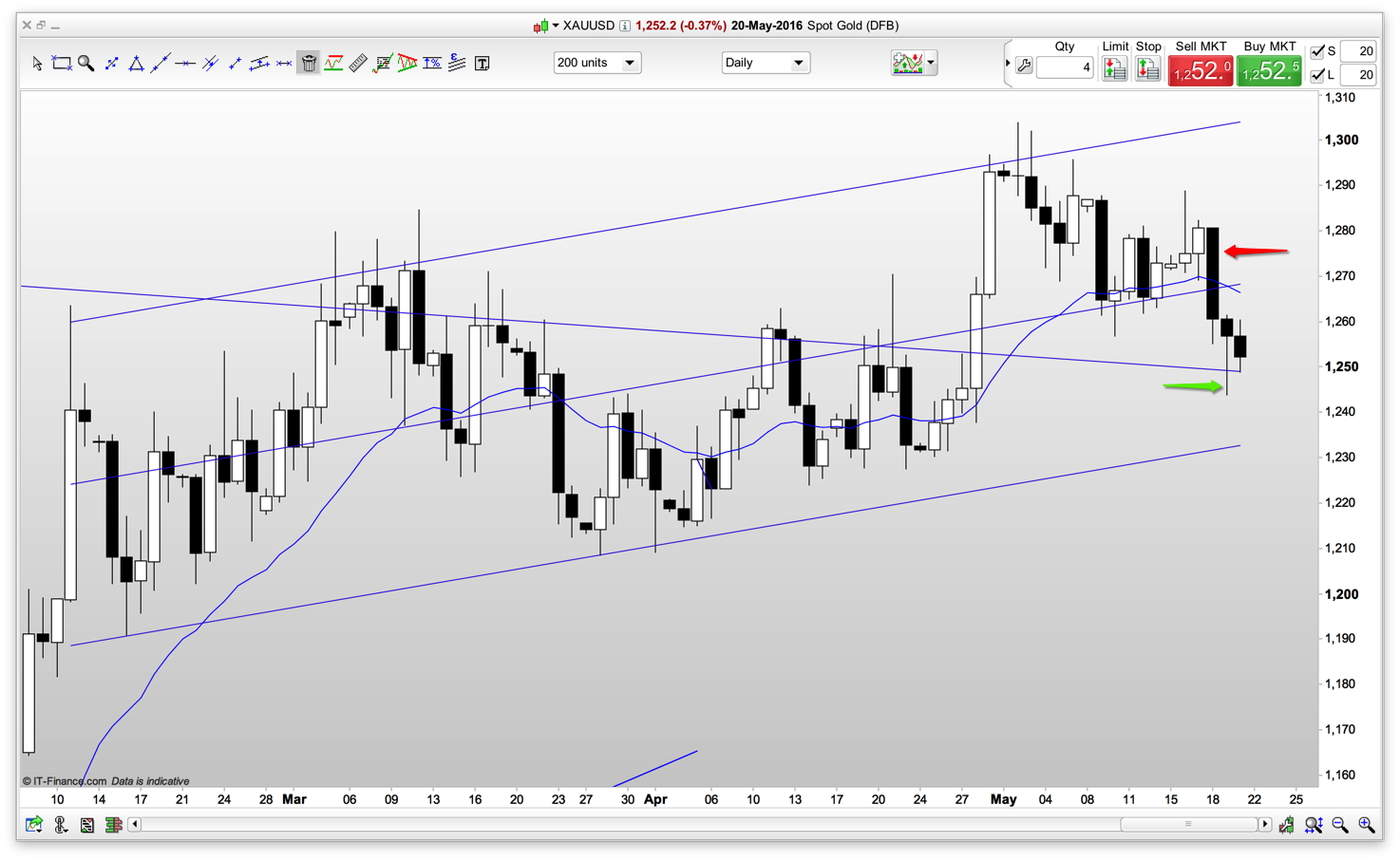
    We shorted at the red arrow and bought back our short for a profit at the green arrow. Gold trades less than silver per ounce and therefore our gold movement this week represented only 30 pips. However, the smaller size is offset by the traders equation: based on probability, our profit target, how far away our stop is and the representative amount we’re prepared to lose.

    USD CAD daily chart:

    Snip20160521_3

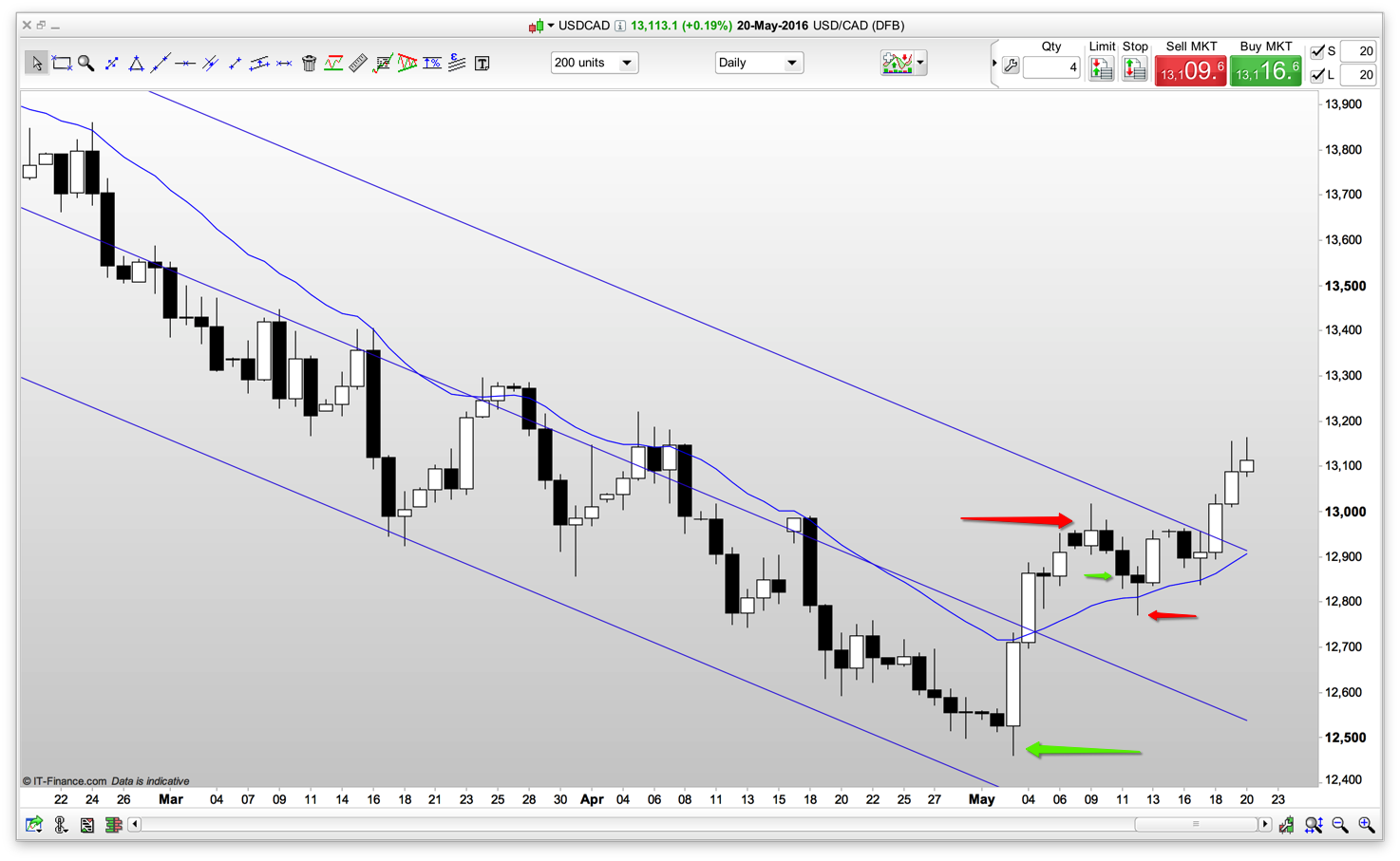
    Over the last few weeks we went long at the larger green arrow and took our profits at the larger red arrow.  We went long again a few days later at the smaller green arrow only to be stopped out of the trade (within a couple of pips!) at the smaller red arrow for a small loss. I then missed the subsequent move up. That is trading. Did I set my exit stop at the wrong place? Maybe. Hindsight is a wonderful thing, and a few more pips below the moving average would have been sensible. But my overall judgement was correct, in that the price was going to go up – and I take confidence from that.

    Crude oil daily chart:

    Snip20160521_4

    My best trade of the week without making any profit. Let me explain. We shorted at the red arrow and were out of the money all week to the tune of 200 pips at one point. We bought back our short at break even price at the green arrow. Best trade because although we were out of the money we did not reach our stop position and we managed a break even price. Ready for the next one!


  • gold and silver – are prices ready to drop?

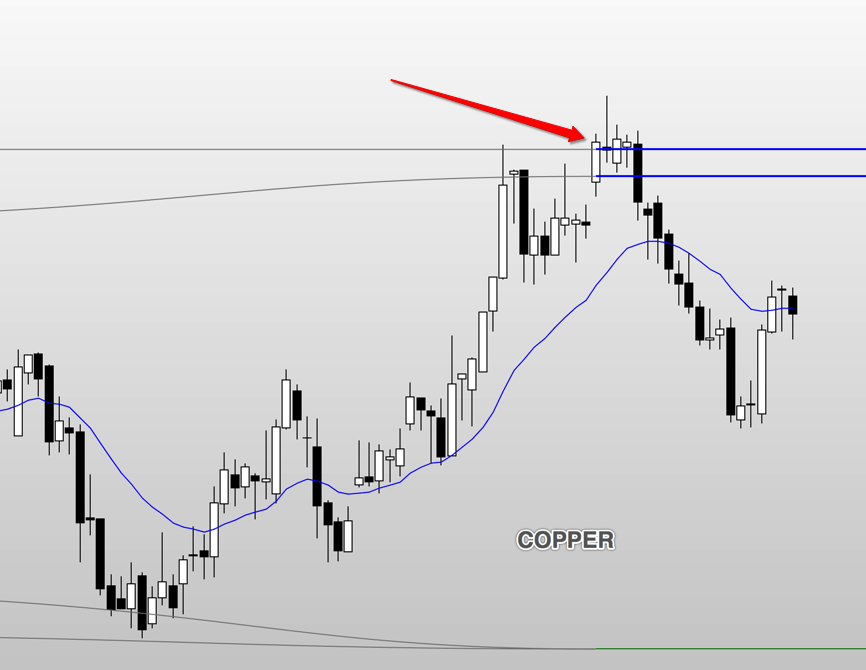
    Copper – An uneventful week for the commodities. All except copper which moved down without us and with gusto. Copper, however, had an unclear read on the COT (often the case with copper) and an unclear read on the daily charts. Therefore we are correct to be out – as to stay in would have been to rely too heavily on hope.

    Crude oil and USD CAD – We hold a small position on crude oil short. But a 200 pip climb is likely and at which point we may add to our shorts. USD CAD, which often reflects a delayed but exact opposite price movement to crude oil, shows a clearer picture. Too much reliance on the difference between these two charts (crude oil and USD CAD) is, however, a ‘chicken and the egg’ question and should be considered but not relied upon.

    Gold – Having taken some profits (short) from gold last week we continue to hold a small position short. Expecting to add to shorts anytime this week. Net position of the commercials remains at a 5-year low. This will provide great momentum to a drop in the price of gold if gold price per ounce falls to the $1,200 region.

    Silver – Similarly with silver. We took some profit last week and continue to hold a small position short. Looking for a price climb to $1,730 before adding to shorts. Silver, however, has an even more dramatic picture on the COT as the net position of commercials is at a 10-year low. As with gold, any significant reduction in the price of silver will probably result in an exaggerated acceleration short.

    Intraday strategy – As an aside, much work has been done this week developing our short-term momentum strategy (namely using GBP USD intraday charts) on trading range breakouts and subsequent channels. I know this doesn’t make a lot of sense to the investor, but to a trader it is a high probability strategy with measurable risk and reward. And possibly the most lucrative of intraday strategies.

  • We take some profit from gold, crude oil and USD/CAD

    Until now we have traded the commodities: gold, silver, copper, crude oil and USD/CAD on a weekly basis. That is referring to weekly charts and a weekly COT report. We have also, as discussed last week, considered introducing the fund to intraday trading.

    Each of which (weekly and intraday) are rather on the extreme. On one hand, we have the overly slow weekly chart market, and on the other, the rather demanding intraday market.

    The balance for the fund is daily charts. Why? …weekly charts are emotionally difficult as we see good profit generated only for that profit to disappear as we remain invested in order to reach our target. There is no compromise here, because to take profit before a target, unless our premise changes, does not provide a traders equation (that is: the trade had more risk than reward).  Over the longer term this would be a losing strategy.

    Gold and silver have emphasised this over the last few weeks where they dropped in price to provide us with good profit potential, only to extend higher than I considered.

    Daily charts, rather than weekly charts, usually means tighter stop positions and therefore lower risk, but in contrast our targets are shorter. Timing wise we are in trades for a week or three rather than several months.

    The COT suits the weekly charts, but often goes against my daily chart readings. This of course happens at all levels of chart, for example, the difference between the daily and the 4-hour chart or between the  5-minute and the one-minute chart. However, I report weekly and to have a profit at the end of one week only to know that profit will go away as we wait for the bigger (targeted) profit seems emotionally foolish.

    With moving to daily charts, our targets are closer and therefore we can take profit more regularly (if available) and wait for the next entry. This means that we will occasionally miss the big move – but trading is rarely perfect.

    This week we took profit from our short in gold as it sank from its high of the previous week – and before Friday’s monthly non-farm payroll brought it up again. Also, we took profit from a short in crude oil as it came down over the week and from our long in USD/CAD as, conversely, it climbed nicely over the week.

  • Gold and Silver finish week on a high

    Silver finished the week on a strong move up. Silver is at, or slightly above, a three-year trend line. The COT shows the net position of commercials at a multiple year low; meaning the majority of commercials (the big buyers and sellers) have short positions on silver. As do we. Difficult to hold through, but that is the strategy.

    Gold provides, as it so often does, a similar picture to Silver.

    Crude oil ventures up towards the position suggested on my charts last week. A possible short on crude may present itself this coming week.

    USD CAD had little movement in weekly chart terms.

    Copper dipped early in the week and gave us a reasonable out position. Copper reversed back up by the end of the week as anticipated.

    The strategy on commodities is to go long or short reasonably early based primarily on commitments of traders (COT) information and supported by analysis of weekly charts. We use weekly charts as that corresponds to the weekly COT release. The COT is released UK time late Friday evening and is based on the previous Tuesdays collation of information by the CFTC.

    This strategy often calls for a significant period of time, several weeks or even months, where the trade is out of the money. Treat the COT as turning a large tanker ship analogy – it ain’t quick!

    To balance this ‘slow’ strategy we’ve decided to include a portion of the Slow Trader fund in our intraday trading. That sounds fancy, but is just a way of saying we trade with charts that are incorporated within the day. In our case 1, 2, 15 and 60 minute charts.

    In this instance we take as many as 9 to 15 trades a day and normally complete all trades before the end of the day. I’ll discuss our strategies for intraday trading in next week’s blog.

  • Copper, Gold, Silver, Crude Oil and USD/CAD this week

    Copper has had a strong week and finished high. Silver in particular has spiked up. Gold also increased but finished the week more or less even. Crude oil has finished the week reasonably strong. USD/CAD is still some way from turning up and will need careful management.

    Here they are in slightly more detail:

    Snip20160423_2

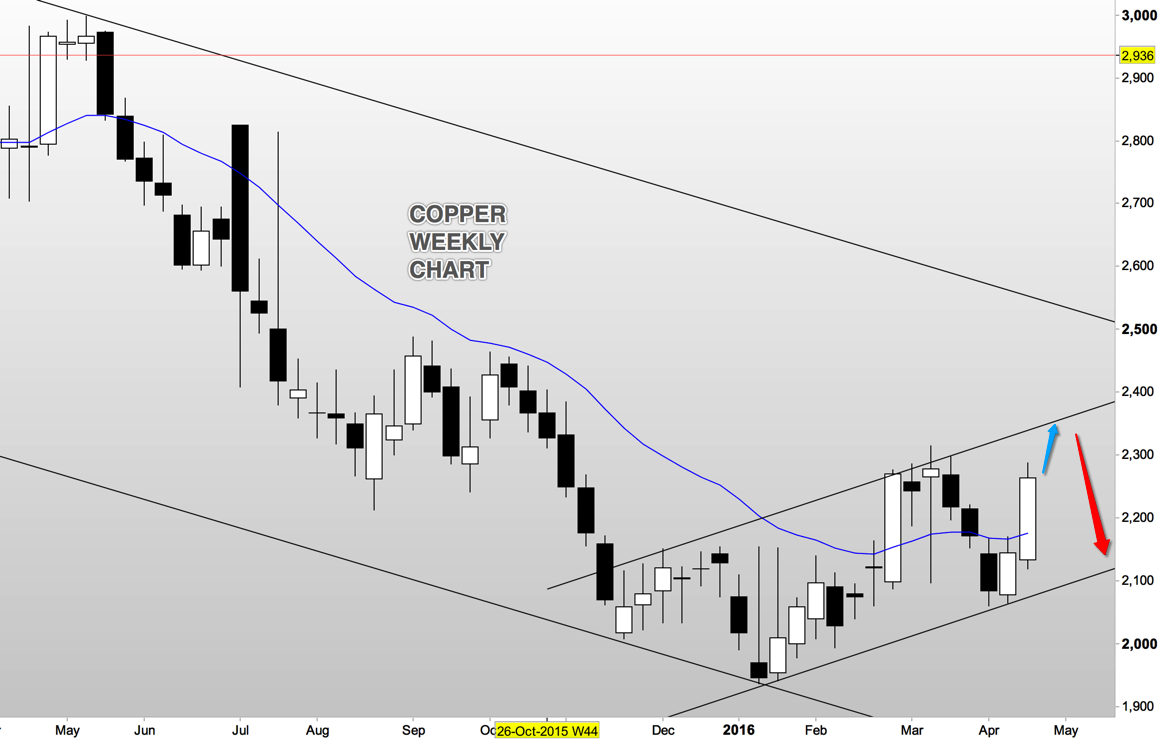
    My premise on Copper has changed. Copper, I feel, is some way from a big turn down. I would consider a small increase in price before a drop to our low 2 weeks previously – and then a possible climb. We will look for the best price to exit our copper trade.

    Snip20160423_4

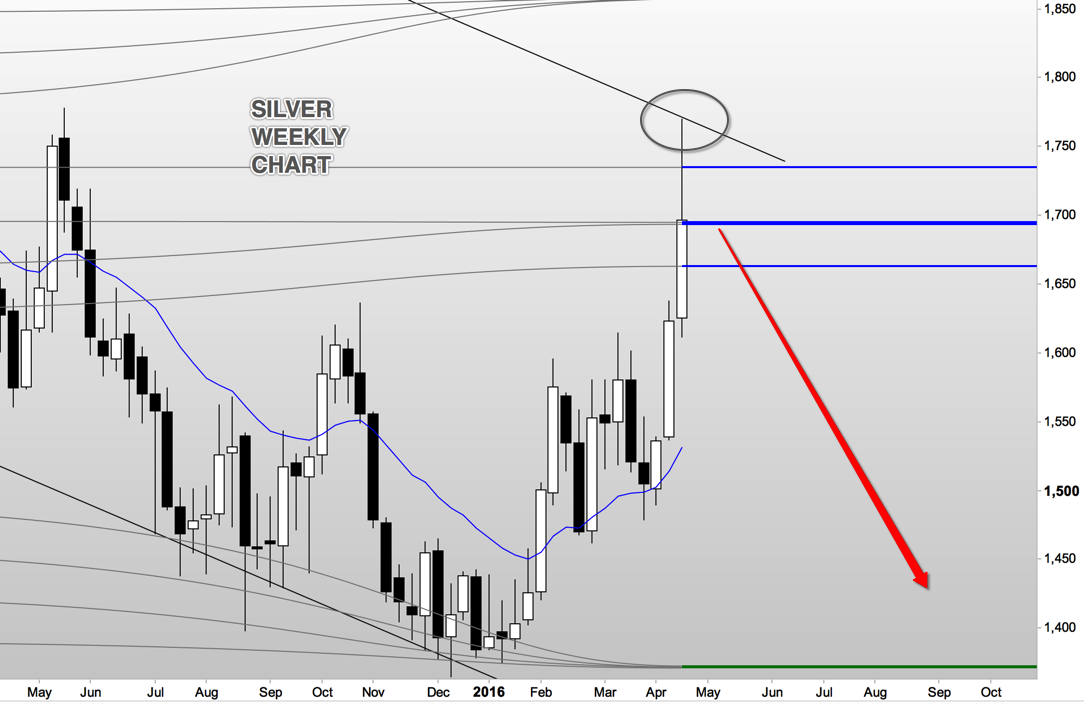
    Silver has had a dramatic couple of weeks. Two strong weekly moves up taking silver from the one year trend line to the, higher, 10-year trend line; indeed, the price of silver bounced exactly off this line – marked with a circle. Always difficult to short when everyone else is long. But that is exactly what we did. Of importance, and supporting our case, the COT for silver shows commercials at an 8-year record with the number of shorts compared to longs. Hold onto your hat!

    Snip20160423_5

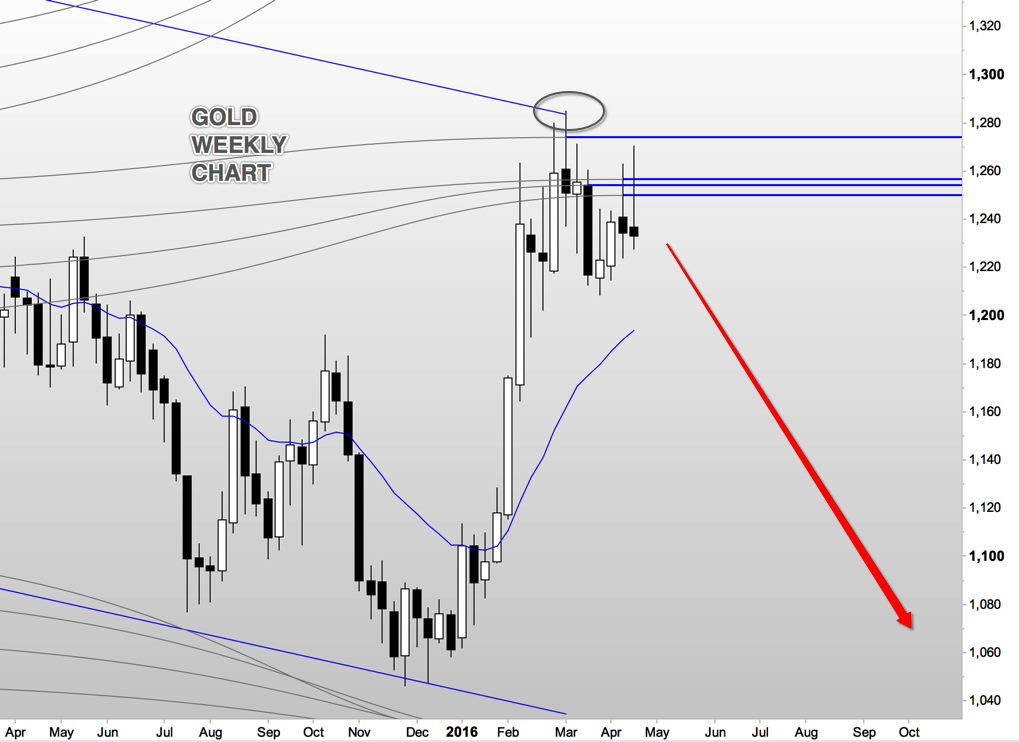
    Gold has not been as dramatic as silver. Up in price all week, gold finished low for the week supporting our prediction of gold progressing further down in price over the coming weeks.

    Snip20160423_6

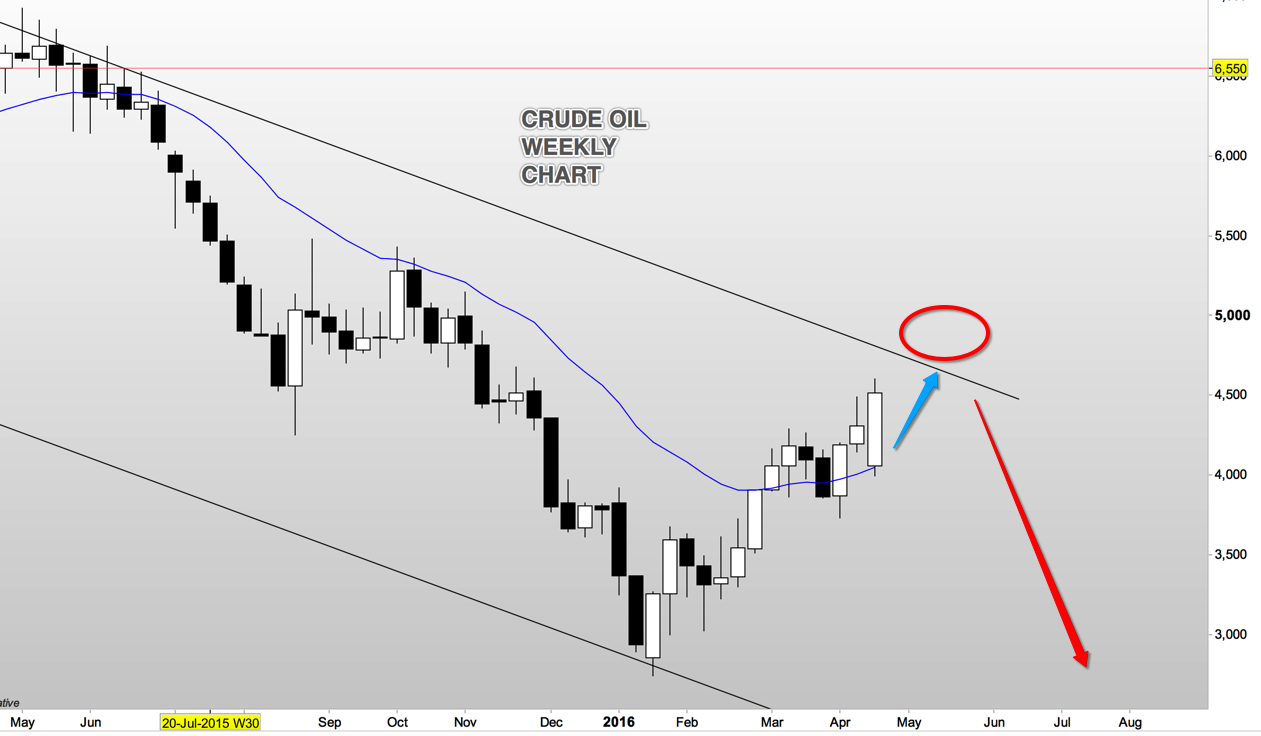
    I’m a supporter of a drop in price again in crude oil, but it may take its time. Price possibly getting to somewhere marked by the red circle. For now, we remain on the sidelines.

    Snip20160423_8

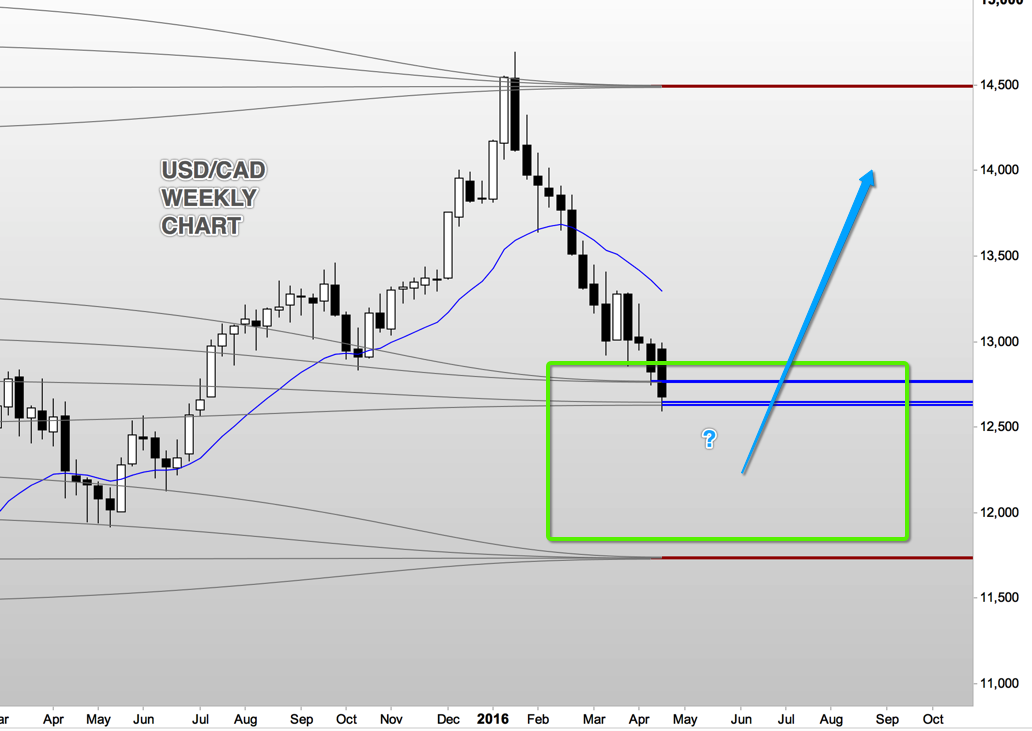
    USD/CAD price mirrors that of crude oil. Therefore, a trade on both is double the risk and a significant consideration. As with crude oil short, it is early days to consider USD/CAD long. A turn somewhere in the green box however is a good probability. But risk reward is excellent when we catch a trade early. Probability is the other major player in the traders equation; moreover, good management of early trades is essential.

  • Achieving excellent trade entries helps alot

    How our trades have progressed this week:

    Snip20160415_3

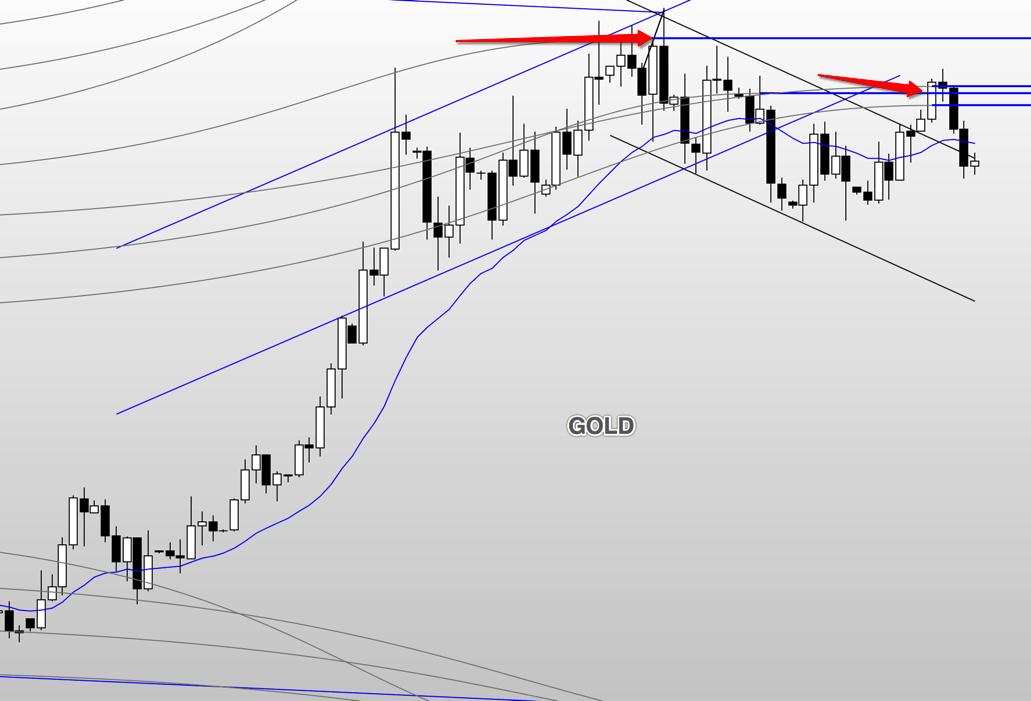
    We are short Gold. We shorted at the red arrows. That is, we expect the price to go down. If Gold goes down in price we gain. It is always difficult to find the best price and often it is simply ‘good is good enough’. But our first take here seemed excellent. Price this week had risen giving us a chance to add to our short. Again, this seems to be at a near top. We now have a lower high (the difference in height between the first and second arrow) and, therefore, the possibility of a continued drop in the price of gold, at least for a few weeks.

    Snip20160415_4

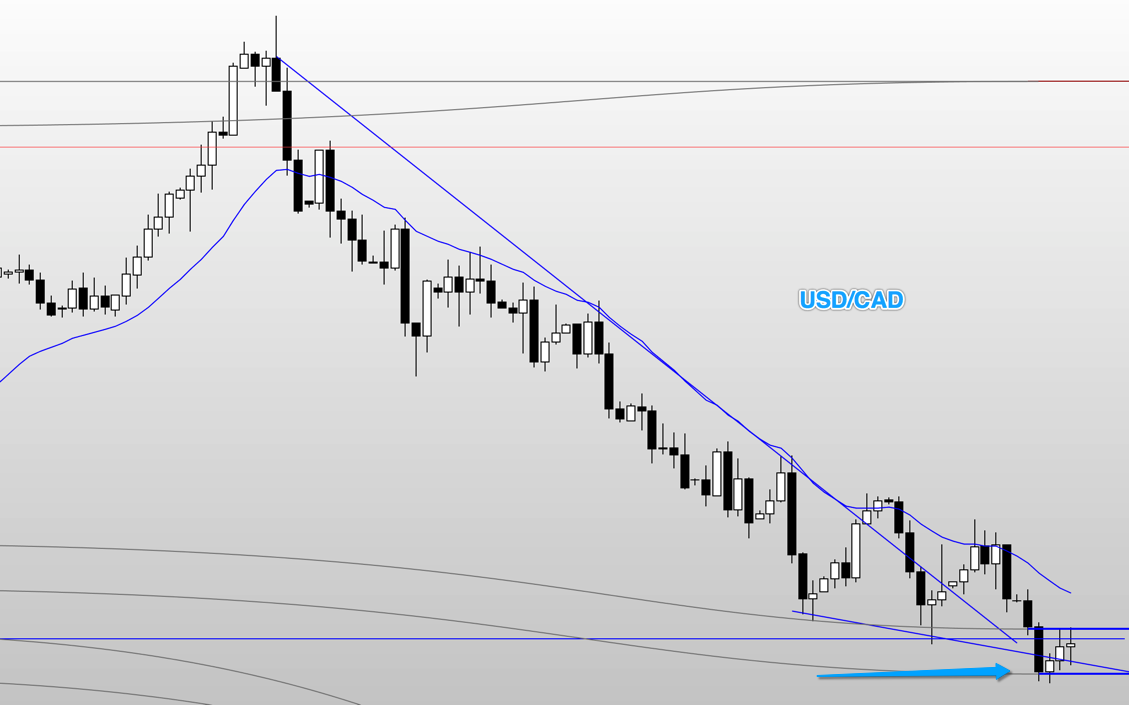
    We went long USD/CAD at the blue arrow. That is we want the price to increase. Our strategy starts with a major trend reversal, and that is often a difficult call. Probability of success is low at this stage, but reward, if it goes our way (up), is worth a trade. Our target is near the top of the screen shot.

    Snip20160415_5

    We first took Silver short at the left red arrow. Price went nicely our way – down. This week, however, has seen a good recovery in price. We entered again, short, at the second red arrow. This is a higher high – often not ideal for a short – but the three pushes up is good context for a trend reversal. From being nicely in the money, to out of the money, is part and parcel of our strategy. We hold until something tells us different, or until we get to, or near, our target. Our target is at the bottom of the screen shot.

    Snip20160415_6

    We shorted Copper at the red arrow position. That is we want the price to go down, and so far, Copper has obliged. We continue to hold until target. The recent retrace in price this week was not sufficient for us to add to our short trade.

  • Trading methods that suit

    A serious trader or investor has to use a method that they understand and that gives them an advantage, an edge – no matter how small.

    That method, or way of trading, has to suit the traders personality. The method could be fast-moving, lower time frame, or slow-moving, higher timeframe. Or a combination of both.

    Emotionally, the method has to suit too. For example, most traders are comfortable trading relatively large positions on slower moving, higher time frame trades such as daily, weekly or monthly charts; however, are less objective with such trades on lower time frame situations such as intraday (day-trading) opportunities.

    Once we sort our emotional tolerance we then need to consider our ability to manage such trades. Do we have the time and the skills necessary to trade lower time frame situations. This is where a trade entry and exit on say a ‘swing’ trade can play out in 10 chart bars or less – which on a 2-minute chart is 20 minutes. The same trade using a daily chart would take some 2 weeks.

    I use three clear trading methods with clear time frames. I feel that in each of the methods I have a small edge, and that is vital. The methods are:

    1. 30-year investing using detailed fundamental analysis of company figures. I’m primarily looking here at finding a company that is selling at half price or less and one that has been consistently excellent for many years (usually 10 years). The company, importantly, needs to be a company that will still be here, and profitable, in 30 years. The calculations took Nick and me over 9-months to develop.
    2. I trade gold, silver, copper, crude oil, treasury bonds and USD/CAD both long and short, and only trade on very specific signals. Each trade is held for several weeks. This is where I mainly trade the Slow Trader fund. The strategy here is sound, tested and profitable.
    3. Intraday trading of any stock, commodity, index or FX that suits – my favourite is GBP/USD. Skilfully, managerially and emotionally intraday trades are the most difficult. Intra day is also immensely time-consuming and takes many years to become consistently profitable.

    You will notice that each method avoids the market crash timeframe of 5 to 15 years. Where most investment and pension portfolios are positioned. Yes, the 30-year method will go through a few crashes during its investment period, but over 30 years the crashes simply provide a ‘dollar-cost-averaging’ opportunity to invest more. The only important crash in the 30-year method that is of concern is the last one. I appreciate that as its 30-years it may not be me making this decision!

  • Our medium term strategy holds good, for now

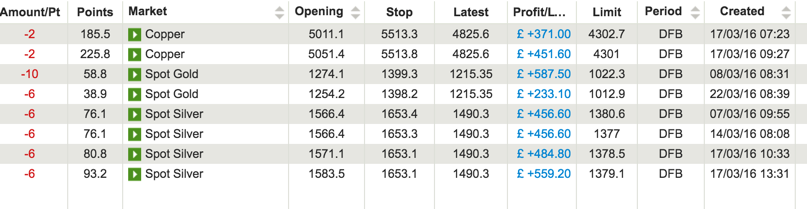
    Here is a snapshot of  our (open) results for the last week. I won’t normally show this detail as it can be misleading when we have a mix of recent and longer term open trades. But as all our trades have similar creation dates, I felt it was okay to include.

    Snip20160401_2

    We have a medium term strategy for these trades. Meaning from 6 to 12 weeks, we are 10 or so days in. Part of the strategy is to open the trade early. If an early trade is not close enough to the extreme (a top or bottom) then we will manage the trade to achieve better entries. Being early is difficult for many as it is nearly always contrary to popular opinion. Also, being early can provide excellent gains only to see those gains retrace to a loss – which is emotionally difficult and the reason why many traders cash-in too soon.

    By early trade, I should mention that we should also not be unreasonably early (it’s never that easy!). Patience is still key. For example, I think, a short in crude oil, currently, is too early. Crude has started to decrease in price this week from a recent up; but to take crude short now is premature. The picture is Similar for long-term treasury bonds that have a potential near term short opportunity.

  • Current short trades in Gold, Silver and Copper.

    We have open trades short with Gold, Silver and Copper.

    Our strategy here shows promise. The aggregate of these trades has seen us in the money by some £1,000. Soon followed by us being out of the money by about £900. The latter was a consequence of the last FOMC meeting and interest rate announcements.

    Higher prices, however, allowed us to add to our short trades more favourably and, later, as the price dropped again, to break-even on a our lower priced, original, trades.

    Our open trades (taken from eleven days ago) currently stand at over £3,000 in profit reasonably distributed between each of the commodities. Early days, however,  as we hold through (as long as our premise remains the same) to somewhere near our targets.

    The following is an update of our trade watch list for Slow Trader fund:

    No change in – Gold, Silver, Copper and Crude Oil.

    In preference to the S&P, I’ve included the 20+ Treasury Bond ETF.

    Moreover, in preference to the currency EUR/USD we will take GBP/USD.

  • Slow Trader Trades

    In our fund (Slow Trader) we recently invested short – that is to say, we want the price to go down – in Gold, Silver and Copper. (This strategy is a one to three-month trade, but varies slightly for each commodity). 

    Fund exposure is currently £70,738 (we are leveraged)

    Silver stop risk is £1,953 – between 4 trades.

    Silver target is £4,633 – between 4 trades.

    Gold stop risk is £1,252 – on one trade. (A limit order is in place to short more if gold price rises).

    Gold target £2,518 – on one trade.

    Copper stop risk is £1,929 – between 2 trades.

    Copper target £2,918 – between 2 trades.

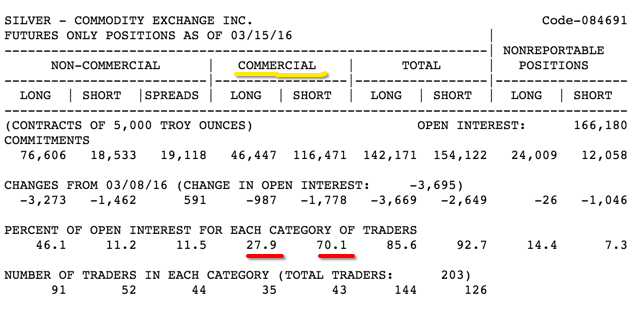
    We use the Commitments of Traders (COT) report to give us a small edge. The COT is, other than cyclical analysis, probably the only indicator that is not price based. And, therefore, an independent view-point. We combine the COT with our own technical analysis of each commodity.

    Here is an example of the COT released last night. The same information is available for each of our commodities. My attention is on what Commercial is doing.

    Snip20160319_6

    The importance of getting the technical analysis right is due to the COT being in lag by nearly 2-weeks. Which, based on our strategy, is between a half and a quarter of the expected trade duration. In other words, we need to use a good amount of interpretation (and rely on technical analysis) for a significant chunk of the trade time.

    More specifically, COT figures are from each Tuesday but are not available until late evening (UK time) on the following Friday (i.e. 10 days). As the markets are closed till Sunday night (UK time) it puts the COT information nearly 2 weeks old. But even with that considered it’s still the best, broad, indicative information we have – other than our own technical analysis.

  • Slow Trader Fund Update

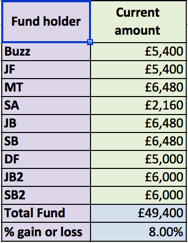
    Slow Trader is now closed to any new funds until next year. Here are the amounts:

    Snip20160305_1

    For the sake of simplicity, percentage gain or loss refers to original funded amounts.

    We are now ready for 2016. Our attention this year is on gold, silver, copper and crude oil. We will also trade from time-to-time the SPDR S&P 500 ETF fund (all sessions) and currency: namely the Euro against the US dollar. We may trade the occasional stock.

    We have an excellent short signal developing for silver. That is, we consider silver will drop again in price. Signals for each of our commodities happen no more than a couple of times a year. Therefore, when we get them we need to take full advantage.

    The S&P and EUR/USD are not cyclical like the commodities – therefore we will trade these via lower time frame charts (one or four-hour chart and, occasionally, as low as the 15 minute chart).

    Commodities are traded through daily charts and in conjunction with the COT report.

    For those building funds for grand kids, or simply looking to buy the Aston Martin DB11 – then here we go!

  • A brief overview of how we did last year.

    We finished the year with only a 8% gain, but that does not tell the whole story. You will recall that 12 months ago I was using a daily trading system that relied heavily on several indicators. I won’t go into detail as to which indicators because it is now irrelevant.

    I also employed a mix of fundamentals, that is finding great stocks that are undervalued and trading them long in accordance with my indicators. This worked very well over several previous years, primarily because the market was raising steadily.

    Around about this time last year I got it wrong. The market had a relatively sharp 15% fall closely followed soon after by a similar rise. The fund at the time was heavily committed and my indicators lagged the fall and rise by just the right amount for me to be invested in the wrong direction on both occasions. The fund was nearly halved.

    It may be odd to learn that I now consider this to be a blessing! This loss forced me to make the jump from indicator and fundamental mix reliance to a system I had been noticing for some time. Price action trading. Indicators are all well and good in a trending market but they provide conflicting messages when the market transitions.

    On the other hand, Price action, or bar by bar trading, is immediate. Of course the down side is that price action takes a lot of work to master. We moved over to price action trading and tentatively built the fund back up by the end of the year to a small profit. In other words, if we accept the loss, and the new fund value at the time of the loss, we actually doubled the fund. I know as a fund contributor that does not sit well but it was a goal and a task that I had to face over the last 9 months.

    Coming into the new year I have taken stock and not traded the fund to any extent. The fund amount remains unchanged at 8% up. This has given me the time for several weeks of back testing, which I hope I have kept you informed about, and the introduction of a new charting system. New software and charts always take some time to master but the change we have made, as the charts are now linked directly to our broker, is a major improvement.

    I was planning to be trading the fund by now but have been delayed a week or two. A trip away and a tummy bug on return didn’t help.

    Finally, this is not a fund that you will find easily elsewhere. It is an aggressive fund but, importantly, where all trades are reasonable trades. That is, all trades have a reasonable measure of risk, reward and probability. I could trade the fund tomorrow against a 60% probability trade to double the entire fund. That, however, would be a long way short of reasonable.

    The goal of the fund is to make money, and make money at a rate that I’m able to do, progressively, and with emotional detachment. (I’ll explain this more fully in a future blog) That emotional detachment (my personal risk aversion) will build with experience.

    We have some new money being introduced to the fund from a current contributor. This money will dovetail into the fund at the present fund level and will have no effect on your profits. The fund remains flexible in the sense that moneys can be withdrawn partially or fully anytime within reasonable trading timeframes. However, as this would be a distraction I would be grateful for any notice that’s possible. I make no charge on the fund, however, once I have doubled your original investment amount I may reconsider this.

    Thank you for your trust and patience. Here’s to a good trading year.