Author: Buzz Lightyear

  • How to learn from trading mistakes

    Three weeks ago was a good trading week. Two weeks ago I tried to catch a ‘falling knife’ (a no-no in trading. But, again… hindsight). And then this week we almost made back for the falling knife thing.

    The old trading saying is ‘don’t try to catch a falling knife, wait until it sticks into the floor and all the wobbles stop’. Well, I know this, but when we don’t see it as a falling knife but rather as an extension of a wedge we feel correct in taking it. It’s only soon afterwards that we realise that it’s an oops trade.

    Okay, I’m starting to lose you in the terms. The thing for me to get from this is that I can learn from it. I take responsibility and I take the lesson. Last week we had a couple more falling knives, one of which I ignored as couldn’t get a traders equation trade from it, and another I took correctly for a profit.

    How did I get around my error? By back testing. I simplified by going back to a maximum of 120 bars on the main screen and that has worked an absolute treat.

    Okay, inevitably these trading lessons happen from time to time, to all traders. ‘Take responsibility, embrace the lesson and come out stronger’…  that’s what I said to myself, and it worked. The wrong way would have been to ignore the lesson, trade more and try too hard to immediately make amends.

  • Sterling’s spike down – from a traders perspective

    You will probably have heard on the news that Sterling (GBP) spiked down massively.

    This happened 5 minutes after midnight yesterday morning. The reason is speculated.

    Technically, from a 50 year – or so – chart it is entirely expected for sterling to drop at this point. Indeed, we would consider a drop down to 1076, rather than 1118 that it did reach, appropriate. But it’s easy for the technical trader (or anyone) to say that after the event. And certainly it wouldn’t have been expected within a 2 minute period.

    Here’s how it looked on a short-term chart for GBP USD.

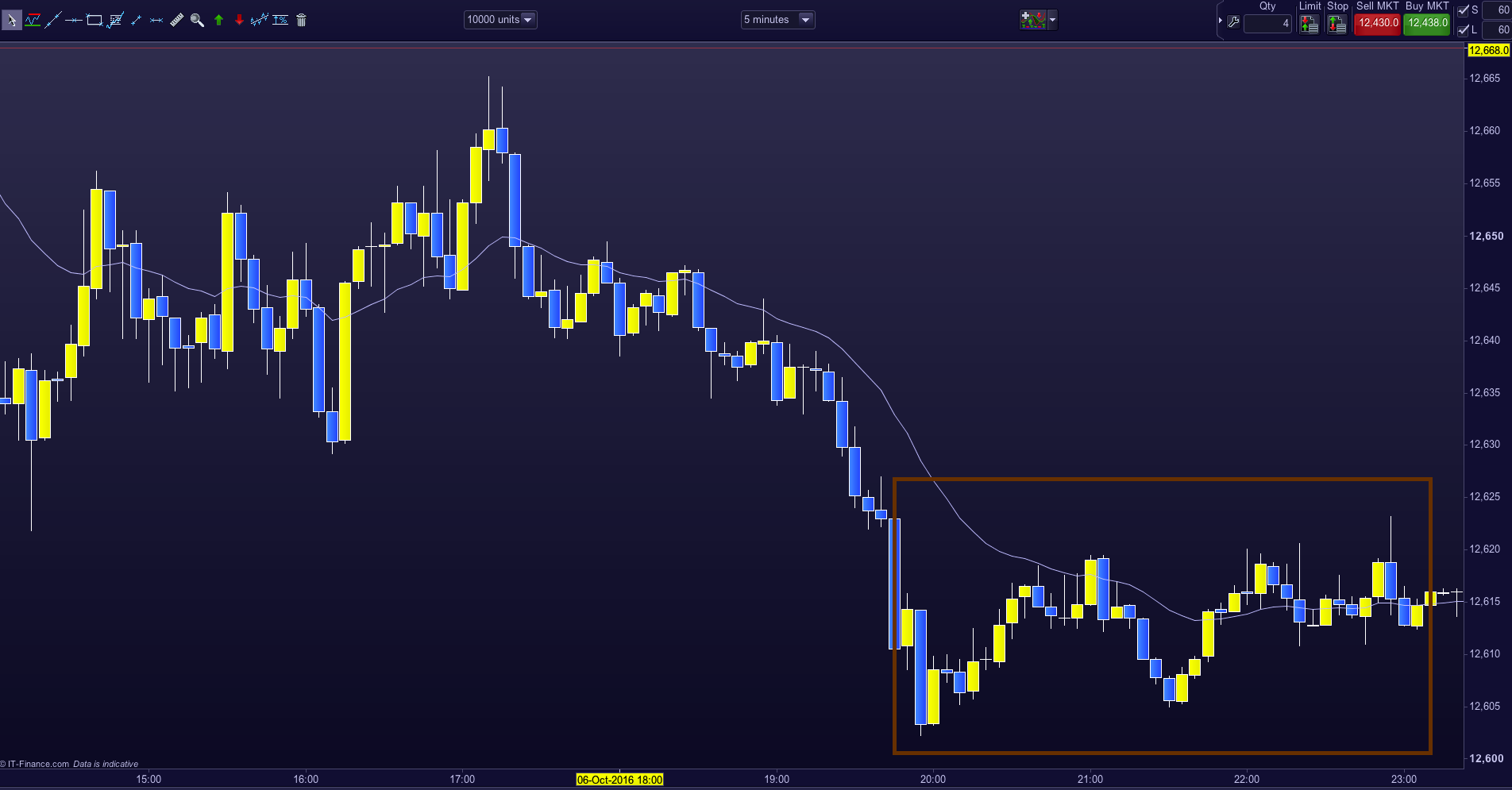
    Bars on a chart are normally represented relative to the biggest bar. Here we can see the 5-minute bar chart before the dip.

    snip20161008_1

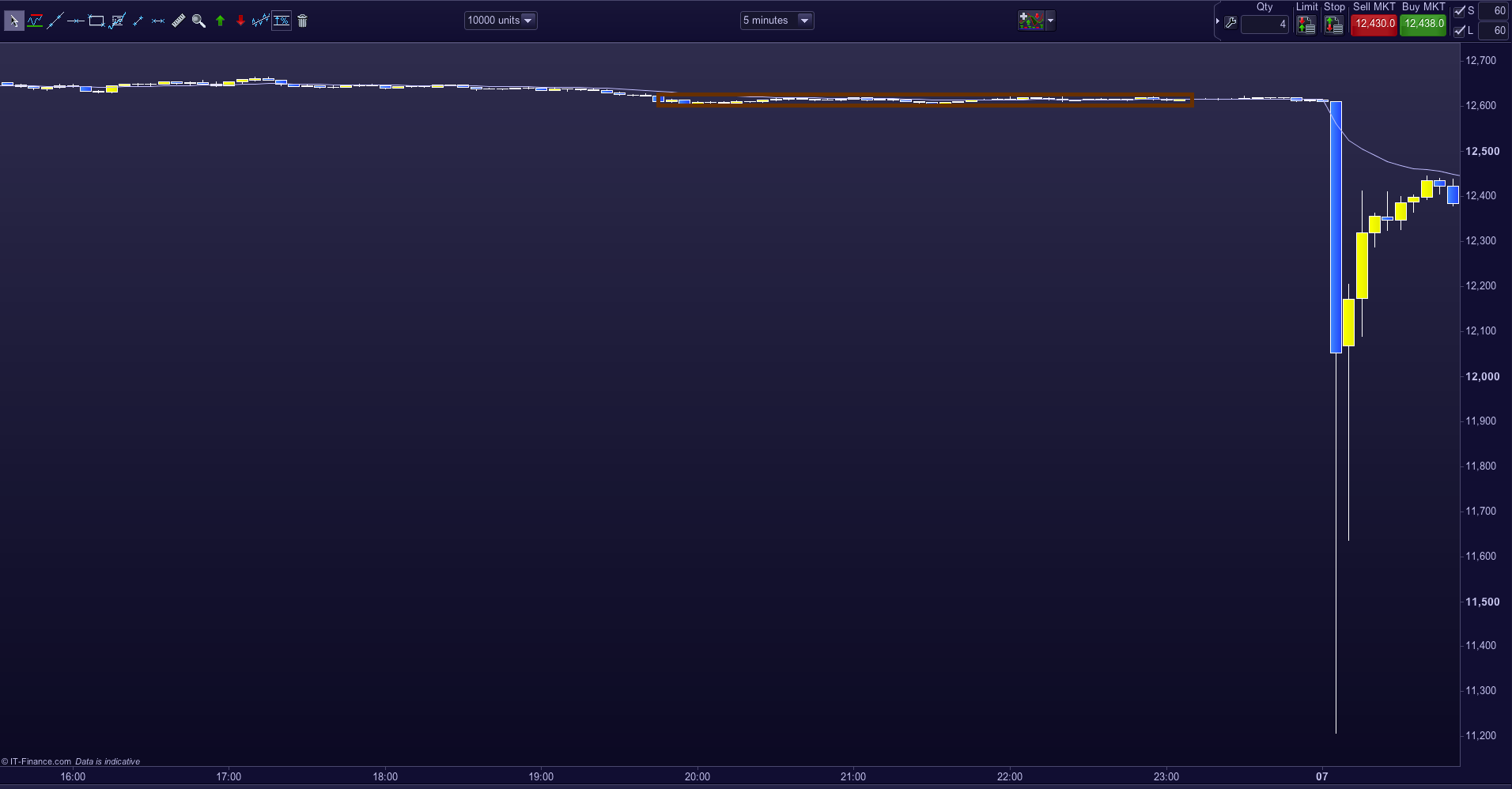
    In contrast, here is the same chart moved forward in time by about an hour. The bars in the reddish box are the same bars on both charts – and provides an idea of how far the dip extended from the perspective of the short-term trader.

    snip20161008_3

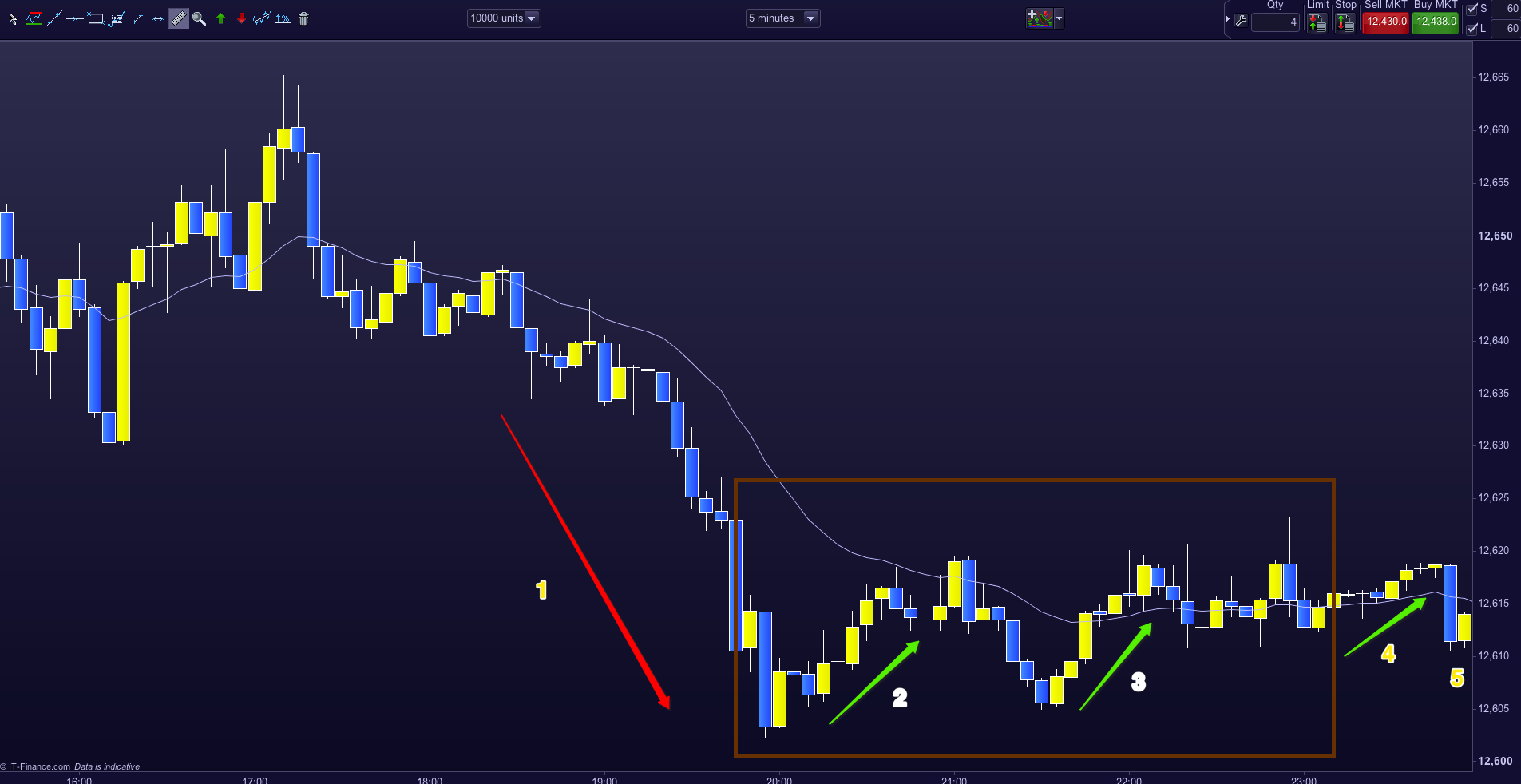
    If a (competent) short-term trader were trading this chart at the time how would the trader have fared? Okay, I think. here’s why:

    snip20161008_4

    The red arrow (1) indicates a clear downtrend and therefore only shorts (price going down) should be considered. Without going into price action talk the green arrows 2, 3 and 4 show that any significant attempt at a pull back is weak. The blue bar (5) is a definite trend bar short, not least of which it closes strongly down and lower than the previous two dozen bars. I would enter short here, or more likely, because of prior price action, before bar 5 formed.

    Ten minutes later price dropped 1,400 pips in 2 minutes. However, it’s all meaningless because if I had traded the drop I’d have made 30 pips (60 pips at the most) as short-term trading is precise and that is where my pre set target would have been.

  • Trading is about dealing with contradictions

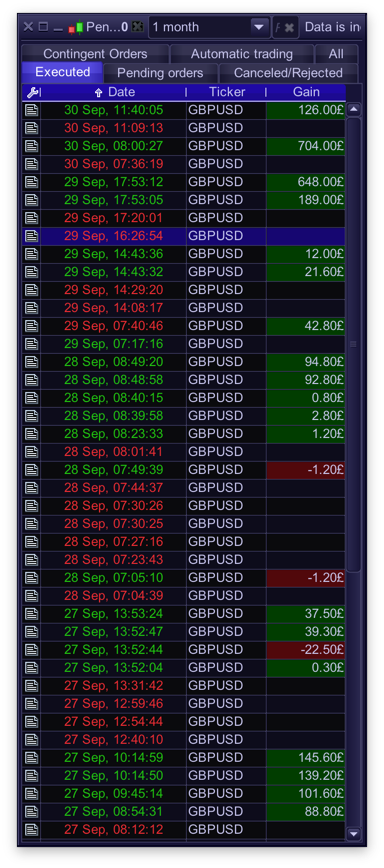
    Here’s the results of the trading week. Something I don’t normally show as it’s a distraction. It would be a distraction to try to make the figures each week. However, a good start and finish to the trading week.snip20161001_3It is not wise to trade if we have distractions. And some distractions are important, so I didn’t trade much mid-week.

    On a different note, something obvious to me this week is that trading is largely about dealing with contradictions. No wonder it’s not easy.

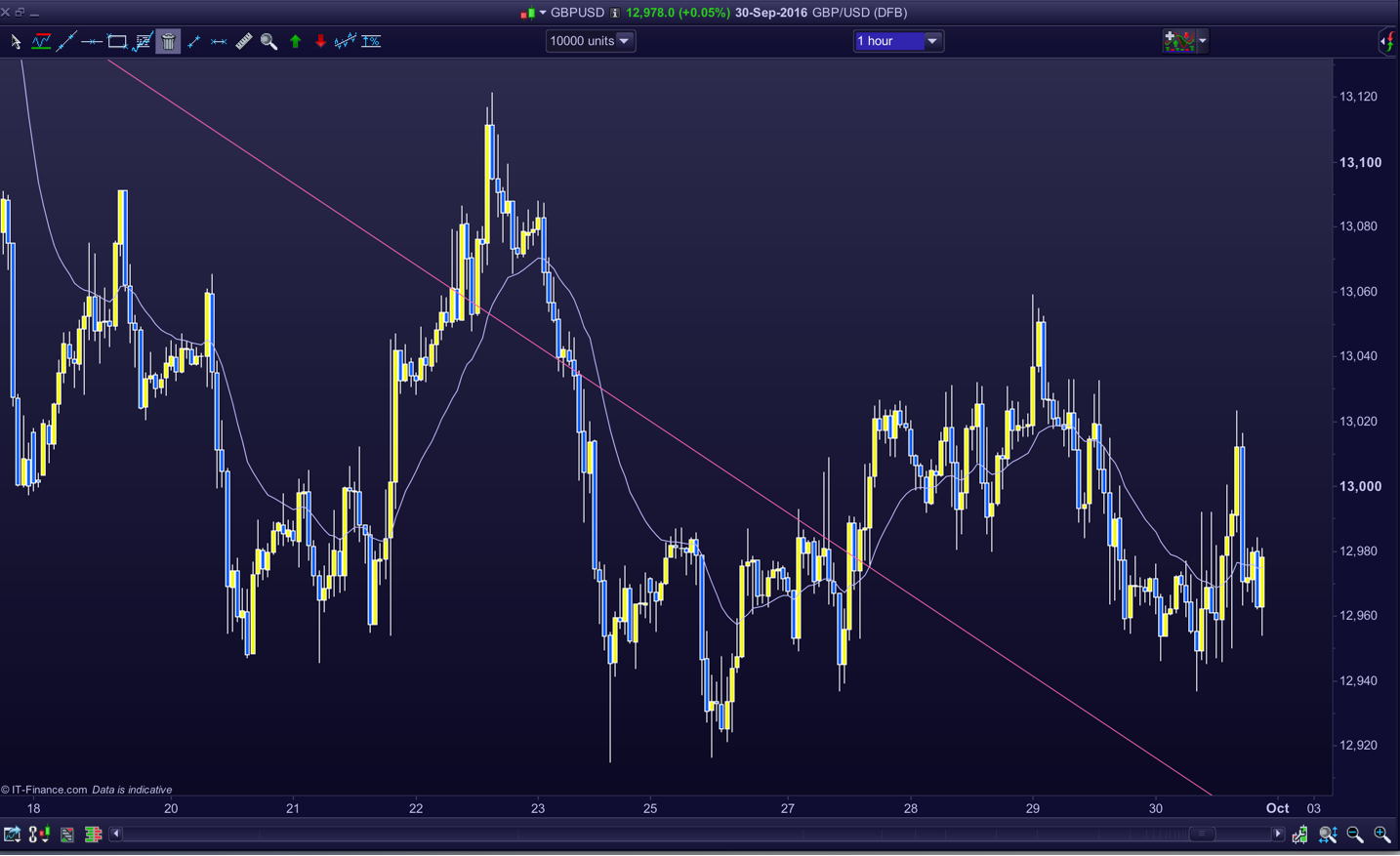
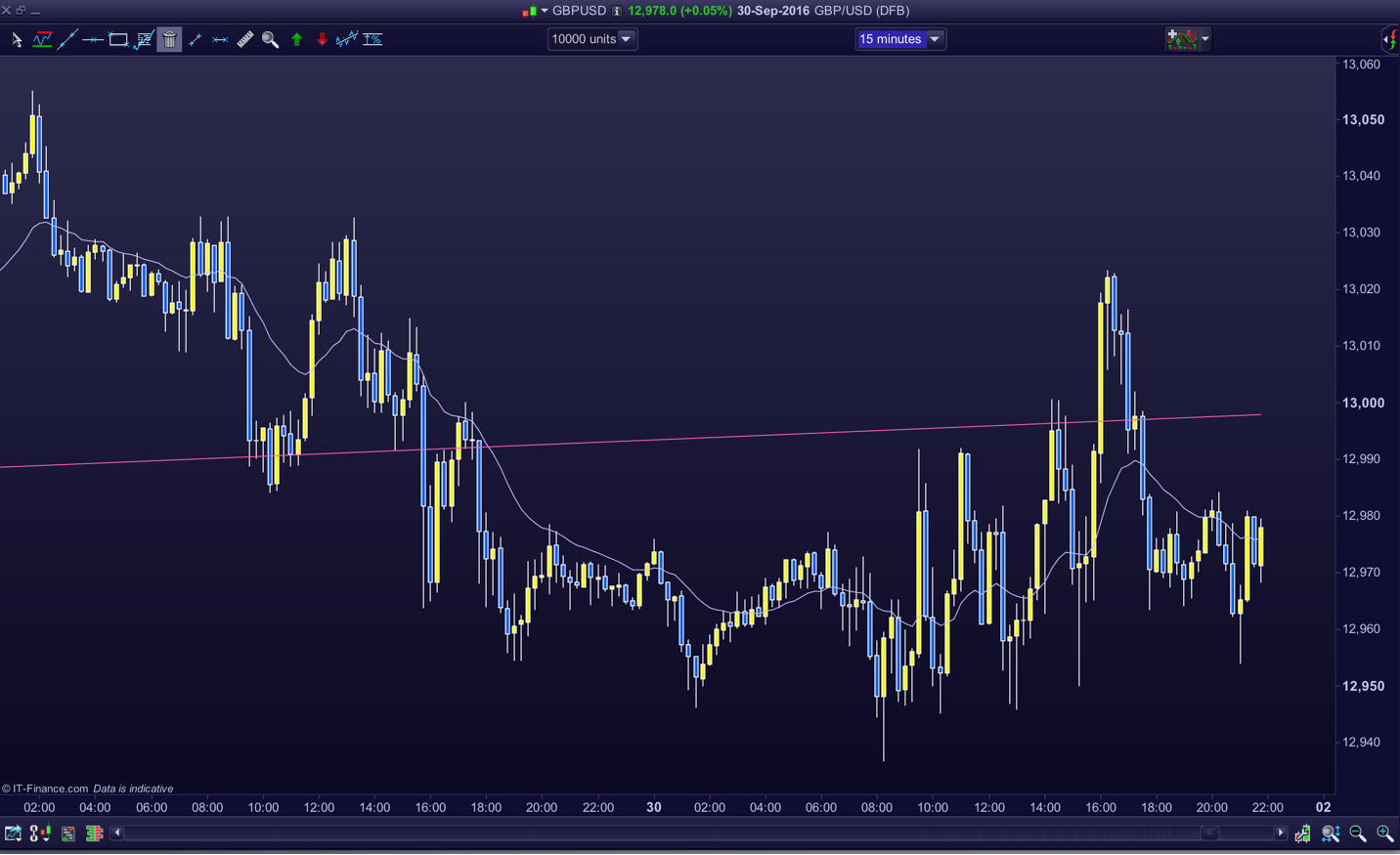
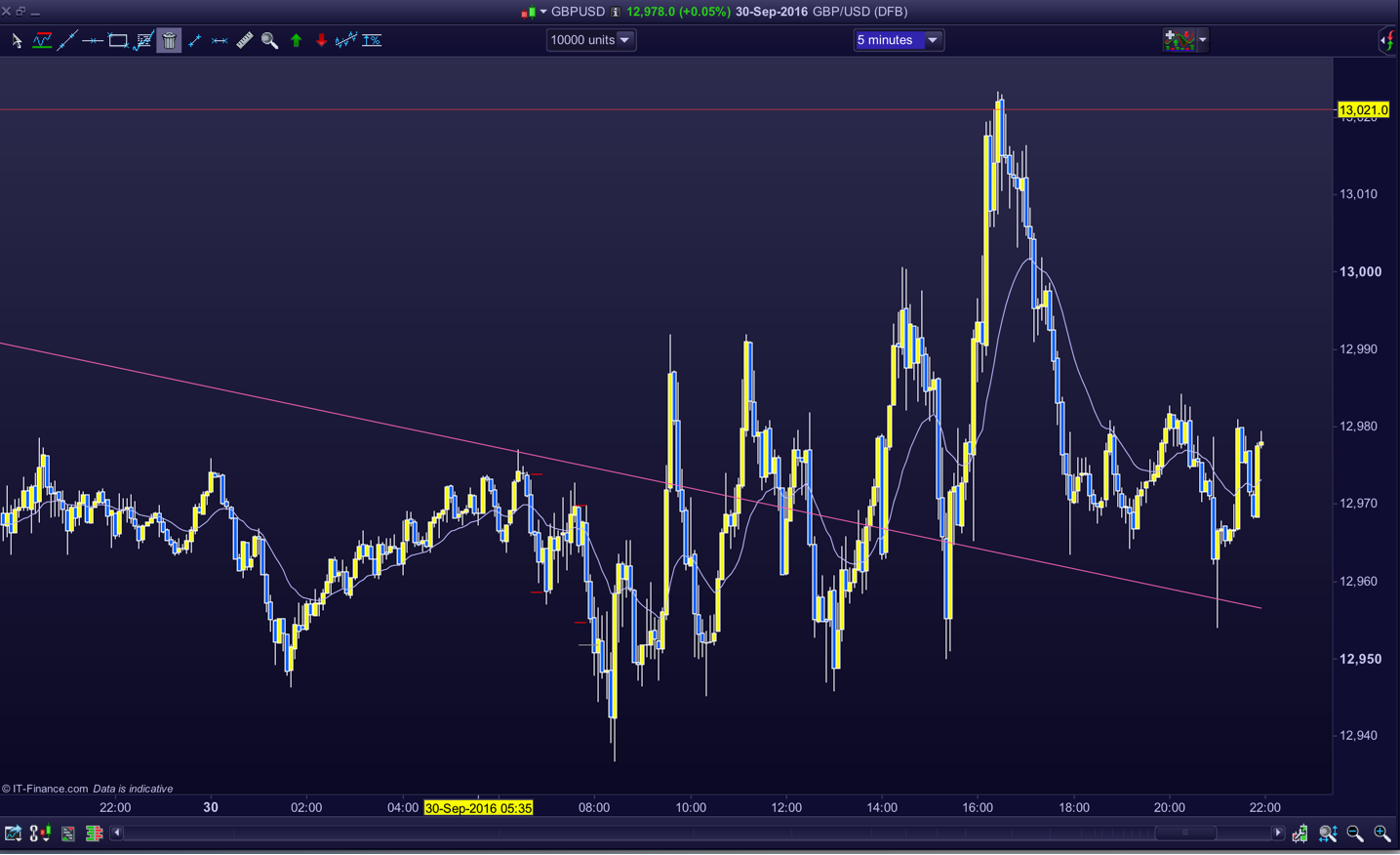
    Below: 1-hour chart, 15-minute chart and 5-minute chart. Each chart is of the GBP/USD pairing and for the same current time. You will notice the purplish line through the middle of each chart which is a ‘value’ line. (or linear regression). Price tries to get back to value. However, value depends on the criteria taken into consideration. The trader trading the 5-minute chart is looking for a different value to say – the trader trading a daily chart. They contradict.

    And it is a traders skill to determine which timeframe they wish to trade and which higher value line may have an influence over them for the timeframe they have chosen.

    snip20161001_7

    snip20161001_8

    snip20161001_9

  • Keep it simple and adapt

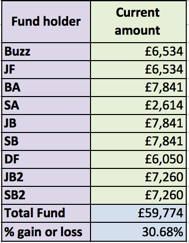
    We are up 30% since the start and 21% so far this year.

    snip20160924_2

    Over my holidays I read all eight trading books by Laurentiu Damir. Seven of which are short e-books written about four years ago. He teaches simple, conservative trades. His more recent book ‘Price Action Breakdown’ provides a good trading concept.

    Laurentiu recommends the higher timeframe charts – such as 4-hour or daily charts. This, as he explains, is because of the effect that multiple news events throughout most days has on the lower (such as 5 minutes) time frame charts.

    Laurentiu teaches reading a chart that is a time frame appropriately above your price action chart. For example, He would take the ‘bigger picture’ from the daily chart but use the 4-hour chart for price action set-ups.

    We use (and reading between the lines I think Laurentiu does too because trading is what he does) the 1-hour chart for market cycle and the 5-minute chart for our price action – and we keep a good eye on the news events that can affect us.

    As Laurentiu explains: the thing with trading is that all of this is a guide. Flexibility based around a solid concept is key. It may be the 1-hour chart but on the day it may be the 30-minute chart. Price action may be 5-minutes but again this may be from the 15-minute or even the 3-minute chart. It’s whatever fits.

    We cannot trade by numbers and be successful, we have to know and understand a lot and, of course, practise a lot – then keep it simple and adapt.


  • Don’t add anything until it’s been practised, briefed and you know it works

    Watched a BBC 2 recording of Skies above Britain 3/5 yesterday. Featured an aviator I knew from my RAF days who now flies weekends as part of a “Wildcat” Pitt Special duo public display team.

    He has a couple of decades of RAF fast jet experience behind him, and looks more like the present day Martin Shaw with his silver hair than when I knew him; but the Wildcat clarity of purpose and professionalism was clear when compared to a few of the other aviators that featured.

    At a stretch, there is a cross over from this to trading. The Wildcat’s preparation, maneuvers and sequence of execution were clear, defined and practised; they never, it seemed, added anything that had not been properly considered beforehand.

    In trading our fund, we are adding profit now week after week. That, I feel, is because we are applying a similar discipline to that of the Wildcat display team. We don’t add anything in until it’s been practised, briefed and we know it works.

    Next blog 24th September, see you then.

  • The retail traders advantage

    As with many areas, the financial market is not as active during much of the month of August. Nevertheless, for those trading, good opportunities still present themselves.

    We traded fewer times this week. Trading opportunities and trading time being the reasons. However, it was a good week. Out of the several trades we managed a couple were break even and the remainder were profitable adding nicely to our Slow Trader fund.

    As I explained previously, this coming week will see us taking few (if any) trades. Trading, however, is like flying in the sense that we must remain current. Therefore, finding time for a few hours of trading will be beneficial. Importantly, any trading must be without distraction.

    On return to full-time trading mid September, and after ‘hols’ in Majorca, I’m going to trade from home. Most retail traders trade from home. That’s the advantage of being a retail trader. It requires a different discipline – with me it’s making sure I don’t over trade.

    This decision to trade from home will save a 50 minute each way commute and allow me more flexibility to be ready for key trading times. Between 6.30am and 8.30am on the opening of the UK market; early afternoon on the opening of the US market; and late afternoon to early evening where good opportunities can also be provided.

    James and I will continue to share trade talk throughout much of the trading day, but now via Skype and a headset.  We’ve traded together, side by side, for so long now that we feel we can communicate trade information (and two heads are better than one) without seeing each others screen.

    When I’m back in the trading chair, and current in the market, we’re ready to move up our usual trading amount a few notches.

  • What we call a ‘controlled trading technique’

    Slow Trader fund up over 10% for the year.

    We’ve moved away from the trade and hold philosophy. A philosophy that ambitiously has the account gaining 30% in a month (sometimes a few days) but worryingly has the ability to go the other way even quicker.

    We’ve moved to what we consider to be a controlled trading technique.  The gains so far with this technique have not been so great as it’s a reflection, clearly, of successful trades and then a reflection of the amount traded.

    Previously we would set a trade and let it ride for days or weeks. That gives the trade good opportunity to profit within a trend. The issue with our new ‘controlled’ trading system is that we only hold a trade for as long as we’re sitting watching the trade.

    However, controlled trading for us wins hands down over the ‘hold and hope’ system.

    What we will do now is increase our amount per trade. We’re confident (and it’s all about confidence) to do this. As we move into October (more of why October next) we will double the amount placed on each trade.

    I’m needed to manage the Hotel for a couple of weeks, as key staff are away, and then I’m away myself thereafter for a couple of weeks in Majorca. That brings us to mid September whereby we’ll start back with a few days of back-testing. We will then have a week of trading at our present risk per trade and to then trade with the more substantial amounts as we move into October.

    This is an exciting (controlled) stage of trading that we are about to embark upon. Thank you for staying aboard.

  • Market cycle

    With my previous styles of trading I had some great years, and the occasional shocker.

    The great years were linked to trending years, that’s where the market consistently moves in one direction.

    However, the market spends about 80% of the time in a trading range. This is where the market bounces up and down, seemingly erratically, between levels.

    A trending strategy, used when the market cycle is in a trading range, does not work.

    The market cycle of trend and trading range is evident in all timeframes.

    Understanding the market cycle, and applying a strategy for the part of the cycle that we are in, is the first key to consistent profitable trading, or more accurately the control of losses.

    Some traders will trade many markets and watch for one to provide the cycle that they prefer. Momentum traders are an example.

    Other traders, like us at present, watch one market (or a few) and have strategies to trade that market no matter what its cycle.

    It does not matter which method is used. What is important is understanding the market cycle and using the appropriate trading strategy.

    That understanding, I have to say from personal experience, is the only time the ‘shocker’ can be eliminated.

  • Minimise unnecessary loss and sharpen profit taking

    Back to live trading after an exhausting couple of weeks that introduced 7 new hotel rooms to our business. For the extent of the renovation See the hotel blog.

    In trades, we started this week with a day of back testing. We then missed a trade day and later in the week had to change our normal routine to a later trade start of mid afternoon.

    The late start provided a different challenge. You will know of the interest rate change and the sudden effect this news had on sterling. Our trade start time this week was after the interest change news and, therefore, after much of the action had already taken place.

    The reduced activity in the market after the interest rate exhaustion meant that we needed to reduce our chart bars from our usual 5, 3, 2 or 1 minute bars down to 23 second bars. At 23 seconds we could get a read on the chart. The issue now is finding a trade that provides at least a 16 pip move, our smallest scalp in the GBP USD chart.

    Working the 23 second chart is rapid. Strategies have to be clear and decisions decisive. Miss the exit signal and the chart is away from us into ‘no man’s land’ before we know it.

    From that experience this week (Thursday after the UK interest rate decision and Friday after the USA non-farm payroll) we have introduced 3 brief but important points to our strategy page on exits.

    If we hadn’t traded the 23 second chart the exit strategy points may not have been as defined or obvious to us. Using these same exit strategies in the higher time frame charts, which we will do this coming week as our routine is back to normal, will minimise unnecessary loss and sharpen profit taking.

  • At the end of every Friday to have made money

    A small profit this week but most days of trading were lost due to a nationwide BT broadband connection issue. We use BT infinity. You may or may not have been affected by the BT thing this week, we were. What is more, a slow, intermittent broadband connection can be annoying in many cases – in live lower time frame trading charts, its scary stuff.

    ….it’s like steering your expensive yacht through a twisty narrow channel, made up from a flotilla of other expensive yachts, and you have a rudder that is a made from a squishy sponge.

    Coincidently, next week is the final big push week of putting the final touches and furniture into the family business extension. So trading time disruption expected. As we go into August we will be back to six hours a day trading days. And the aim of the fund remains: at the end of every Friday to have made money.

  • The cool headed, eagle-eyed trader

    To win consistently at day trading we need to love what we do, because it involves a lot of screen time.

    Day trading is our prefered trading timeframe because we are in control, on a moment by moment basis – we do not wander off and leave our trade to ‘hope’.

    That said, day trading, more so than the higher, trade and hope, timeframe of trading requires a cool, well rested head. Any sign of tiredness, or distractedness, will show, as clear as day, in our trading results.

    This week, and the coming few weeks, with the opening of our extension to our family business, the distraction and the tiredness is there and we have modulated our trading to balance this.

    Our primary trading timeframe is the 5 minute chart. However, we will use as low as one minute charts to get a better read on a 5 minute chart entry.

    Whenever we see a complete chart the entry and exit points can quite easily be given by an 8-year old. However, to find good entry and exit points consistently, in real-time, requires at least 10,000 hours of dedicated chart time.

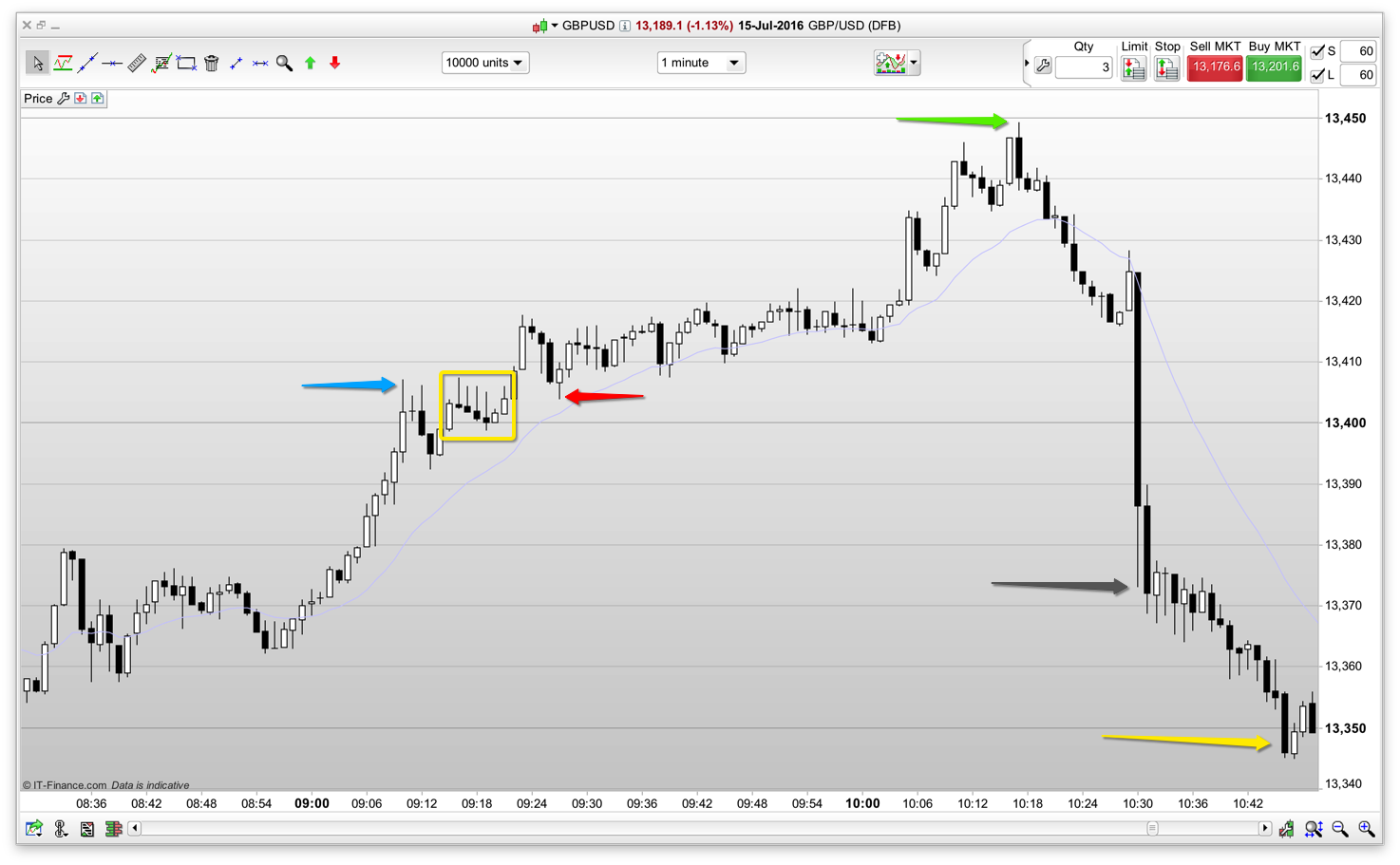
    Below is a trade we took yesterday on the one-minute chart. The trade went against us initially, but our wide stop and reading of the chart left us with a profit. Any other trader would have traded differently, and on another day with the same trade we probably would too, but this is how it ‘panned out’ for us.

    Snip20160716_4

    We entered the trade short (that is for the price to go down) with a scalp and a swing at the blue arrow (I’ve saved you from the multiple trend lines and measurements that go into finding this entry). We had a wide stop of 60 pips.

    To the eagle-eyed trader, the ‘price action’, shown in the yellow box, was a signal to get out of the trade. However, we held and it was only at the red arrow (actually, it was slightly higher than the red arrow shows, and therefore slightly slower than the eagle eye!) that I got out of our scalp at a small loss.

    The swing portion of the trade went against us for over an hour where another scalp entry was presented at the green arrow. The scalp entry would be taken off at the grey arrow and the swing at the yellow arrow. In actuality, we did not take the green arrow entry and took the original swing off a little above the grey arrow.

    When a trade does not go our way immediately  (and the law of trading probability says that sometimes they won’t) it needs a cool, well rested, head to deal with it and achieve a profitable outcome.

  • Amount per trade

    A disjointed week of trading. Monday is for back testing, at least for us for the near future. Tuesday was a day of local teacher strikes, so, as I’m considered as not having a ‘proper job’ I’m asked to look after the grand kids. Of course I say yes. Wednesday went well with a full win (I explain full win next). Thursday was not so good with a half loss brought about mainly through poor communication between James and me. We spent the afternoon of Thursday resolving this through back test and practise. Friday was the ‘non farm payroll’ day which comes around every first Friday of every month and which, at present, we don’t trade. The week can be quickly eaten into if we don’t concentrate and dedicate ourselves to the task.

    What do I mean by a full win? This comes from the average size of a market. Normally, we can trade the currency pair GBP USD with between a 20 (near) and a 60 (far) pip stop. (During a non farm Friday up to 240 pip stop may be required).

    We normally have a distant stop of 60 pips and a near stop of 20 pips, and we trade anything in between. We take two concurrent trades per trade entry. The first trade is a scalp (a reward that is at least one times the risk) and the second and concurrent trade which is also a scalp or, wherever possible, converted to a swing (a reward that is at least twice the risk).

    Putting on two trades each time or taking partial profits from a single trade, if your broker allows this, amount to the same thing. Two separate and concurrent trades have advantages but can be difficult to manage.

    Back to our example, the minimum we can trade on the GBP USD is £1 per pip. Therefore, with a stop at 60 pips and two concurrent trades: that’s £60 + £60 = £120 per trade. Each trade must be the same in terms of management and potential loss. With this in mind, a closer trade with a 20 pip stop would require £3 per trade ((20 x £3) + (20 x £3) = £120).

    That is why for GBP USD we have a minimum trade of £120. If our stop is, say, 30 pips or 40 pips then we have to do a quick mental calculation to know how much to trade to retain the same potential, pre agreed, loss per trade.

    Trades for us grow exponentially. As confidence in our trades grows, and if we can retain the ability to trade without the amount on each trade emotionally affecting our decisions, then our trades will build as follows: £120 per trade (£60 + £60 risk), £240 (£120 + £120 risk), £480 (£240 + £240 risk), £960 (£480 + £480 risk) ……and so on and so forth – but then we need to consider spread and the effect this has.

    Each of the above represents a full win. At present we trade £240 (£120 + £120 risk) per trade.

  • ‘slow trader’ moves to day trading

    I am taking our ‘Slow Trader’ hedge fund out of commodities and any medium or longer term trades. We are going fully into day trading and trading a single item – which at the moment is the currency pairing GBP USD.

    (Medium term trading of commodities is an excellent way to trade, but we need to focus 100% of our efforts and, for us, that is day trading).

    It is not possible to day-trade until a trader reaches a certain stage in his or her ability to read and manage in the lower timeframe charts. I think that we are close enough now to this ‘stage’ that we can touch it.

    To believe that it is possible to day-trade the lower charts is like asking some of us (non athletes) to run a 4-minute mile. If we did not know better, because we can watch the olympic games, we would quickly conclude that the 4-minute mile is unachievable; we would probably give up and defend our egos with comments such as ‘it’s not possible’.

    For those that do achieve the 4-minute mile (incredible as that is) they will get nothing from it other than personal satisfaction. That is because all the wins, the glory (the profit) is being able to go a few seconds under 4 minutes.

    In our day trading we feel that we are now achieving the equivalent of the 4-minute mile. We are now day trading where we can almost guarantee a break even at the end of the week. A shout of ‘well, yippee for you’ is justified, but all the work goes into the foundation. To push the running analogy further – once we see ourselves achieving the 4-minute mile, only then can we believe that we can get a few seconds under.

    Why favour day trades over medium term trades? For us it is because day trading is clear and finite. Trades are completed before the end of the day, and certainly not carried over a weekend. You are not waking up to a real shocker. In Andrew Tobias’ (updated) book ‘The only investment guide you’ll ever need’, he explains how he was in a hedge fund that after 5 years increased his fund 4.5 times – soon after 5 years it was at zero. And that is the thing with hedge funds, the unpredictable explosive nature – both up and down.

    My aim is different to this. I want to increase our fund in a regular (almost predictable) way, week on week. The hard work has been done, all we need to do now is manage those extra seconds.

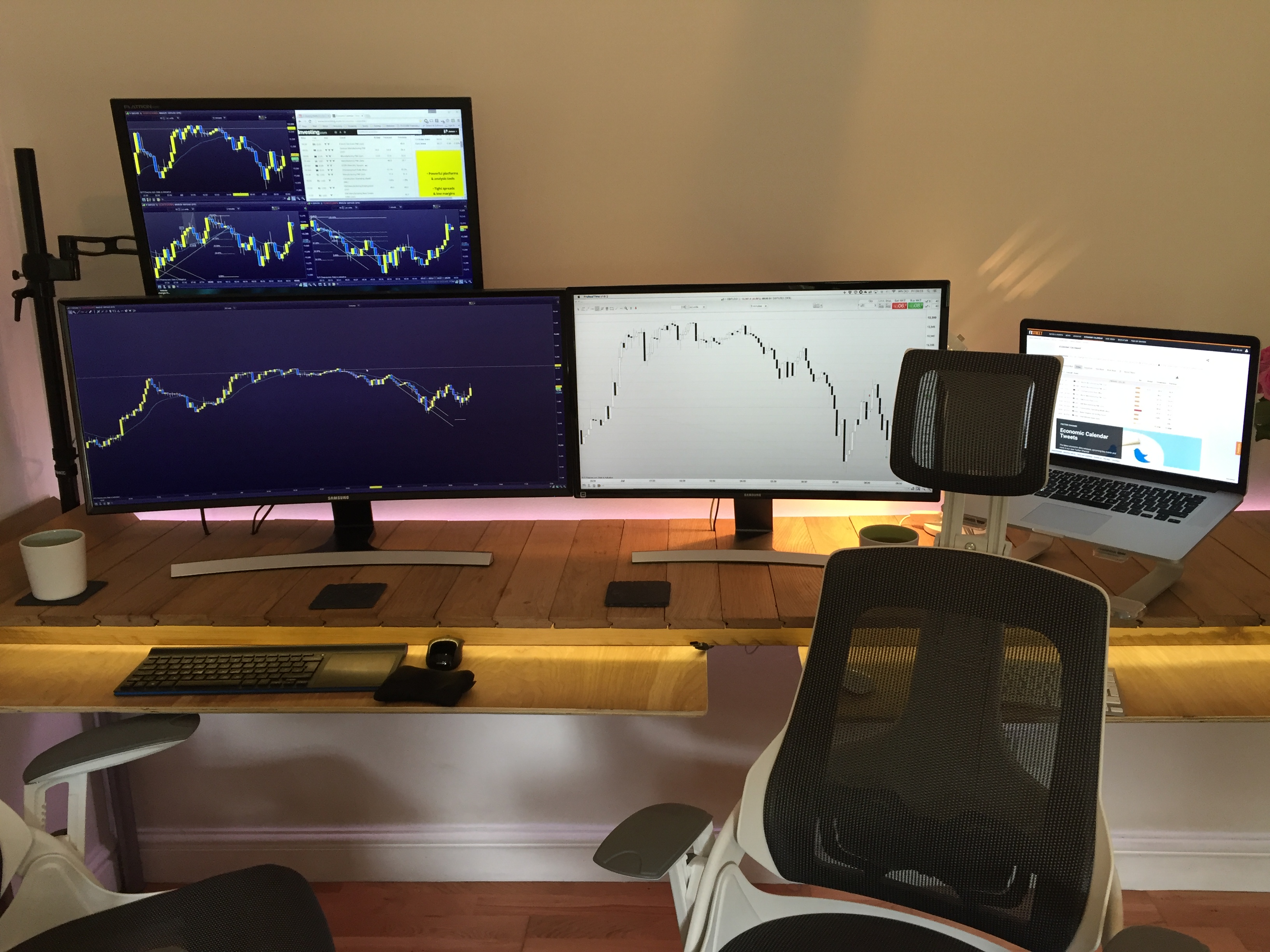
    Our trading desk:

    IMG_1321

  • Retail traders stay out!

    What a week….and, no, we didn’t make a killing on the pound but nor did we lose anything.

    Retail traders (people who trade their own money) were strongly advised – and correctly so – not to trade the early morning of the vote results. Here’s why:

    Snip20160625_1

    Firstly, a trade we took late morning of the day before the vote results, the 23rd.

    When you see a chart after the event you wonder how you didn’t realise that it wasn’t going to go up. We went short (to say the price was going to go down) at the green arrow. One of our strategies is to short at the top of a ‘trading range’. The green arrow was the top of a wide trading range.

    The price, however, broke out long. Our stop, as per our strategy, was equal to the height of the trading range which was over 65 pips. The break-out long went over 50 pips before it pulled back, very suddenly, to give us a break-even out.

    I mention this to put things into perspective. Usually, in GBP USD, our stops are between 20 and 40 pips away. Even early on the 23rd we were up at over a 60 pip stop. Not only that, margins change so that the leverage that you get to know is now different which means if you get it wrong your whole trade can be cashed out very quickly by your broker. Spreads (we mentioned these a couple of blogs back) go through the roof and, most importantly, we have the great probability of slippage where, simply put, you can ‘lose your shirt’.

    We do not trade the monthly FOMC report because price can bounce 150 pips one way and, often, immediately reverse over 150 pips the other way. The early hours of the 24th the market moved over 1,700 pips with over 500 pips of pull back.

    Trading is a ‘zero-sum game’ which means that one person’s gain is another person’s loss. Institutions lost many billions the other night and retail traders trading could have blown out their accounts and more. If you use a retail trader that made money through the big move down then get rid of them as they are gambling and next time might not be so pretty.

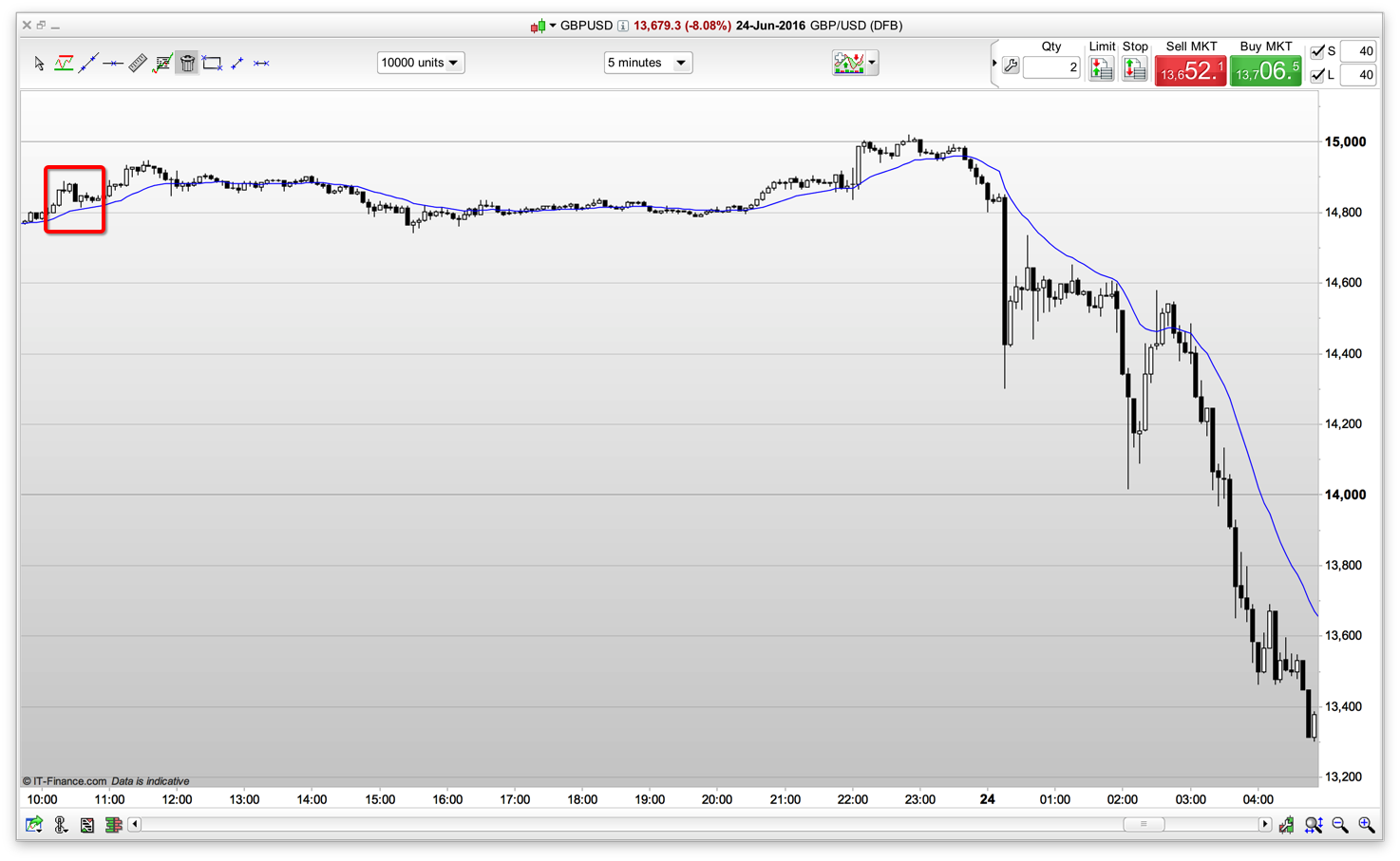
    In the chart below, to put things into context, the red box was the time of the large bars shown in the chart above.

    Snip20160625_2

    Gold

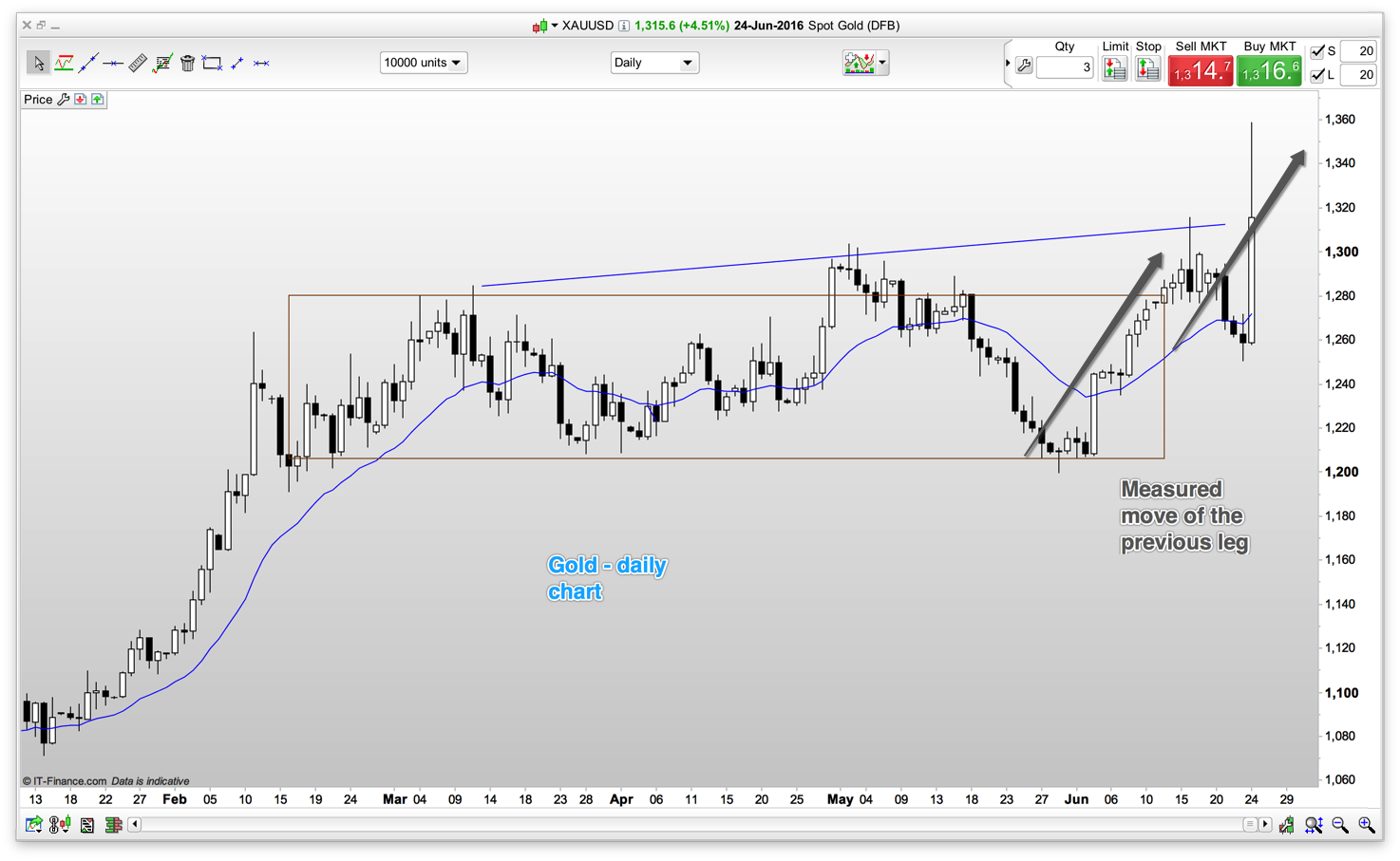
    For the next few weeks, due to the expansion of our family business coming on-line, I’m only trading between 8am and 1pm. This allows me time to trade the currency pairing GBP USD only. For the time being I’m monitoring the commodities. Gold moved up to an exact measured move of the previous leg. Something James had spotted – and I’d relayed the possibility of, a few blogs back – and thus providing a great short opportunity. Over the next few days we may get a second (and therefore more secure) opportunity to short gold. But I need more evidence that the price will not go up further.

    Snip20160625_3


  • Learn the language

    Finding our trading style is important. Most of us bounce around different trading systems, methods and personalities looking for what is right for us. And what is right for us is not necessarily right for many other traders. The combination, and therefore choice, of indicators, methods, timeframes and systems is massive. To stumble across a way that matches our personality, time and commitment is probably not going to happen immediately. Most of us (and certainly me included) try everything that we can find – thereby being driven by the personalities of the people encouraging us to use (and pay for) their system or method. This is a time-wasting and expensive way to go about things. Not only expensive because we pay for the system, but also because if the system does not suit our personality then the expense comes via our inevitable trading losses.

    It only occurs to me now that instead of simply following the suggestion of a well-meaning friend or well worded promotional material (or whatever) we should analyze ourselves and find what would be best for us. At least narrowing down the search so we have a better chance of finding whats right for us. The same applies to investors to a large extent. The mystique surrounding trading makes us reluctant to make our own decisions, as we feel that we don’t know enough about it to decide, and it is far simpler to just follow a suggestion from someone who claims to be very successful at it. Well, that is a rubbish way to go about it. The basics of trading couldn’t be simpler, but is made difficult by its language; therefore, the first thing to do (as a trader or investor) is learn the language.

    You will be surprised at how simple trading and investing is, once you get past the coded words. I said trading couldn’t be simpler, and that is true, but transforming that into something that provides a consistent profitable return is quite another thing. But there I go, like everyone else, bringing in the mystique again!