Author: Buzz Lightyear

  • Fund Update

    Hi

    Good progress this month. Still slightly down but a good move to neutral.

    Done with little time available for trading. Most time was taken up with a trading course in London, the completion of a detailed Australian on-line trading course and a weeks skiing in Austria!

    My review of my trading has made it more specific. More focused. Rather than hundreds of charts I now concentrate on a dozen foreign exchange pairings, a similar number of company shares and half a dozen or so commodities. What a change.

    Each of the above have to be traded with an advantage. With something that gives me a better than good chance of winning. I’m also trading shorter term than before. Rarely day trading, but taking trades for only a few days or a week or so. The exception being the commodities which can still be over a few weeks.

    Soon, I will be set to trade full time – the lodge is becoming the office.

    As your funds are leveraged there is little point in going for capital growth. I can’t trade more (because it is leveraged) than I have already. Therefore, I propose that as soon as we are neutral I send you a monthly cheque from any profits.

    An annual review is therefore not needed. As you are monthly you can withdraw part or all funds whenever your fund account is neutral or better.

    Distribution of profits is done on your share percentage of the fund you are in. Cheques are tax free.

    Talk to you soon.

    Regards

    B


  • Go Back to Basics

    Some of you have asked recently for thoughts on what/when to invest next.

    Before that, lets go back to basics.

    Something I got from Tony Robbins’ last book, the most important thing is to firstly sort out our income, growth and fun.

    I’ll run a blog or two sometime later to expand on these but for now: income is stuff that generates you cash without having to get out of bed; growth is mostly what we talk about when we refer to share investment; and finally, fun is shorter term high risk and reward.

    All of us dismiss this as either too simplistic or we think we have done it. When actually we haven’t. Honestly, its key.

    Now, take your growth part and decide what to do with it.

    I recently enquired after a few internet trading systems and took a look at some of the more popular trading magazines. Wow, you quickly get inundated. If its all that good why are they not billionaires?

    The point is, most of the magazines and probably all of the trading systems are not for your growth but for your fun. they are mostly short term and reactionary. So, back to the beginning, lets not get confused and put our growth stuff into short term, high risk by mistake.

    Growth is a nine month view, and a few years reviewed six monthly is best.

    Trying to judge your growth fund from the popular magazines is almost like trying to judge the long term weather forecast from the front page headlines of the Daily Express. Its reactionary. It will at best get you in when you should really be getting out and at worst make you procrastinate with headline information overload.

    Take your allocated growth pot of money and divide it into investment portions. (You are looking for growth here. If from your popular magazine you have the company with the latest oil exploration technique then this is not growth but the high risk fun part).

    With your growth portions: less is more. Look for solid companies that are in areas that you think will continue to grow. One of my portions would be an index tracker of the FTSE 100 and/or S&P 500 (e-mini if I could get it). I would also save one of these portions to put into gold but not until mid February. The same timing for an oil or oil associated company like Petrofac.

    Shares will trend up this year. That is, the index will finish higher. But there will be a bit of ‘fun’ in-between.

    B


  • Hedge Funds Update

    We remain down:

    Sorry, that is how it is. How much down I’m going to keep to myself for a while. I know we’ll be even by the next report, 23rd February. After that, based on patterns, I say that we’ll be up 40% by 23rd April. And after that, until the annual report of Slow Trader Hedge we’ll gain a further 10%. (Ferrari Hedge started later and will fare slightly better).

    We will therefore have a total gain in Slow Trader Hedge of only 50%. Somewhat short of my double prediction.

    What went wrong? Encouragement from you possibly did it, and I have to say good natured encouragement at that. The problem was me. My inexperience of dealing with other peoples money. I tried too hard.

    I could have tried to edge some back over the early New Year but decided against it. When you take a hit, at least in the trading sense, its sometimes best to take a ‘review’ time out.

    Slow Trader and Ferrari Hedge, and my own funds, have been completely out of the market for a few weeks.

    We have only just trickled back in. Building slowly over the next few weeks as buy patterns present themselves and as my indicators suggest.

    I often knock the managed funds, because they fail most of the time. I still have no support for managed funds but I do now appreciate what they have to do. Unlike me, they have additional pressure from share holders, bosses etc; they cannot simply take time out to regroup.

    I continually read that 94% of people that do what I do fail to make the grade. In the case of managed funds, fail to beat the index – in my case, fail to stay profitable, or worse.

    I need to learn from this experience and do my thing – not the thing that is encouraged of me. If that makes sense!

    As a Slow Trader or Ferrari Hedge investor you have no downside this first investment year. Original invested amounts can be returned whenever wanted, and with no detriment to remaining investors.

    But over the next few months…. I think its going to be positively exciting.

  • Eve’s share list – what do you think?

    Eve (not actual name) has this share list.  Through an ISA so LSE only.

    There are a mixture of FTSE 100, 250, AIM and small cap here. As we only calculate FTSE 100 and 250 (Grouped as FTSE 350) and S&P 500 shares I’ll show this based just on medium term chart signals rather than Nick’s company numbers.

    Aggreko – trending down but medium term is a hold.

    Barclays – choppy recently. Short term (a possible) hold. Medium term, sell.

    Centamin – short term a slight drop. Medium term hold. Moreover, gold to increase this year.

    Delling Group – unless you know something! sell.

    Glencore – copper to rise. I’d say hold.

    HSBC – banks more difficult to judge. Simply by the signals its a sell, and has been since late September.

    Petrofac – oil industry has taken a hit. However, Petrofac is one of our ‘top buy tips’ based on company numbers. Crude oil to increase again in March. Hold.

    Premier foods – short term is a probable dip. Medium term difficult. Unless you know something! again consider a sell.

    Quindell – recently increased nicely. If you need the cash, sell. If not, and you like a bet, then hold.

    Wetherspoon – neutral with a slight trend upwards. Could equally go up or down! It is going to do something based simply on the length of time it has done nothing! Probably to continue its current drop to 780p, but a climb is possible. Tentative hold.

    Any spare cash and nothing in the ‘top buy tips’ takes your interest consider an index tracker in FTSE 100 or S&P 500 e-mini or even a gold ETF. However, if holding Centamin (gold) then consider diversification and exposure to too much in one commodity. You also have copper and oil, in some regard, through Glencore and Petrofac respectively.

    All the best

    B


  • My S&P 500 top buy tips 2015

    Again, from Nick’s spreadsheet, I have selected a few S&P 500 shares to buy as part of your go-get-em portion of your money.

    Google Inc (either GOOG or GOOGL), Priceline Group Inc, Green Mountain Coffee Roasters Inc, Michael Kors Holdings Ltd, Qualcomm Incorporated.

    These are based on the company showing above 80% consistency of growth, a present value that Nick has as less than 55% of potential, and no, or insignificant, debt. P/E has to be representative of the companies sector and certainly not above 40. There are lots of other criteria, but these cover the main ones.

    They are also based on a medium term buy signal about to show. Probably within a couple of weeks.

    Be aware, however, that you need to understand the company too. Blackberry, for example, would have qualified for a few years in the above category – but at that point Blackberry also had no future market.

    B

  • A bit more about top buy tips for 2015

    You will notice that my buy suggestions yesterday are mostly expensive by UK share prices. These are not shares that you will hope to double your money with in a few months. That is a different approach altogether.

    I found that suggesting such volatile shares didn’t work because to buy volatile shares, unless you are really in the know about such a share, is trading rather than investing. A difference between trading and investing is that timing is everything. And unless you have my indicators or similar and watch your volatile share regularly you can miss it.

    The shares I have pointed you to are part of your go-get-em or growth fund. This is not your fun fund. That is something entirely different. How you divide your total account into: Annuity (or pension), go-get-em (or growth) and fun is up to you. I think it is not that difficult as the only areas that should alter are the annuity and fun. The go-get-em should, to my mind, always stay the same.

    In other words, if your age is 25 your fun fund is bigger than your annuity. Probably much bigger! Later in life the proportion of these funds equal each other and then later still in life they switch places. However, the go-get-em portion can stay the same throughout. And these are the shares I gave you yesterday. It is important to regularly adjust the proportions. Lets say you have particular success in your fun fund then this has to be redistributed back to an overall fund balance that is right for you. This should be done regularly and certainly annually.

    In the next day or two I will provide the US growth shares.

    B


  • My FTSE 350 top buy tips 2015

    Nick’s spreadsheet shows us the true value of a company and measures a companies consistency of growth: here are my picks from Nick’s FTSE 350 spreadsheet. These companies show wonderful potential future values and all with better than 80% consistency of grown.

    I would look at buying within the next couple of weeks. You have, coincidently, good sub sector diversification here too.

    Hargreaves Landsdown PLC, Rotork PLC, Intertek Group PLC, Weir Group PLC, Aggreko PLC, Premier Oil PLC, Playtech PLC, Randgold Resources Ltd, Rightmove PLC, Petrofac Ltd, Fisher (James) and Sons PLC, Aberdeen Asset Management PLC and Nostrum Oil & Gas PLC.

    …energy companies, namely crude oil, will have a hesitant start to 2015 but then recover much of recent lost price.

    In addition to the above companies, consider a simple index tracker of the FTSE 100, FTSE 250 and/or S&P 500. They will do well this year. Remember, the secret is attention to cost. Ongoing cost is more important than entry cost. Vanguard FTSE UK Equity Index have an entry of 0.4% of fund but a low 0.08% ongoing cost. Shop around.

    Consider a ETFS Gold (LSE: Epic Bull). Gold will have a good 2015. Based on cycles we could see a gold high near the end of March, then a drop followed by a similar high end of October. For those that bought Centamin PLC look for a sell at one of these dates. Preferably the end of March.

    Diversification through Treasury Bonds and Gilts are excellent for the longer term investor. If you don’t have these yet then leave until next year. It is a fair assumption that interest rates will remain for a while and therefore Treasury Bonds will stay level or decrease slightly this year.

    If you hold Domino’s Pizza, Burberry, Easy Jet or Hikma Pharmaceuticals – all previous recommendations – you could consider taking profits now. 

    My next blog will be from Nick’s S&P 500 spreadsheet – for those that can invest in the US.

    Warm regards

    B

  • How to get the most from my retirement pot

    First of all, because of the holidays, the next fund report (Slow Trader and Ferrari Funds) will be about 23rd January 2015. With Slow Trader, we took a hit in the last report and we had 2 or 3 trades that were still to come off. These took us a good 10% lower than my last report. However, on the plus side we currently have several trades that are running and these are in profit. Let us see.

    I’ve made simple but significant changes to our trading technique. In terms of timeline, I’ve come out more – now taking a broader view. To that end we will use the ‘futures style’ purchasing rather than the relatively expensive Daily Fund Bet. This will help to reduce our fund operational costs.

    I’ve back tested weeks worth of trades to find the best timelines for our indicators. There is never a sure bet, if it were that easy…

    However, I am confident that we have something that suits the current market. These things need regular review as what worked a while back might not necessarily work as well today.

    I’ve titled this article – how to get the most from my retirement pot – because that is what I’ve been looking at recently. Primarily to find the best pension scheme for my small company and employees. The one I have chosen is http://bandce.co.uk/ the peoples pension.

    Other than it being internet based, so no middle man, the pension is clear and easy to use and provides some great funds to choose from. More importantly, it only charges 0.5% with no other costs. The low charge over a 20 years or more is significant.

    One of the problems with mutual or managed funds (including banks) is the high management cost of their funds. This is a secret the big funds have kept for decades. For every percentage charged in management you can deduct at least 20% from your final lump sum. If you’re keeping a fund for 40 plus years the percentage is higher than this. Therefore, a managed fund that is costing you say 2.5% will reduce your final award by some 50%. If your fund was due to pay out £100,000 then you would only get £50,000 – maybe as little as £35,000. You’re giving the fund managers potentially £65,000 – and for what!

    How is this possible? Its all to do with that magical reason: compound interest. Probably the most powerful tool you can financially teach your kids, grand kids etc. If you want more proof of this read Tony Robbins recent book Money: Master the Game. Its a mammoth read but well worth it. Obviously the book uses American terminology, but the UK is similar with different names.

    If not managed or mutual funds then how do I invest my money? Simple, self-managed index or tracker funds. This is something that will track a bunch of companies – say the FTSE 100 or S&P 500 – and will cost you very little to do so. In compound terms you keep that £65,000 rather than, as in the example above, give it to a bank or fund manager. Also, don’t let your broker suggest that a managed fund will get you more return over time for your money – your broker is not your friend. Over the last 20 years the stock or share market has gone up almost 10%. The average for managed funds has been about 2.5%. What a difference. Indeed, some 98% of managed funds do not beat the market – or, in other words, do not beat your self-invested index or tracker fund.

    Diversification in funds is important. In our hedge funds, for example, I look carefully at sectors in turn. Careful not to overload in any one sector. An index fund, by its nature, invests through all sectors. How you distribute your money is individual depending on age, retirement goals, health. However, with 15 years to go before retirement be very cautious of being overly exposed to the share market. The reason is that, historically, the share market has taken belly churning drops twice in any 12 year period. The suggestion, therefore, of 15 years gives you a buffer. If you cashed in your fund in late 2008 you would have got nearly 50% less than a few months prior. Not good.

    They don’t get a great press, but fixed annuities are a great way to go. Do not, however, go with the first suggestion from your pension fund if they provide an annuity. Shop around and get the lowest cost. Is a low cost annuity safe? After 2008 throughout the USA hundreds of banks went bust but not one insurance company (an annuity provider) went under.

    I would split my retirement money as:

    • Annuity
    • Go-get-em or growth fund
    • Fun fund

    I would consider 60% of my funds with an annuity. Again, depending on personal funds and circumstance. That is your safe fund. Your income to live on and hopefully help pay the bills. Most of the remainder I would put in a growth fund or a ‘go-get-em’ fund. But of this I would put as much as 50% in gilts or bonds (with a mix of treasury and corporate and the bigger mix being long-term gilts or treasury bonds). Of the remainder of the go-get-em amount, I would put 30% in a cheap to run tracker or index fund: of the small remainder I would split between commodities and gold. My final, now small, chunk of my overall amount would be my fun fund. You might consider the hedge you have with me as your fun fund. The beauty of a hedge is that this fund loves it if the market goes up or down. Both are good. What it does not like is a flat market.

    There you go, I hope that has generated some thought.

    I recommend this 30 minute animation ‘How the Economic Machine Works’ – well worth 30 minutes of anyones time. http://www.economicprinciples.org/

    Also, if you need to check out your state pension statement go to https://www.gov.uk/state-pension-statement

    Have a wonderful Christmas and see you back here in the New Year.

    B


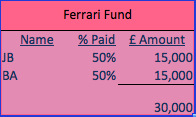
  • Ferrari Fund, 17th November 2015.

    Ferrari started 17th November 2014.

    This fund, similar to Slow Trader, will be run as a hedge and will concentrate on FTSE 350 and S&P 500 equities.

    Ferrari will also buy and sell commodities via ETFS.

    As with Slow Trader, this fund is closed to new investors until its anniversary.

    Screenshot 2014-11-25 12.59.16

  • 23rd July, Slow Trader Hedge Fund – 4th Month

    We are down 4%

    During the period we were up a maximum of 15% and it has been a big drop to take us back to -4%.

    The emotions are difficult during these times, particularly as you are trading other peoples money. I traded very well at the beginning of the period to take us 15% up. And then – well there is no hiding or making excuses – I didn’t follow my own strategy and, by-and-large, made a series of poor trades on the short side.

    If I can liken spread betting accounts to climbing Everest: we started at base camp, got blow down the mountain initially then made a charge up the mountain – 15% up. We hit a crevasse and, as your guide, I got the abseil ropes out instead of the crampons and possibly a couple of ice picks.

    crevasse-glacier-mclain-700972-xl

    We have slipped all the way back, just down from base camp. To consider a new guide is understandable. This guide – me – has had a few years climbing other, more forgiving, share ranges. This is the 4th year on this mountain, meaning spread betting. I got to the top – well, slightly above the top if you want to picture a short vertical helicopter ride. Another year I got half way up the mountain and another almost 2/3rd of the way up the mountain.

    During each of these attempts I’ve re-visited base camp, and once quite late in the year. So all is not lost in our attempt to get to the top – which is the same as doubling our money.

    I’ve studied the issue hard over the last two weeks and readjusted to help move with the change of the market. I’ve also reaffirmed my own strategy and operation. In this game when you get it right your financial reward is good but when you get it wrong the hit always seems higher.


  • Open a Slow Trader Fund

    How our fund works and what it costs.

    Trading cycle: from buy to sell (or sell to buy if we are short) is anything from a few days to a few weeks.

    Lets say you have £30,000 to trade. In this example, we will trade no more than £600 on any one stock or share. And during any one cycle we will trade some 10 to 15 times concurrently.

    Our strategy is to find intermediate trends. We get that right about 8 times out of 10. That sounds okay, but is spoiled by activation of our stop loss by larger than acceptable fluctuations in the share price; and by spikes in share price, including so-called ‘tree-shakers’ – don’t forget the hoops and loops – they can also be devils! The last two I made up, but you get the idea.

    However, where the spikes and the like are going to affect us a couple of times a year, to our advantage, we will have occasion to surf an intermediate trend. Hopefully, two or three times a year. In other words, we will stay in a trend for more than one cycle. Maybe for several cycles, and this is where the true profits are. Such a trend, even with one trade, can pay for all those pesky spikes and whatnots in one go.

    Our operation is three fold:

    1.   Find correct entry and exit points primarily from stocks and shares within the S&P 500 and FTSE 350.

    2.   Trade with regard to the share value or, as Warren Buffet calls it, the ‘margin of safety’. In other words, if we are taking a long then we want the share to be undervalued. Conversely, if we are taking a short we want the share to be overvalued.

    3.   Trade within our money management criteria.

    Trading vehicle:

    Our trading vehicle of choice is a spread betting account. We use IG. Unlike a normal share trading account, a spread betting account is tax-free. (Many people use these accounts to bet rather than trade. Those that bet, I have read somewhere, lose some 8 or 9 times out of 10).

    What it costs you:

    As the account is leveraged we pay a fee when we trade over a single day. This is called a daily fund bet (DFB). A DFB is our trade of choice due to the trading time frame we follow. To help cover this we deduct 2.5% of the final fund amount.

    Also, we deduct the same percentage of profits up to a maximum of 20% (For example, if profits are 15% we will deduct 15% of those profits. If, on the other hand, profits are 50% we will deduct only 20% of those profits).

    In other words, let’s again say your fund starts with £30,000 and, after one year, is at £50,000. Your costs are: £1,250 (to help cover the DFB), and £4000 (which is 20% of your profits). What you would get back is £44,750 (£50,000: less £1,250 less £4,000).

    For buy (long) trades IG charge the one-month LIBOR plus or minus 2.5%. This applies for sell (short) trades together with a borrowing fee. Dividends are credited if long and debited if short. For simplicity, we deduct a flat 2.5% of total end-of-year fund. This is less than the true costs to us and therefore in the case of an account that finishes even, or slightly above even, this will normally be a loss to us in terms of costs.

    How long does the fund run?

    A fund runs for one year. Two months before expiry you can decide to cash-in or rollover. In either case costs are subtracted annually.

    We can trade only 4 funds not including our own. A fund can be made-up from a group or from an individual. Each fund is to be a minimum of £30,000.

    A margin call is not your responsibility. However, your attention is drawn to the disclaimer page in slowtrader.com

    Note: Slow Trader Fund, 23rd July 2015, only has the DFB 2.5% charge. However, going forward from 23rd July 2015 the profit charge will also apply for those that wish to rollover and or place additional funds.

  • Finding the Trend

    Consistently finding the trend is possibly one of the most difficult things to do when trading.

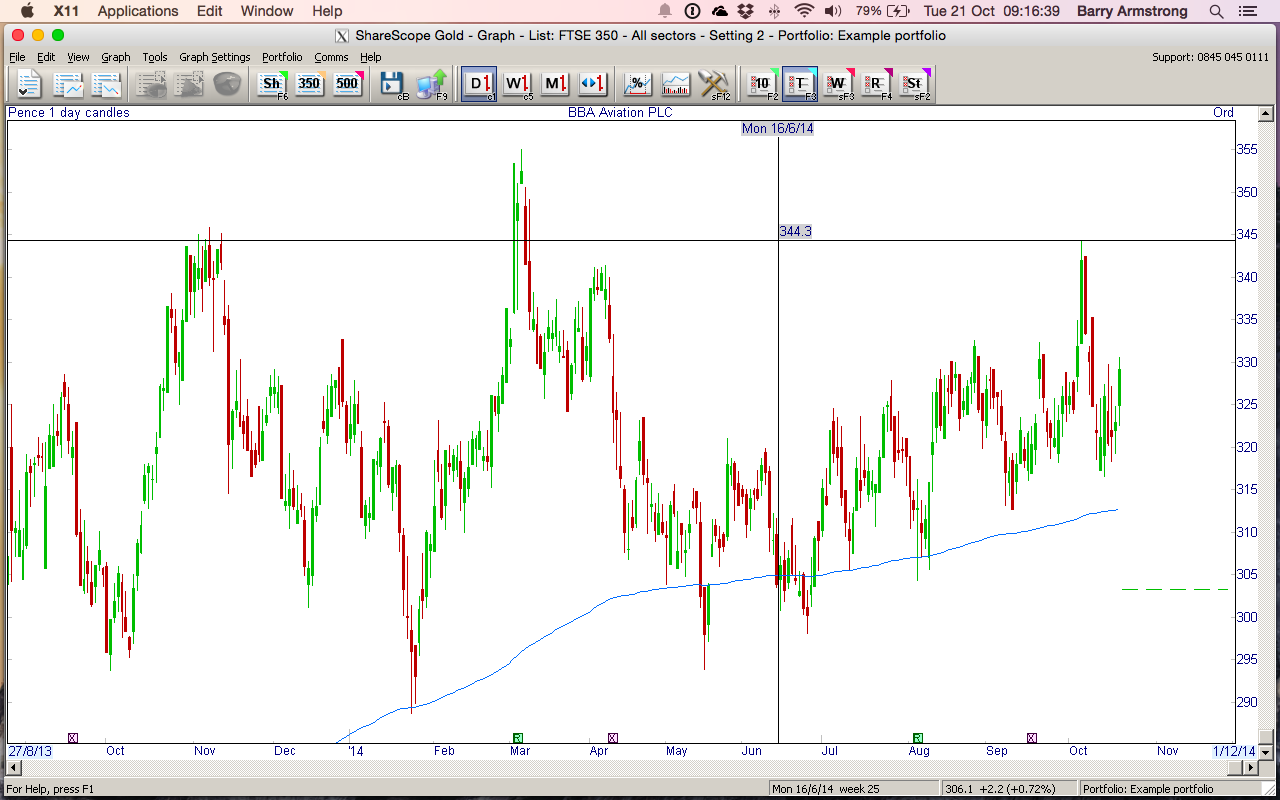
    One idea is to use a single 260 day moving average. This represents about a year in trading days. If trading long then the lows of the chart for at least a week prior are to be above the 260 day moving average.

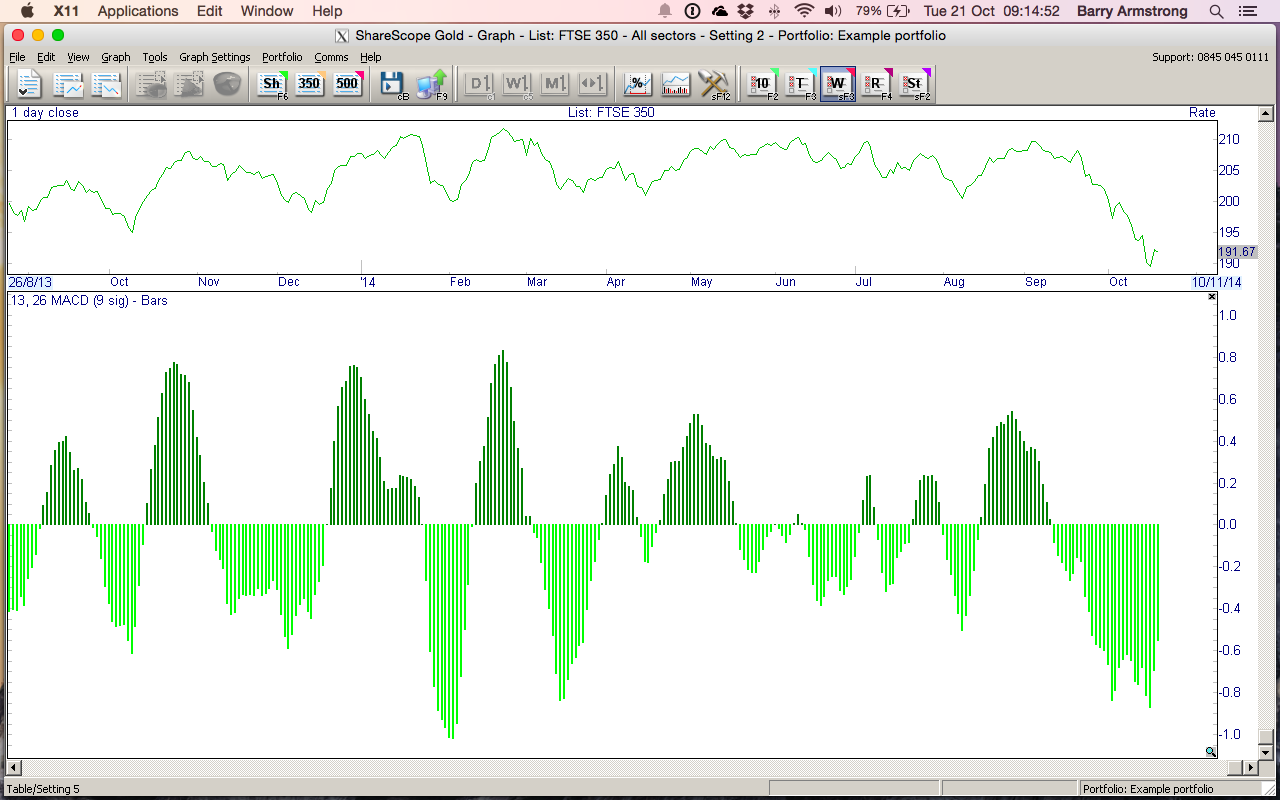
    However, only trade long when you have this together with your chosen market as a whole moving long. This is important and the opposite is true if trading short. The figure below shows the current FTSE 350 in MACD histogram weighted by cap. This market is tentatively moving long, i.e. moving into a tentative buy regime. I say tentative because of the shape and depth of the histogram.

    Screenshot 2014-10-21 09.14.55

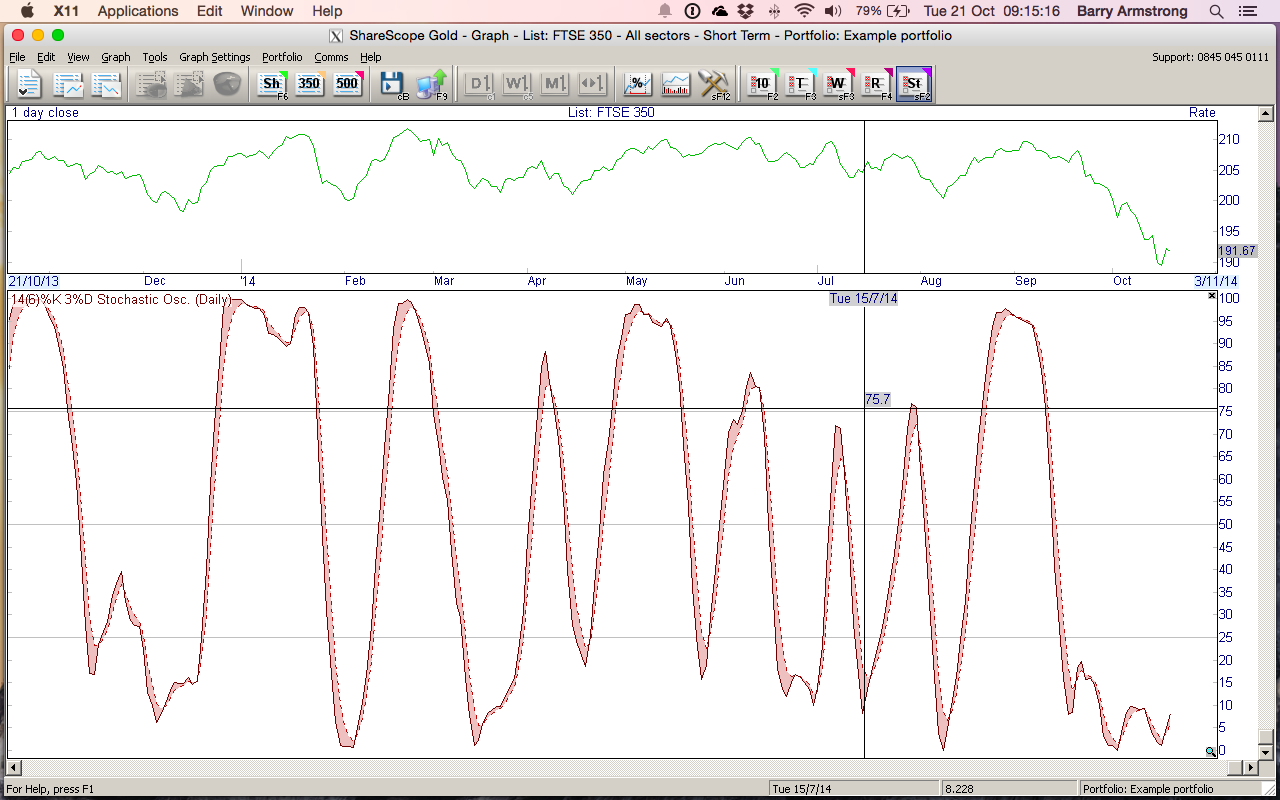
    Together with the histogram, if trading long, the stochastic, or similar indicator, must show an over sold:

    Screenshot 2014-10-21 09.15.16


    Here are a few shares that currently meet the 260 day moving average criteria:

    Screenshot 2014-10-21 09.16.29

    Screenshot 2014-10-21 09.16.39Screenshot 2014-10-21 09.16.29


    The individual share must also meet the MACD and Stochastic requirements. As an added assurance, the calculated Margin of Safety is to be acceptable, depending on whether you are long or short.

    Happy trading

    B

  • 23rd July 15, Slow Trader Hedge Fund – 3rd month

    We are up 5%.

    The markets have been interesting. We were right to go short for this trading period. A few lessons along the way. Soon after I blogged last month, within a couple of hours actually, we took a hit from Carnival. You can see below how the share spiked up. Marked by the arrow.

    Screenshot 2014-10-20 09.15.31


    Our stop was just at the top of this spike. However, I immediately re-traded the share to go short and as you can see, this was correct. The lesson for me wasn’t necessarily the stop position, that was one of those things, it was more that I had invested in Carnival PLC (London Stock Exchange) and Carnival Corp (S&P 500). Both shares are intrinsically linked. So when one spiked the other spiked. This meant our risk wasn’t 2% but 4%.

    Our fund dropped to 8% below. From this low we have achieved about a 16% increase this month to be 5% up. Without the Carnival error we would have been much higher. To that end, I have taken it a step further and, unless a good reason not to, only trade one share per sub sector at anyone time. This is because shares within sub sectors tend to be similar. If one drops quickly the whole sub sector often drops quickly. Its all about risk management.

    Here are a few other trades we took this period: (We went short so entered at the top arrow and exited at the bottom arrow)

    Screenshot 2014-10-20 09.40.08 Screenshot 2014-10-20 09.42.10 Screenshot 2014-10-20 09.45.11

    You will notice that we don’t try to judge the tops and the bottoms. I did, however, exit too early on many, this is a skill I am working on. But a profit is still a profit! Each of the trades made us more than £350.

    As the market neared the end of the downward period we sold out completely. We are now, albeit with some caution, only taking trades to go long, i.e. the market is moving, rather hesitantly, into an upward phase. This upward phase may be brief or prolonged. But as we are short to intermediate trading that is not so much a factor.

    All the best, see you next month.

    B

  • 23rd July 15, Slow Trader Hedge Fund – 2nd month

    We are down 4%

    To be clear, the down (or up when we get it) is always reference to the initial amount. So, last month we were down 6% and this month we have gained and we are now down 4%. Wow.

    That is a point in itself: and why it is important not to be down too much. If we lost, say, 50% of the portfolio then we would need to double whats left (i.e. achieve a 100% gain) just to bring the fund back to its starting point.

    The previous month we were invested primarily in the UK (FTSE 350) and I placed stops too close for the quick change that happened. All our trades last month were for the market to short (go down).

    Early this month we made a number of winning trades, again all from short positions. But the amounts were mostly small. Probably because I was wary of our recent loss and kept the trades light. Those winning trades took us back almost to even in the fund. I have tidied up the fund (let go of some trades that did not go as planned) which has brought the fund down to the -4%.

    More lately this month we are invested primarily with the US (S&P 500). Again all short trades.

    I am not predicting the market going down, these days I don’t get involved in those sort of long term thoughts. I am simply following my own indicators for each individual share and I’m only finding shorts. There are a few longs to be had but they don’t show strong enough on my indicators to consider buying. So short it is.

    As an aside, whist on holiday recently I devoured one of Larry Williams books – Long term secrets to short term trading. Not that I’m short term, more short to intermediate. Mr Williams’ lessons on entering a trade to gain best results has helped. His book also reinforced my already established strategy.

    Strategy: find intermediate trends to trade.

    Sounds easy but most people get this bit wrong. Again that is why we are short at the moment. I cannot find suitable long intermediate trends.

    As part of our money management, I have moved our maximum investment per trade from 1.5% to 2% of total funds. Again, if you think about it, this is another reason to gain money as this has an exponential effect on each 2% traded as the 2% is relative to the amount in the fund at the time.

    Also, we will be looking at a maximum of 55% equity used. We are presently at 43%. For those that think I should be fully invested, remember that this is a leveraged account. Its like taking out a mortgage, you get a lot more for your pound. And we need a buffer as we don’t want a margin call.

    More next month, and see you soon.

    B

  • 23rd July 15, Slow Trader Hedge Fund – 1st month

    We are down 6%.

    The mistake I made was a simple one, I set stops too close.

    A stop is a safety net.

    If a share price goes the wrong way then you can set where you say ‘thats it, I’m out’. This stop does not protect you, however, from a rapidly moving share price. to do that you need a guaranteed stop. But thats another story.

    Without getting into technical detail, I have learnt a lesson on stop setting. This is the second time I have learnt this lesson so hopefully this time it sticks.

    The first time was in February when the market made an unexpected large turn downwards. My stops were, in my opinion, too close as I stopped out over several trades only for the market to reverse and carry on nicely in my chosen direction, but without me!

    A similar thing happened in early August. My stops are now wider but still maintaining not more than 1.5% risk in any one share. I have already seen the benefit of this recently.

    We are 6% down. However, that does not include shares that are currently active. We are short at the moment with about 45 separate trades. That means all our trades are for share values to go down. Most of these trades are in credit or moving into credit.

    Trading and logging this fund, together with my own funds, has been easier than I anticipated.

    Talk to you next month.

    B