Category: Slow Trader Hedge Fund

  • Weekly Diary – Slow Trader Fund 7th November 2015

    I will provide the fund amount the first Saturday of each month, or close to it.

    We are 7% up on our original investment:

    Snip20151107_8

    The name Slow Trader refered to my trading style. Namely my steadiness in terms of: ‘the tortoise and the hare’. It was not intended to refer to the pace at which the fund will grow. I’ve moved from indicator based trading to raw charts and price action trading. This is definitely a trading style where the stabilisers have been taken off. And, as with that analogy, once we are comfortable without the stabilisers we can achieve so much more.

    I have been very cautious only trading with small amounts over many months. We have not missed opportunities because in price action trading there are several opportunities daily. What is important is that we learn how to read the charts with a high level of confidence. Moreover, we need to be able to manage our trades correctly varying our approach, depending, for example, on the trade scenario: trend (breakout or channel) or trading range, swing trade or scalp, scaling in or not, scaling out or not, and on each trade we need to consider a positive traders equation.. only to mention a few.

    The trading amount will build naturally. I wouldn’t like to say if it will take a couple of weeks or a couple of months. It will just happen at the right time. A professional price action trader to go from okay (that is if her fund survives the learning stages) to successful would take 3 to 7 years. I feel that this timeline has been reduced for us due to: my previous trading experience (I wasn’t going in cold to price action trading) my full-time dedication to the process (a luxury most traders starting out cannot do) and sharing my day-to-day learning with my son (James) where we have been able to bring each other along much more quickly than someone working alone would be able to do.

    Snip20151107_11

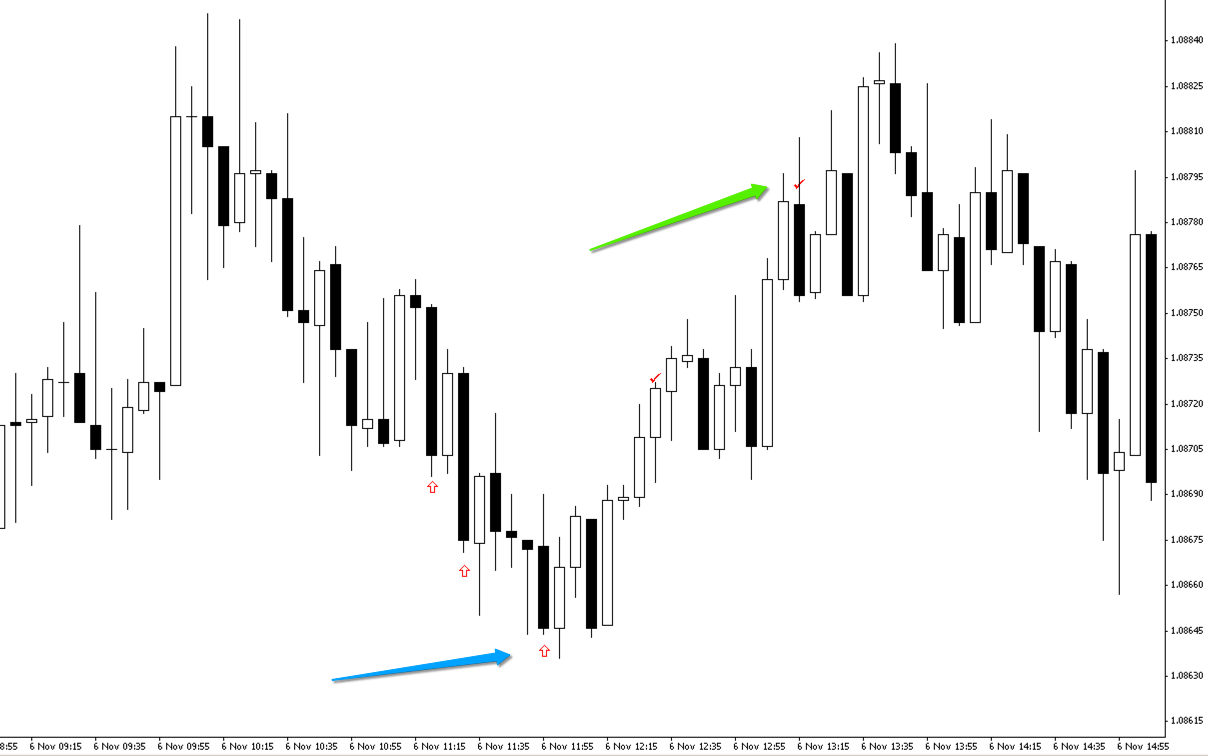
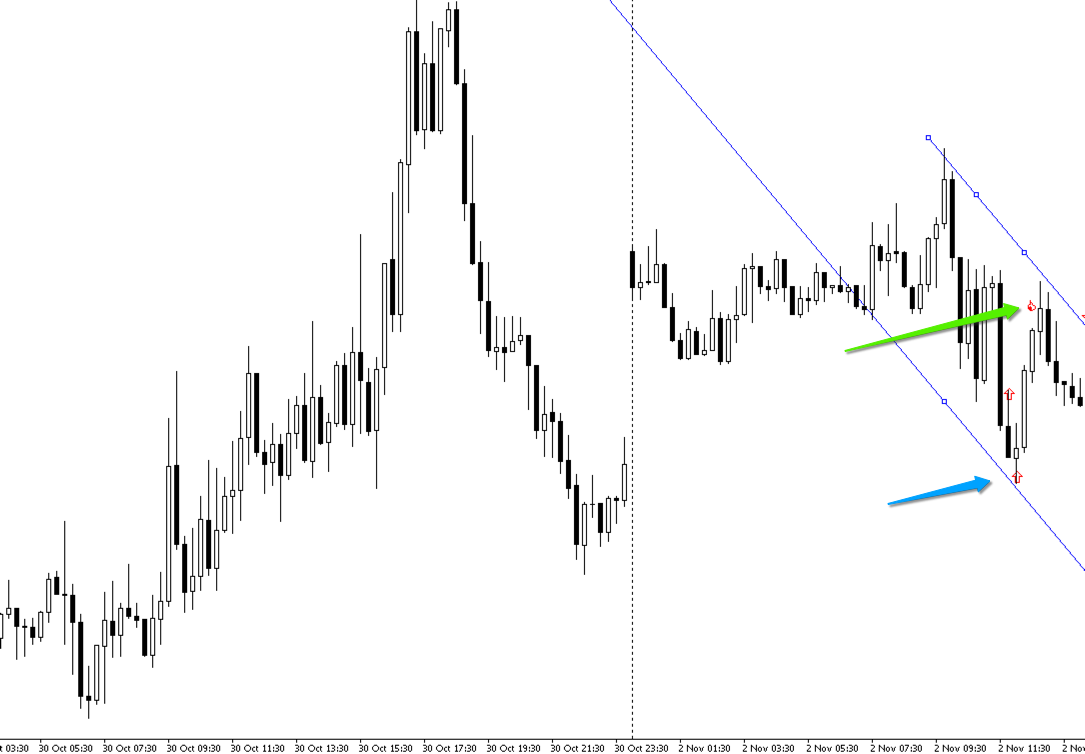
    Above is the 5 minute chart of the EUR USD from yesterday. As we can see, we took a buy at the blue arrow and sold at the green arrow. Actually, we scaled in and scaled out but the result overall is the same. We had done this eleven times over the last couple of days without a loss. However, what I’m about to show proves the need to maintain an overall awareness to what is happening in the market.

    Snip20151107_16

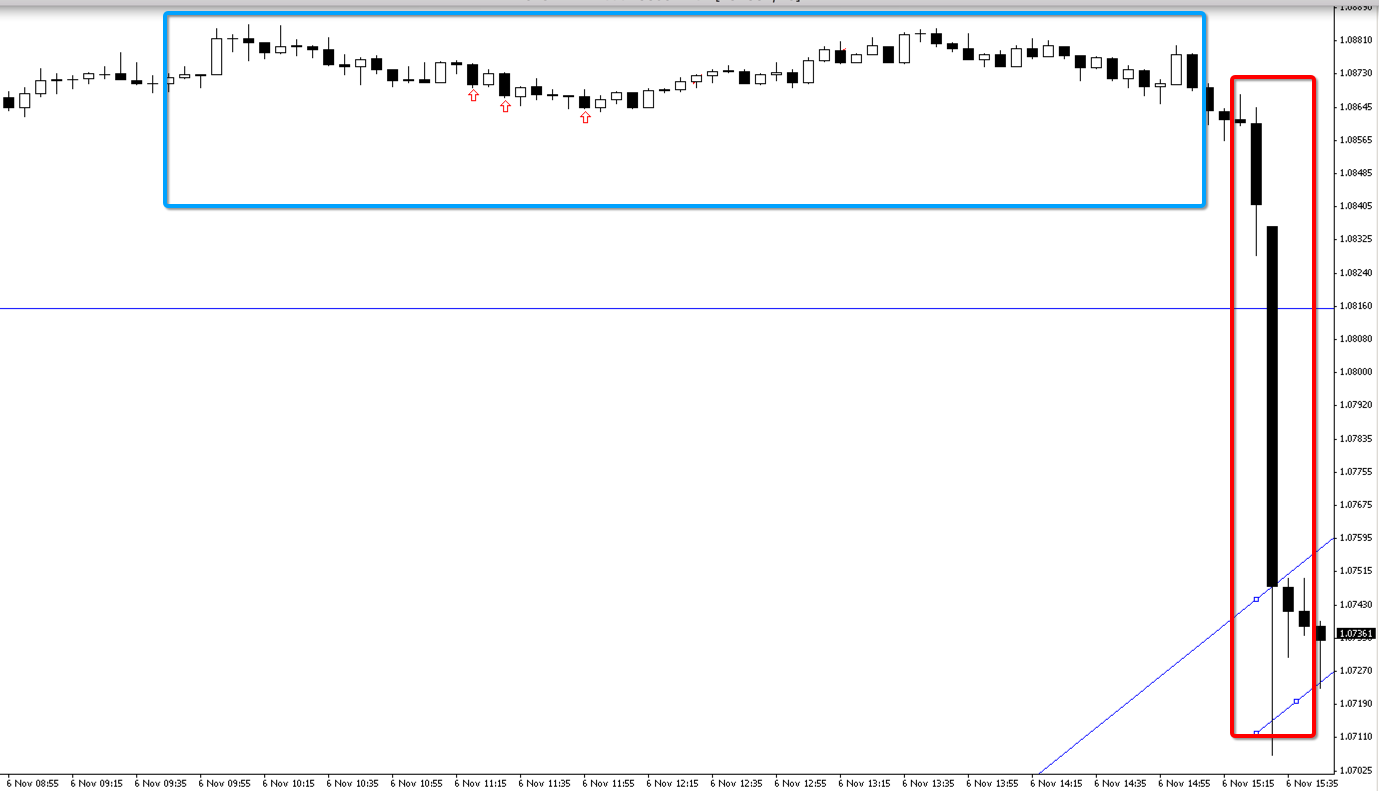
    The blue box above is the same chart information as the first chart. The reason it looks all squashed up is because of what happened a few minutes later: the announcement of the monthly nonfarm payroll in the USD. This large movement distorts the vertical (y-axis). I don’t trade these announcements. They are difficult to predict. Often moving significantly one way only to reverse. The S&P 500 weakened due to the announcement but in the chart above the US dollar strengthened. Also, short or long spreads (the spread is where a broker makes her profit) increases dramatically during these volatile moments. The bottom line is that it is essential to know about these events and if we don’t have a stratergy – stay out.

  • To scale in is sometimes benefitial, but…

    The thing about ‘live’ trading is that we only see the bars (candlesticks) to the left. If I show a chart with the whole trade, the start and the finish, it’s easy to say…”yeh, I would have seen that, no problem.” But without the bars on the right, that is, the future movement already in place, it is, as we all know, so much more difficult. Let me show you an example:

    Here is a chart from a trade I took a couple of days ago based on 5 minute bars EUR USD:

    Snip20151104_2

    We took a successful trade, with a buy shown by the blue arrow and a sell shown by the green arrow. So confidence was high. We considered that the context, that is the stream of bars, is following a tight downwards (bear) channel. What do we do next?

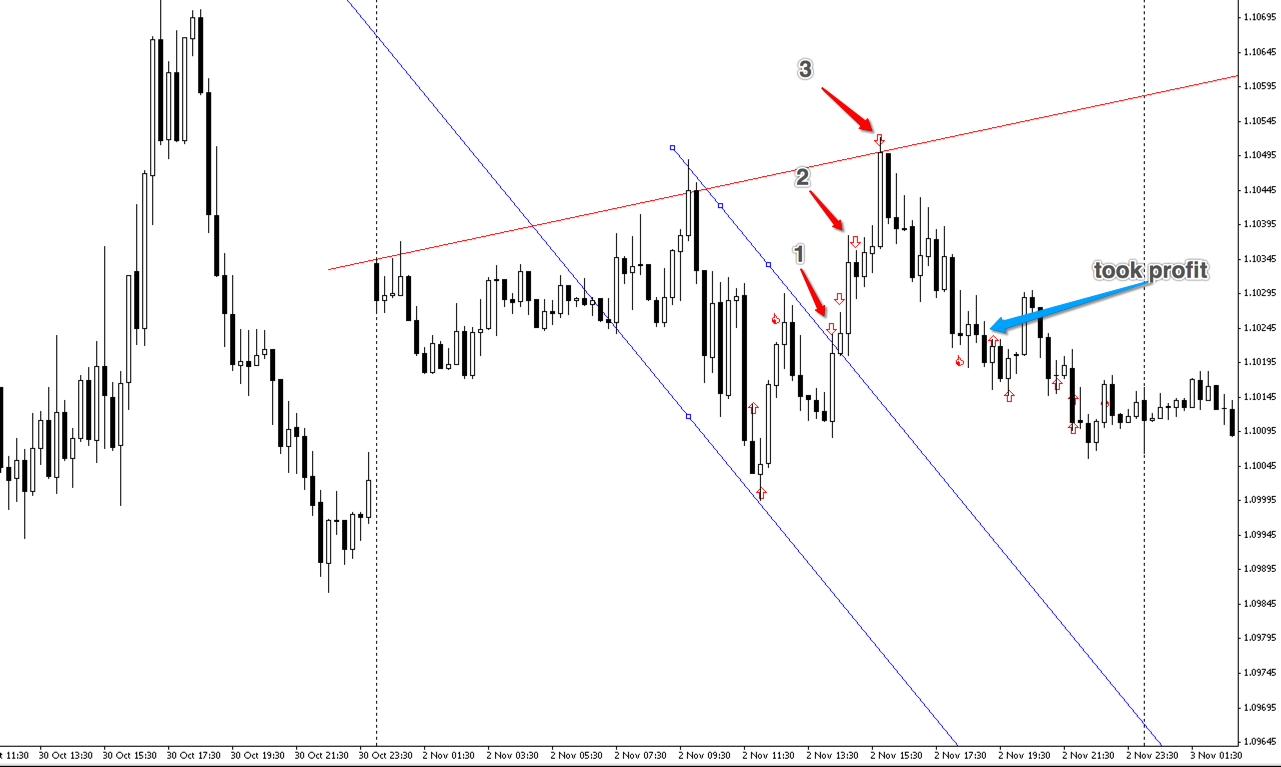
    We consider that if the bars come up to the top of the channel we’ll go short as we have a 60% chance of the trade following the trading range. Here’s what happened:

    Snip20151104_4

    The trade came up to the top of the channel so, as planned, we shorted. We bet that the price would go down at (1). However, the price went up represented between (1) and (2). This, we considered, was an exhaustion spike so we ‘scaled in’ (added to our short) at (2). When the price zoomed up again it was clear price was going for the red line, a higher but different channel. So we shorted again at (3). We had three shorts in place at this stage. (1) was very much out of money, (2) was somewhat out of money and (3) never went out of money. We took profits at the blue arrow with break even for (1) and the others nicely in profit.

    To Scale in requires a large stop (and therefore a large risk) and if we get it wrong, if we don’t read the context correctly, we can take a very hard knock. However, if done correctly, scaling in can be beneficial.

  • Weekly Diary – Slow Trader Fund

    A week of lessons and some missed trades.

    A few areas that I’ve traded this week have been disappointing. Not by judging the trade correctly, far from it, that has been good, but by being stopped out too soon. A novice trading error possibly. It’s a great lesson to take forward.

    Here are the trades in question:

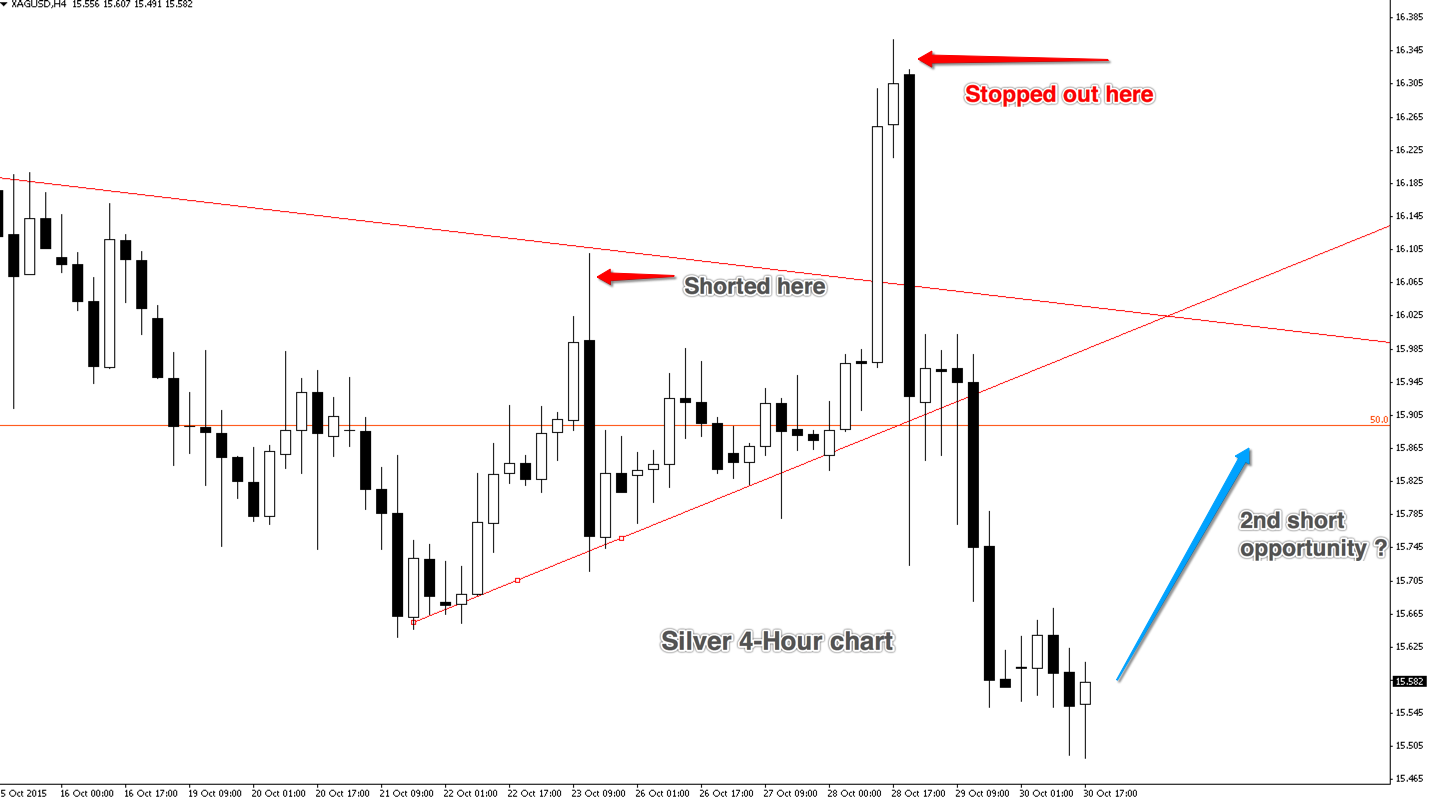
    Silver. We had a good ‘short’ signal for silver. Both on the chart and the COT. The COT was a little early, so I set what I considered to be a good size stop. A stop is the exit point, the point at which we get out and accept our loss if all goes wrong. Notice on the chart below how the price climbed to almost the exact position of my stop. A stop twice this distance with a reduced trade amount was the answer. We may have a second chance if price retraces as I’ve indicated with the blue arrow.

    Snip20151030_13

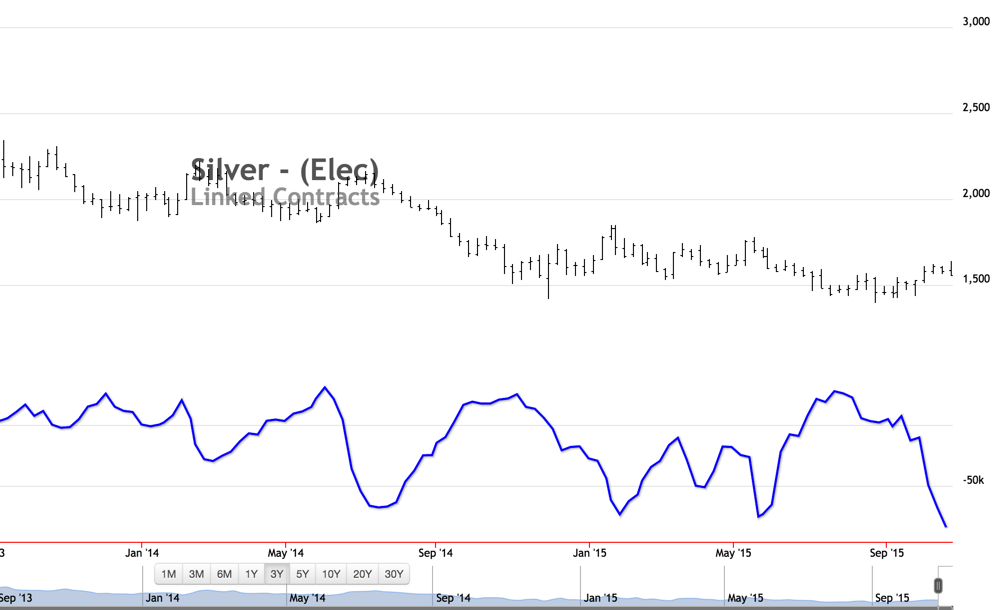
    Notice the COT below for silver. It is at a 3-year low shown by the blue line. Once this turns up, and remember that the COT is big picture only, this will support a short for silver. Gold has also come down with a similar, although not quite so pronounced, COT picture.

    Snip20151030_14

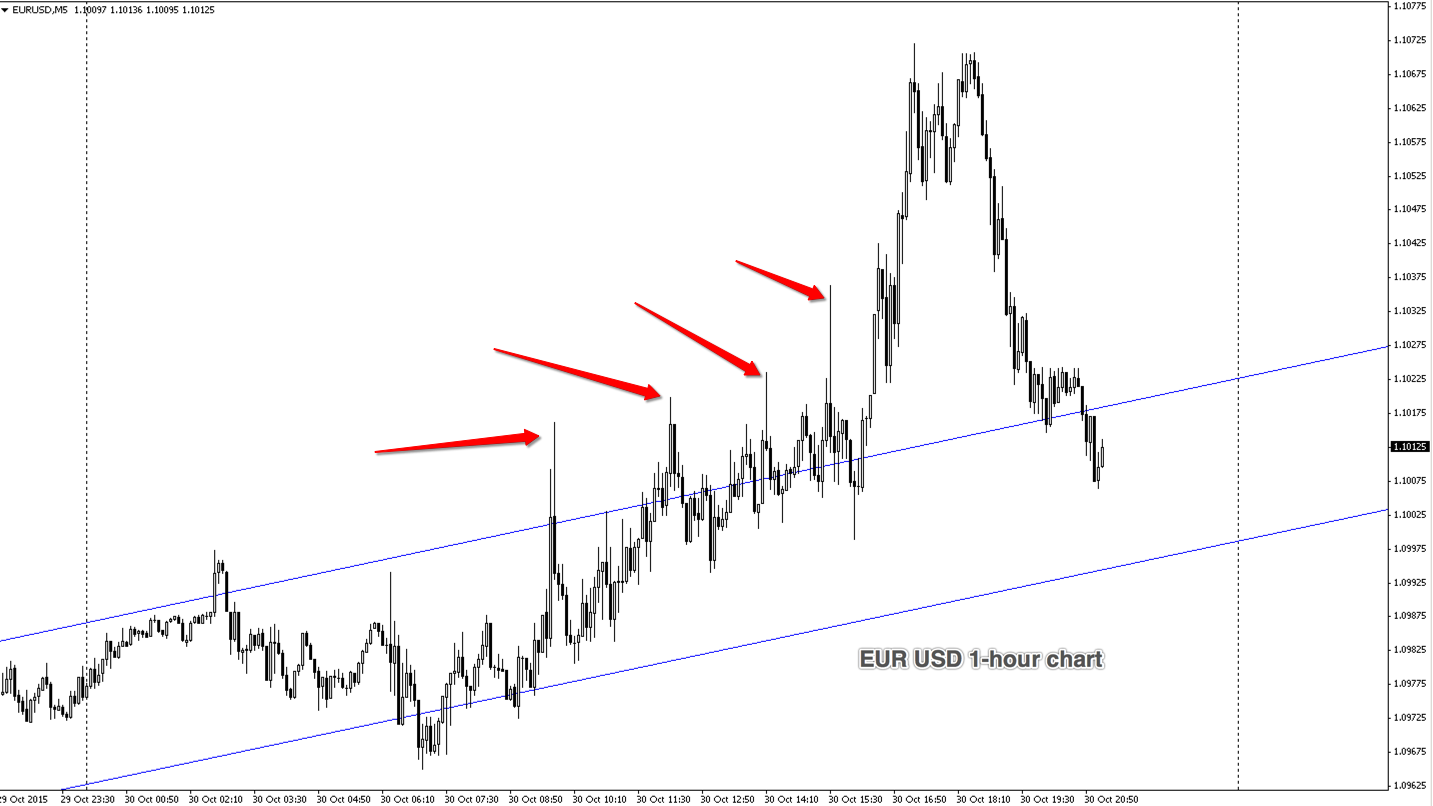
    EUR USD. The currency pairing of EUR USD is one that I trade day-to-day. Notice how volatile this currency has been of late. I have provided the 1-hour chart to illustrate this by showing several recent spikes up.

    Snip20151030_18

    The spikes may not look like much, but to a day trader (trading an intraday chart) they are a challenge. Again a significant stop distance (about 40 pips) is necessary. However, this makes for difficulty achieving a traders equation of 2:1 on a 40% probability trade, which is the minimum requirement for most swing trades.

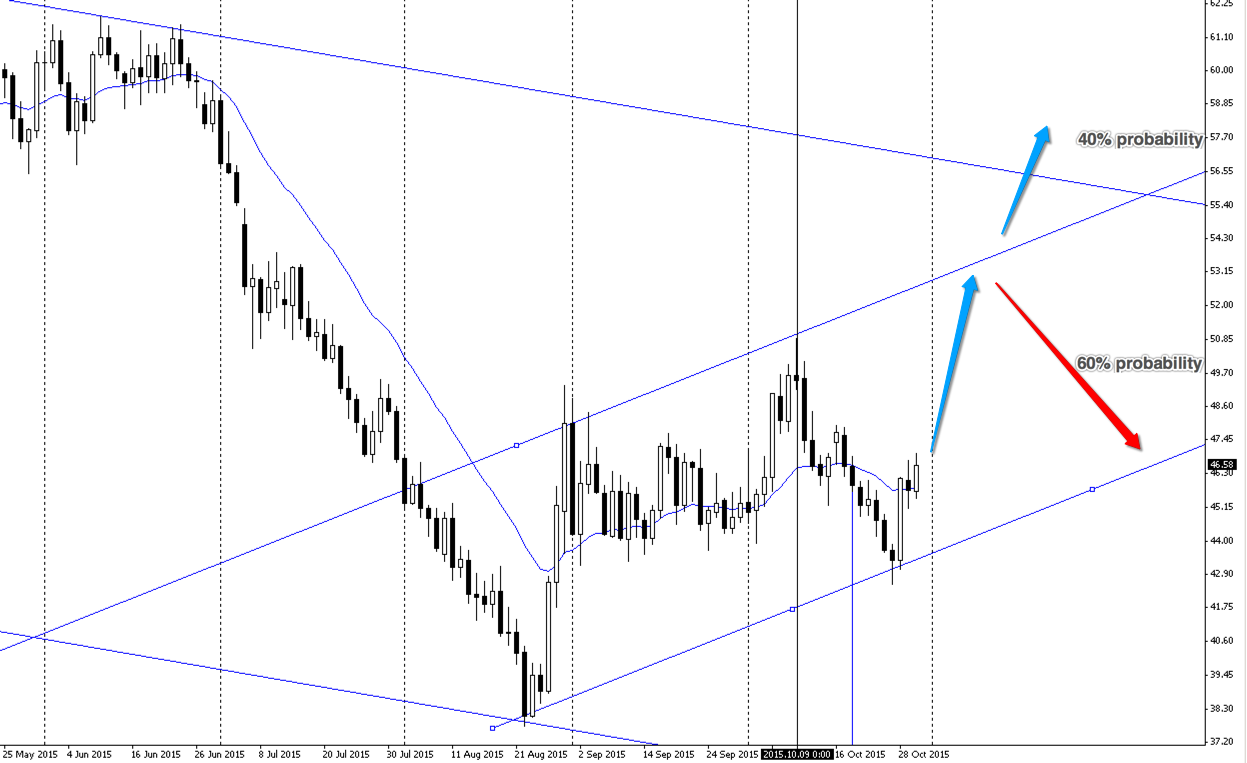
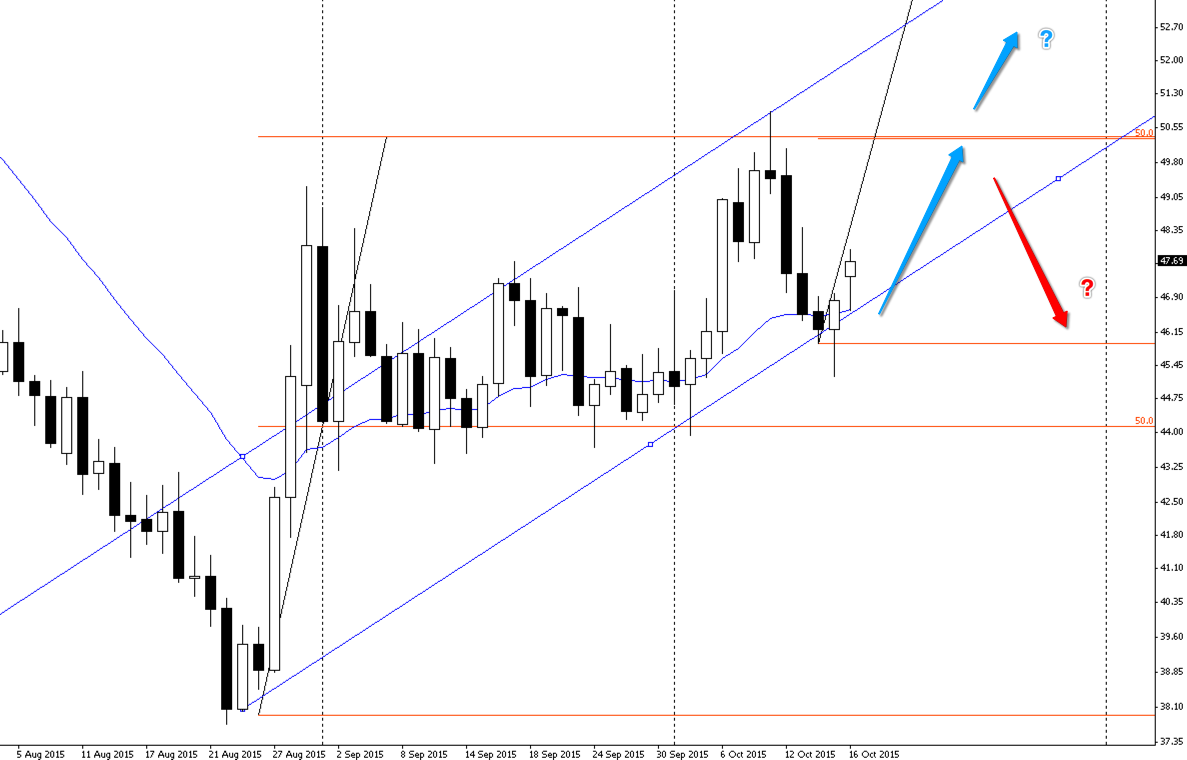
    Crude Oil. A wide trading range has developed for WTI. The Price of WTI moved down to coincide with the top of the first daily breakout. An expected phenomenon . The (buy) signal, although bearish on the daily chart, was good in hindsight; however, I will look for a second entry opportunity to go long if price retraces back to the lower trend line and again provides a good buy signal. After that, I’d expect price to climb to the top of the channel that I’ve drawn with a 40% or 60% probability of ascending or descending respectively.

    Snip20151030_19

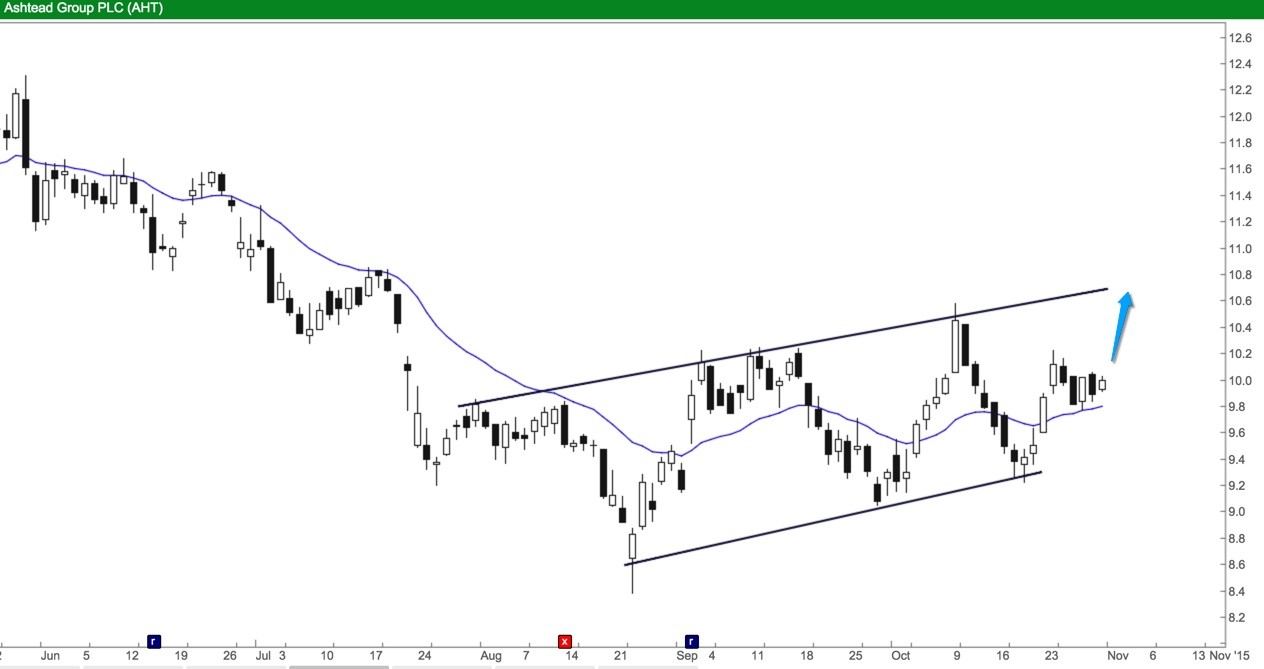
    We remain in Ashtead Group PLC with a target shown by the blue arrow below.

    Snip20151030_20

    Finally, A reminder that Slow Trader values will be provided every first Saturday of the month.

  • Context

    There are many ways to trade. It is not important which trading method we choose as long as it works for us.

    My own method comes under the general name of ‘Price Action’. Simply, this requires the ability to read raw chart information and can be used on all timeframes. Here’s a couple of charts: can you tell the timeframe?

    Snip20151027_7

    Snip20151027_8

    The top chart is a daily candlestick chart of Gold, and the bottom chart is a 15-minute candlestick chart of Silver. The point being that it is not possible to see a difference in these charts without the timeframe along the bottom. Price Action works similarly for all timeframes.

    It is good, however, to ground ourselves on a certain timeframe and use only the neighbouring timeframes for clarification. For instance, if I were to use a daily chart to find a trade then I may venture to a weekly chart for guidance and possibly to the 4-hour, or even 1-hour chart, for final confirmation. But probably no lower. Equally, if I were trading from a 5-minute chart then the 15-minute, or possible the 1-minute, chart may provide some price clarification.

    On another point, the distinctive parts of Price Action are: firstly, knowing the meaning behind each of the candlesticks …yes, they individually tell a story and the greater the timeframe the more defined is the story. Secondly, and more importantly, is the need for context – that is the story that is told by a stream of candlesticks. We may take a trade based purely on context but we would never take a trade based only on the distinction of a single candlestick. Too many trading methods and seminars base their teachings primarily on the story a single candlestick tells, where the real ability is in reading the stream, the context.

  • Weekly Diary – Slow Trader Fund

    Snip20151024_2

    Ashtead Group PLC (AHT) was a good buy for us, so far. The buy was at the bottom of a trading range, as we can see above. This has a 60% probability of climbing to, or near, the top of the range indicated by the target arrow. Of course, there is a 40% probability that the price will break higher from the trading range top. However, we have taken this for a ‘scalp’ rather than a ‘swing’. A swing would be where we would allow the price to retrace before going (hopefully) up higher. A scalp, on the other hand, is generally a movement from one extreme of a range to another without a retrace.

    Snip20151024_4

    The picture for crude oil, WTI, has changed slightly from my suggestion last week. The COT, shown above, only works with some degree of sureness when it is in harmony with the trend. The little turn up, that we can see at the very end of the blue chart line above, represents a downturn in the price. That tiny turn up represents about two weeks of price movement. I like to keep the COT on a 3-year chart as I find this best for perspective. COT, we may recall, is big picture stuff only. And, again, is only to be trusted when in unison with the trend. Which, in this case, it is not.

    Snip20151024_6

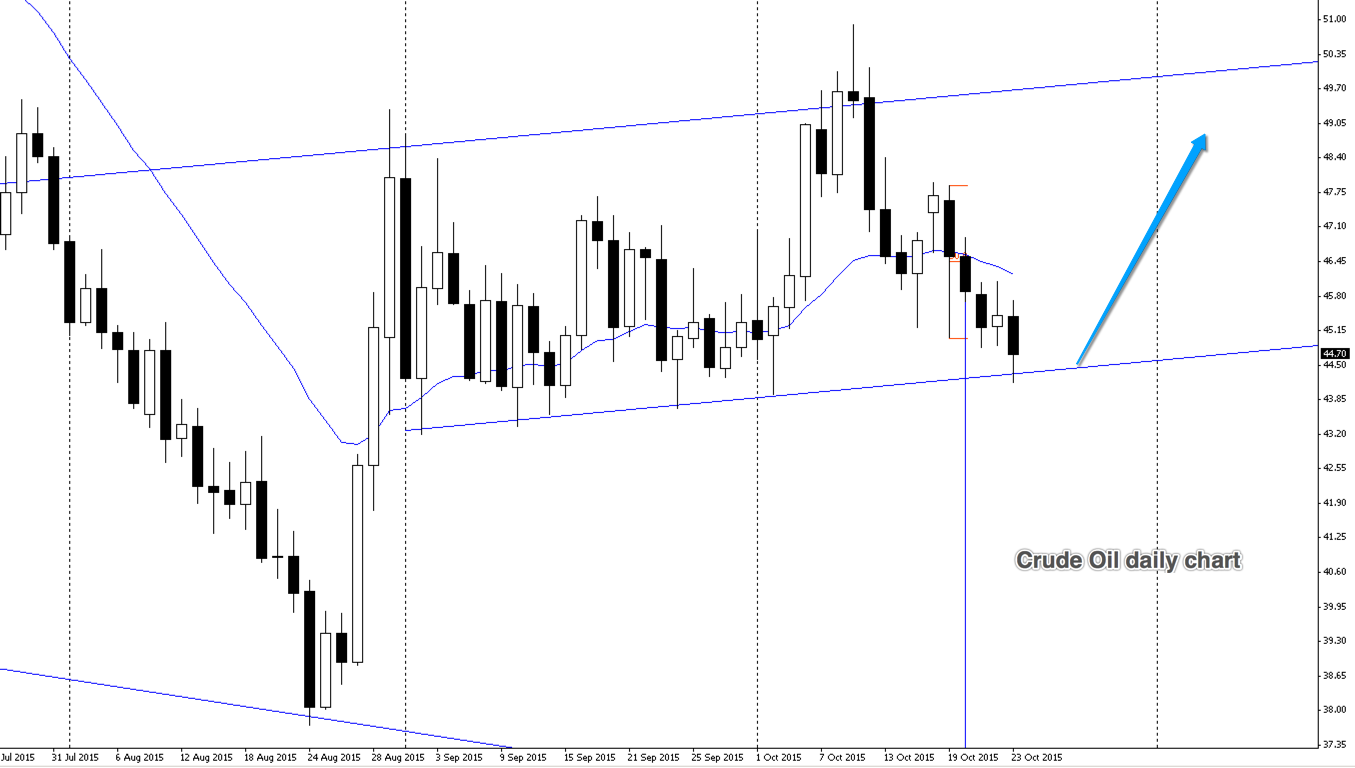
    Above, is the daily chart for crude oil. My own thought, is a move upwards soon, as indicated by the blue arrow, to provide a wide trading range. The price tried to turn upwards last week but failed. For another turn up we will need some price action confirmation supported by the COT.

    Other activities include an introduction of swing day trades on the FX market in EUR USD. In day trading I find it benefits greatly to concentrate on one market. I scalp and swing in my personal fond on day trades. Slow Trader, for the time being, will be swings only in day trading respects. Swings tend to be lower probability trades, about 40%, but have bigger reward potential. They are also less intense to scalps. We will see how this progresses for the fund and, of course, I will keep you posted.

  • Trade with this in mind or buy a lottery ticket

    Here’s a trade by list that gives me an edge. Not only in trading but in business too:

    • Know the rules and follow them
    • Don’t lose money
    • Make a little money
    • Make a lot of money

    Know the rules: good management is the same. One of the primary things that my bank manager looks for, before he will loan to my business, is a management team that knows and follows the rules. This is as important to him, if not more so, than the underlying value of the loaned against asset. In trading it is no different, management of the rules and strategies needs to be clear and followed.

    Don’t lose money: very obvious in hindsight. But in the heat of a trade, patience is not always the first thing that comes to mind. Patience is essential, but not to the point of paralysis. The oxymoron is that losing money is part of trading. After all, trading is a 60% certainty at best. The important thing here is only lose what we judge comfortable to lose. If we lose more than what is comfortable then refer immediately to ‘know the rules’.

    Make a little money: if we work hard to make small amounts of money in trading then the big stuff will come eventually. If we find ourselves passing this part and going straight to ‘make a lot of money’ bit, then we need to quickly refer back to ‘don’t lose money’.

    Make a lot of money: this happens automatically if we do the first three consistently. It doesn’t happen any other way unless we find ourselves with a lucky lottery ticket.

  • Slow Trader Diary

    Slow Trader fund up this week to + 5%.

    To report the fund each week encourages trades to be cashed too early to show a profit. That is silly. Therefore, I propose that the fund be reported, whenever possible, the first Saturday of each month.

    The diary of trades taken, good and bad, and those trades that are on the radar, will be discussed each week as usual.

    These are considerations coming up:

    Crude oil (WTI)

    Snip20151017_8

    We have a buy signal on the daily chart shown above. A 60% probability of WTI climbing to $50. After that the price may descend into a trading range, or may continue climbing for a measured move up to about $55. Whether we hold or not at the $50 line will depend on price action and momentum when, and if, we get there. Also, the COT is in our favour for this trade.

    Gold

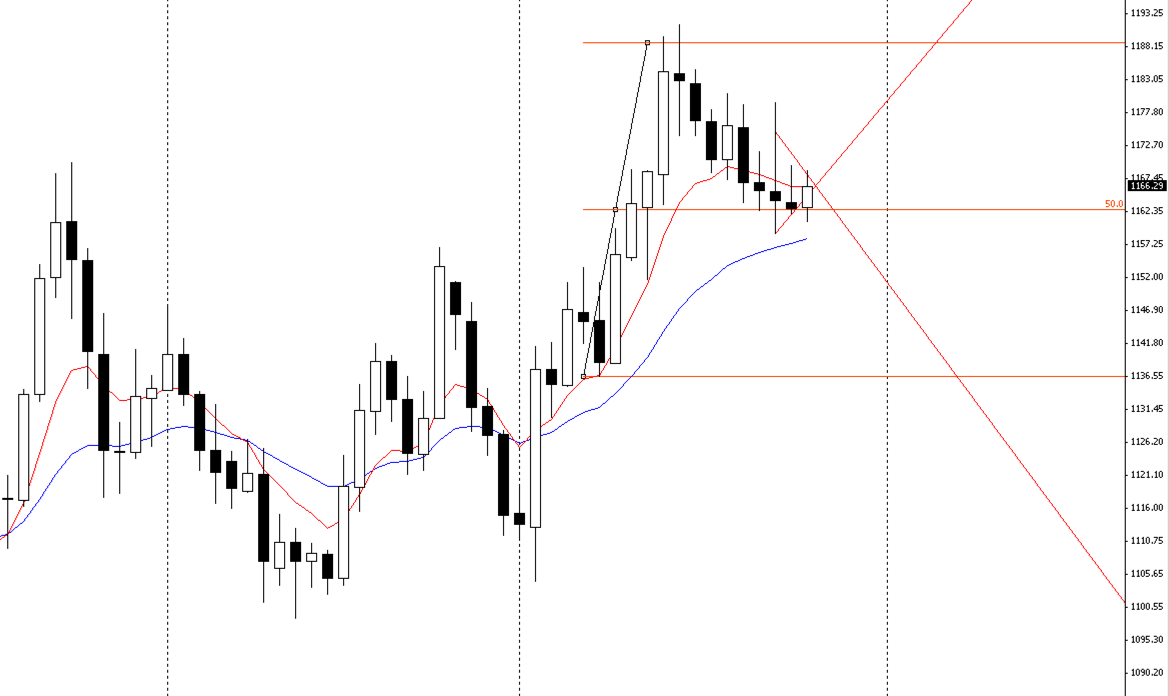
    Snip20151017_11

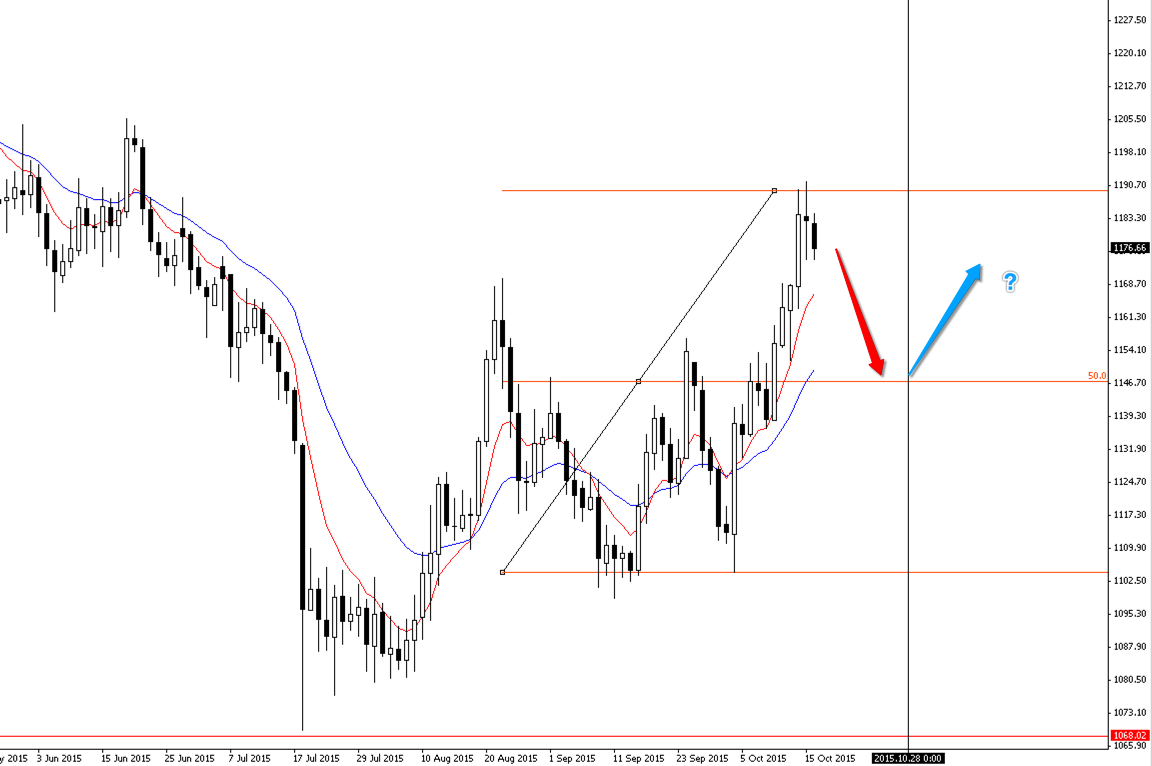
    Gold has provided a measured move up, in agreement with the COT. After a breakout on 2nd October, gold is now in a short term bull trend (a bull channel on the daily chart). It has reached a resistance level, however, and the likelihood is that price will fall back slightly (XAU USD) to $1150. Possibly forming a trading range just above its 5-year low. If this happens, we will look for a buy opportunity if price action and the COT agree.

    S&P 500

    The S&P 500 has broken above the resistance level that we discussed last week. The ratio has now swapped to 60% probability to the price climbing. Indeed, a new high could result in the coming weeks.

    This positiveness in the S&P puts a good light on stocks within the index. We will look for opportunities to buy ‘fundamentally’ good stocks as and when they provide price action buy opportunities.

  • Let the market show its cards first

    Trade the ‘now’ and not try to force the trade to do what we expect, is a worthy consideration.

    We come across this from time to time in most areas of our lives. In trading it happens daily, sometimes several times a day.

    We have a preconceived idea of how something will play out, which is fine, it’s called planning. But when this blinkers us to the flexibility of reacting with the ‘now’ the planning can be detrimental.

    Day trading, more than any other form of trading or investing, brings this out more clearly because of the short time frame involved. By that I mean that the lesson is learnt and understood because it all happens in one day and we can analyze it correctly for what it is.

    In other forms of trading or investing the time frame can be much longer, several days, weeks or years. And this gives us time to reanalyze, rethink, and convince our brains that how it played out was actually our original (failed) plan all along.

    Trading should be analysed and planned, as I showed in my last blog with regard to the possible future price movement of the S&P. But in following the plan, the ‘market’ will buck and fake and keep us guessing. If we let greed take over and we try to force our plan onto the market to squeeze every penny from the trade then more often than not we will not win.

    If we don’t read the ‘now’ signals we will waste a lot of cash trying to force the market to do our bidding.

    To combat this, it is correct to analyze and plan but not at the expense of the ‘now’. By the now I mean the price movement that is happening at this moment.

    Let the action play out, let the market show its cards before we commit.

  • Slow Trader Diary – week 40

    A small move in the right direction, we’re now up by a total of 3%.

    I won’t break this down into broker costs as I think you’ve got the idea of broker costs now. Also, I will only show the percentage gain as a whole number (rather than its actual of 3.74%, as we have trades open and therefore the percentage is only a snapshot).

    Again, this month has been light on trading as the S&P, on the daily charts, is at a junction. Let me explain:

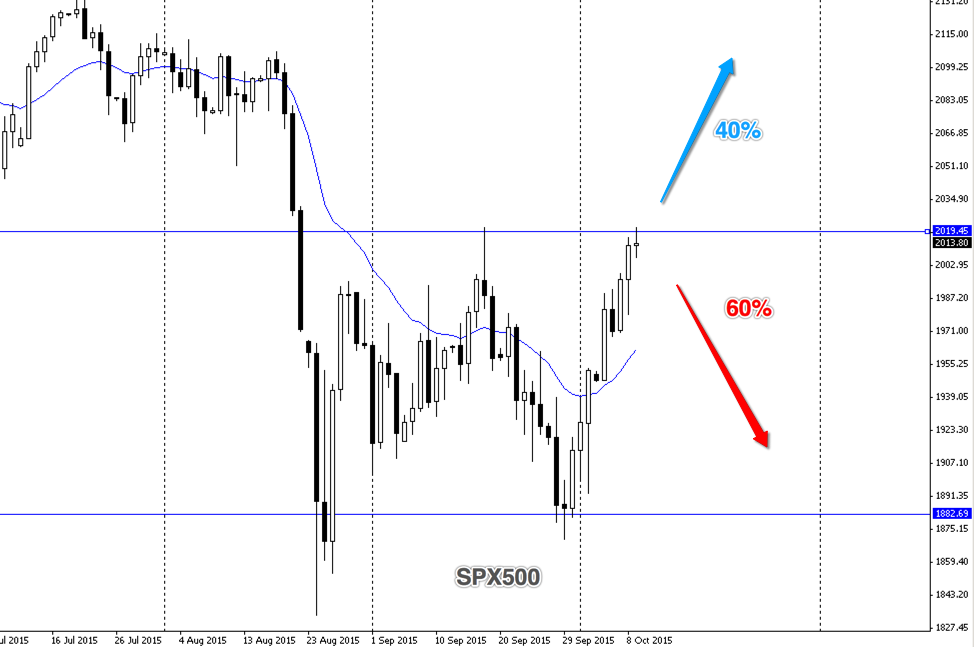
    Snip20151010_4

    The S&P 500 is at a trading range turning point. From here the S&P is statistically more likely to go down and stay within the price range of the last few weeks.

    This is reflected, to some degree, in individual shares within the S&P. And here’s the trading dilemma. We have to be patient and wait for the next move to show itself before we commit.

    Fake moves may also occur that dummy one way and go another. Part of the joy of trading.

    80% of trading range moves will stay within the trading range. Therefore, statistically, we favour a down move at this point. However, a breakout of the range, and a move up, is clearly a probability. A 40% to 50% probability.

    There are many price action techniques that will guide us as to the next move as it develops.

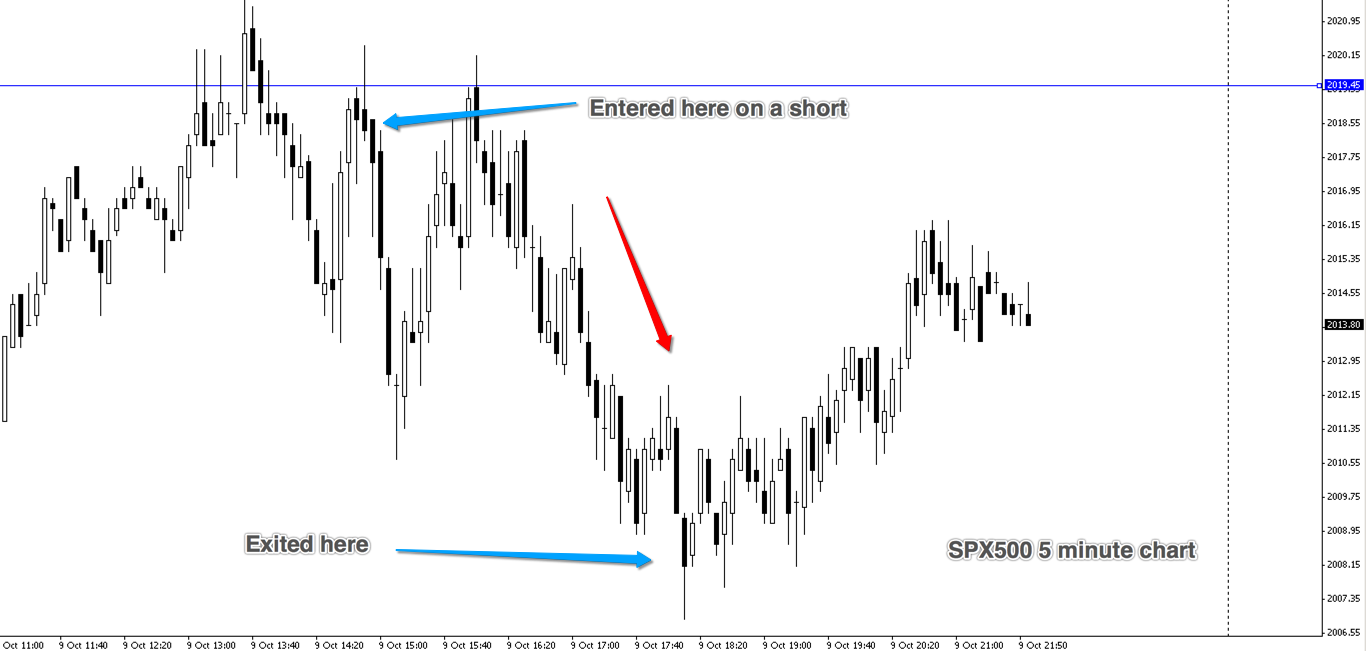
    Returning to the week already traded, here’s where we got our gain. It’s a trade, taken unusually for the Slow Trader fund, on the 5 minute chart. As there was nothing on the daily charts I took a day trade similar to one in my personal fund. Here it is:

    Snip20151010_7

    For those not familiar with charts in different time frames this can be odd. The 5 minute chart immediately above is the S&P price movement throughout a single day shown in 5 minute bars. In other words, the chart immediately above is the price movement within the very last, rather small, bar of the top chart above.

    We made money from the market going down. I’m not saying from this that I’m favouring the S&P market going down, just that for that part of the day we had a 60% chance of the market dropping. So we took it. Our exit was (in this time frame) at a major support level.

    You will notice from the chart above that after we took the trade we dropped to, what I would call, a minor support level. We were in nice profit, and then the market turned back up again.

    This is a swing, and is something an inexperienced trader finds hard to manage. An inexperienced trader jumps ship too soon. Our target was the major support, however, we had to see our profits build – go back to zero – and then build again, as we roller coaster our way to our target exit point.

  • The most important thing is…

    60% probability of success is the best we can expect from a trade. Even if we think it’s a cert.

    If we look at a trade and say, ‘yeah, I think that will definitely work,’ then the probability is still, at best, 60% that it will happen as we want it to happen.

    On the other hand, if we look at a trade and say, ‘yeah, I think there is a chance of that working,’ then it’s a 40% probability.

    In other words, the best we can expect is between 60% to 40% of being right in any one trade.

    Therefore, our reward needs to be at least twice our risk in a 40% probability trade and at least equal to our risk for a 60% probability trade. Each of these make a positive traders equation.

    Striving for trades that give a positive traders equation is the way to make money over a series of trades.

    Achieving a positive traders equation is the most important thing to grasp, and do, as a trader. 

  • Slow Trader Diary – week 39

    We remain just above even. No trades taken this week.

    The week was spent trading small amounts with my personal fund (£1 per point in the currency pairings).

    This gives me the chance to work through, and live trade, many of the lessons from the holiday modules with small risk.

    It would be silly to just jump straight in. Trading is like any other demanding job, you need to work your way back in after a break.

    Slow Trader is daily charts and therefore not day trading; however, the day trading techniques I use in my personal account are the same for slow trader with the daily charts. What I do in one day with day trading takes a week or so using daily charts. However, daily charts are more defined to my mind; and, as I trade much larger amounts through the daily’s, I need to be on my game. Daily’s are my prefered charts.

    Due to the China situation, both the S&P and the FTSE have seen a large drop since August. That will be reflected in individual stocks and shares of course. I am watching the S&P for a turn.

    Snip20151003_2

    Commodities to keep an eye on:

    Coffee price is at a 10 year low. The COT report supports an increase in Coffee but it’s early days. As coffee price increases we can look to see what effect this has on coffee companies such as Green Mountain.

    Gold is at the same price that it was in 2009. Gold price remains uncertain. The COT is a buy and gold shot up yesterday in reaction to the US nonfarm payroll monthly report. From our point of view, however, gold is now a wait and see.

    Crude oil is, as we all know, at a significant low. The COT is at a minor buy stage. However, the trend down for crude is so strong we would need to see an established move up before considering buying. Most amateurs will buy crude thinking it can only go up…..not sure about that one. I certainly would need to see evidence first before committing. Okay, we miss the very bottom and therefore maximum gain, but to try to find the bottom is very weak in terms of probability, actually it’s foolish.

    Currencies:

    Those not thinking that we live in a global economy should have watched the nonfarm payroll at exactly 1.30pm yesterday. The results were not favourable to the US and most major currencies (including the S&P) moved, simultaneously, the price difference of a big trading day in less than a few seconds. Eye watering stuff.

    As a trader the above shows the importance of knowing the big event news item times. I do not trade the news, for me the probability of getting it right is too low.


  • Investing or Trading?

    Investing first:

    Investing is buying into something that appreciates. In stocks and shares, any price increase after about a year is 100% because of the fundamentals: the strength of the books, the management, the continued saleability of the underlying product….to mention a few.

    Most of us have investments in pensions or managed funds.

    Over a bunch of years the market goes up about 9% on average. However, somewhere between 7 to 15 years the market crashes. Timing is everything.

    Moreover, most pension and managed funds don’t beat the market, actually an astonishing 95% of them; on top of that, they charge several percent annually to do so.

    If we need our invested funds, 15 years before would be best, move it into something that is not market based, at least not ‘fundamentally’ based.

    Now for trading:

    Trading is generally over a shorter time frame and is mostly technical based: that is, the reaction of price when price reaches a support or resistance. In its simplest form, it is one person’s opinion (or computers) against another.

    And, as a computer does not have an opinion – it is of course emotionless – that presents the biggest obvious challenge to most human traders.

    Some 75% of trades are institutional based (the big money). The remainder is made up from other entities such as high frequency trading (HFT) systems, large hedge funds and the like. Smaller (professional) organisations and home traders represent less than 5% of the market.

    To be clear, when the (small) professional trader or home trader trades she is up against the institutions – computers mainly – so she better know her unemotional stuff.

    That is probably why few home based traders, particularly lower timeframe traders like day traders, make it. Cheery, eh.

    The one factor more than any responsible for successful trading is – no it’s not luck – is trade management, boring as that sounds. Good trade management always provides a positive traders equation of: risk, reward and probability.

    Without a clear calculation of each of these (and probability is often the one that is missed) then we are not trading but doing something else…gambling, maybe.

  • Slow Trader Diary – week 38

    First diary post after being away for some three weeks.

    We are 2% up overall. The only trade left open while I was away was gold. And, although we are still open in gold, its current position nudges us into the positive.

    Let’s review: A while back, October last year, as you know, we took a double hit when the market dropped and then dropped again against all indicators.

    This brought me to change my trading technique. I went from indicator based to price action based. How to best explain these? Indicator based is like painting with numbers; it’s never going to be independent but is generally steady. Price action is blank canvas stuff.

    To get good at price action is like the artist. It doesn’t happen overnight. There is a lot of effort and practise put in along the way. But, as with the results of an artist over a paint with numbers person, the results can be outstanding.

    Lets do some sums:  if we start with £100 and gain £2 that’s obviously £102, a 2% gain.

    The simple mathematical issue with losing money however is this: if we start with £100 and lose half (50%), making our new amount £50, then to get back to our original figure of £100 we need a 100% increase.

    To be clear, if we lose 50% we need to do 100% to get back to the start.

    Sorry for the oversimplification, but I feel that we all forget about the importance of not losing money (particularly when trading or investing) because of the doubling effect shown above.

    And that is what I have had to do with price action since October. Where a 2% increase for the investor is unexciting, for me, the trader, it has been because I’ve had to nurture the fund up with a large increase to get back to the beginning.

    I love the price action way. So much so I managed to get about 50 hours of price action concentrated practise done through dedicated modules while I was away. That’s the the same as a pilot having to do time in a simulator. It’s necessary.

    I continue to run the fund primarily with daily signals reported weekly.

    Of note, I have three separate funds: a small fund for the grand kids (something most of you are looking towards slow trader to do) which I use weekly charts for; Slow Trader fund with which I use daily charts; and, a personal day trade account with which I use 5 minute charts.

    Price action works the same on all charts regardless of the time frame. I would not have more than one fund account on the same timeframe, too confusing and with intraday (day trading) is absolutely necessary. But separated this way they work well together.

    Next post: what makes it investing, trading or gambling?

  • Slow Trader Diary – week 35

    We are open with gold.

    Broker charges for the week were a credit of £9.48.

    Here’s our gold trade:

    Snip20150829_1

    Our target is in the region of 1212. This is in-line with the COT and if the present Up continues it will nicely form a recent Up (or recent trend upwards). However, as we have seen this week, the market remains volatile.

    Of the other trades we considered earlier in the week:

    Silver moved down lower than expected, did not provide price at a level I could determine. So no trade.

    Snip20150829_3

    NZDUSD remains a possibility to go up briefly. But it is presently stable below its low of recent weeks. It may move up soon. However, this is an advanced trade as it is against the big trend and is without a recent Up.

    Snip20150829_2

    GBPUSD, having been quite stable through the initial turmoil of the week, just blew down. It may turn at the 15350 region or continue down to as low as 15190. I’m less convinced of this trade. It has, for now, become choppy which always makes for a difficult read. The COT is still a buy but is weakening, we do not have a recent trend, although the mid trend remains up. Only excellent (daily) price will convince me to take GBPUSD at the moment.

    Snip20150829_5


    EURUSD is approaching our predicted bounce point. However, the COT is about to turn and we are all aware of the volatility presently associated with the EUR. My own thought is that the bounce could happen but it will be short lived. Price may turn down again before the previous high thus establishing a recent Down (or recent down trend).

    Snip20150829_6

    WTI, or crude oil, bounced off its lower stop this week. This move is gently supported by the COT, nothing dramatic for the time being. Too early to decide, but it is on the watch radar now.

    Finally, the S&P and FTSE have moved up slightly, but the roller coaster might not be over yet.

    As I’m away for a few weeks the next diary will be 26th September.

  • Wonderful opportunities

    Difficult times in the trading business for the longer-term investor.

    Wonderful opportunities for short-term swing traders, if we get it right.

    I sat on the side lines as the markets slipped recently. Unable to take advantage of shorts (trading the market to go down) as it all happened so suddenly. The large dips in FX (foreign exchange pairings) occurred, in those I monitor, within a minute.

    There are after shocks, so timing any recovery is interesting. Those that I will consider are:

    Snip20150826_35

    Silver. At some point soon I consider Silver will rally, short term. However, recent Up (or recent trend) is against us so a buy to go up becomes an advanced move, meaning the buy signal needs to be clear.

    Snip20150826_36

    NZDUSD is firmly down on the long trend. The COT is a buy, but we have to be careful with the COT signals when the COT is going against the longer trend; the COT, in this instance, still often works but can be short lived. Having said that, there is a (possible) short term buy opportunity here.

    Snip20150826_37

    I’m looking for a buy in gold at about 1125 price with a good buy signal. Catching the signal with the correct buy: on-market, on-limit or on-stop is key.

    Snip20150826_40

    GBPUSD has been relatively stable over the last few days. A retrace to the 21-day moving average (MA) is worthy of consideration. It may happen quickly, if at all.

    Snip20150826_41

    EUR might strengthen again soon against the USD. Unless I get (daily, or, at a pinch, 4-hour) price action at a support level I will not take this until about the 1120 level.

    Snip20150826_44

    Finally, the S&P 500. This, I find, is possibly the most difficult to judge. With the recent dip the S&P could provide a good gain on a bounce. A buy in the region of 1836, but could go down further to the 1770 region. Good price action, or whatever is your chosen price criteria, is important here.

    Lower trade values and generous stop positions are considerations when volatility is high.