Blog

  • The stabilisers have to come off, eventually

    Who takes up retail financial market trading? I initially imagined that it would be young adults, the ones we see on the sports betting adverts, but I was wrong. It’s primarily professional people: engineers, doctors, dentists, lawyers and well-to-do retirees. But unlike our usual work, we struggle to be successful at financial trading.

    Because, unlike our usual work, we are now dealing with uncertainty; and in this world, because we don’t understand the future, it is not possible to work rationally. To overcome this we look at the future by naive projection of the past.  We are now in a world where 60% certainty (if we’re very good) is as good as it gets. We therefore look to a method and indicators to help make what is irrational seem more rational.

    That brings me onto the decision of how to trade. The ‘how to’ question is probably one of the most difficult and important decisions a financial trader makes. However, as with choosing a career when we’re young, we do not have the experience to be sure we are making the right choice. Therefore, we are overly influenced by those around us.

    In trading we tend to go with the method that we learnt from the first seminar we attend. We try that to the point of financial exhaustion and either quit, or if we’re particularly determined, we will venture to try another seminar and another method. And so the cycle continues until we achieve expert or get lost in the ‘dip’ somewhere.

    With a little thought it does not need to be so difficult. We first need to find the broad category of trading method that suits us. If we stay away from the ‘get rich quick’ merchants (those advertising the secret or ‘the one thing’) then there are a lot of excellent tutors available.

    We do need to find that broad category first however: no point in learning chess when what we really enjoy is the simpler pace of draughts (checkers). Once we have that broad method that we determine is the one for us, we can then go to work on the finer detail.

    It took me a long time to find ‘price action’ as my prefered trading method. I notice also, looking through the internet, at great beginner introductions to price action that are available. Many however provide confluence ideas of price action with indicators: moving averages, Fibonacci retracement, stochastic overbought and oversold to mention a few.

    That’s fine, we all start with all of these; they’re supports and we feel, and were told, we would be foolish to attempt to trade without them. However, price action is much more than this (or I should say much less because with true price action indicators are a distraction at best). Once price action is learnt we can deal very well with the irrationality of it all and we can strip away the supports. After all, even Bradley Wiggins, probably earlier than most, had to take the stabilisers off at some point.
  • Reward/risk has to be right

    Rather embarrassingly on my part, I discovered something simple but fundamentally wrong with my trading. I made the adjustment today, and amended the ‘algo to trade by’ page. Even a tweak, if it is a fundamental tweak, can make a profound difference.

    As in many things, but I feel particularly in trading, I cannot be so keen on my backtest work that I’m not prepared to take a fresh look once I’m in the trading room for real. As Yogi Berra said, “in theory there is no difference between theory and practise; in practise there is.”

    My foundation is my reward/risk, or what is referred to as R. To achieve a planned 2R (actual R can be much better) means that my planned reward is twice my planned risk. I had the minimum acceptable R as too small. Again, in theory (or backtest) it’s fine but in practise – often with a less precise entry point and a variable spread – working with less than 1R is not viable for me.

    I call a 1R a scalp and a 2R a swing. My strategy, because of my abundance of less than 1R scalp opportunities, was scalp/swing. And this provided me with few swings. Moreover, the scalp element (less than 1R) required an 80% (win/loss) success rate to see accumulation of reward.

    Changing to swing/scalp and limiting scalp to not less than 1R is greatly preferable. Profitable scalp percentage is now 60% – still high but that’s the issue with scalping. And the swing percentage to be profitable is 40%; anyone suggesting less does not have a spread to contend with (prop trader rather than retail trader) or they’ve ignored it.

    To a non trader this all seems a lot about nothing. But it’s like a golfer playing a match without the long clubs and therefore having to take too many hits on the par 5 holes.

  • Downside, like Steve Jobs

    Let us chat strategy for a moment. Wikipedia says strategy “is a high level plan to achieve one or more goals under conditions of uncertainty.”

    Many that provide trading strategies have it wrong. What they are actually providing is a way to trade, or a  method, or a system. The way that I trade is contained within my ‘algorithm to trade by’ page and this is something I tinker with all the time. (I call it an algorithm so that I keep in mind that I’m up against algo-trading which is unemotional, timely and precise).

    What I don’t tinker with, however, is my strategy; well, at least not without a great deal of consideration. A strategy is to be clear:

    • Multiple swing
    • Swing
    • Swing/scalp
    • scalp

    (traders interpret a swing and a scalp differently, see ‘algorithms to trade by’ in the paragraph clarification)

    I may use a multiple swing strategy for very long-term value investing such as with Nick’s top FTSE 350 shares; a swing only strategy is perfect for intermediate traders or experts not intraday or unable to watch the trade; swing/scalp (my passion) is the full-time experts choice; and scalp only is, well, a difficult strategy because of the often poor reward/risk ratio.

    As I’m a swing/scalp strategist I also sub-divide that strategy into swing/scalp or scalp/swing; taking the first more determinedly than the second, but that’s for another time.

    Each strategy requires little understanding, just rationality in comparing two outcomes (price up, price down), exercising the better option and holding for the desired target. I get out at break even if my algorithm tells me to. It’s about control of the downside and then about the maximisation of the upside.

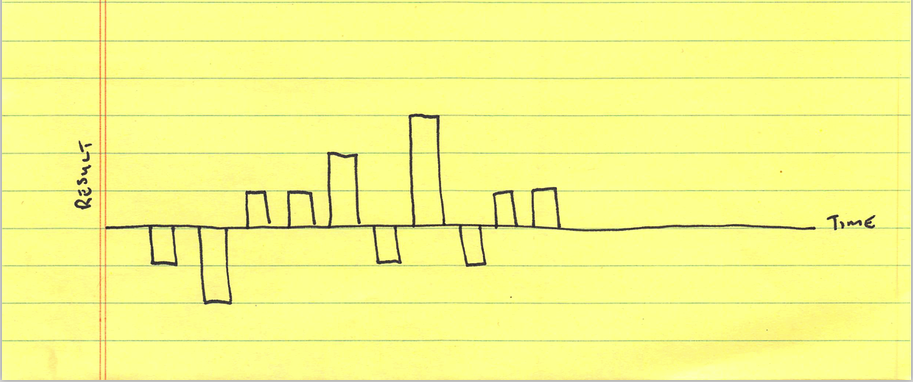
    The first sketch below was used by Steve Jobs at one of his presentations to show how he took (many) minimal downsides before he eventually got the big upside.

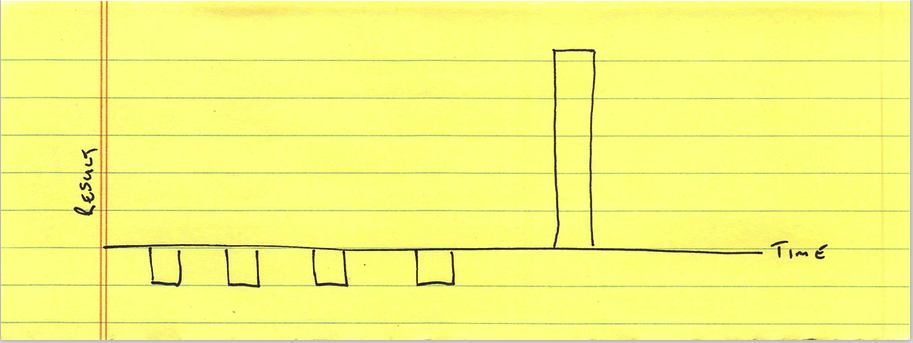
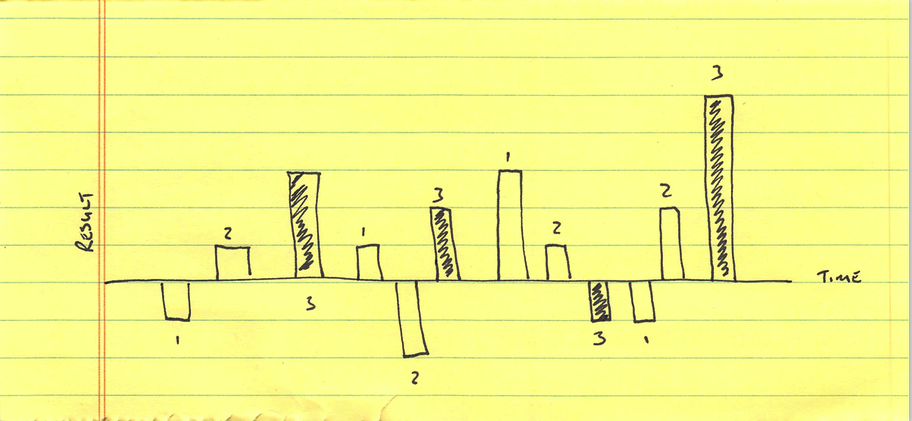
    The same is for good trading. The next sketch might represent how much was made or lost each year with a longer term investment. If we checked the results, say, every three years we would only once see a decrease in our year on year portfolio results, therefore minimising emotional drain.  Each blue horizontal line might represent a £1,000 (or multiples of) year on year profit or loss.

    Finally, a sketch of a day traders result for the day. A single blue horizontal line up or down represents a scalp win or loss; two horizontal lines is a swing. The bar with three horizontal bars up was a swing that was entered early and provided the extra profit. We should never see more than two bars at any one time to the downside. Each swing and scalp, therefore each horizontal blue bar, is the same in value whether the scalp was 10 pips or 30 pips. Each horizontal line represents the traders risk. A traders risk (each horizontal line) might be £60, or £600, or £6,000 – or any figure in between – depending on the traders account. But it has to be consistent.

    The point here is that any downside (for the sake of emotional drain and our pocket) has to be known, acceptable and controlled. This is something most of us don’t understand when we start out. Steve Jobs understood this and he did okay.

  • A sucker game

    A point worth serious thought from Nassim Taleb from his book “Antifagile: things that gain from disorder”.

    Yes, he creates, I think, an appropriate new word (antifragile) to help get his meaning across. In one area Taleb presents his argument on medium risk (referral to a financial portfolio) and how he considers there to be no such thing as “moderate” risk.

    His point is that in the event of a “Black Swan”, that is a catastrophic negative event, then all – low, medium and high – risk is going to get hit. (As an aside, I consider that a negative Black Swan, to an expert intraday trader, can become a positive Black Swan).

    Fully committed to a “moderate” risk account is, actually, at full risk; at best, this provides medium upside potential but with all the possible downside. That is because medium risks can be subjected to huge measurement errors.

    Taleb points out that: rather than being fully committed to a “moderate” risk portfolio (and in the event of a negative Black Swan, a potentially emotionally draining experience); better to be 90 or 80 percent in a boring, inflation proof, no risk cash (or: bond, cash, share mix – my words) account and 10 to 20 percent in a very high risk account. (Taleb uses 10 percent very high risk, I’m simply following Pareto’s law)

    The 80/20 example means that we have little downside – assuming that 10 to 20 percent downside is acceptable – whilst still exposed to massive upside.

    To finish, Taleb writes: “Someone with 100 percent in so-called ‘medium’ risk securities has a risk of total ruin from the miscomputation of risks”…..”that in fact is a sucker game”.

  • Nothing to lose

    I hear this a lot in sports “I’ve got nothing to lose….”

    But it does work. It is obvious in tennis, a sport I watch whenever I can. A game, for example, that is closely matched but the score, not reflecting this, has one player up a couple of sets. Often the opponent with “nothing to lose” at this point turns the match around.

    This is a mindset that I use in trading but in a different way to our tennis player. Let me explain:

    If I were to use the sporting analogy in trading, that is, I’m on the ropes and nothing to lose, it would be the way of the gambler. No planned consideration from the outset of probability.

    The participant in our tennis analogy starts out risk averse but then with “nothing to lose” relaxes and wins low probability shots. The opponent that is two sets up, looking for the final set to win the match, goes the other way only taking high (predictable) probability shots.

    Unlike our tennis player friend, the expert trader has a planned “nothing to lose” attitude from the outset. The (retail) trader does not have to return every ball. We can wait to take the high (obvious) probability trade when we know our opponent is wrong footed. When we do take the low probability trades we do it (staying with the analogy) at a crucial point in the game where the reward is many times the risk.

    In other words: “I can only lose a relatively small portion of my funds with each trade. With low probability trades my wins are a few times greater than any potential loss. On high probability trades I’m selective with my entries.”

    With this in mind, and with lots and lots of practise, I can be properly confident and relaxed, over the longer run, because I manage probability, … nothing to lose.

  • Slow Trader fund to a corporate CFD trust account?

    A few words going forward regarding our ‘Slow Trader’ fund.

    As our fund grows I’m looking at its future organisation.

    I’m considering moving the fund to a CFD traded corporate trust account, nominated as a hedge fund.

    If we were to do this we still wouldn’t pay stamp duty, but we would pay capital gains tax.

    Shares within the company would reflect the share distribution of the fund. Any losses would be tax-deductible.

    It’s important that we retain the ability to hedge (trade long and short), and are able to trade intra-day in our present selection of forex, commodities and shares, from a platform I’m familiar.

    Some technical stuff: A CFD, a derivative, satisfies this requirement. CFDs have a spread on forex and commodities; shares are commission only, no spread. Which is all good for us. Moreover, CFDs are traded on margin with a provision for guaranteed stop orders.

    A private limited company for such a purpose would be relatively easy to manage and report. I will let you know on this and seek everyones thoughts after I get further clarification from my accountant.

  • Law of large numbers

    In all forms of trading – whether it be short, medium or long-term trading – there is an overwhelming tendency to take winning trades (incorrectly) too early – that is before target, and to allow losing trades (correctly) to go all the way to our stop-loss.

    Psychologists would, I’m sure, have a good explanation for this. But it does cause a disproportionate problem for the trader. If we are trading correctly, as a casino, then we are looking for the accumulated positive smaller percentage over the longer run and after the many win, lose and break-even trades have been accounted.

    That casino percentage is quickly taken away when our losses are often greater than our wins. Therefore we have to develop a very clear ‘don’t touch until target’ strategy.

    Easier said than done I agree. However, we manage it with our stop-loss position so clearly it must be possible with our target position too. Within my “algorithm to trade by” page I’ve set myself very clear rules that prevent me (emotionally) from taking profits early without a predefined strategic reason.

    To be consistently profitable it helps to have the ‘law of large numbers’ batting for us.

  • Longer-term, should we consider North Korea et al

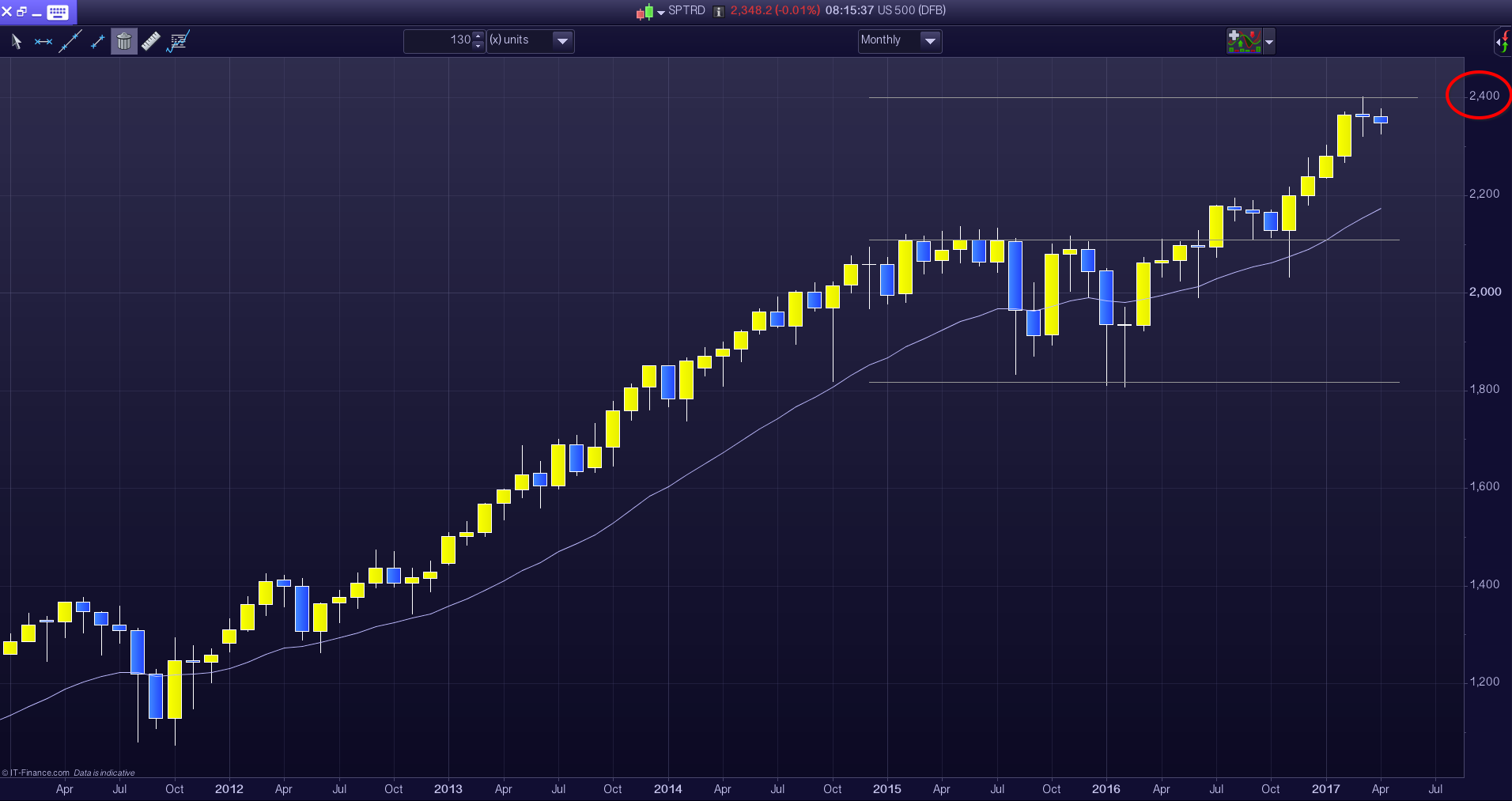
    A reminder that we periodically take a look at the US 500 chart (or S&P) to get a feel for what our chosen FTSE 350 companies may do.

    We use the US 500 and the FTSE 250 charts as the FTSE 100 is, we feel, more driven by the large commodity companies and therefore does not provide us with a platform to judge the non commodity companies within the index.

    Even if this were not so, we’d still consider the US 500 as a good indicator of not only the associated 500 companies but also of companies within the FTSE 350.

    The US 500 is at a big number position which often has an effect on the chart. Moreover, we have a measured move up to its present position from the 2014-2015 high and low. It would seem also that we are in for a consecutive ‘bear’ month. (The bulls go up and the bears go down).

    The strength of the bulls however would, to my mind, not bring the chart too far down at this stage. I would consider any pull back to be a flag rather than a major reversal. Possibly the next 2 to 3 months may see a pull back. This, I think, will probably be bought by the bulls and the market pushed back up to the high of the big number again.

    On the daily chart this will create a more significant double top. And this in itself may be strong enough to create a major trend reversal which will start on the daily chart and follow through to be measured on the weekly and possibly the monthly chart as a reversal.

    Where would the reversal go? Back down to the 1800 position and at the low of 2014 to 2015.

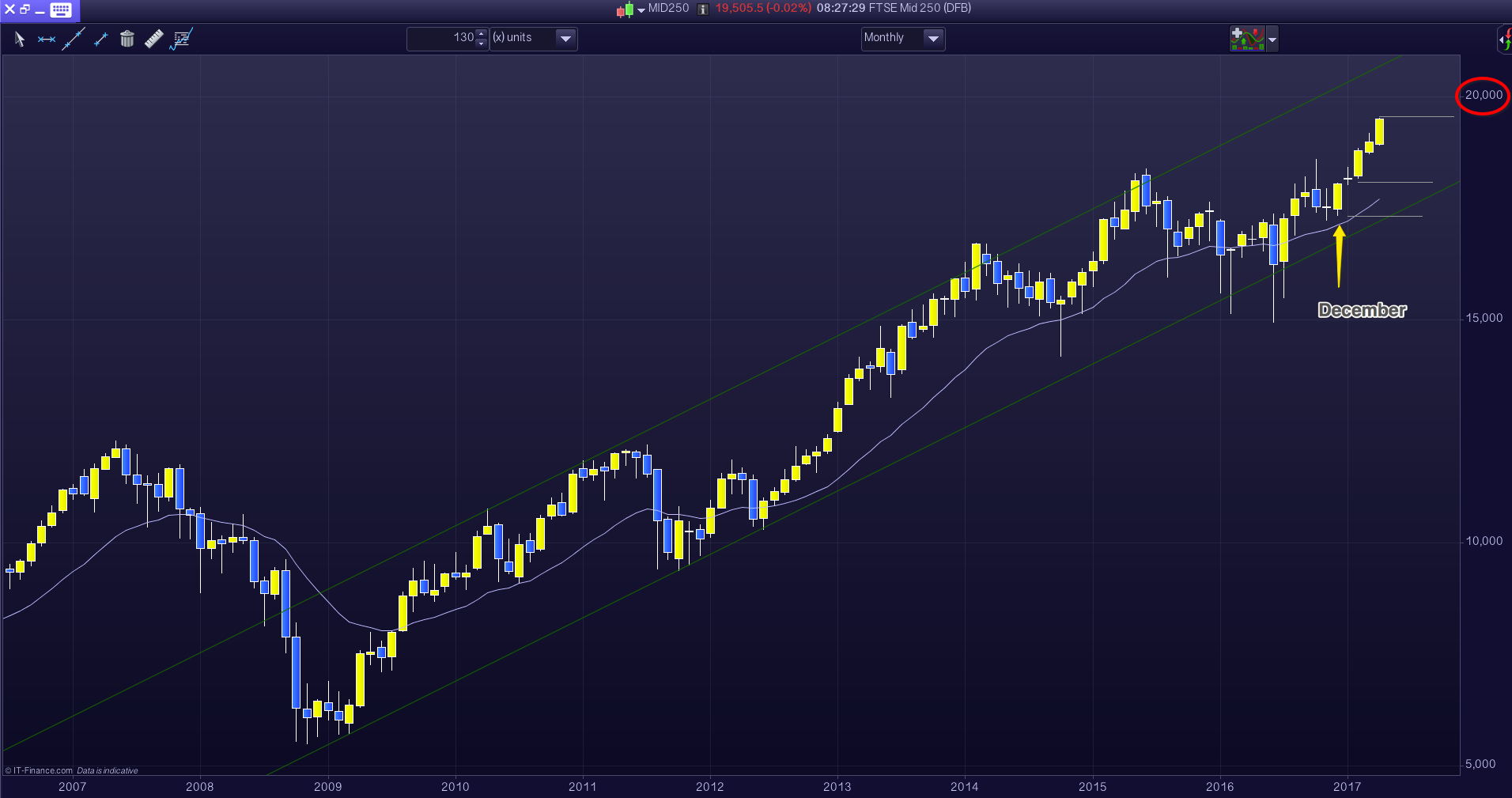
    Lets now take a look at the FTSE 250 monthly chart.

    The chart has been in a tight bull channel for some time. Of note, I would have bought the December close anticipating a swing target that is at, or almost at, the present high. This high is still short of the top of the channel but it is at a measured move position and almost at a big number. I personally wouldn’t short at this point but I wouldn’t take it long from here either. I’m waiting to see what happens.

    Finally, do we factor in Trump, North Korea and Syria? Well, yes, these could be a catalyst for at least a small correction and if so this will accelerate the points we’ve made.

  • Not a good idea to match experts

    Each of my faults, the ones that I’m aware, seem to balance themselves out.

    For example, my type of dyslexia (probably detectable in many of my spellings) gave me reading problems as a child (I’ve overcompensated as most would now consider me a voracious reader) but was balanced by my skills in mathematics.

    Later in my career as a squadron commander my propensity to change my mind in a flash and go with a different tack was undoubtedly frustrating for my management team.

    That same trait is, as it turns out because I wasn’t aware that this oddity of mine could possibly be put to advantage, gives me a traders edge.

    That is because in trading, and in particular my chosen method of short-term trading, is based on probability. Where (according to Taleb) probability is about the belief in an alternative outcome, it is not about the odds.

    Beliefs (Taleb goes on to say) are said to be path dependent if the sequence of ideas is such that the first one dominates. We may be programmed to build a loyalty to ideas in which we have invested time – a good salesman, for example, will take advantage of this principle.

    A great trader on the other hand will change their belief (probability assessment) in an instance. That is why it is not a good idea to attempt to take the same trade of an expert: we know they are long, they said convincingly that they are going long, we follow and take the trade long – the expert went short.

  • Financial spread betting

    For my day trading I use a financial spread betting company.

    Don’t get bothered by the word ‘betting’, it could quite easily be called financial spread trading. However, putting the ‘betting’ word in there qualifies for no tax (under the current rules).

    My opinion on why no CGT, stamp duty or explicit trading commissions:

    • It is well-known that most (and I mean most) people lose at financial spread betting. It’s not the spread betting that people lose at per se, it’s trading in general and particularly day-trading.
    • Therefore, if financial spread betting were taxed, then the large majority would be claiming tax offsets for their losses.
    • Spread betting companies, on the other hand, make money (they operate like the casino) and the government are better off leaving the pundit who is attracted to and enjoying tax-free trading (losses) and taxing the profitable companies.

    Financial spread betting is a derivative based trading which simply means that we don’t own the physical product. This does give us the advantage (not necessarily always an advantage) of being able to buy, go long, or sell, go short.

    We also, unlike an ISA trade, don’t pay a fee for our trades. (I’m considering short-term trades from a DFT here). However, we do pay a spread. A spread being the difference between the buy and the sell-price.

    It might be noticed in my ‘algorithm to trade by’ page that I make repeated reference to the spread – in particular half-spread. The beginner doesn’t fully appreciate the importance of managing the spread. Furthermore, both the beginner and the intermediate, particularly if the latter drops into the dip, don’t fully understand the importance of managing margin and leverage.

    Spread:

    • On selecting a spread betting company probably my biggest criteria is the tightness of the spread.
    • A spread of, say, 2.5 pips for GBP/JPY is not a lot when we are trading at the minimum of £1 per pip. (As an aside, my amount per trade is always based on my reward/risk measurement which, in turn, is based on a consistent potential loss per trade).
    • If we entered a trade and exited immediately then for the £1 per pip example this would cost us £2.5 for the joy of trading.
    • Okay, that sounds very reasonable particularly as the average ISA has a ‘in/out’ trade cost of £24. (An ISA also has a spread, but lets keep it simple)
    • An expert’s (retailers) account may take them to the region of £60 per pip. An immediate ‘in/out’ in this example would cost £150. And they wouldn’t want to do that too often.
    • So, as we can see spread is a definite factor in financial spread betting; in my day-trading I measure to 0.1 of a pip so the spread is very closely included in my measurements.

    The real benefit of spread betting is leverage – for the expert at least who has learnt how to manage leverage and margin. The beginner, and often the intermediate trader, will misuse leverage (only having to commit 1% to 10% of funds to a trade). There is an enquiry ongoing to protect the inexperienced trader by a substantial reduction in leverage allowed. Particularly if a trader has less than 3-years experience. The effect of which will probably kill financial spread betting as an attractive trading vehicle for the expert.

  • Sequences and signals in the moment

    In “Moonwalking with Einstein: The Art and Science of Remembering everything”, Joshua Foer considers that chess masters don’t plan ahead as far as we think they do.

    Actually, Foer shows how such players don’t plan their moves ahead of time more than the next couple. However, he does show that through a great deal of practise chess masters rely on recognising, in the moment, many sequences of moves.

    Clearly the more skilled an opponent then the more subtle, seemingly random or non standard a response of effective play can be expected.

    In the same way as a chess master will remain open and reactive, so must a short-term trader, and particularly in the markets of heavily traded currency pairings.

    The expert trader does not fall in love with a preconceived trade. It’s simply a trade that is happening in the moment and one that the trader will reverse their decision on in a heartbeat if a sequence or signal gives predetermined reason for change.

  • Algorithm to trade by

    Nicholas Taleb, in his book ‘fooled by randomness’, suggests that “some psychologists estimate the negative effect for an average (traders) loss to be up to 2.5 the magnitude of a positive one”.

    Therefore in short-term trading, and particularly day-trading, that is a lot of pangs.

    A longer-term investor may check her portfolio, say, once a year. If she averages a 15% gain per year then this investor will have an emotional pang about one in nine years.

    The expert day trader on the other hand (the beginner and intermediate trader are off the scale here) will have 7 to 15 trades per day of which about half will be an emotional drain. Leaving the trader some 250% more emotionally drained – and that’s on a reasonable day!

    Beginners are attracted to day-trading because it sounds cool, and, as a stop order can be closer in a low time frame trade, they can trade for less per trade than on a higher timeframe chart. An individual’s chance of surviving the beginner to intermediate to expert in day trading is slim.

    An expert day trader, someone who was properly coached or who has graduated from the ranks of the higher time frame trades, will, I feel, only survive the emotional pangs of day trading if they develop and follow an (unemotional) algorithm.

    That is why I’ve renamed my page ‘how I trade’ to ‘algorithm to trade by’.

  • Long-term, what does the S&P chart suggest

    The S&P 500 is, I think, a reasonable guide for us when considering our long-term FTSE 350 top ten.

    The chart we are considering is the monthly chart, and this snip covers the last few years. The month just gone finished with what is known, technically, as a doji. This is an indecision or a trading range bar.

    The chart has been strong, having now completed a measured move up from the last pull back at about 1800. Also, the chart is currently at a big number, being 2400.

    The big number, completion of a measured move and finishing the month as a doji all point to a probable pull back at this stage. Albeit a small (in monthly chart terms) pull back; what the technical analyst would call an anticipated bear flag.

    Any small pull back will, in all likelihood, be bought and the chart pushed back up to 2400 or higher. However, if the pull back is stronger than anticipated (…the possible government shutdown crisis and the congressional fight over the continuing resolution that expires on April 28 is a factor) then we could see the chart coming back down to the 1800 level. As we’re on the monthly chart such a scenario would take one to two years.

    The bottom line is that the chart is at a measured high with a doji and significant news on the way. I would hold for a time and see where this leads. A pull back to 1800 would provide a good buy point – but, of course, in holding we may miss (and possibly the more probable) further move up.

  • Do it (trade) like a casino

    I day trade the currency pairing GBP/JPY with 5-minute bars as the primary chart. My edge for these trades includes: the recognition of context, or where the chart is in regard to a trend or a trading range; my strict minimum trade requirements (as I’m a retail trader I have to pay and, therefore, consider the spread); and, finally, my Green Line Entry Measure (GLEM).

    Each of these points are contained within a strategy that I’ve proven through ‘live’ trading and rely upon to provide consistency over time for all of my trades; a strategy – because of the nature of the game – that is always open for amendment. A strategy that makes us more like a casino; the management of the casino rather than the gambler.

    A casino – after taking into consideration all the big winners, the big losers and everyone in between – will consistently take 4.5% in profit from all takings, over time. That is because they too (the casino) are working to a tried and tested strategy. My volume is, of course, nothing like a casino, so I need to take trades that are 60% probability or better. If less than 60%, on the rare occasion that I select low probability trades, I need to have a consistent reward/risk that makes the trade worthwhile.

    Moreover, I also trade the Slow Trader Fund in several currency pairings, the commodities of gold and oil and Nick’s top FTSE 350 companies. These are all traded with the 4-hour bars as the primary chart. I’ve chosen 4-hours as this provides multiple trading opportunities a week. Moreover, with my day trading my charts need to be linked to my broker as I require an accuracy here of 0.1 of a pip. These charts (British broker) do not provide the important New York close bars which would be required if I were to select entries from daily bars. Hence, another reason for 4-hour instead of daily bars.

    With regard to Nick’s top FTSE 350 companies, please do not miss read me here, they are, for investors, a long-term consideration. They came to the fore because of their strong fundamentals and ‘value’. Because of their strength, fundamentally, these companies could ‘weather’ a market turn down (or two) better than many. I have placed them in the 4-hour trade cycle but: with my context, probability and price action strategy, it could almost be any ten companies.

    As an aside, the best index for technical judgment of the longer-term market cycle, I consider, is the weekly or even monthly bars of the S&P 500 index. Yes, even for companies within the FTSE 350. Movement on the S&P is generally followed by the FTSE. I’ll provide a S&P synopsis soon.

    To finish, we have detail on short-term trading (my day-trading and 4-hour chart work) and information on the very long-term investment considerations (Nick’s top ten). However, we do not have information on the mid-term investment/trading opportunities. This is not my area.

    Steve, however, has a great track record in this regard, and one that is just getting better and better. A key member in a ‘high energy’ company, Steve is responsible for a budget that annually goes into the multiple millions. Therefore, not a full-time analyst but someone who has put his working skills to good use in selecting mid-term investments. From many examples is his purchase of Sky PLC in early December, and before Sky made a 25% positive jump.

    I will ask Steve, if he’d make a contribution to this blog and share with us his mid-term ideas and thoughts. I hope he will agree.

  • Slow Trader Fund, We’re Ready for Action

    Thank you for your patience while I’ve performed a complete overhaul of my short-term trading strategy. Readers will notice the amount of work involved in the ‘how I trade’ page. This has been a great exercise, and one of which I’m confident will be well worth the wait.

    A reason for taking so long is that our strategy, I believe, can only truly be devised under live trading conditions. The way we react to probability trades under live conditions is significantly different to what would otherwise be developed under benign back-testing conditions.

    To that end, I’ve traded and worked on the strategy these last few months with my own account and traded small. The fund has remained in waiting.

    Now I’m at the other end of the strategy development, we will see a gradual build-up to normal fund trade amounts.

    My thoughts on how I see the fund going forward from today:

    Slow Trader allows investors the opportunity to access a short-term trading fund.

    Why an opportunity, and why short-term trading is not possible for most people:

    • Firstly, short-term traded funds are not readily available. Moreover, expert (and hopefully successful) short-term traders charge a lot – up to 50% of profits and large participation fees.
    • Secondly,  short-term trading is a difficult skill to master. It takes several years for a trader to graduate from the ‘beginner’ level, through ‘intermediate’, to ‘expert’. And, expert is where all the capitalised reward is found. In other words, short-term trading, in contradiction to its name, takes a long time to learn.
    • Finally, learning the short-term trading skill is often, through the beginner and intermediate stages, financially penalizing.

    From the 4-hour chart the fund trades:

    1. Nick’s qualifying UK shares – long only.
    2. Currency pairings GBP/USD, EUR/USD, AUD/USD, USD/JPY – long and short.
    3. Commodities Gold and Oil – long and short.

    For each of these I’m looking for an edge:

    1. Nick’s qualifying UK shares already have the fundamentals. And, although fundamentals are normally not a factor for a trade of less than 9-months duration, we nevertheless have them on our side. The principal trading advantages that I use, however, are probability, context and price action.
    2. In our currency pairings we again bring probability, context and price action to the fore.
    3. Commodities also use probability, context and price action but are also traded inline with the COT report.

    The 4-hour chart is used in preference as this provides at least two trading opportunities per day. This means that trades can be open from several hours to several days.

    The page ‘how I trade’ is written with the 5-minute chart in mind but applies equally to the 4-hour chart and is the essence of how I approach probability, context and price action. Nick’s qualifying UK shares are published quarterly through this blog and guidance on the COT will also be given as the COT occasion provides – the COT cycle for each commodity coming round independently a few times a year.

    I provide an annual detailed report on the fund and a semi-annual ‘how goes it’ review.

    The goals of the fund are:

    1. Not to lose money (and this defines our risk level)
    2. Increase the fund by 30% (as a minimum year on year)
    3. Compound the fund year on year