Category: How to become a trader

  • Forex trading signal, a high two reversal

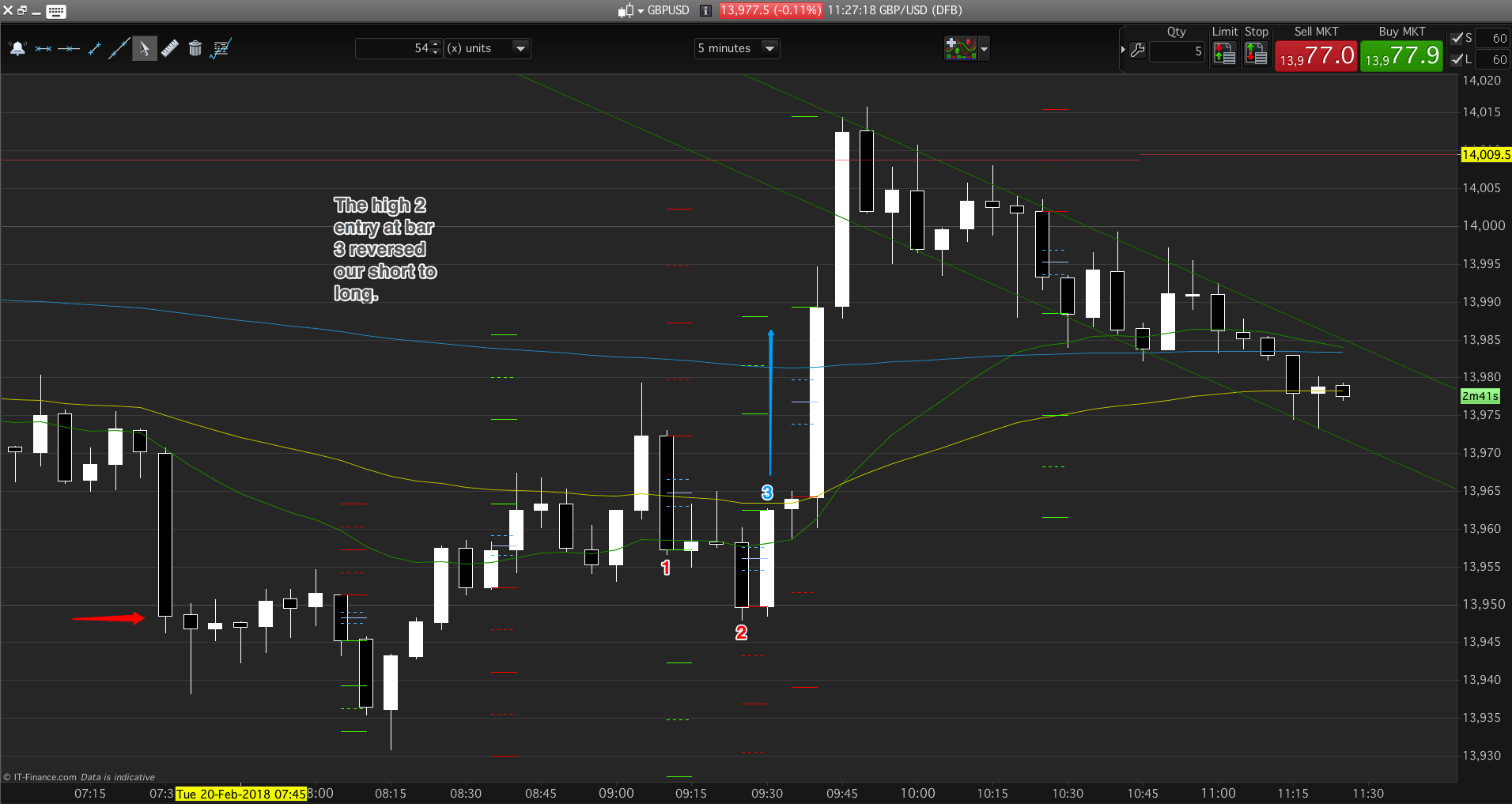
    We entered short at the close of bar one which provided a reasonable probability of a measured move. Tuesday 20th February, 9.30 am.

    The close at bar 2 put us in the money and looked right at this stage to reach our target. We only noticed later that the close of bar 2 equalled the support level at 7:30 marked by the red arrow.

    A high 2 was activated (bar 3) closing above the previous three bars. This required an immediate exit of our short for a small loss and a reversal entry long.

    This we did and were rewarded with the big move for the day so far.

    The reversal entry is often hard to do and one that we do reluctantly and only if we are confident of the Forex trading signal.

  • Forex trading and USA holiday

    Good morning Forex day traders, 8 am Monday 19th February 2018.

    Our first trade of the day was missed. From the close of the bear bar at bar 1, an unassuming engulfed bar, I went for my first pot of tea of the day. I missed the second bear bar, bar 2, which provided a probable entry short of 8 pips.

    8 pips are our minimum entry in the GBP/USA currency market.

    The short went 12 pips below our planned exit, down to Friday’s low and to the significant number of 14000. That, of course, means 1.4 dollars to the pound.

    Trades today will in all likelihood be light being a USA holiday. A trading range day is expected, but occasionally on such holidays, a trend can form.

    Our missed entry looks good on paper, but in reality, I would have not made the short. The spread at the time was double, which is typical for a no-news Monday morning. As I don’t pay the entry spread, I always like to achieve a limit entry, the subsequent pullback at the close of bar 2, and at 2 pips spread, would have not worked.

    We wait patiently for the next opportunity.

  • Trade management, a skill

    Trade management is a skill and tricky to achieve, the first thing in the morning! The trade is from 8.15 am 16th February 2018.

    The chart below shows a possible wedge, three pushes down marked by the red arrows. A strong bull-bar, the close of which is characterised by the green box, provided a reasonable probability of an entry-long with a target back up to the previous high.

    We enter (the green box) long. The follow-through, however, is somewhat weak. Until we get the bear bar, the close of which is marked by the red circle. This could have been accepted as a small loss exit position.

    However, we hold. The trade is expected to go back to the low of the day. The risk is a breakout short.

    At the price action long, shown by the green horizontal arrow, we scale-into the trade. Our target is a breakeven on the original bet and a small profit on the scaled-in take.

    To scale-in improves probability but is not for the beginners.

    A screenshot of the trade live.

  • Price action is all well and good, but context counts more

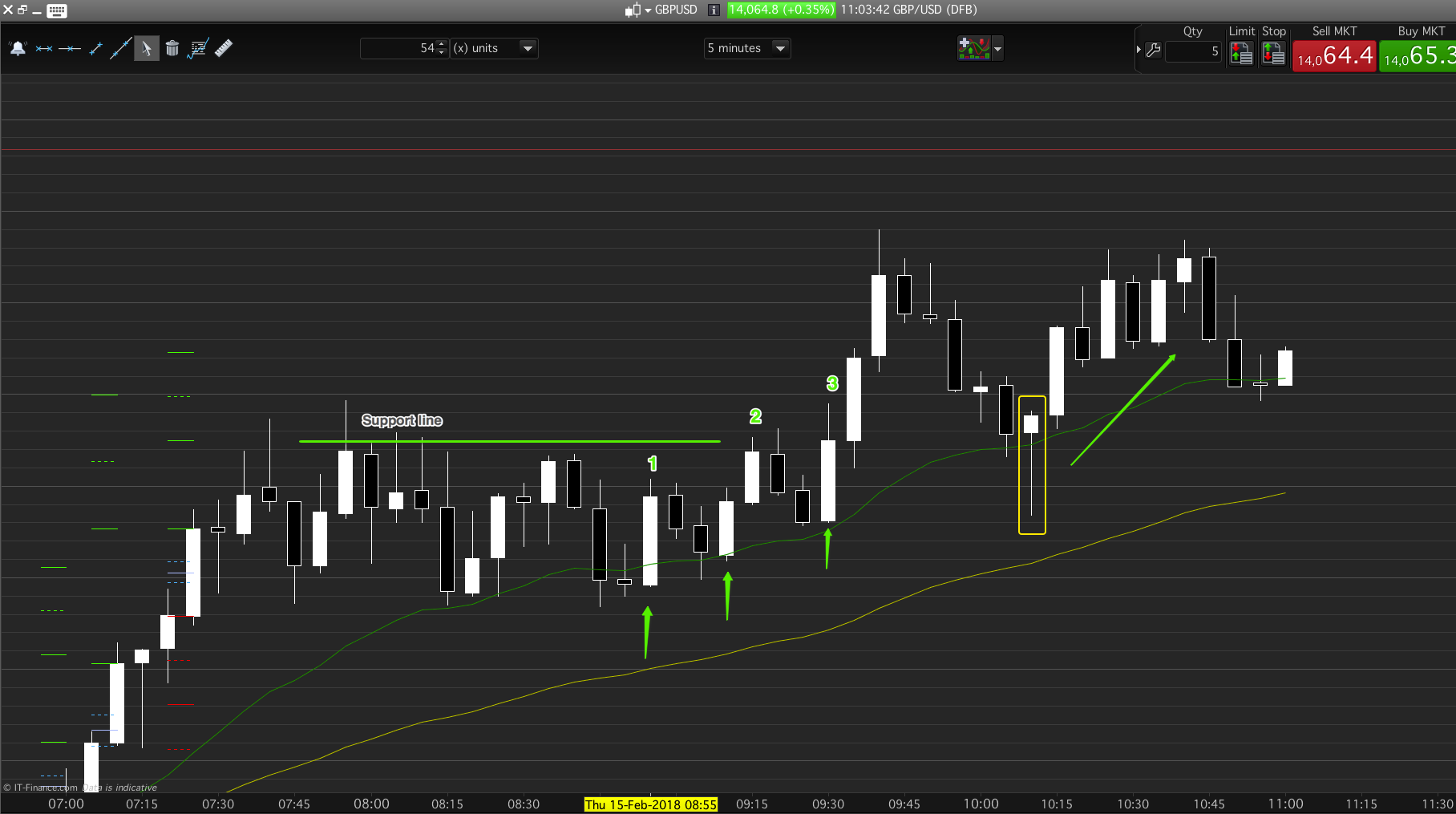
    10.45 am 15th February. After the tight channel long the market went into a narrow trading range for a couple of hours.  The close of bar 3 provided the first opportunity long as the close was slightly above the support line.

    However, we considered that bar 3 was the third push long, an embedded wedge, and therefore not a likely trade. In hindsight, computers saw this as two pushes down with higher highs and higher lows. The market went up after bar 3, without us!

    Our next opportunity was the price action provided by the pin bar marked by the yellow box. The close of the pin is above the support line (and at the 21 EMA) and gave a 60% to 70% chance of a trade long, at least to the top of the previous high and a 15 pip profit; which we are happy to say, it did.

  • Advantage of the scalp over the swing, if we can make the entries

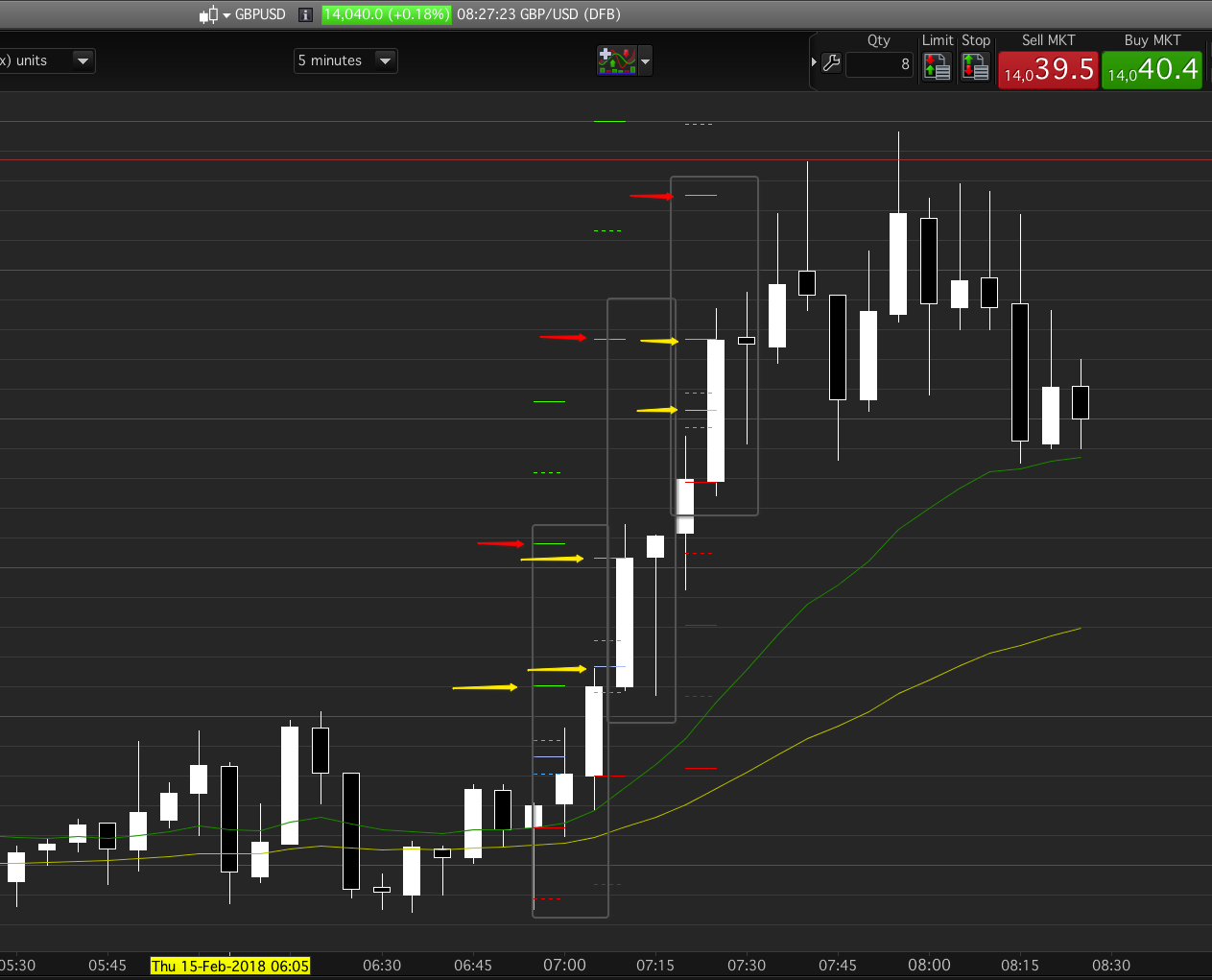
    Good morning Day traders, 15 February 2018. A great start to the day for the early risers. The higher timeframe chart, daily in this case agrees with a possible trend long.  Soon after 7 AM on our 5-minute bars we get a breakout, indicated left to right by the first yellow arrow. We enter here for a scalp long and exit at the lowest red arrow.

    We immediately take another entry near the close of the first exit, from this measurement we also set a pullback entry. We make these entries long for a scalp target shown by the middle red arrow.

    A third entry is achieved, albeit more tentative as we are near the possible top of the push. We trade here with a decreased amount due to our stop being below all the bars shown.

    Again we get the breakout and the pullback entry and take the final scalp at the target shown by the top red arrow.

    Achieving about 70 pips for what was only a 32 pip move overall. That is the advantage of the scalp over the swing, the difficulty is making every entry.

    Yellow arrows are trade entries, red arrows are trade exits.

  • Plan, Brief, Execute and Debrief

    The quality of our trades depends on the quality of the decisions we make. We are not born with this ability, we learn it. Strategies guide and define our choices. Therefore, based on sound principles, a good plan is a vital step for us to produce right decisions.

    Once we have a clear understanding of each part of our strategy, we can invent our own way of recalling its sequence (as an ex-military pilot I like the plan, brief, execute and debrief order of things)

    1. Plan (News and Market Cycle)
    2. Brief (Backtest and Probability)
    3. Execution (Valid Entry)
    4. Debrief

    Our ebook has many pages, but the simple block above helps collapse all our work into a process that allows, more often than not, to provide a profitable solution.

  • The margin is a changing!

    The margin on spread bet and CFD accounts are about to increase significantly. Why?

    Many (and indeed any accountants we’ve spoken to) consider spread betting in the same light as a sports betting app.

    They couldn’t be more different. Financial spread bets and CFDs demand a different level of consideration to sports betting. The difference between a CFD (contract for difference) and spread betting – apart from a grown-up name – is in detail.

    Beginners ought to start with CFDs as losses are deductible and then move to spread betting once profitable as profits on spread bet accounts are not taxed. Most do it the other way round.

    In both the trade is an agreement rather than a purchase of a security. They are traded as a derivative of the market. That is why they can be traded both long and short either as a stand-alone trade or as a hedge.

    This sports app miss conception possibly fuels the increase across the board of margins in CFDs and spread bet trades.

    Not too long ago margins were calculated at 0.5% of the potential risk, it is mostly now 1% of the risk and soon to increase to 5% of the risk.

    If we take the currency pairing of Sterling versus the Dollar the market as we write is at 13,962. To spread bet this at say £10 per pip (a pip, in this case, is the final digit). The risk is 13,962 x £10 = £139,620

    Probably not the same as a sports app bet! The margin required to trade at 5% is £6,981. If we consider that a suitable maximum margin of our account at any one time is not more than 10%, then we would require £69,810 to trade. Many serious retail traders trade up to four times this amount.

    So, yes the margin increase ought to make many traders reconsider.

  • Day trading

    As Jack Welch told us: “change before you have to.”

    Beginners are attracted to day trading because, most of us when we start out, only consider one thing: risk.

    With day trading we’re offered a low-risk and the beginner takes this (usually unsuccessfully) with low probability entries.

    The professional counters by (mostly) taking high probability opportunities.

    This often requires close attention for long periods followed by quick and decisive action.

    Like all the best games, day trading is easy to learn but hard to master.

    As Seth says, “if failure is not an option, neither is (the) success.”

  • A traders engine is….

    What best helps us make money as a financial trader?

    Is it:

    1. a fantastic strategy
    2. time on our hands to be able to trade
    3. enough money to trade at the level we desire
    4. an environment without distraction
    5. the correct equipment and support software
    6. to be able to trade objectively, all the time

    The list could go on. And of course, we could argue that all the above have a part to play, to some degree or other.

    However, from our lessons, it is the final item that takes the biscuit.

    To trade objectively (or in the zone, or from a ‘now’ moment perspective) is the engine of the whole process.

    I have read ‘Trading in the Zone’ by the late Mark Douglas several times and it was only the last read where, for me, the so-called ‘light’ came on.

    This may mean that I’m a bit slow in this regard. Or it could be that we need to gain a certain level of traders experience before we can properly grasp what Douglas was telling us.

  • Risky

    Readers will know that our chosen trade method is day trading a currency pairing.

    People that are not familiar with how we go about our business will think ‘gosh, that’s risky’. And of course, to a large extent, they are right.

    As with many disciplines that require a great deal of skill and practise (to simply achieve mediocrity), it comes across as risky because most don’t take the time and effort to learn.

    Ironically a principal draw for us to day-trading is the control of risk.

    Our e-book on the subject to be released within the first quarter of next year shows, we think, in some detail how this is possible.

    Day trading, if done well and with practice, can provide a consistent daily or weekly return. So unlike other more traditional trade or investment methods.

    With all worthwhile disciplines, it does not come to us overnight.

    As Seth Godin said:

    “The hard part is ‘steady.’

    Anyone can go slow. It takes a special kind of commitment to do it steadily, drip after drip until you get to where you’re going.”

  • The NASA effect

    From mid-January, James and I will again trade together, full-time. His contribution is to: (1) reduce mistakes made and (2) maintain our focus.

    Of course, there is more to it than that. Each trader has to similarly trade competent and knowledgeable. When that comes together, however, trading together really helps.

    Mistakes:

    In the pilot world, it is known as crew resource management or CRM. During the late 50’s too many Comet aircraft were crashing and too many of those were due to pilot (or crew) error.

    NASA had a look and devised CRM; its success, throughout aviation’s history since then and the space program, was staggering. CRM is a method that prevents egotism.

    The movie ‘Sully’ quietly shows CRM in operation. Each move by either the captain or the co-pilot is confirmed and checked by the other. It’s an accepted way in the aviation world.

    So much so that it has made its way, under different names, into the hospital operating theatre.

    Concentration

    Distractions clearly affect performance on the job. In a recent essay, Dan Nixon of the Bank of England pointed to a mass of compelling evidence where constant interruptions accustom (us) to distraction, teaching us, in effect, to lose focus and seek diversions:

    Conducting tasks while receiving e-mails and phone calls reduces IQ by about ten points relative to working in uninterrupted quiet.

    That is equivalent to losing a night’s sleep and twice as debilitating as using marijuana.

    By one estimate, Nixon says it takes nearly half an hour to recover focus fully on the task at hand after an interruption.

    The day-traders world (not as dramatic as aviation – our feet are on the ground for a start) very much demands our total attention.
  • Can a trader swim?

    I remember reading ‘Total Immersion’ by Terry Laughlin some years ago.

    Good over short distances, personally I had trouble maintaining swim pace anything over a couple of pool lengths.

    I was looking for swim inspiration and feel that I probably got something else. My swim result, although improved, is still poor but I was fascinated by Laughlin’s philosophy.

    He had phrases such as ‘worry less about the power of your engine, and more about the sleekness of your fuselage’.

    And,…. ‘aim to glide through the water, concentrating on balance, fluidity and relaxation, delaying exhaustion by using just the muscles you need, and only when you need them’.

    But it was his reference to Kaizan that caught my attention. The secret, laughlin reckoned, was the Kaizen principles at the heart of Japanese manufacturing: continuous incremental improvement ‘through cleverness, patience and diligence’.

    ………and then the achievement of ‘unconscious competence’.

    That is a state I’d like to achieve in my approach to trades.

    Terry Laughlin, a swimming coach, author, died on October 20th, aged 66.

  • Do we trade the news?

    Finding the right currency pair to trade is key to success. We want steady movement of price but not unpredictability or undue volatility.

    We also don’t want to move between currencies too often because, as a short-term trader, we get familiar with the flow (the news) of the currency.

    We traded GBP/USD up until Brexit and then moved to USD/JPY. Since the recent North Korean influence we moved back to GBP.

    In what detail do we follow the news of a currency? here’s an overview:

    • Since November 2015 the pound (GBP) has depreciated by over 15% against other currencies, mainly because of worries caused by last year’s Brexit referendum.
    • As the cost of imports has risen, inflation has jumped.
    • At the last release, Consumer-price inflation (CPI) was 3%, the joint-highest level since 2012.
    • But inflation may soon be on its way down again.
    • The annual rate of CPI has averaged almost exactly 2%, in line with the bank’s target.
    • Of note, as an open economy with a fairly volatile currency, GBP is prone to short-term spikes in inflation.
    • The effect of the GBP plunge last year will, it is considered by reports, soon fade.
    • Import prices will therefore not continue to rise sharply.
    • There has been a close correlation between movements in sterling and the “core” rate of inflation (a measure which excludes the most volatile components). If that correlation continues, then within a few months, reports suggest, the headline rate of inflation should near 2%, assuming sterling holds steady.
    • But the pound suffers whenever there is bad news about Brexit, and there is a fair chance that the months ahead will contain plenty of that.
    • But for now, at least, inflation looks more likely to fall than to rise much further.

    News is the first consideration on our pre-trade list. For a news release that we consider could provide volatility or unpredictability we are trade ‘flat’ a few minutes before release of the news, and usually much earlier than that.

    We have an awareness of the news and importantly the possible volatility a certain news release can provide.

    But we do not:

    1. second guess the effect of a news release, or
    2. trade with a certain trade direction in mind due to news or fundamental considerations.
  • Trade entries

    Trade entries entered the most are:

    (1) On-limit entry trades that don’t activate, lead the way; this means we did not get the price we were prepared to pay for the trade. And that’s fine. (on-stop entries are not part of our strategy)

    (2) Next, with a similar number, are break even or near breakeven trades; usually these are trades that did not provide the follow through we anticipated. A difficult area of a trade and a clear strategy statistically works best here.

    (3) Further down the score are trades that make target.

    (4) Those trades that are profitable but are exited before target due to price action, rather than nerves, are similar in number to those that hit target.

    (5) Trades that hit stop or are exited early due to price action are fewer than those that hit target, thank goodness! (importantly, these trades are smaller than the target hit trades)

    (6) However, the big leveler on trade entries, and the difference between a consistently profitable trader and everyone else is limiting, zero would be nice, the amount of batty entries. By batty we refer to ego or tired entries, but more often than not they are miss read market reversal entries; a low risk, low probability trade that invariably ends up being vastly more expensive than anticipated.

    The simple conclusion is: read the market cycle and price action and stop batty entries.