Author: Buzz Lightyear

  • 1st month of the 12 month challenge.

    I am trading US stocks through the Lightspeed platform. Although there are commissions to pay with Lightspeed, it is a solid platform, and trades execute immediately, unlike many commission-free sites. As a day trader, the immediacy of trade execution is essential.

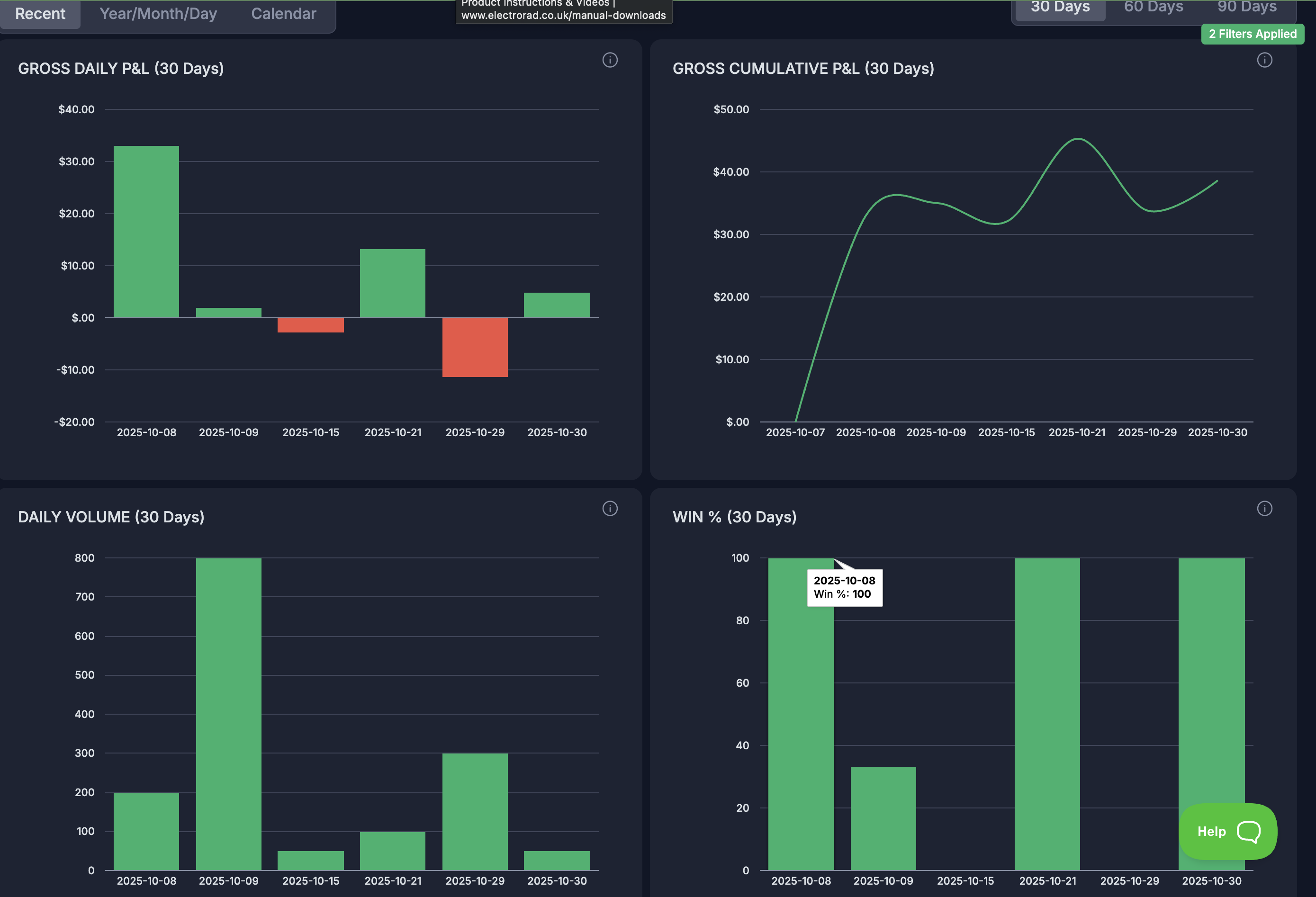
    October was a relatively slow month. Additionally, I had a project to complete: redesigning an area of the business into a guest gym. However, I still managed to trade for at least half of the month, and took trades on only six of those days.

    In my preferred trading range of $2 to $20 per share, movement, apart from one stock that skyrocketed and I missed, has been light.

    As I build the fund, starting with only $2,500, I must be cautious that fees do not significantly exceed the profits; this requires me to consider my trading style carefully.

    Please note that I am buying and selling actual shares, which differs considerably from leveraged derivative trading. Once I enter a trade, even if I hold it for only a few seconds, the full cash commitment is not available again until the following day, regardless of whether the trade is a win or a loss.

    Selectivity in trades is crucial, but so is commitment. Not all trades are equal. Where able, I try to gradually build my commitment to a trade as its suitability becomes clearer—a much more challenging skill than it seems, which is why most of us tend to make a single entry.

    Additionally, I try not to overstay my welcome in a trade. I focus on exiting when the trade weakens, but I always look for a re-entry if the market conditions suggest it—a challenging balance to keep.

    My results, however, indicate that I tend to exit trades that are likely to maintain momentum too early, which is an area I need to improve.

    To that end, I have recently shifted my focus away from price action trading. As someone who has long advocated for this approach, I found myself prioritising candlestick patterns and price movements over the tape.

    By “tape,” I mean both level 2 data and time and sales information. By eliminating candlestick charts and instead using exponential moving averages, along with a session volume-weighted average price across several timeframes, I could still identify a justifiable entry signal, while entirely focusing on analysing the tape.

    Furthermore, focusing more clearly on the tape has significantly reduced my drawdowns, but it is still early days.

    The profit results from last month are inconsequential, but we are prepared to capitalise on any long-only volatility that may emerge.

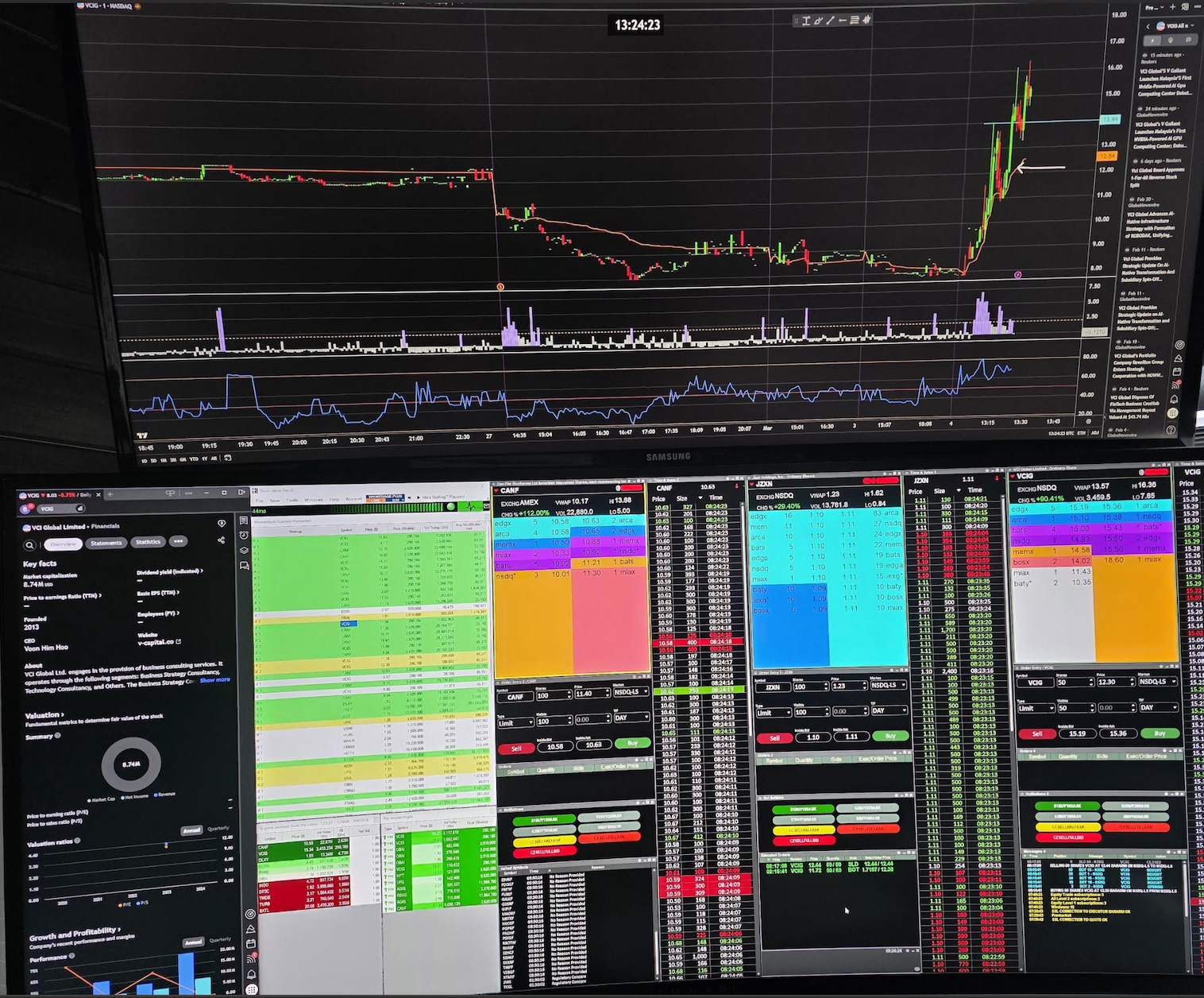
    The lower screen shows three Lightspeed level 2 displays and their associated time and sales. The upper screen displays four charts of the same stock over different time frames, absent the usual bar chart.

    Fund at $2,588, a 3.4% increase. It’s a start!

  • Forex trading signal, a high two reversal

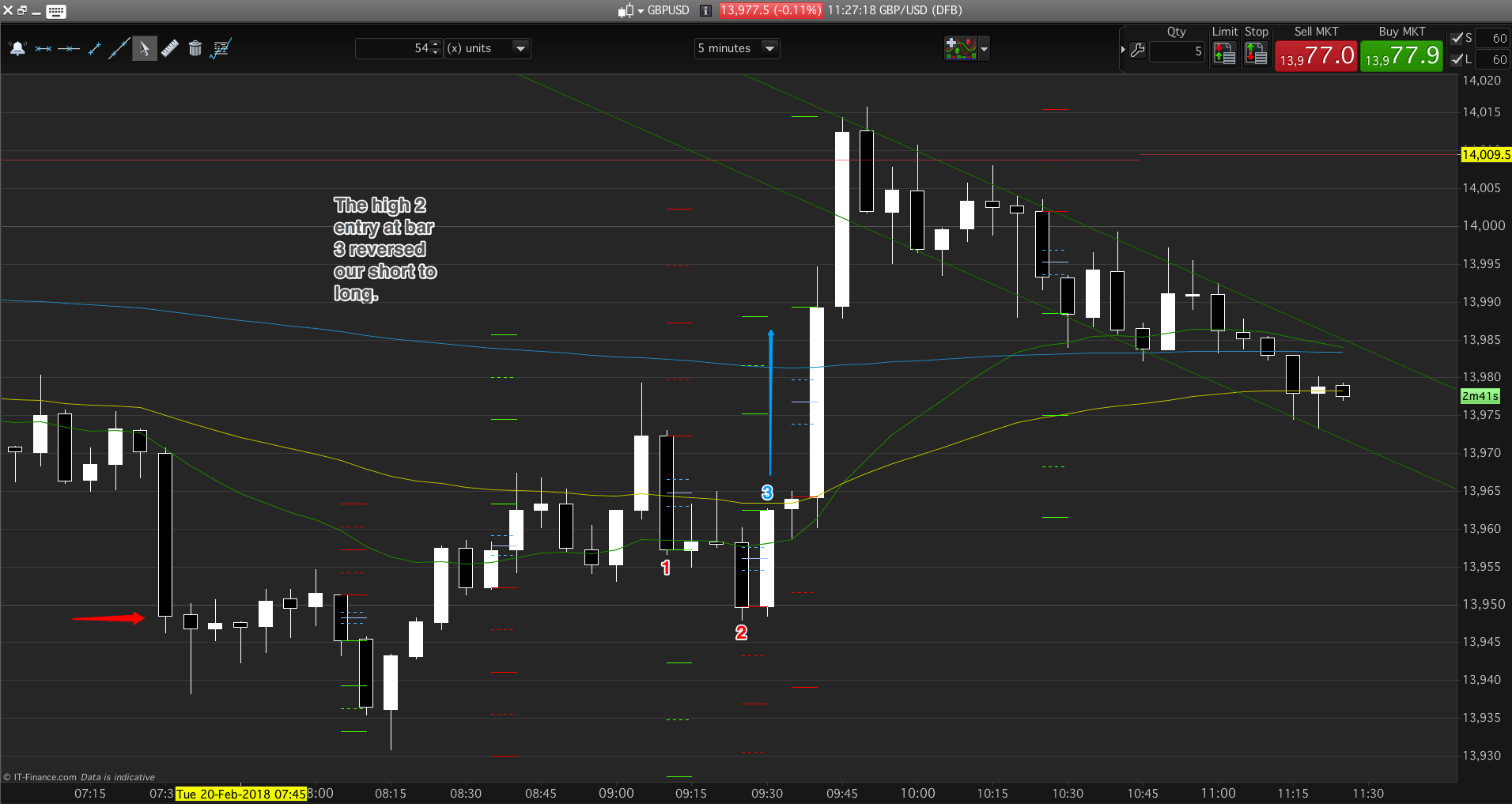
    We entered short at the close of bar one which provided a reasonable probability of a measured move. Tuesday 20th February, 9.30 am.

    The close at bar 2 put us in the money and looked right at this stage to reach our target. We only noticed later that the close of bar 2 equalled the support level at 7:30 marked by the red arrow.

    A high 2 was activated (bar 3) closing above the previous three bars. This required an immediate exit of our short for a small loss and a reversal entry long.

    This we did and were rewarded with the big move for the day so far.

    The reversal entry is often hard to do and one that we do reluctantly and only if we are confident of the Forex trading signal.

  • Forex trading and USA holiday

    Good morning Forex day traders, 8 am Monday 19th February 2018.

    Our first trade of the day was missed. From the close of the bear bar at bar 1, an unassuming engulfed bar, I went for my first pot of tea of the day. I missed the second bear bar, bar 2, which provided a probable entry short of 8 pips.

    8 pips are our minimum entry in the GBP/USA currency market.

    The short went 12 pips below our planned exit, down to Friday’s low and to the significant number of 14000. That, of course, means 1.4 dollars to the pound.

    Trades today will in all likelihood be light being a USA holiday. A trading range day is expected, but occasionally on such holidays, a trend can form.

    Our missed entry looks good on paper, but in reality, I would have not made the short. The spread at the time was double, which is typical for a no-news Monday morning. As I don’t pay the entry spread, I always like to achieve a limit entry, the subsequent pullback at the close of bar 2, and at 2 pips spread, would have not worked.

    We wait patiently for the next opportunity.

  • Trade management, a skill

    Trade management is a skill and tricky to achieve, the first thing in the morning! The trade is from 8.15 am 16th February 2018.

    The chart below shows a possible wedge, three pushes down marked by the red arrows. A strong bull-bar, the close of which is characterised by the green box, provided a reasonable probability of an entry-long with a target back up to the previous high.

    We enter (the green box) long. The follow-through, however, is somewhat weak. Until we get the bear bar, the close of which is marked by the red circle. This could have been accepted as a small loss exit position.

    However, we hold. The trade is expected to go back to the low of the day. The risk is a breakout short.

    At the price action long, shown by the green horizontal arrow, we scale-into the trade. Our target is a breakeven on the original bet and a small profit on the scaled-in take.

    To scale-in improves probability but is not for the beginners.

    A screenshot of the trade live.

  • Price action is all well and good, but context counts more

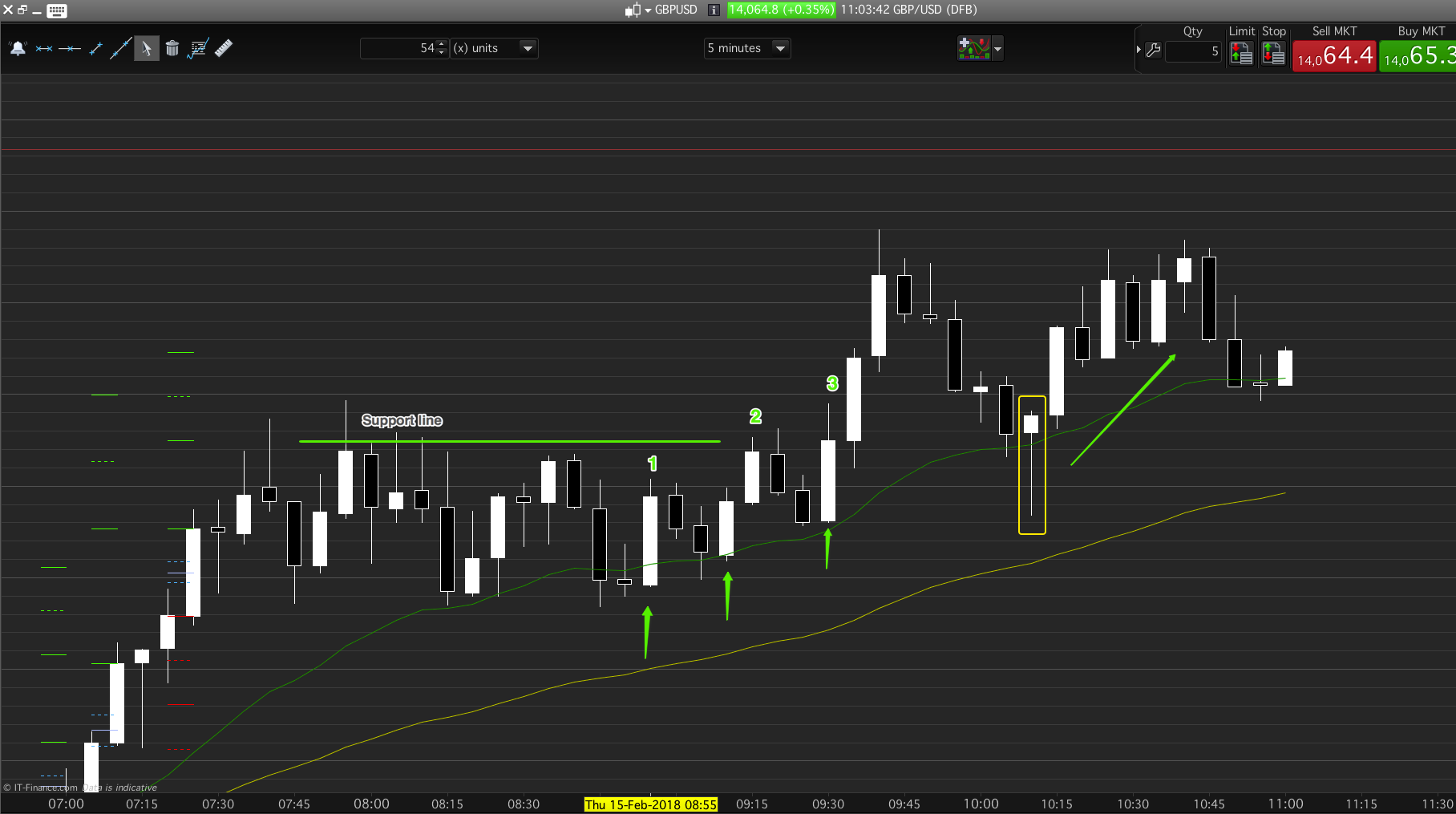
    10.45 am 15th February. After the tight channel long the market went into a narrow trading range for a couple of hours.  The close of bar 3 provided the first opportunity long as the close was slightly above the support line.

    However, we considered that bar 3 was the third push long, an embedded wedge, and therefore not a likely trade. In hindsight, computers saw this as two pushes down with higher highs and higher lows. The market went up after bar 3, without us!

    Our next opportunity was the price action provided by the pin bar marked by the yellow box. The close of the pin is above the support line (and at the 21 EMA) and gave a 60% to 70% chance of a trade long, at least to the top of the previous high and a 15 pip profit; which we are happy to say, it did.

  • Advantage of the scalp over the swing, if we can make the entries

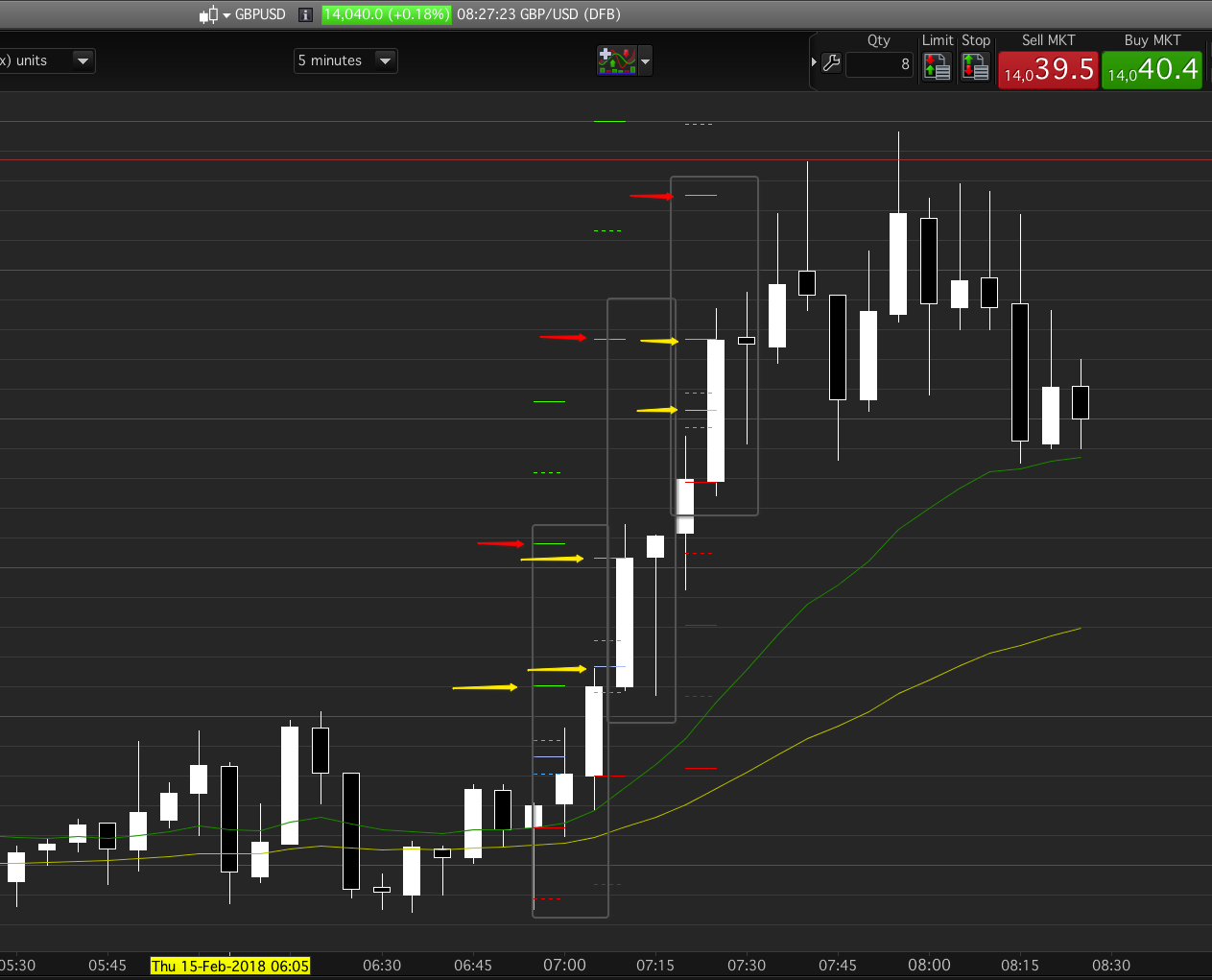
    Good morning Day traders, 15 February 2018. A great start to the day for the early risers. The higher timeframe chart, daily in this case agrees with a possible trend long.  Soon after 7 AM on our 5-minute bars we get a breakout, indicated left to right by the first yellow arrow. We enter here for a scalp long and exit at the lowest red arrow.

    We immediately take another entry near the close of the first exit, from this measurement we also set a pullback entry. We make these entries long for a scalp target shown by the middle red arrow.

    A third entry is achieved, albeit more tentative as we are near the possible top of the push. We trade here with a decreased amount due to our stop being below all the bars shown.

    Again we get the breakout and the pullback entry and take the final scalp at the target shown by the top red arrow.

    Achieving about 70 pips for what was only a 32 pip move overall. That is the advantage of the scalp over the swing, the difficulty is making every entry.

    Yellow arrows are trade entries, red arrows are trade exits.

  • Trading range morning

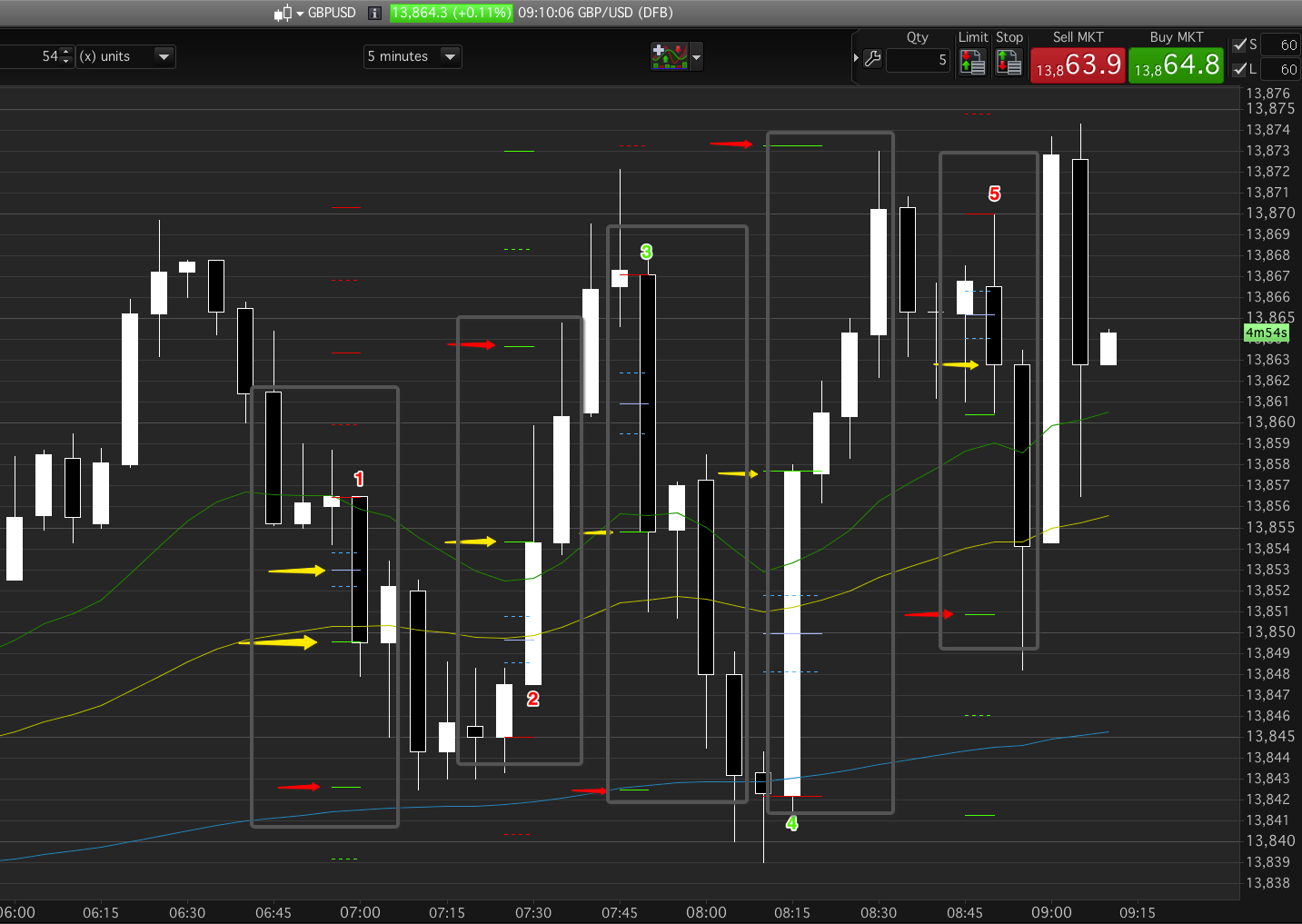
    The example below provides a 30 pip trading range (TR) before significant news at 9.30am. The close of bar 1 gives us our first opportunity short. At this stage, we are not sure of a trend or TR therefore as there is doubt we take the scalp. On reaching the scalp target, we have three pushes down and hence probably a reversal to establish the TR. The fourth entry at the close of bar 4 did not reach the target. We exited on-market in this instance at the close of the third bull bar after entry. Bar 5 short was interesting. An excellent signal and as the bar was small, we took the measurement, unusually, from top to bottom including the wick. However, the institutions also liked this signal as the price, although showing a small PB, raced down and we did not get our entry.

    Yellow arrows indicate entries and red arrows exits.

  • First trades of the day

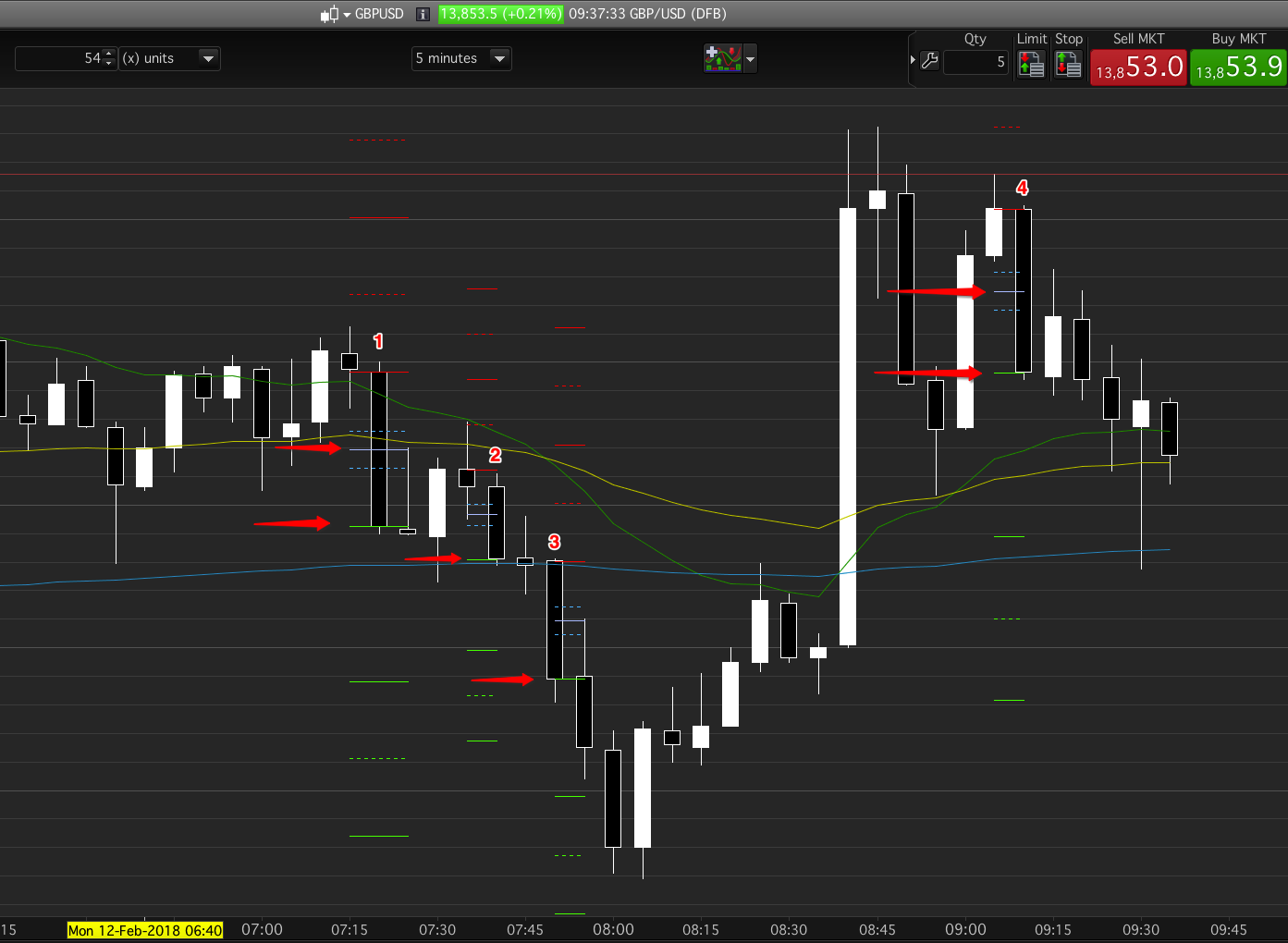
    First trades of the day can often test our resolve. Bar 1 below was our early trade this morning (12th February 2018). The London market is starting, and this can introduce volatility. Moreover, we don’t feel settled into the chart, we have a possible wedge that could take the price long and as the day has no news to mention we could be in for a trading range day.

    We place our limit order short at the close of bar 1 and at the midpoint of the same bar. The next bar, a pin bar down but not a new low, is not the follow through we were looking for. We exit on-market for a break even. Bar 2 and bar 3, on the other hand, provide confirmation of reasonable probability of at least a scalp short so we take our limit order shorts at the close of each; the midpoint pull-back limit entries were not activated.

    Our initial trade (from bar 1) if we’d held it would have provided 27 pips of profit. Bars 2 and 3 entries combined provided 17 pips of profit.

    Some traders would have taken the first bull bar long after bar 3, however changing trade direction that quickly is difficult. Bar 4 was our next opportunity. By now we were in the groove and entered at the close of bar 4 and at its midpoint. The subsequent scalp provided over 28 pips of profit.

    Short entries were taken at each of the red arrows.

  • New funds to trade

    All traders look for an edge, an ideal way to enter, manage and exit a trade.

    It is crucial that a chosen edge suits us individually too.

    The time-critical stress of the day traders world is probably not for everyone. Nor, for others, the weeks or months of being out of the money, as in the longer time frame deals.

    However, if we have the time, the knowledge and the inclination we might be comfortable trading in both disciplines.

    More than this, one helps to condition the other. In day trading we have learnt the art of the identification of a likely trade. In longer-term trades, we appreciate the need for trade management and a requirement to ignore emotion and the uncanny ability to hit targets when we are not necessarily observing the trade moment to moment.

    A big supporter of the commitments of Traders (COT) report, not everyone is as it is infrequent in its signals and notoriously broad in its message. However, with longer bets, as a ‘conditional’ trader, the COT provides arguably the only edge that is not in itself related directly from the price.

    Day trading has provided us with skills that can be coupled very well with the longer term charts and this, in conjunction with the COT, offers an exciting way forward.

    With additional funds coming in to trade, we looked at what would complement our day trades but not emotionally or otherwise interfere.

    Significant commodities and a selection of currencies traded from weekly charts in unison with the COT is our chosen direction.

  • Plan, Brief, Execute and Debrief

    The quality of our trades depends on the quality of the decisions we make. We are not born with this ability, we learn it. Strategies guide and define our choices. Therefore, based on sound principles, a good plan is a vital step for us to produce right decisions.

    Once we have a clear understanding of each part of our strategy, we can invent our own way of recalling its sequence (as an ex-military pilot I like the plan, brief, execute and debrief order of things)

    1. Plan (News and Market Cycle)
    2. Brief (Backtest and Probability)
    3. Execution (Valid Entry)
    4. Debrief

    Our ebook has many pages, but the simple block above helps collapse all our work into a process that allows, more often than not, to provide a profitable solution.

  • The margin is a changing!

    The margin on spread bet and CFD accounts are about to increase significantly. Why?

    Many (and indeed any accountants we’ve spoken to) consider spread betting in the same light as a sports betting app.

    They couldn’t be more different. Financial spread bets and CFDs demand a different level of consideration to sports betting. The difference between a CFD (contract for difference) and spread betting – apart from a grown-up name – is in detail.

    Beginners ought to start with CFDs as losses are deductible and then move to spread betting once profitable as profits on spread bet accounts are not taxed. Most do it the other way round.

    In both the trade is an agreement rather than a purchase of a security. They are traded as a derivative of the market. That is why they can be traded both long and short either as a stand-alone trade or as a hedge.

    This sports app miss conception possibly fuels the increase across the board of margins in CFDs and spread bet trades.

    Not too long ago margins were calculated at 0.5% of the potential risk, it is mostly now 1% of the risk and soon to increase to 5% of the risk.

    If we take the currency pairing of Sterling versus the Dollar the market as we write is at 13,962. To spread bet this at say £10 per pip (a pip, in this case, is the final digit). The risk is 13,962 x £10 = £139,620

    Probably not the same as a sports app bet! The margin required to trade at 5% is £6,981. If we consider that a suitable maximum margin of our account at any one time is not more than 10%, then we would require £69,810 to trade. Many serious retail traders trade up to four times this amount.

    So, yes the margin increase ought to make many traders reconsider.

  • Day trading

    As Jack Welch told us: “change before you have to.”

    Beginners are attracted to day trading because, most of us when we start out, only consider one thing: risk.

    With day trading we’re offered a low-risk and the beginner takes this (usually unsuccessfully) with low probability entries.

    The professional counters by (mostly) taking high probability opportunities.

    This often requires close attention for long periods followed by quick and decisive action.

    Like all the best games, day trading is easy to learn but hard to master.

    As Seth says, “if failure is not an option, neither is (the) success.”

  • A traders engine is….

    What best helps us make money as a financial trader?

    Is it:

    1. a fantastic strategy
    2. time on our hands to be able to trade
    3. enough money to trade at the level we desire
    4. an environment without distraction
    5. the correct equipment and support software
    6. to be able to trade objectively, all the time

    The list could go on. And of course, we could argue that all the above have a part to play, to some degree or other.

    However, from our lessons, it is the final item that takes the biscuit.

    To trade objectively (or in the zone, or from a ‘now’ moment perspective) is the engine of the whole process.

    I have read ‘Trading in the Zone’ by the late Mark Douglas several times and it was only the last read where, for me, the so-called ‘light’ came on.

    This may mean that I’m a bit slow in this regard. Or it could be that we need to gain a certain level of traders experience before we can properly grasp what Douglas was telling us.

  • Slow Trader Fund

    Our Slow Trader fund has sat on the fence for a few months waiting for me. Not being a boom and bust trader, I have traded small whilst developing our ‘probability trading’ technique.

    A level of profitability through consistency has to be achieved before increasing trade size. The technique provides that, now it is up to me.

    It may seem a bit odd that I’ve moved away from trading a market, US stocks, that has increased this year as an index 20 percent or so. UK shares not so much at 6 or 8 percent as an index.

    To day-trade profitably I need to give it (day trading) all my attention. Having trades open in other areas and time frames were definitely a distraction for me.

    Why have I chosen day trading despite the many stories that tell us not to trade this way? Bizarrely, it is control. As a ‘probability’ trader, we accept that we are trading a market that is random. In other words, we accept that anything can happen.

    If we except that anything can happen, then we accept the risk. We accept that the market is only about a price that can go either up or down. In ‘probability trading’ we also accept that certain effects happen when lots of traders trade. Things happen that can give an observant trader an edge.

    Despite the simplicity described, it has taken me a couple of years to combine price action trading and money management, specific entry and exit techniques, and group it all together, test it exhaustively and call it probability trading.

    Fund contributors that think the share market, and particularly the US stock market, are to continue climbing throughout 2018 ought to withdraw their funds from Slow Trader and head that way.

    After all, that is the market, with you, that Slow Trader originally entered.

    If you stay in the Slow Trader fund, and to do so you don’t need to do anything else, you become part of a probability day-trader fund. Our advantage: we are not concerned about a good or a bad year for stocks and shares; we trade a currency pairing in the short-term, with an edge; with (to quote Mark Douglas) rigid rules and flexible expectations.

    We have developed a day trading strategy that allows us to take money consistently – day in, day out.  We scale-up though when we’re ready.