Tag: slow trader fund

  • Slow Trader fund to a corporate CFD trust account?

    A few words going forward regarding our ‘Slow Trader’ fund.

    As our fund grows I’m looking at its future organisation.

    I’m considering moving the fund to a CFD traded corporate trust account, nominated as a hedge fund.

    If we were to do this we still wouldn’t pay stamp duty, but we would pay capital gains tax.

    Shares within the company would reflect the share distribution of the fund. Any losses would be tax-deductible.

    It’s important that we retain the ability to hedge (trade long and short), and are able to trade intra-day in our present selection of forex, commodities and shares, from a platform I’m familiar.

    Some technical stuff: A CFD, a derivative, satisfies this requirement. CFDs have a spread on forex and commodities; shares are commission only, no spread. Which is all good for us. Moreover, CFDs are traded on margin with a provision for guaranteed stop orders.

    A private limited company for such a purpose would be relatively easy to manage and report. I will let you know on this and seek everyones thoughts after I get further clarification from my accountant.

  • Slow Trader Fund, We’re Ready for Action

    Thank you for your patience while I’ve performed a complete overhaul of my short-term trading strategy. Readers will notice the amount of work involved in the ‘how I trade’ page. This has been a great exercise, and one of which I’m confident will be well worth the wait.

    A reason for taking so long is that our strategy, I believe, can only truly be devised under live trading conditions. The way we react to probability trades under live conditions is significantly different to what would otherwise be developed under benign back-testing conditions.

    To that end, I’ve traded and worked on the strategy these last few months with my own account and traded small. The fund has remained in waiting.

    Now I’m at the other end of the strategy development, we will see a gradual build-up to normal fund trade amounts.

    My thoughts on how I see the fund going forward from today:

    Slow Trader allows investors the opportunity to access a short-term trading fund.

    Why an opportunity, and why short-term trading is not possible for most people:

    • Firstly, short-term traded funds are not readily available. Moreover, expert (and hopefully successful) short-term traders charge a lot – up to 50% of profits and large participation fees.
    • Secondly,  short-term trading is a difficult skill to master. It takes several years for a trader to graduate from the ‘beginner’ level, through ‘intermediate’, to ‘expert’. And, expert is where all the capitalised reward is found. In other words, short-term trading, in contradiction to its name, takes a long time to learn.
    • Finally, learning the short-term trading skill is often, through the beginner and intermediate stages, financially penalizing.

    From the 4-hour chart the fund trades:

    1. Nick’s qualifying UK shares – long only.
    2. Currency pairings GBP/USD, EUR/USD, AUD/USD, USD/JPY – long and short.
    3. Commodities Gold and Oil – long and short.

    For each of these I’m looking for an edge:

    1. Nick’s qualifying UK shares already have the fundamentals. And, although fundamentals are normally not a factor for a trade of less than 9-months duration, we nevertheless have them on our side. The principal trading advantages that I use, however, are probability, context and price action.
    2. In our currency pairings we again bring probability, context and price action to the fore.
    3. Commodities also use probability, context and price action but are also traded inline with the COT report.

    The 4-hour chart is used in preference as this provides at least two trading opportunities per day. This means that trades can be open from several hours to several days.

    The page ‘how I trade’ is written with the 5-minute chart in mind but applies equally to the 4-hour chart and is the essence of how I approach probability, context and price action. Nick’s qualifying UK shares are published quarterly through this blog and guidance on the COT will also be given as the COT occasion provides – the COT cycle for each commodity coming round independently a few times a year.

    I provide an annual detailed report on the fund and a semi-annual ‘how goes it’ review.

    The goals of the fund are:

    1. Not to lose money (and this defines our risk level)
    2. Increase the fund by 30% (as a minimum year on year)
    3. Compound the fund year on year
  • Fish and chips or a’ la carte?

    If our restaurant served fish and chips one week and a’ la carte the next, both set of customers are going to be disappointed at some point.

    As with what we serve at the restaurant (within reason) we have to be clear in what we represent in trading.

    Most of our Slow Trader contributors are slightly north of 60. Okay, all except you SA. But you’re close enough for it not to matter.

    Therefore, you’re looking for the fund to do something interesting within the 3 to 7 year period. The younger readers, those under 45, can opt for our share ISA idea, a 20 to 30 year investment.

    These are the two options we’ve blogged about. (1) a dynamic fund that uses lower time frame charts; and (2) a long-term ISA investment based mostly on fundamentals.

    We like the short-term and the very long-term. We don’t like what 99% of the investment market are using, the medium term investment idea. For the long-term investors they expect to go through a few market crashes. Its part of the game. The long-term investors look at this as an opportunity to buy more at lower prices. The Slow Trader is a type of hedge fund that trades both long and short. The fund rides the wave whether it’s going up or down. Everything else in a market crash, the 99% of the investment market, gets stuck in no man’s land with a significantly reduced portfolio.

    For the Slow Trader fund we’ve had some glaring blunders and some moments of brilliance. We’ve benefitted from taking the time to trade the 5-minute charts over the last year, as the lessons from this were vital. However, we’re delighted with the early results from trading 4-hour charts.

    We’ve traded shares from the daily charts but were significantly more successful coming back to the 4-hour charts. Therefore, we now trade a selected mix of currency pairings (FX), commodities and FTSE shares using 4-hour charts.

    We have three trading opportunities a day 8am, 12pm and 4pm. (8pm is a consideration for the FX and commodities-the share market is closed at this time-but as the market goes into night it generally has little movement). With the 4-hour charts we can trade many more markets than is possible with a lower timeframe chart, and we are more likely to benefit from an extended trend.

    Notice the trade amounts in the “how much do we risk” page for 4-hour charts. This is not a gimmick. We trade with a close eye on this page. For the time being however we are trading in the lower amounts per pip/tick and will graduate up to full trading potential (at risk in the thousands) within a few months. It is startling how the fund can grow when we get it right, getting it wrong is not an option – hence the start with the new charts at the lower risk amounts.

  • Slow Trader Fund Update

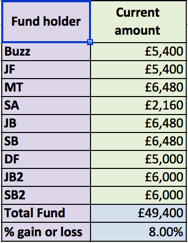
    Slow Trader is now closed to any new funds until next year. Here are the amounts:

    Snip20160305_1

    For the sake of simplicity, percentage gain or loss refers to original funded amounts.

    We are now ready for 2016. Our attention this year is on gold, silver, copper and crude oil. We will also trade from time-to-time the SPDR S&P 500 ETF fund (all sessions) and currency: namely the Euro against the US dollar. We may trade the occasional stock.

    We have an excellent short signal developing for silver. That is, we consider silver will drop again in price. Signals for each of our commodities happen no more than a couple of times a year. Therefore, when we get them we need to take full advantage.

    The S&P and EUR/USD are not cyclical like the commodities – therefore we will trade these via lower time frame charts (one or four-hour chart and, occasionally, as low as the 15 minute chart).

    Commodities are traded through daily charts and in conjunction with the COT report.

    For those building funds for grand kids, or simply looking to buy the Aston Martin DB11 – then here we go!

  • A brief overview of how we did last year.

    We finished the year with only a 8% gain, but that does not tell the whole story. You will recall that 12 months ago I was using a daily trading system that relied heavily on several indicators. I won’t go into detail as to which indicators because it is now irrelevant.

    I also employed a mix of fundamentals, that is finding great stocks that are undervalued and trading them long in accordance with my indicators. This worked very well over several previous years, primarily because the market was raising steadily.

    Around about this time last year I got it wrong. The market had a relatively sharp 15% fall closely followed soon after by a similar rise. The fund at the time was heavily committed and my indicators lagged the fall and rise by just the right amount for me to be invested in the wrong direction on both occasions. The fund was nearly halved.

    It may be odd to learn that I now consider this to be a blessing! This loss forced me to make the jump from indicator and fundamental mix reliance to a system I had been noticing for some time. Price action trading. Indicators are all well and good in a trending market but they provide conflicting messages when the market transitions.

    On the other hand, Price action, or bar by bar trading, is immediate. Of course the down side is that price action takes a lot of work to master. We moved over to price action trading and tentatively built the fund back up by the end of the year to a small profit. In other words, if we accept the loss, and the new fund value at the time of the loss, we actually doubled the fund. I know as a fund contributor that does not sit well but it was a goal and a task that I had to face over the last 9 months.

    Coming into the new year I have taken stock and not traded the fund to any extent. The fund amount remains unchanged at 8% up. This has given me the time for several weeks of back testing, which I hope I have kept you informed about, and the introduction of a new charting system. New software and charts always take some time to master but the change we have made, as the charts are now linked directly to our broker, is a major improvement.

    I was planning to be trading the fund by now but have been delayed a week or two. A trip away and a tummy bug on return didn’t help.

    Finally, this is not a fund that you will find easily elsewhere. It is an aggressive fund but, importantly, where all trades are reasonable trades. That is, all trades have a reasonable measure of risk, reward and probability. I could trade the fund tomorrow against a 60% probability trade to double the entire fund. That, however, would be a long way short of reasonable.

    The goal of the fund is to make money, and make money at a rate that I’m able to do, progressively, and with emotional detachment. (I’ll explain this more fully in a future blog) That emotional detachment (my personal risk aversion) will build with experience.

    We have some new money being introduced to the fund from a current contributor. This money will dovetail into the fund at the present fund level and will have no effect on your profits. The fund remains flexible in the sense that moneys can be withdrawn partially or fully anytime within reasonable trading timeframes. However, as this would be a distraction I would be grateful for any notice that’s possible. I make no charge on the fund, however, once I have doubled your original investment amount I may reconsider this.

    Thank you for your trust and patience. Here’s to a good trading year.

  • New Money

    New money: Some of you (investors in the slow trader fund) have asked about adding to your fund.

    This is a good time if you wish to do so, and before the end of next month. I’m away for a week soon so anticipate that it will be the end of February before our trades are again proportional to the fund amount.

    Additional funds will have no effect on the investments of those not adding in. Our amount risked per trade is a simple (moving) percentage of the total fund. Therefore your percentage gain on a trade is much the same regardless of the size of the fund. Moreover, combining our funds allows us to trade more fully than we would otherwise be able to do with the amounts we have invested individually in the fund.

    Costs: The only measurable cost to us is a small interest charge by the broker for each consecutive day that we hold a trade. There are no charges from me.

    What to do with your medium term stocks: consider holding for a while. Stocks have taken a battering recently, particularly the banks, but a recovery over the next few weeks is a reasonable probability. Whether we see a new high – or, just as probable, a retrace in a few months to a lower low – is too early to tell.

    New software: I explained in a previous blog my need to backtest, that is now coupled with a change of charting software that has taken a few weeks to sort. The new software provides a greater degree of trade placement accuracy and is, we now know, a good improvement on our previous system.

  • Monthly Slow Trader Fund update – 13th January 2016

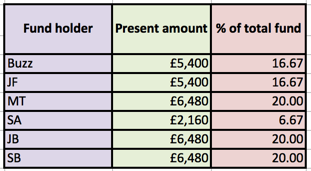
    The fund remains up by 8%.

    Snip20160113_1

    The last month has been a time for what can be called ‘backtesting’. In other words, development of trading strategies by using historical charts. As in any practise, most benefit is gained when tests are as realistic as possible. And I would say that in many ways, backtesting is more exhausting because the equivalent of several days of trading can be done in just a few hours. But backtesting is an essential part of a traders life.

    For the fund, live trading starts again this Monday. Its starts slowly, that is with a small risk and builds as proficiency builds. The build-up is subjective but I would expect to go to full fund entries within 2 to 3 weeks.

    My aim, is to achieve a monthly gain of 5% to 10% going forward. I use this simply as a guide to help me balance risk. No trading day is the same but it is reasonable to expect to find between 5 and 15 good trades per day. My maximum risk (for our fund size) starts out small but builds to about £400 maximum risk per trade. More often than not I will take half risk (£200) on most trades.

    I provide this information so you can see how a traders day is a constant consideration of gaining an edge through good chart reading and awareness of risk, reward and probability. And as this gains in momentum, day after day, the 5% to 10% monthly gain is not ambitious but very achievable.

    Taking a month to backtest can be frustrating to (you) the investor. It is certainly a luxury that most fund managers do not have. However, most funds lost more than 10% last month….  just a thought.


  • Monthly Slow Trader Fund update – 5th December 2015

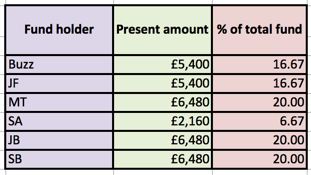
    Slow Trader Fund is up by a total of 8%. Here’s individual positions:

    Snip20151205_29

    You may recall from recent posts that I’m spending more time developing day-trading abilities. That is: trading from the 5 minute chart.

    Slow Trader is a daily chart fund. This has not changed.

    However, development of day trading technique will be of great benefit to the fund.

    That is because price action in each time frame is similar. Trade management, trade frequency, assessment time and pressure are different.

    Trading in the 5 minute chart demands a constant (all day usually) watch of the chart. My style is to watch only one chart when in the 5 minutes. And from this one chart there are usually many opportunities in the day to trade.

    In contrast, far fewer opportunities are available for trades from the daily chart. Therefore, usually a number of different (daily) charts can be analysed.

    A successful day trader (and I mean the 5 minute chart, as the one minute chart is intense and draws a trader down the path of extreme scalping rather than – my prefered – trades which are broad scalps and swings) can profitably trade the daily charts.

    The same is not true in reverse.

    The benefits for the fund in my being able to trade the 5 minute charts is exponential.

    The New Year goal for the Slow Trader Fund is growth at a monthly rate of 5% to 10%. Ambitious but, I think, doable.

    Next fund update is 6th February.

  • Weekly Diary – Slow Trader Fund 7th November 2015

    I will provide the fund amount the first Saturday of each month, or close to it.

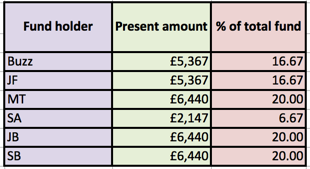
    We are 7% up on our original investment:

    Snip20151107_8

    The name Slow Trader refered to my trading style. Namely my steadiness in terms of: ‘the tortoise and the hare’. It was not intended to refer to the pace at which the fund will grow. I’ve moved from indicator based trading to raw charts and price action trading. This is definitely a trading style where the stabilisers have been taken off. And, as with that analogy, once we are comfortable without the stabilisers we can achieve so much more.

    I have been very cautious only trading with small amounts over many months. We have not missed opportunities because in price action trading there are several opportunities daily. What is important is that we learn how to read the charts with a high level of confidence. Moreover, we need to be able to manage our trades correctly varying our approach, depending, for example, on the trade scenario: trend (breakout or channel) or trading range, swing trade or scalp, scaling in or not, scaling out or not, and on each trade we need to consider a positive traders equation.. only to mention a few.

    The trading amount will build naturally. I wouldn’t like to say if it will take a couple of weeks or a couple of months. It will just happen at the right time. A professional price action trader to go from okay (that is if her fund survives the learning stages) to successful would take 3 to 7 years. I feel that this timeline has been reduced for us due to: my previous trading experience (I wasn’t going in cold to price action trading) my full-time dedication to the process (a luxury most traders starting out cannot do) and sharing my day-to-day learning with my son (James) where we have been able to bring each other along much more quickly than someone working alone would be able to do.

    Snip20151107_11

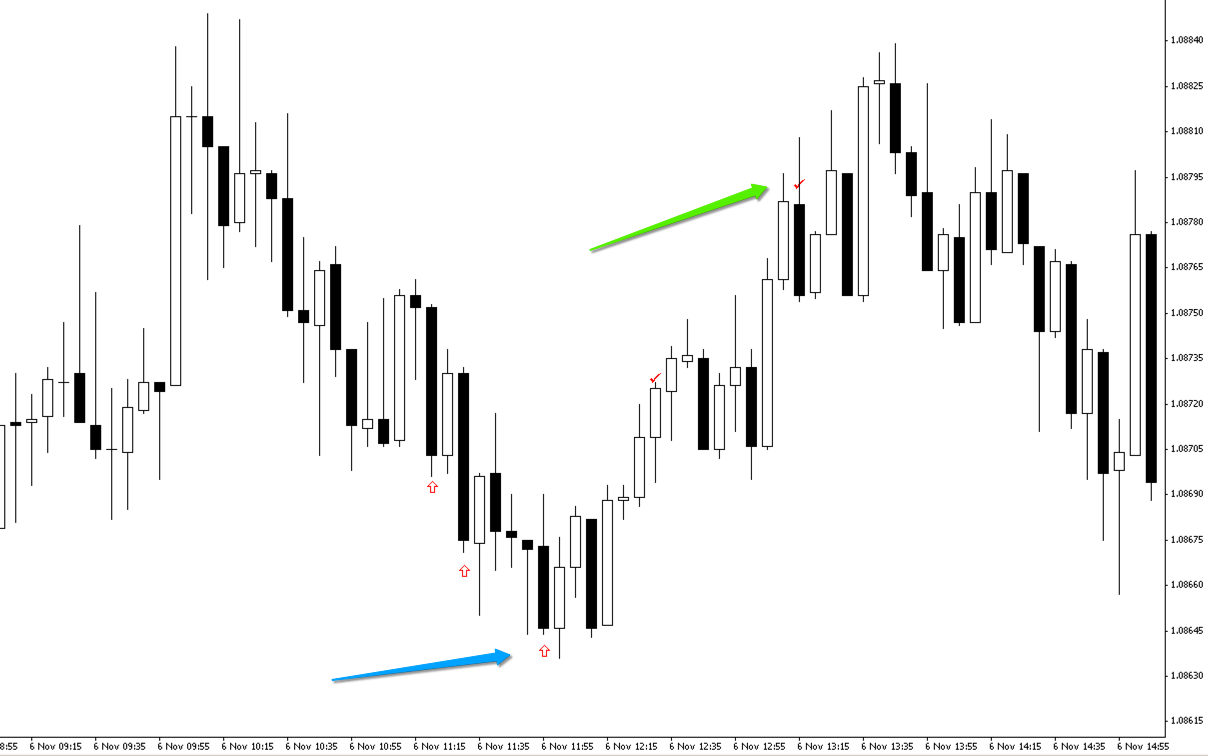
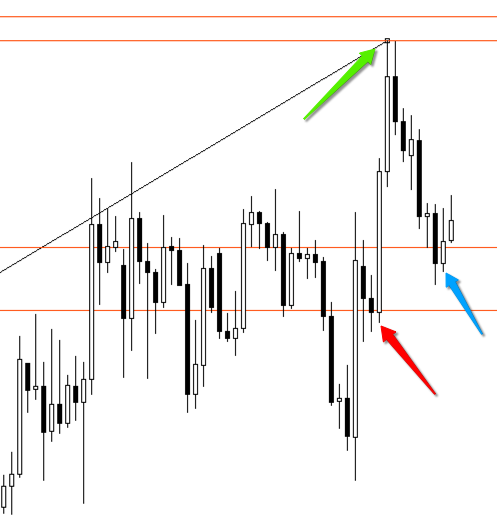
    Above is the 5 minute chart of the EUR USD from yesterday. As we can see, we took a buy at the blue arrow and sold at the green arrow. Actually, we scaled in and scaled out but the result overall is the same. We had done this eleven times over the last couple of days without a loss. However, what I’m about to show proves the need to maintain an overall awareness to what is happening in the market.

    Snip20151107_16

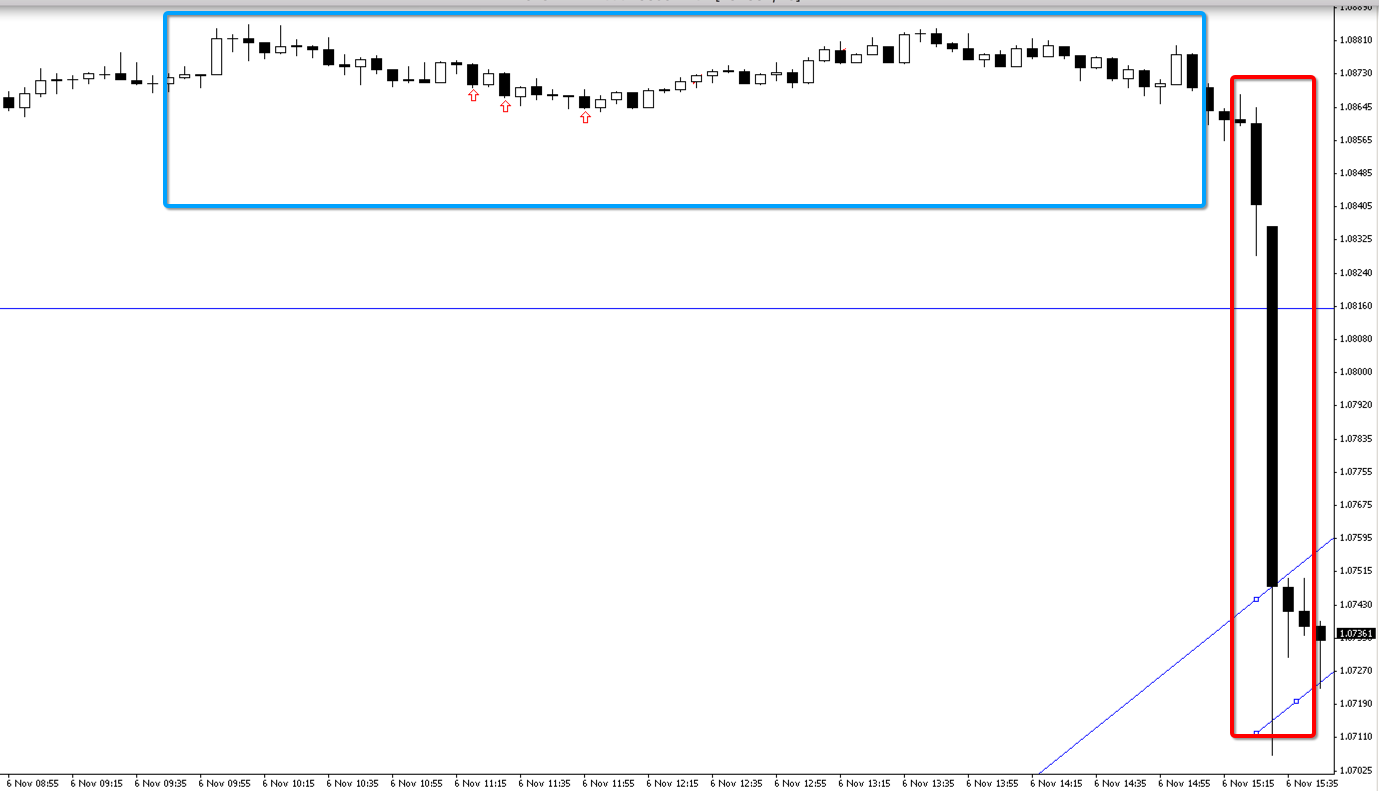
    The blue box above is the same chart information as the first chart. The reason it looks all squashed up is because of what happened a few minutes later: the announcement of the monthly nonfarm payroll in the USD. This large movement distorts the vertical (y-axis). I don’t trade these announcements. They are difficult to predict. Often moving significantly one way only to reverse. The S&P 500 weakened due to the announcement but in the chart above the US dollar strengthened. Also, short or long spreads (the spread is where a broker makes her profit) increases dramatically during these volatile moments. The bottom line is that it is essential to know about these events and if we don’t have a stratergy – stay out.

  • How goes it? Week 25

    For simplification, I’ve combined Slow Trader and Ferrari into one fund which we will refer to as Slow Trader Fund.

    Our strategy in Slow Trader is to short term trade (using, primarily, daily close bars rather than intra day bars) shares in the FTSE 350, stocks in the S&P 500 and major foreign exchange (FX) currency pairings.

    Arm Holdings. We came out at a little over break even. I moved our stop as I was not happy with the possible trend change of this share price. The share price did move below our buy point but has subsequently moved up again. We are out for the time being.

    Halliburton Co. We set this share stop also to a little over break even. This took us out without lose and the share price has continued to drop. A good move on our part.

    BT Group. Moving the stop too early is usually not a good thing. I feel that the stop  should only be moved if something happens to make you change your mind about the share or the share price has climbed sufficiently to put you into a different price bracket. I got this wrong with BT. I moved the stop and got stopped out for £17 profit but the share turned and continued up!

    Ashtead Group. – £311 lose. On reflection, not a good share to take. A ranging share price, rather than my strategy of taking trending prices, this share dropped well below my entry price – but has subsequently turned up again.

    CLS Holdings.  – £325 lose. I made fundamental mistakes with this one. Incorrect retracement level without price action. If I had waited (patience is the virtue of a good trader) and measured the retrace correctly this could have been a winner.

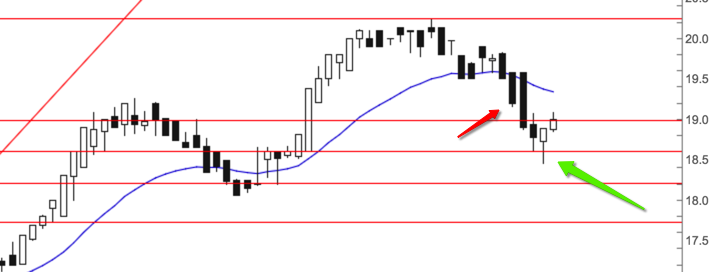
    Snip20150620_7I bought at the red arrow, the green arrow was of course the correct buy point.

    Card Factory. – £311 lose. This is a relatively new share. Only 5 years of fundamental information, I prefer 10 years.

    Snip20150620_8

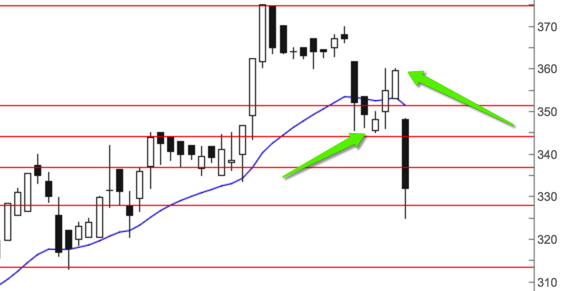
    We were in credit – having bought at the lower green arrow – but a sharp drop took us out. You will notice that I sell a share for a lose (or more accurately, I’m stopped out if a share price drops below what I think is acceptable).

    FX AUD/USD. + £394. This is the first time you have been introduced to FX. This is on an intra day 4-hour chart so you can see the move.

    Snip20150620_9

    We bought at the red arrow, we sold at the green arrow and we bought again (and we are still in) at the blue arrow. Easy! Okay, sometimes it goes ideally like this.

    We also had interest charges (mostly for carrying shares over the weekend) of – £32.

    We are currently in:

    CLS Holdings. We bought again at the green arrow on the CLS chart above. Although the price has moved up we are still -3.7 points as this is the spread. The spread is how the broker (in our case IG) make their money. It is the same as when you go on holiday and change your sterling for euros, you have a buy and a sell rate.

    ITV PLC. + 2.6 points.

    Money supermarket. + 12.1 points.

    Monster Beverage. + 568 points.

    Underarmour. + 464 points.

    WPP PLC. – 9 points.

    FX AUS/USD. – 20.9 points.

    Finally, anyone wishing to short term trade for themselves I am trialling a notification system to help you. You will get my information direct to your smart phone so you will need an account that you can action through your phone. More later.

    B

  • How we are doing, June 2015

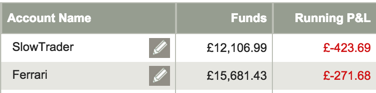
    Here are our funds as we stand. As you can see, Ferrari, which shows share trading, is up. However, Slow Trader, which shows FX (foreign exchange) trading is down.

    Snip20150603_4

    I am not concerned about Slow Trader’s position as the FX market is a difficult beast with great volatility. We are simply learning how to tame it.

    That’s not meant to be flippant. I regularly trade the FX now with over a thousand pounds a day gain. The secret is learning how not to give it all back in small chunks. That is, improving the win loss ratio.

    Our strategies are maturing and I’m confident we’ll see the FX benefits very soon.

    With regard to Ferrari, I am delighted with its progress. We were well over £16K a few days ago. The recent down trend in the market hit us but that, in turn, provides buying opportunities.

    Snip20150603_6

    Going forward, I have spoken to most of you and I get the feeling that there is no great excitement about an income fund at this stage.

    Therefore, although I will still treat the fund as income, I propose that we grow the higher investors to £9,000 each and review the situation.

    One reason to keep the fund lighter, and remember it is a leveraged fund, is my own confidence in trading a larger (leveraged) fund. You may not consider the size of the fund to be large. But because the fund is leveraged (and with the associated risks that imposes on me) – and if you compare what we are doing with a traditional fund – we are talking short term trading with the equivalent of over £100,000.

    Having said that, I feel that as we grow in experience, I am happy to expand the trading fund.

    Going forward, I will now report on the fund as early as possible at the beginning of each month.

    Regards

    B

    P.S. For those who wish to trade for themselves in shares, my next blog will explain my real time share buy information via whatsApp.

  • Hedge Funds Update

    We remain down:

    Sorry, that is how it is. How much down I’m going to keep to myself for a while. I know we’ll be even by the next report, 23rd February. After that, based on patterns, I say that we’ll be up 40% by 23rd April. And after that, until the annual report of Slow Trader Hedge we’ll gain a further 10%. (Ferrari Hedge started later and will fare slightly better).

    We will therefore have a total gain in Slow Trader Hedge of only 50%. Somewhat short of my double prediction.

    What went wrong? Encouragement from you possibly did it, and I have to say good natured encouragement at that. The problem was me. My inexperience of dealing with other peoples money. I tried too hard.

    I could have tried to edge some back over the early New Year but decided against it. When you take a hit, at least in the trading sense, its sometimes best to take a ‘review’ time out.

    Slow Trader and Ferrari Hedge, and my own funds, have been completely out of the market for a few weeks.

    We have only just trickled back in. Building slowly over the next few weeks as buy patterns present themselves and as my indicators suggest.

    I often knock the managed funds, because they fail most of the time. I still have no support for managed funds but I do now appreciate what they have to do. Unlike me, they have additional pressure from share holders, bosses etc; they cannot simply take time out to regroup.

    I continually read that 94% of people that do what I do fail to make the grade. In the case of managed funds, fail to beat the index – in my case, fail to stay profitable, or worse.

    I need to learn from this experience and do my thing – not the thing that is encouraged of me. If that makes sense!

    As a Slow Trader or Ferrari Hedge investor you have no downside this first investment year. Original invested amounts can be returned whenever wanted, and with no detriment to remaining investors.

    But over the next few months…. I think its going to be positively exciting.

  • How to get the most from my retirement pot

    First of all, because of the holidays, the next fund report (Slow Trader and Ferrari Funds) will be about 23rd January 2015. With Slow Trader, we took a hit in the last report and we had 2 or 3 trades that were still to come off. These took us a good 10% lower than my last report. However, on the plus side we currently have several trades that are running and these are in profit. Let us see.

    I’ve made simple but significant changes to our trading technique. In terms of timeline, I’ve come out more – now taking a broader view. To that end we will use the ‘futures style’ purchasing rather than the relatively expensive Daily Fund Bet. This will help to reduce our fund operational costs.

    I’ve back tested weeks worth of trades to find the best timelines for our indicators. There is never a sure bet, if it were that easy…

    However, I am confident that we have something that suits the current market. These things need regular review as what worked a while back might not necessarily work as well today.

    I’ve titled this article – how to get the most from my retirement pot – because that is what I’ve been looking at recently. Primarily to find the best pension scheme for my small company and employees. The one I have chosen is http://bandce.co.uk/ the peoples pension.

    Other than it being internet based, so no middle man, the pension is clear and easy to use and provides some great funds to choose from. More importantly, it only charges 0.5% with no other costs. The low charge over a 20 years or more is significant.

    One of the problems with mutual or managed funds (including banks) is the high management cost of their funds. This is a secret the big funds have kept for decades. For every percentage charged in management you can deduct at least 20% from your final lump sum. If you’re keeping a fund for 40 plus years the percentage is higher than this. Therefore, a managed fund that is costing you say 2.5% will reduce your final award by some 50%. If your fund was due to pay out £100,000 then you would only get £50,000 – maybe as little as £35,000. You’re giving the fund managers potentially £65,000 – and for what!

    How is this possible? Its all to do with that magical reason: compound interest. Probably the most powerful tool you can financially teach your kids, grand kids etc. If you want more proof of this read Tony Robbins recent book Money: Master the Game. Its a mammoth read but well worth it. Obviously the book uses American terminology, but the UK is similar with different names.

    If not managed or mutual funds then how do I invest my money? Simple, self-managed index or tracker funds. This is something that will track a bunch of companies – say the FTSE 100 or S&P 500 – and will cost you very little to do so. In compound terms you keep that £65,000 rather than, as in the example above, give it to a bank or fund manager. Also, don’t let your broker suggest that a managed fund will get you more return over time for your money – your broker is not your friend. Over the last 20 years the stock or share market has gone up almost 10%. The average for managed funds has been about 2.5%. What a difference. Indeed, some 98% of managed funds do not beat the market – or, in other words, do not beat your self-invested index or tracker fund.

    Diversification in funds is important. In our hedge funds, for example, I look carefully at sectors in turn. Careful not to overload in any one sector. An index fund, by its nature, invests through all sectors. How you distribute your money is individual depending on age, retirement goals, health. However, with 15 years to go before retirement be very cautious of being overly exposed to the share market. The reason is that, historically, the share market has taken belly churning drops twice in any 12 year period. The suggestion, therefore, of 15 years gives you a buffer. If you cashed in your fund in late 2008 you would have got nearly 50% less than a few months prior. Not good.

    They don’t get a great press, but fixed annuities are a great way to go. Do not, however, go with the first suggestion from your pension fund if they provide an annuity. Shop around and get the lowest cost. Is a low cost annuity safe? After 2008 throughout the USA hundreds of banks went bust but not one insurance company (an annuity provider) went under.

    I would split my retirement money as:

    • Annuity
    • Go-get-em or growth fund
    • Fun fund

    I would consider 60% of my funds with an annuity. Again, depending on personal funds and circumstance. That is your safe fund. Your income to live on and hopefully help pay the bills. Most of the remainder I would put in a growth fund or a ‘go-get-em’ fund. But of this I would put as much as 50% in gilts or bonds (with a mix of treasury and corporate and the bigger mix being long-term gilts or treasury bonds). Of the remainder of the go-get-em amount, I would put 30% in a cheap to run tracker or index fund: of the small remainder I would split between commodities and gold. My final, now small, chunk of my overall amount would be my fun fund. You might consider the hedge you have with me as your fun fund. The beauty of a hedge is that this fund loves it if the market goes up or down. Both are good. What it does not like is a flat market.

    There you go, I hope that has generated some thought.

    I recommend this 30 minute animation ‘How the Economic Machine Works’ – well worth 30 minutes of anyones time. http://www.economicprinciples.org/

    Also, if you need to check out your state pension statement go to https://www.gov.uk/state-pension-statement

    Have a wonderful Christmas and see you back here in the New Year.

    B