Tag: probability

  • Day trading

    As Jack Welch told us: “change before you have to.”

    Beginners are attracted to day trading because, most of us when we start out, only consider one thing: risk.

    With day trading we’re offered a low-risk and the beginner takes this (usually unsuccessfully) with low probability entries.

    The professional counters by (mostly) taking high probability opportunities.

    This often requires close attention for long periods followed by quick and decisive action.

    Like all the best games, day trading is easy to learn but hard to master.

    As Seth says, “if failure is not an option, neither is (the) success.”

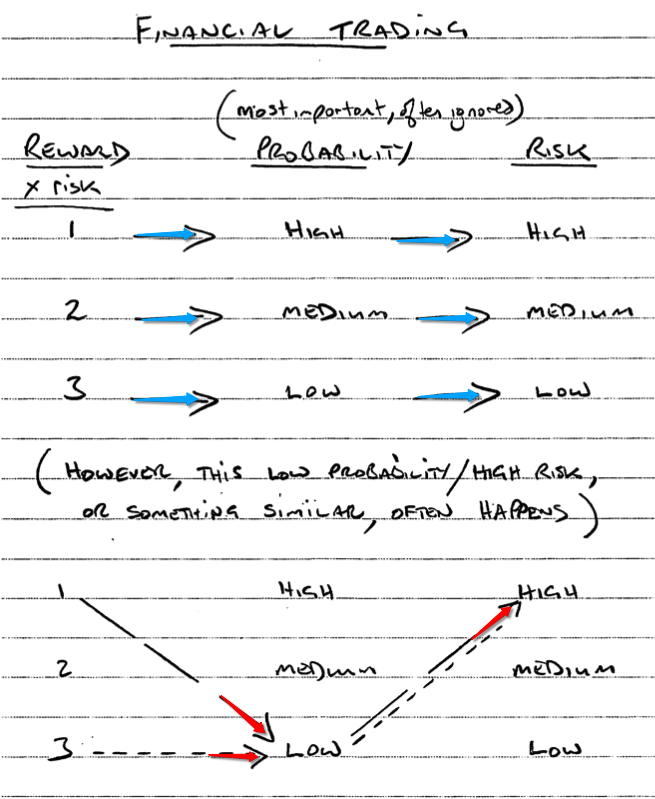
  • Most important, but often ignored

    Probability is something we understand very clearly when it comes to sports, but it seems to be a concept that we struggle with as a trader.

    We realise (because it’s been mentioned a few times) that the difference between a trader and a gambler – if we where to picked one thing – is adding or not adding probability into the mix of reward and risk.

    Some sports lend themselves very well to the example of probability. Basketball, tennis and (particularly) golf come to mind. I mentioned basketball last week because the point scoring matches well the traders multiples of reward to risk.

    In basketball we can score 3 points from a shot taken from outside of the defenders area; 2 points from inside the area; and 1 point from a free shot, if the opponent commits a foul. As a trader we often look to achieve a minimum target that is 3, 2 and 1 times our actual risk. (I like this to be planned risk but it is actual risk that the traders equation depends).

    We could suggest that a basketball shot taken from outside the defenders area has a probability of success that is low (it’s a long way to throw it!); however, the risk is also low as the defending team have little chance of a quick, undefended, attack in reply.

    A 2-pointer attempt is medium in probability as the (6’7″) defenders are there with us in the shooting area. It is also medium in risk as it is a dynamic manoeuvre and often with the full commitment to the shot from most, if not all, of the team; a quick steal and counter attack is possible.

    A free shot is never available in trading, therefore, I’d equate the 1-point attempt, in basketball terms, to the lob up court to a teammate in the hope of a quick score. The risk of interception is high but the probability, if our own team member catches it, of scoring quickly is also high.

    All well and good, but where does this take us in financial traders terms? As a trader, and regardless of which timeframe of chart we trade, we’re all looking to take trades where the probability, reward and risk make good sense. To do otherwise is, as we’ve said, gambling.

    As an aside, as a trader we’re always participating in the basketball equivalent of the NBA championships because the trading professionals (institutions and the like) make up most of the opposition and in this ‘zero sum game’ they’re always-in.

    In our basketball match, if we lob the ball up court but we don’t have a team member to receive it we have given the ball away; if we take a 3 point shot at basket when we have no defenders between us and the basket we have merely reduced our probability for no good reason.

    Our judgement of probability in sports is generally very good – instinctively making a workable probabilistic assessment; but as a trader we often ignore this all important aspect.

    Technical trading is a financial ‘sport’ where we can only participate against the professional league. At that level we cannot get probability, reward and risk confused. To do so is the same as chucking the ball up court without a receiver.  As want-to-be traders however we seem to do this all the time (ignore probability) and wonder why we don’t win.

  • A three-pointer, bar by bar

    I played a lot of basketball as a young adult. A sport relatively new to the UK at the time, I consider it the one major factor that gave me the confidence to go on and achieve my career aspirations as a pilot.
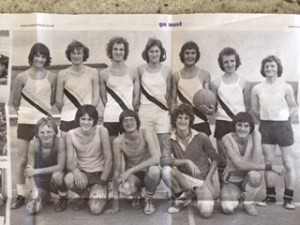

    The shot on the left from sometime in the early 70s and the reunion (good to see there is little change!) last week.

    How to relate this to trading. Well, sometime in the 80s the basketball three-point rule was introduced. This is a lower probability shot taken from beyond the three-point line, a designated ark surrounding the basket.

    Thank goodness they introduced this, as our opposition last week were younger (obviously), fitter, bigger, stronger – we had little chance of getting near the basket for the more probable closer shot. However, our long-range (low probability) shots, and particularly from the little bald guy on the left, were excellent.

    The equivalent in trading is a trade taken at an inflection point, where the probability is low but the reward can be at least three-times the risk.

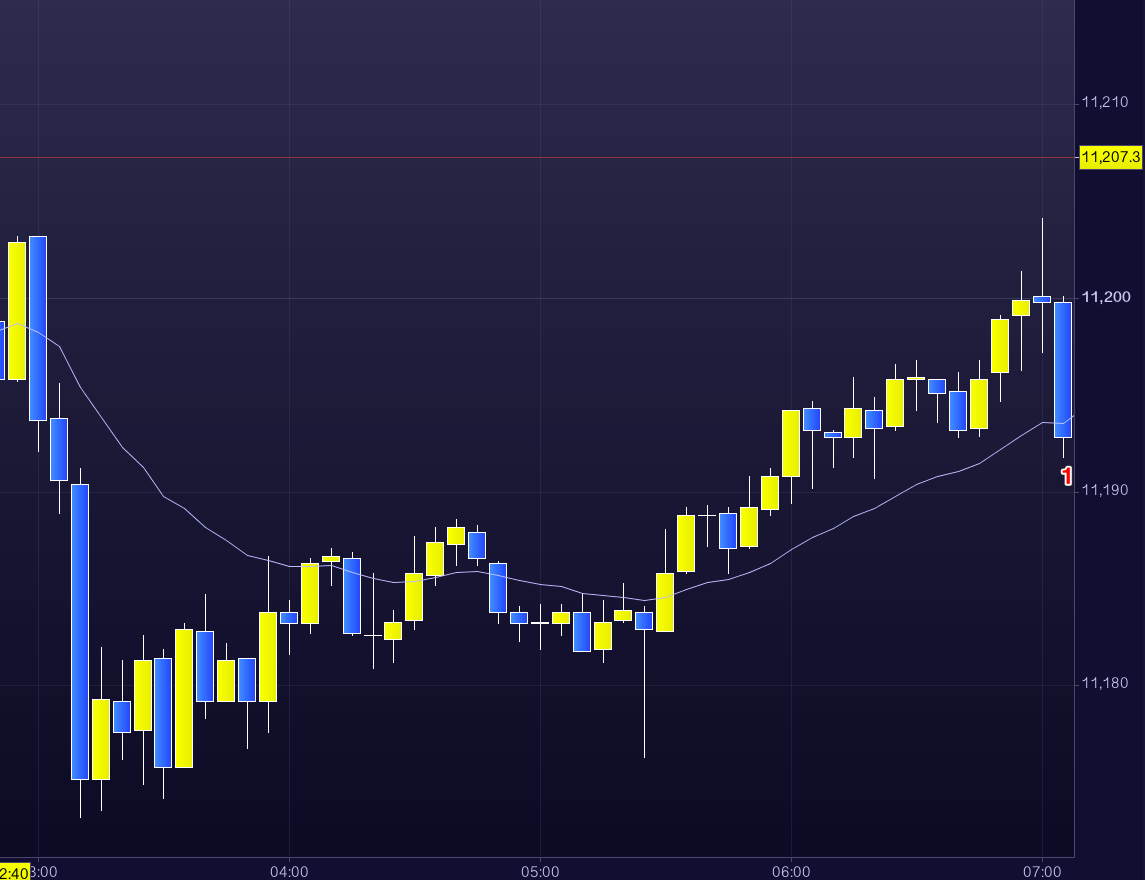
    Here’s an example: a bar by bar trade taken yesterday morning.

    (Before I do so, I must explain that due to the uncertain volatility to sterling from Brexit negotiations I’ve dedicated myself over the last couple of weeks to being familiar with the currency pairing USD/JPY. You may recall that previously I favoured GBP/JPY. The former has, in general, smaller bars, however, the spread is correspondingly small.)
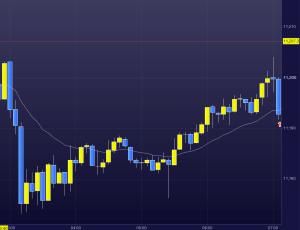
    For a couple of days the chart has been in a broad trading range. From the higher timeframe chart (not shown) the upper channel of the range is higher than bar 1 marked on the chart. However, as the higher time frame chart is always in short it would not be unusual for a decrease in price at this point. From the close of bar 1 we only have a moment to decide. I enter the trade short.
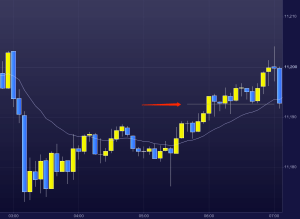
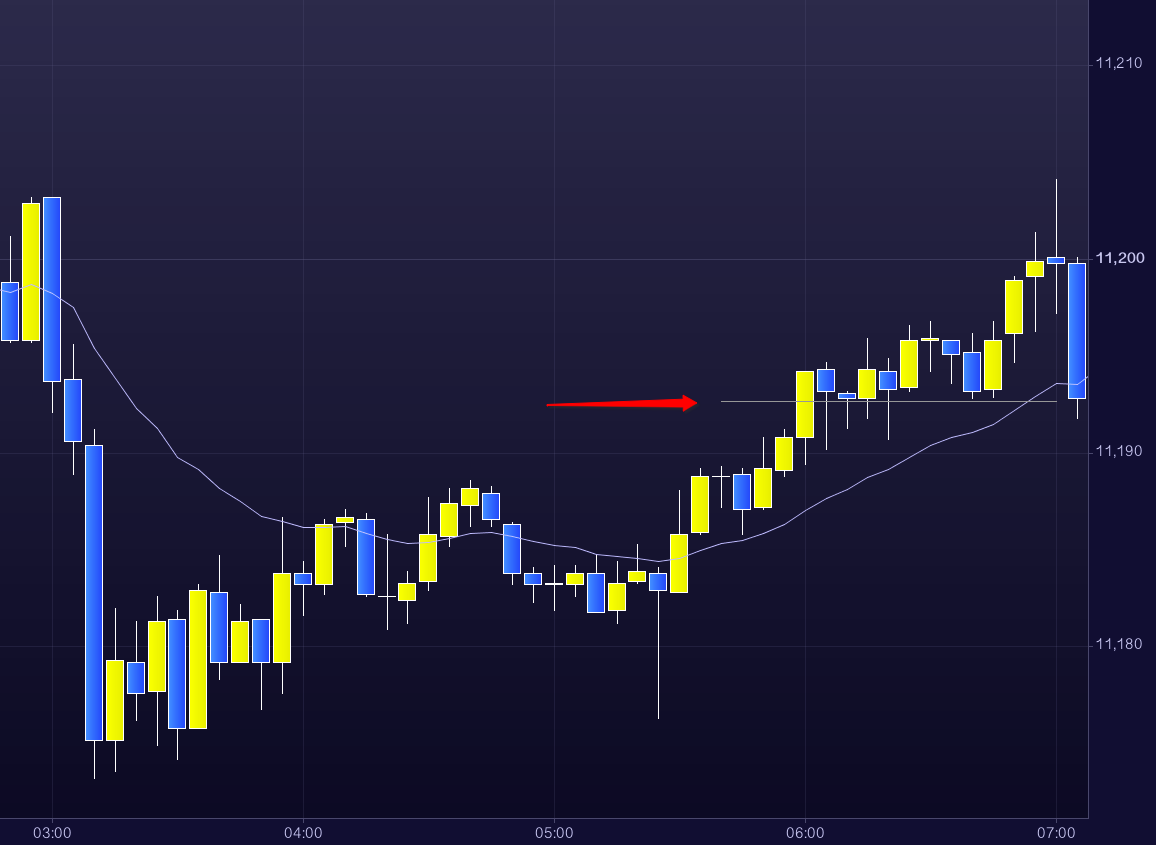
    We are aware that the close of our entry bar has engulfed several of the previous bars and closed below the 20 bar exponential moving average. However, significantly the bar has not yet crossed a change in premise line (marked by the red arrow). In basketball terms, a weak two-pointer.
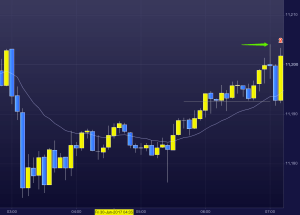
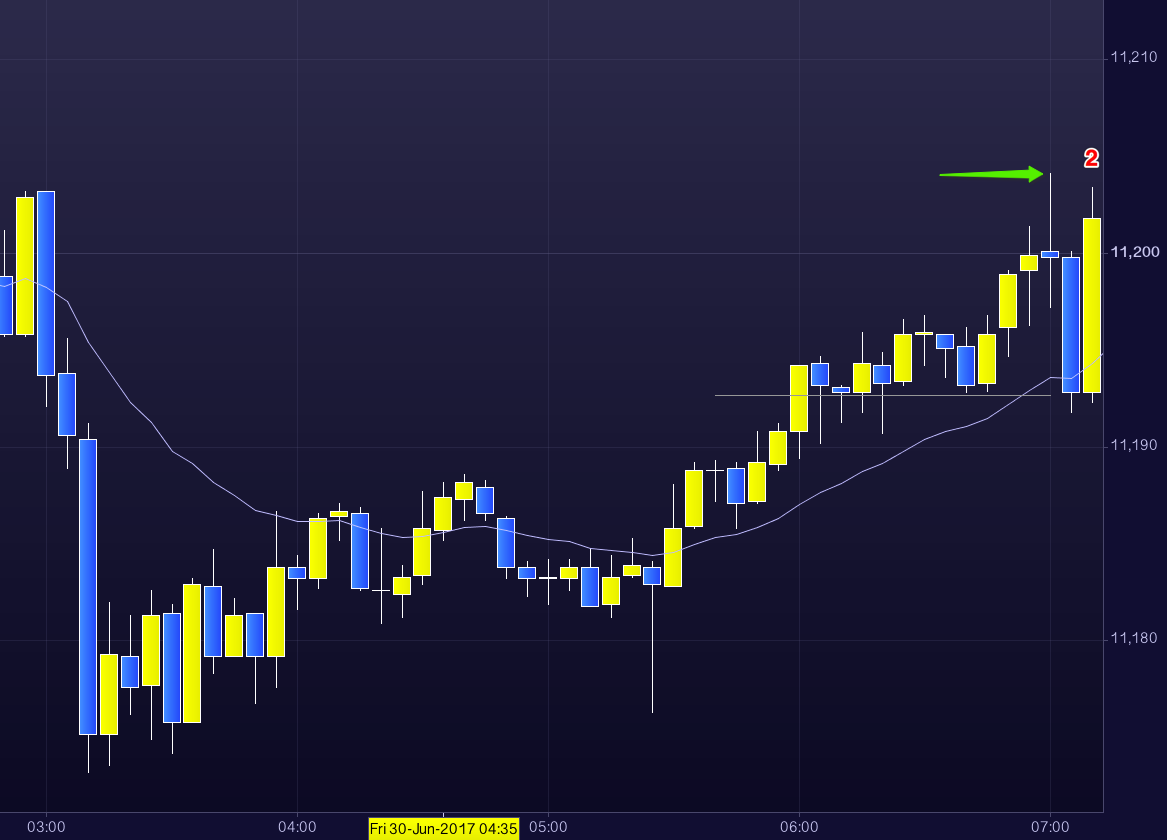
    The next bar (bar 2 on the chart) goes against us. It closed higher than previous closes but is still below the recent wick marked by the green arrow.
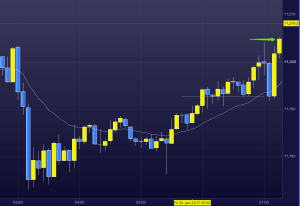
    Another bar higher, a close beyond the wick and the likelihood of at least another move higher (and probably up to the channel line of the higher time frame chart). We’re out of the money with this trade. But we’ve structured the trade so that we have a distant stop position.
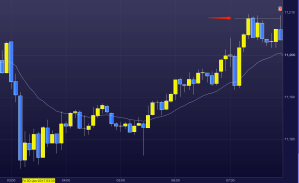
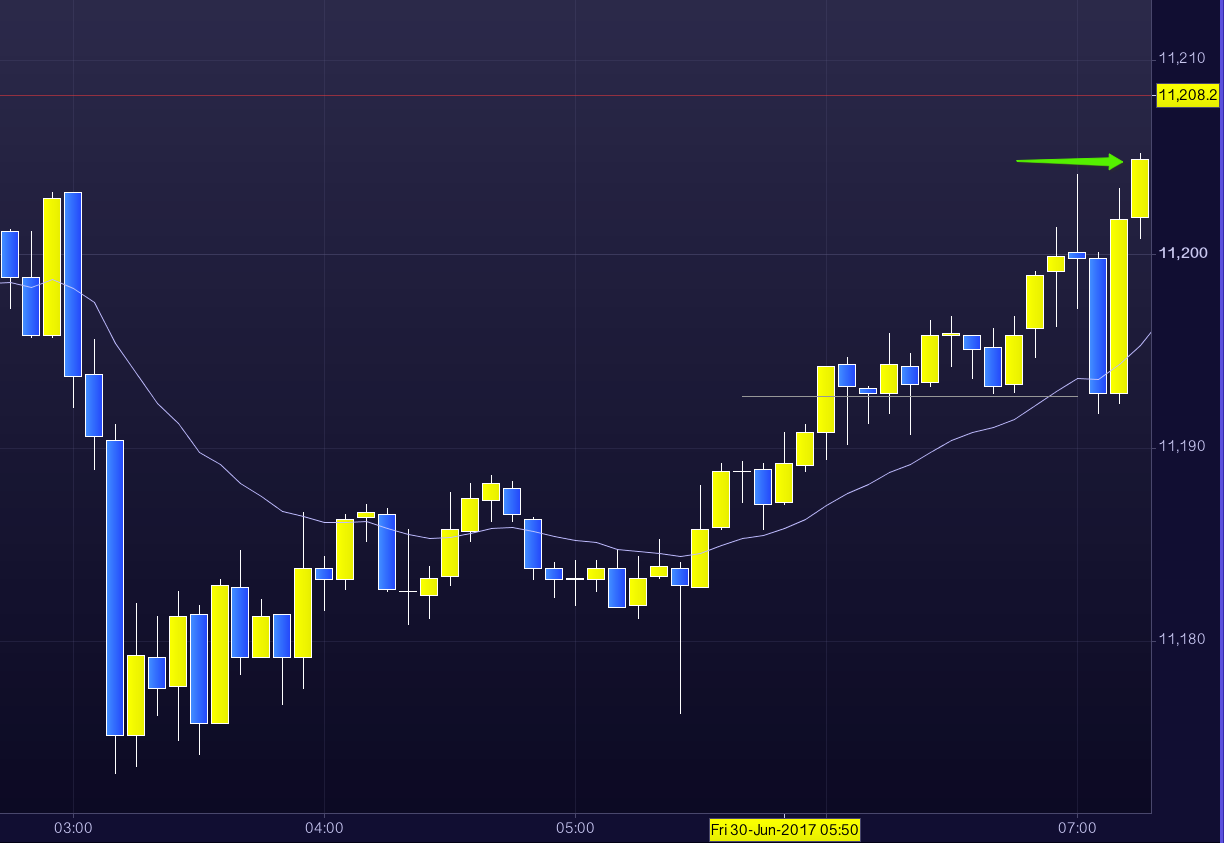
    Price starts to show some bearishness again and after a slight pull back we set a limit order to short at the high of the previous bars which gets filled from the wick of bar 3. (A low probability three-point basketball shot!) We are now entered short twice – once at the close of bar 1 and again from the high of bar 3. (Our stop for both is at least a measured move above the last leg of bar 2 and its subsequent bars).
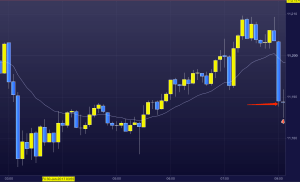
    Hurrah, we get our anticipated short which puts us back into the money with our initial entry and in good profit with our second entry. The doji at bar 4 puts uncertainty back into the mix, and I exit both trades.
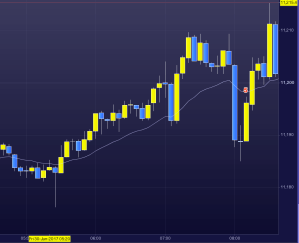
    This was correct as the market then went long. The purists would say that bar 5 is a good probability long…..however, after a ‘three-point bounce off the ring and in manoeuvre’ I wait, stay flat and gather my thoughts.
     

  • Nothing to lose

    I hear this a lot in sports “I’ve got nothing to lose….”

    But it does work. It is obvious in tennis, a sport I watch whenever I can. A game, for example, that is closely matched but the score, not reflecting this, has one player up a couple of sets. Often the opponent with “nothing to lose” at this point turns the match around.

    This is a mindset that I use in trading but in a different way to our tennis player. Let me explain:

    If I were to use the sporting analogy in trading, that is, I’m on the ropes and nothing to lose, it would be the way of the gambler. No planned consideration from the outset of probability.

    The participant in our tennis analogy starts out risk averse but then with “nothing to lose” relaxes and wins low probability shots. The opponent that is two sets up, looking for the final set to win the match, goes the other way only taking high (predictable) probability shots.

    Unlike our tennis player friend, the expert trader has a planned “nothing to lose” attitude from the outset. The (retail) trader does not have to return every ball. We can wait to take the high (obvious) probability trade when we know our opponent is wrong footed. When we do take the low probability trades we do it (staying with the analogy) at a crucial point in the game where the reward is many times the risk.

    In other words: “I can only lose a relatively small portion of my funds with each trade. With low probability trades my wins are a few times greater than any potential loss. On high probability trades I’m selective with my entries.”

    With this in mind, and with lots and lots of practise, I can be properly confident and relaxed, over the longer run, because I manage probability, … nothing to lose.

  • Not a good idea to match experts

    Each of my faults, the ones that I’m aware, seem to balance themselves out.

    For example, my type of dyslexia (probably detectable in many of my spellings) gave me reading problems as a child (I’ve overcompensated as most would now consider me a voracious reader) but was balanced by my skills in mathematics.

    Later in my career as a squadron commander my propensity to change my mind in a flash and go with a different tack was undoubtedly frustrating for my management team.

    That same trait is, as it turns out because I wasn’t aware that this oddity of mine could possibly be put to advantage, gives me a traders edge.

    That is because in trading, and in particular my chosen method of short-term trading, is based on probability. Where (according to Taleb) probability is about the belief in an alternative outcome, it is not about the odds.

    Beliefs (Taleb goes on to say) are said to be path dependent if the sequence of ideas is such that the first one dominates. We may be programmed to build a loyalty to ideas in which we have invested time – a good salesman, for example, will take advantage of this principle.

    A great trader on the other hand will change their belief (probability assessment) in an instance. That is why it is not a good idea to attempt to take the same trade of an expert: we know they are long, they said convincingly that they are going long, we follow and take the trade long – the expert went short.

  • Probability

    Most are aware that I took losses at the end of Trump week. No blame to the US president-elect, the responsibility is all mine. Ironically, it came after my boastful ‘fulfilment’ blog. Hey-ho.

    Losses always take ten times longer to make back. But they’re lessons we’ve paid for so we should heed them. To that end, the basics of what we do have not changed; however, entries and targets most certainly have changed.

    We’re all familiar with the concept of risk and reward. However, we rarely consider the third equal partner – probability. In general, the smaller the risk the smaller the probability.

    Therefore, we’ve increased managed risk but also increased probability by taking trades that meet our “always in” criteria. This is not simply trend but a trade taken with context in the direction of a trend bar that has broken a premise point.

    Here’s an example from yesterday of what I mean:

    snip20161203_1

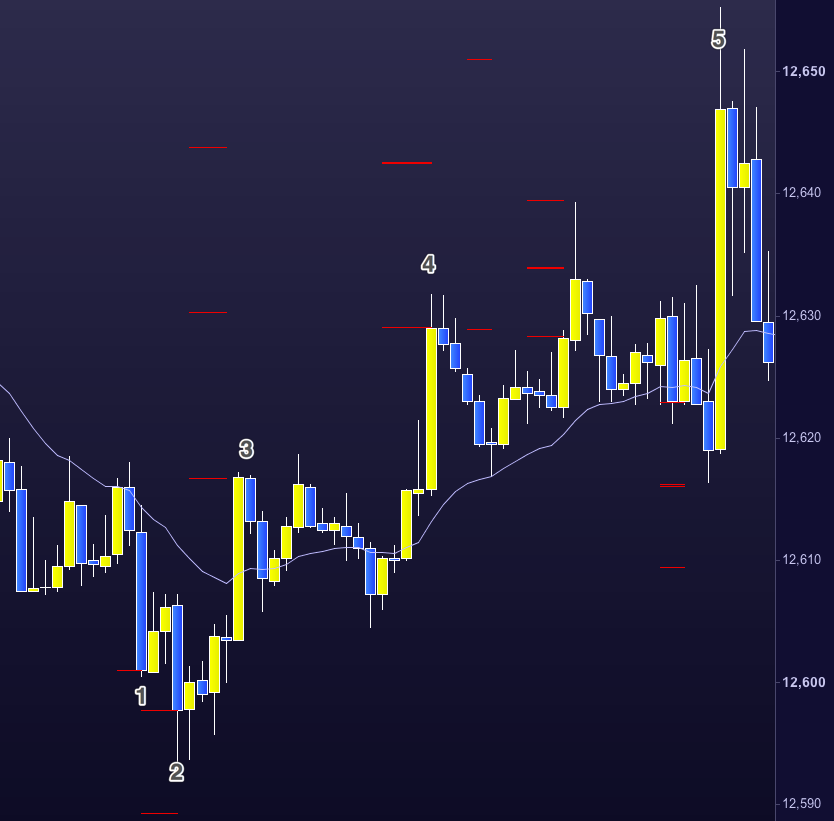
    Left of frame is a down trend with a classic 3 push down. Three measured pushes usually means a reversal. Previously we’d be looking to take the bottom of bar number 1 long, as it’s the third leg down. However, bar number 2 was a ‘final flag’ or a final extension down. Our stop may have previously been set close below bar number 1. Thereby providing a low risk but also a low probability trade. In this example we’d have been stopped out at bar number 2.

    We now, as we did yesterday, enter the trade long at the top of bar number 3. This is arguably a higher risk but higher probability entry. We can see that this bar has also closed above a line of premise. Meaning above the previous high bars to the left.

    The red dashes are my measured targets. My target was close to the top of bar number 5. However, in this instance I came out earlier as bar number 5 was a news based US monthly non-farm payroll announcement – and they can be quite another thing.

  • Think like a trader

    A Trader, unlike an investor, will calculate very clearly how much they are prepared to lose; and that has to be an amount that does not alter a traders objectivity.

    All trades are somewhere between a 40% to 60% probability. There is no certainty in trading.

    However, the lower probability trades need at least double the reward to risk. In such a trade if our trade amount is say £200 we would expect to achieve a reward of at least £400. If not, we don’t take the trade. In such trades, however, a reward many times the risk is possible. If managed consistently well such trades can be profitable with only 30% of trades being winners.

    In the higher 60% probability trades we need a reward at least one times the risk. Therefore, if our trade amount is again £200 then we would need to achieve at least a £200 reward. Even if managed well, such trades still require better than a 70% success rate to be profitable.

    Achieving a profitable traders equation is vital. And determining what is a low or high probability trade, and therefore determining the reward required, is a necessary skill.

    How do I decide the trade amount? I simply use a 44th of the fund amount and trade half that amount on intraday chart trades and the full amount on daily chart trades. I would consider 3 to 9 trades a day on intraday charts, and 1 to 3 trades a week on daily charts, to be an average.

    I have traded the last month with a low risk amount of £20 per trade. This I find is a good amount to prove back tested strategies and still remain objective. The results are exciting and we are ready now for a gradual increase again to full amount trades.

  • Is the medium-term market prediction a coin toss?

    There are any number of ways to tell us what the market is going to do next.

    1. We could consider market cycles. This is a big favourite of Larry Williams. And within reasonable tolerances he does seem to get it right.
    2. We could use fundamentals. Which is looking at the books to determine a companies economic well-being.
    3. We could use technical analysis. Which doesn’t care one bit about the ‘value’ of a company but uses charts to show predictable patterns.
    4. We could listen to the, more often than not, short-term media comments, and panic!

    We all favour one method or another. I’ve tried all of them, but I do stay well away these days from number 4.

    The current probability of the market going significantly up or down, over the medium term, is 50/50. That is the same as betting on a coin toss. I wouldn’t do it.

    (….okay, I do take trades that have no better than a 40/60 probability of success. But that is because the reward to risk is so good. And if we consistently play the 40/60 rules correctly, and let them run, when we catch one…. voilà.)

    As a trading style, I favour the very short-term stuff, it’s based on technical analysis, and it is how I manage the slow trader fund. I also favour the very long stuff (30-years plus) based primarily on fundamentals with the buy timing helped by technical analysis.

    Everything in between, I leave to the coin tosses.

  • Weekly Diary – Slow Trader Fund 28th November 2015

    Here’s a potential trade from the middle of this week that, for one reason or another, I did not take but one that I think illustrates the potential of Price Action Trading when done well:

    Snip20151128_26

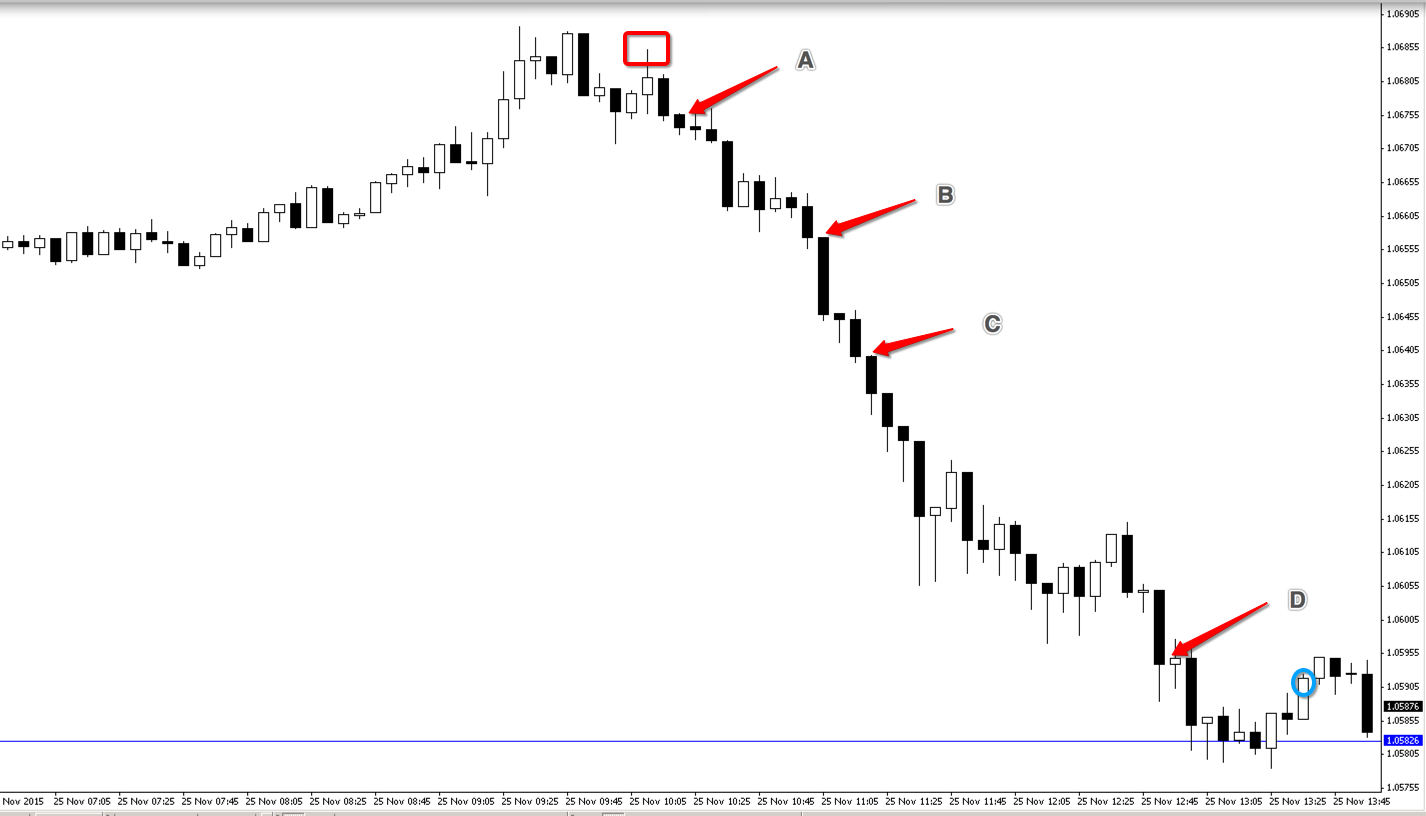
    This is the EUR USD 5 minute chart for Wednesday 25th November. The red square was at 8 am (UK time). For the watchful this showed itself as a major trend reversal (MTR) or a lower double top. (There is nothing major about a MTR because in a higher time frame, say the daily chart, this is just a medium-sized doji bar of no spectacular context).

    However, on the 5 minute chart a good sell (or short) position was shown at position ‘A’. MTR’s, such as we have here, have a probability of about 40% in working. Therefore it is more than likely that we will lose our money. With this in mind, we need to manage our trade accordingly. That is, trade an amount that we can afford to lose. Placing a trade at ‘A’ we would have a stop (a position we will get out with a maximum loss) just above the highest bar. About 20 pips away. Lets say our maximum trade in this situation is £9 per pip, therefore we have a 60% chance of losing £180 – plus the spread so we’ll call it an even £200 risk.

    We have to be confident with our read of the charts. At position ‘B’ we are provided with an opportunity to add to our trade. If we do so we could place an additional £9 trade with our stop now for both the ‘A’ trade and the ‘B’ trade at the opening (original) position of our trade at ‘A’. That is: we have a break-even stop for our first trade and again about a £200 risk for our second, or ‘B’, trade.

    We then follow the same sequence of events at ‘C’ and possibly again at ‘D’. We would exit the whole lot at the blue circle. To be fair I would probably have managed the trade on the way down and exited some of my trade earlier, just below ‘C’. However, you probably get the message.

    Trading a MTR is only one of many strategies. A MTR is high risk, no better than a 40% chance of success, but the reward compared to the risk is high. In this case the reward was 4 to 1 for the initial trade. The potential return from this trade, if managed correctly, and with entries as I’ve suggested, was in the region of £1700. That is assuming that the trades were held all the way to the blue circle and that the trade at ‘D’ was exited at break even.

    Not a bad return for a mornings concentration.

  • Weekly Diary – Slow Trader Fund

    A week of lessons and some missed trades.

    A few areas that I’ve traded this week have been disappointing. Not by judging the trade correctly, far from it, that has been good, but by being stopped out too soon. A novice trading error possibly. It’s a great lesson to take forward.

    Here are the trades in question:

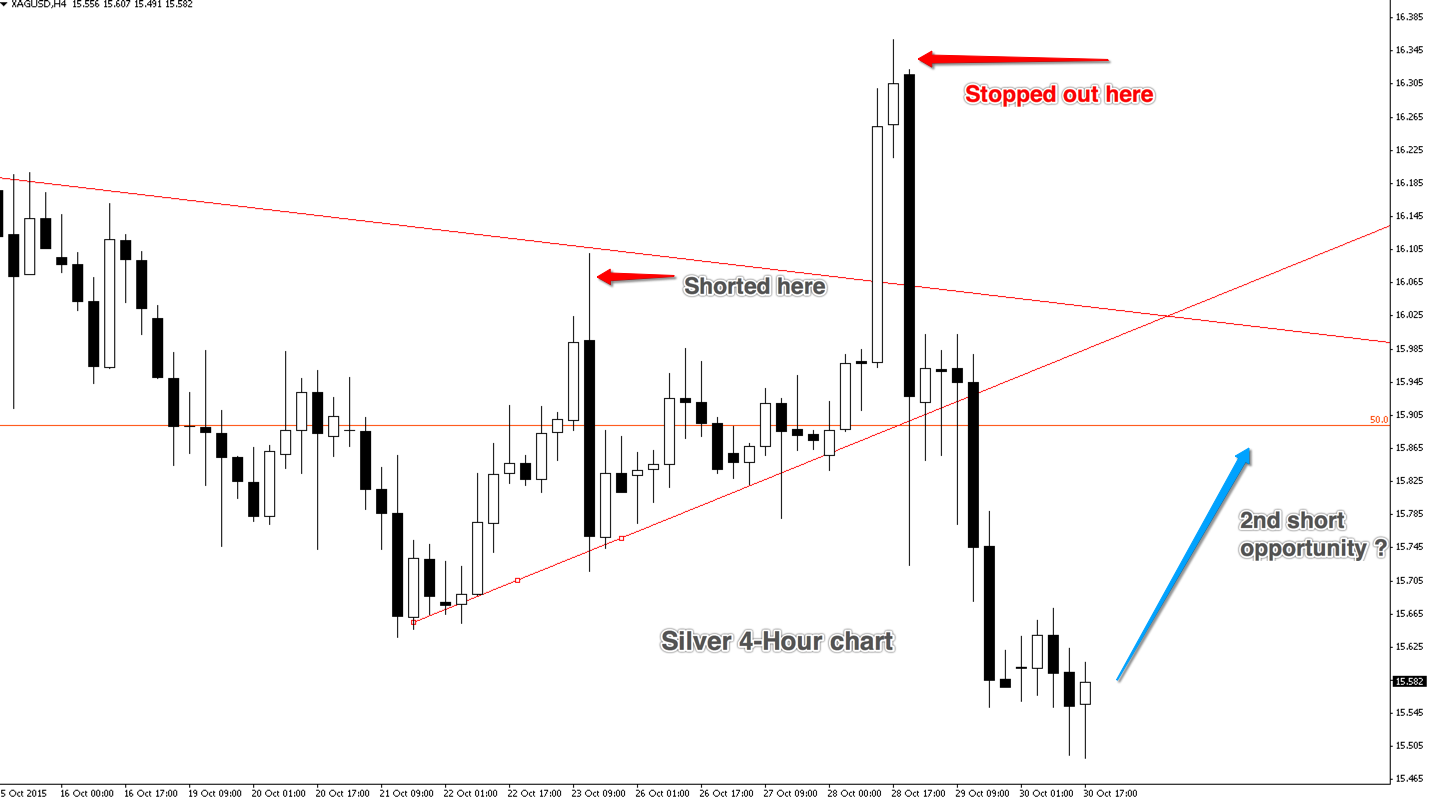
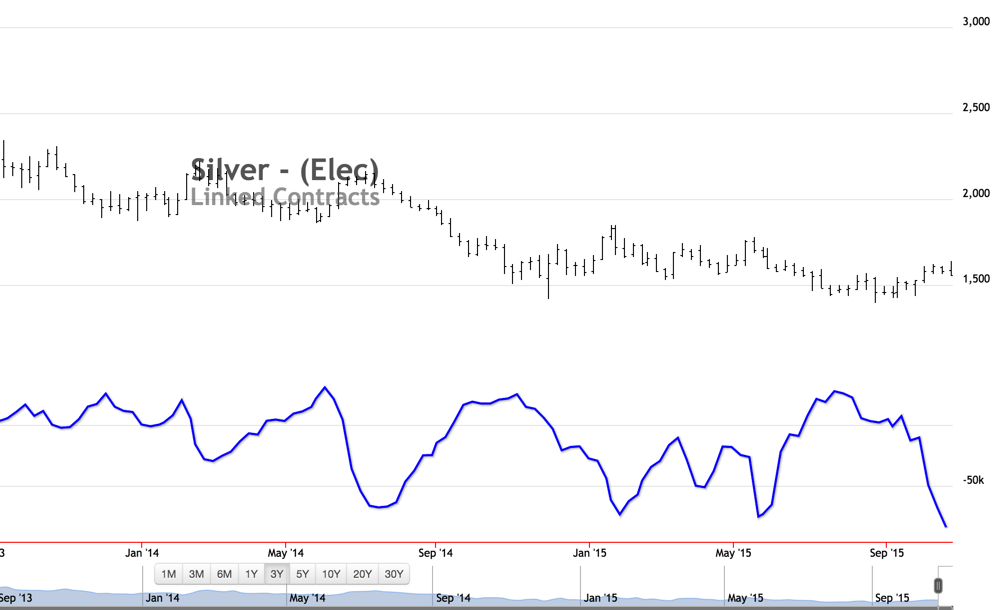
    Silver. We had a good ‘short’ signal for silver. Both on the chart and the COT. The COT was a little early, so I set what I considered to be a good size stop. A stop is the exit point, the point at which we get out and accept our loss if all goes wrong. Notice on the chart below how the price climbed to almost the exact position of my stop. A stop twice this distance with a reduced trade amount was the answer. We may have a second chance if price retraces as I’ve indicated with the blue arrow.

    Snip20151030_13

    Notice the COT below for silver. It is at a 3-year low shown by the blue line. Once this turns up, and remember that the COT is big picture only, this will support a short for silver. Gold has also come down with a similar, although not quite so pronounced, COT picture.

    Snip20151030_14

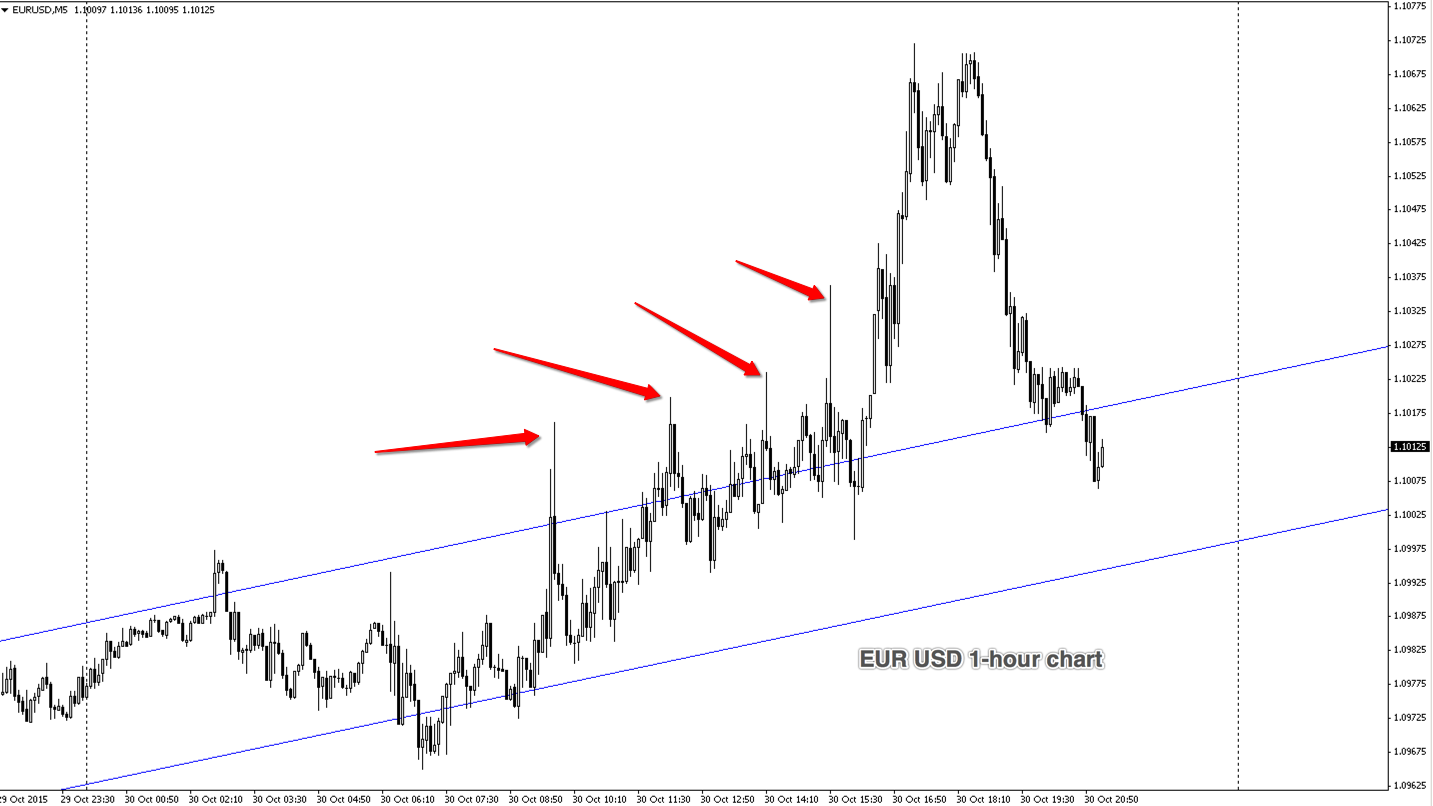
    EUR USD. The currency pairing of EUR USD is one that I trade day-to-day. Notice how volatile this currency has been of late. I have provided the 1-hour chart to illustrate this by showing several recent spikes up.

    Snip20151030_18

    The spikes may not look like much, but to a day trader (trading an intraday chart) they are a challenge. Again a significant stop distance (about 40 pips) is necessary. However, this makes for difficulty achieving a traders equation of 2:1 on a 40% probability trade, which is the minimum requirement for most swing trades.

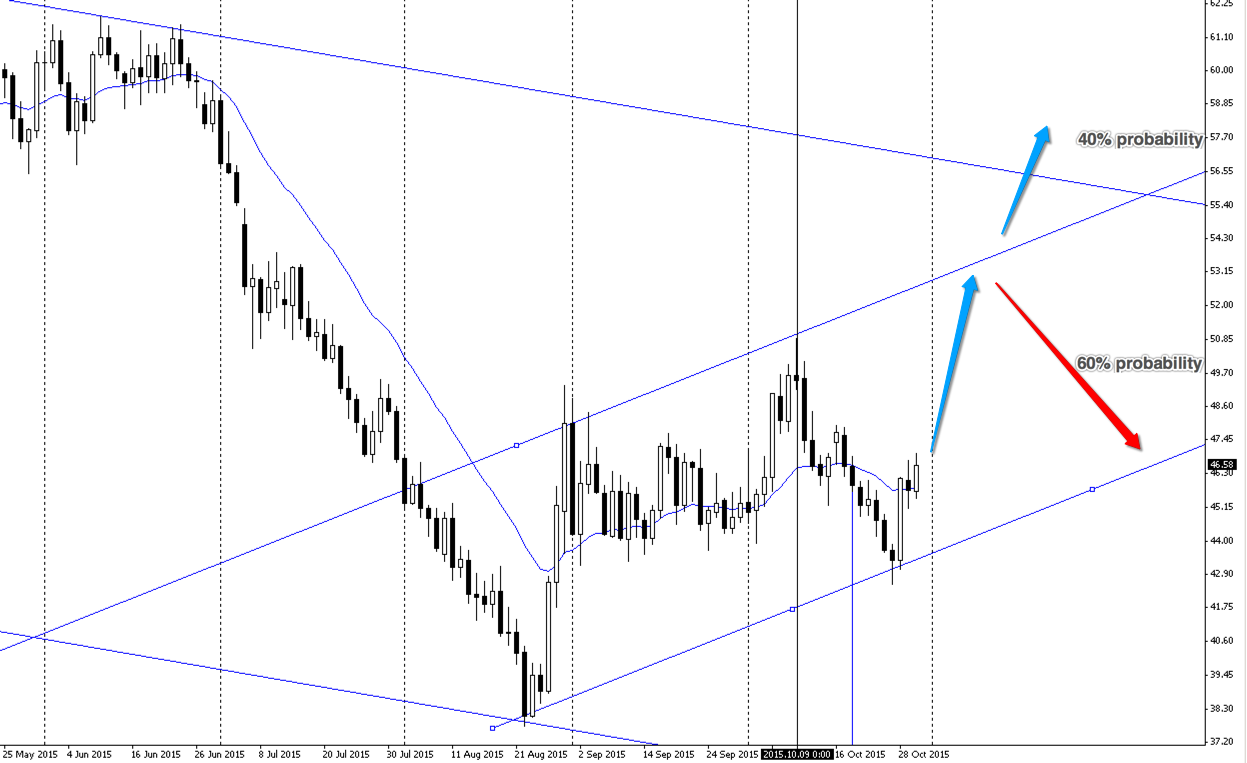
    Crude Oil. A wide trading range has developed for WTI. The Price of WTI moved down to coincide with the top of the first daily breakout. An expected phenomenon . The (buy) signal, although bearish on the daily chart, was good in hindsight; however, I will look for a second entry opportunity to go long if price retraces back to the lower trend line and again provides a good buy signal. After that, I’d expect price to climb to the top of the channel that I’ve drawn with a 40% or 60% probability of ascending or descending respectively.

    Snip20151030_19

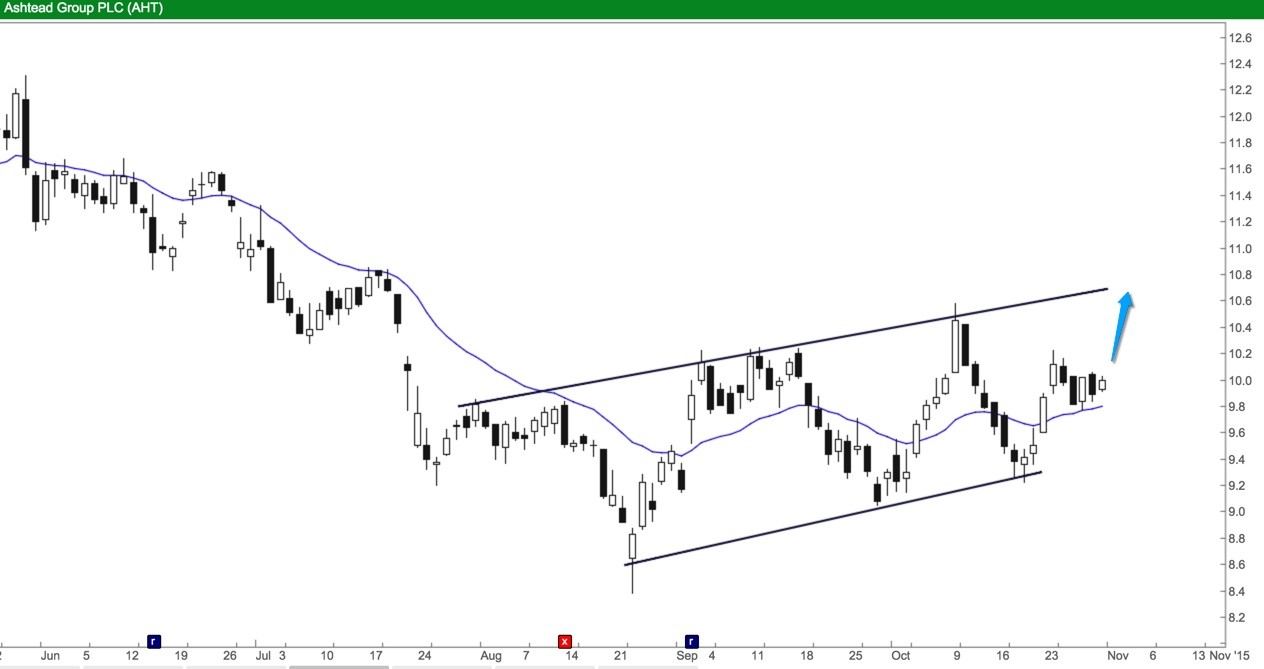
    We remain in Ashtead Group PLC with a target shown by the blue arrow below.

    Snip20151030_20

    Finally, A reminder that Slow Trader values will be provided every first Saturday of the month.

  • The most important thing is…

    60% probability of success is the best we can expect from a trade. Even if we think it’s a cert.

    If we look at a trade and say, ‘yeah, I think that will definitely work,’ then the probability is still, at best, 60% that it will happen as we want it to happen.

    On the other hand, if we look at a trade and say, ‘yeah, I think there is a chance of that working,’ then it’s a 40% probability.

    In other words, the best we can expect is between 60% to 40% of being right in any one trade.

    Therefore, our reward needs to be at least twice our risk in a 40% probability trade and at least equal to our risk for a 60% probability trade. Each of these make a positive traders equation.

    Striving for trades that give a positive traders equation is the way to make money over a series of trades.

    Achieving a positive traders equation is the most important thing to grasp, and do, as a trader. 

  • Investing or Trading?

    Investing first:

    Investing is buying into something that appreciates. In stocks and shares, any price increase after about a year is 100% because of the fundamentals: the strength of the books, the management, the continued saleability of the underlying product….to mention a few.

    Most of us have investments in pensions or managed funds.

    Over a bunch of years the market goes up about 9% on average. However, somewhere between 7 to 15 years the market crashes. Timing is everything.

    Moreover, most pension and managed funds don’t beat the market, actually an astonishing 95% of them; on top of that, they charge several percent annually to do so.

    If we need our invested funds, 15 years before would be best, move it into something that is not market based, at least not ‘fundamentally’ based.

    Now for trading:

    Trading is generally over a shorter time frame and is mostly technical based: that is, the reaction of price when price reaches a support or resistance. In its simplest form, it is one person’s opinion (or computers) against another.

    And, as a computer does not have an opinion – it is of course emotionless – that presents the biggest obvious challenge to most human traders.

    Some 75% of trades are institutional based (the big money). The remainder is made up from other entities such as high frequency trading (HFT) systems, large hedge funds and the like. Smaller (professional) organisations and home traders represent less than 5% of the market.

    To be clear, when the (small) professional trader or home trader trades she is up against the institutions – computers mainly – so she better know her unemotional stuff.

    That is probably why few home based traders, particularly lower timeframe traders like day traders, make it. Cheery, eh.

    The one factor more than any responsible for successful trading is – no it’s not luck – is trade management, boring as that sounds. Good trade management always provides a positive traders equation of: risk, reward and probability.

    Without a clear calculation of each of these (and probability is often the one that is missed) then we are not trading but doing something else…gambling, maybe.