Tag: GBP/JPY

  • A chart mix

    My mother missed her step coming off a pavement and fell and broke her hip. She is doing remarkably well and I look forward next week to getting back to my trading, I’m a couple of weeks behind.

    Trading GBP/JPY on the 5 minute charts works well for me. I like the size of this market and on many days GBP/JPY can be quite defined. Anyone familiar with EUR/USD or even GBP/USD will find GBP/JPY quite lively.

    Many that trade major pairings will not take the spread into consideration, a mistake I think, but not a big one. Particularly if they trade from 15 minute charts or higher. GBP/JPY however, on a lower time frame, teaches us the necessity to consider the spread. To do otherwise, and be consistently profitable, is more difficult – I think.

    To make the best of both possibilities I’m happy with my results of concurrently trading GBP/JPY on the 5 minutes chart (as the priority chart) with a watch on USD/CAD, Gold and EUR/USD – each of which are on the 15 minute chart. I tried many possibilities but these choices give me good opportunity, diversity, liquidity and a spread value that I prefer.

    For example, GBP/JPY does not work with GBP/USD as both react almost in unison. Moreover, oil is often a mirror image of USD/CAD: so to trade one would have too much influence on the other. I do find that Gold and EUR/USD often have similar movements and on such days I consider a swap to AUD/USD or (and I’m in the early stages of this) the US 500 SPTRD.

    Other FX pairings, and particularly exotics, are not considerations for me. Primarily due to spread but also we are dealing with randomness and probability, and we don’t need big uncertainty too. As already mentioned, I’ve looked carefully at the US 500 SPTRD and this is a possibility on the 15 minute chart with good liquidity once the US market has opened.

    To trade the fund on the 4-hour charts is not possible (for me anyway) with already four intraday charts to manage. If my results are what I know they can be (and so far so good) over the next few weeks I will consider how to join the slow trader fund within this – more intensive – methodology.
  • Do it (trade) like a casino

    I day trade the currency pairing GBP/JPY with 5-minute bars as the primary chart. My edge for these trades includes: the recognition of context, or where the chart is in regard to a trend or a trading range; my strict minimum trade requirements (as I’m a retail trader I have to pay and, therefore, consider the spread); and, finally, my Green Line Entry Measure (GLEM).

    Each of these points are contained within a strategy that I’ve proven through ‘live’ trading and rely upon to provide consistency over time for all of my trades; a strategy – because of the nature of the game – that is always open for amendment. A strategy that makes us more like a casino; the management of the casino rather than the gambler.

    A casino – after taking into consideration all the big winners, the big losers and everyone in between – will consistently take 4.5% in profit from all takings, over time. That is because they too (the casino) are working to a tried and tested strategy. My volume is, of course, nothing like a casino, so I need to take trades that are 60% probability or better. If less than 60%, on the rare occasion that I select low probability trades, I need to have a consistent reward/risk that makes the trade worthwhile.

    Moreover, I also trade the Slow Trader Fund in several currency pairings, the commodities of gold and oil and Nick’s top FTSE 350 companies. These are all traded with the 4-hour bars as the primary chart. I’ve chosen 4-hours as this provides multiple trading opportunities a week. Moreover, with my day trading my charts need to be linked to my broker as I require an accuracy here of 0.1 of a pip. These charts (British broker) do not provide the important New York close bars which would be required if I were to select entries from daily bars. Hence, another reason for 4-hour instead of daily bars.

    With regard to Nick’s top FTSE 350 companies, please do not miss read me here, they are, for investors, a long-term consideration. They came to the fore because of their strong fundamentals and ‘value’. Because of their strength, fundamentally, these companies could ‘weather’ a market turn down (or two) better than many. I have placed them in the 4-hour trade cycle but: with my context, probability and price action strategy, it could almost be any ten companies.

    As an aside, the best index for technical judgment of the longer-term market cycle, I consider, is the weekly or even monthly bars of the S&P 500 index. Yes, even for companies within the FTSE 350. Movement on the S&P is generally followed by the FTSE. I’ll provide a S&P synopsis soon.

    To finish, we have detail on short-term trading (my day-trading and 4-hour chart work) and information on the very long-term investment considerations (Nick’s top ten). However, we do not have information on the mid-term investment/trading opportunities. This is not my area.

    Steve, however, has a great track record in this regard, and one that is just getting better and better. A key member in a ‘high energy’ company, Steve is responsible for a budget that annually goes into the multiple millions. Therefore, not a full-time analyst but someone who has put his working skills to good use in selecting mid-term investments. From many examples is his purchase of Sky PLC in early December, and before Sky made a 25% positive jump.

    I will ask Steve, if he’d make a contribution to this blog and share with us his mid-term ideas and thoughts. I hope he will agree.

  • The short the medium and the long

    What is new for 2017?

    Firstly, for my day trading from 5-minute charts I’ve chosen:

    EUR/USD  AUD/USD  GBP/JPY  GBP/USD and Gold

    I trade these most days (half day Friday) from 8am to 6pm. With an hour or two off here and there for good behaviour. I will report day trading ideas from time to time through this weekly blog.

    Secondly, for the ‘slow Trader fund’ from daily charts I’ve chosen:

    The UK top 200 shares

    This was after reflection over the holiday period. Trading currency pairings on a higher term chart, when probably taking the opposite view on a lower term chart, is difficult. Therefore, we needed a home for the fund and the UK top 200 shares fits the bill. Why not US stocks? There is a change in tax on US stocks and also we consider that later this year a large move in the dollar is likely. There is enough going on trying to pick share direction – we don’t need to have to factor in major currency changes too.

    I’m excited about this move of the fund. We will trade both long and short based on ‘price action’ technical analysis. It will provide stability and the increase that we’re looking for. I review all qualifying shares every trading day morning. Entries are based on daily charts, however, best entries may be found on lower time frame charts. Ideally we are looking for entries to last a few days out to a maximum of a few weeks.

    I’ve chosen a selection of the top 200 shares that have what I’m looking for in terms of price, liquidity and stability. I will blog the complete list later and keep members updated of results through this blog.

    Finally, we also want to provide information for the best UK pension ever. That is long-term (many years) investment via a UK share ISA.

    This is a reintroduction to Slow Trader of fundamental analysis. Nick has kindly agreed to provide regular information from his spreadsheet on which UK shares are great performers and available at the right price. Nick will be reviewing the FTSE 350 (that is the FTSE 100 and 250 combined) and I will keep you updated from this list. I won’t provide a description of companies, as I’ve done before, but simply the essentials from the spreadsheet. These are for long only consideration.

    This is all about the fundamentals and the incredible analysis tool that Nick has created. However, James and I will add our long-term (weekly and monthly chart) technical slant. More of this soon.


  • Brexit, are we going to trade it?

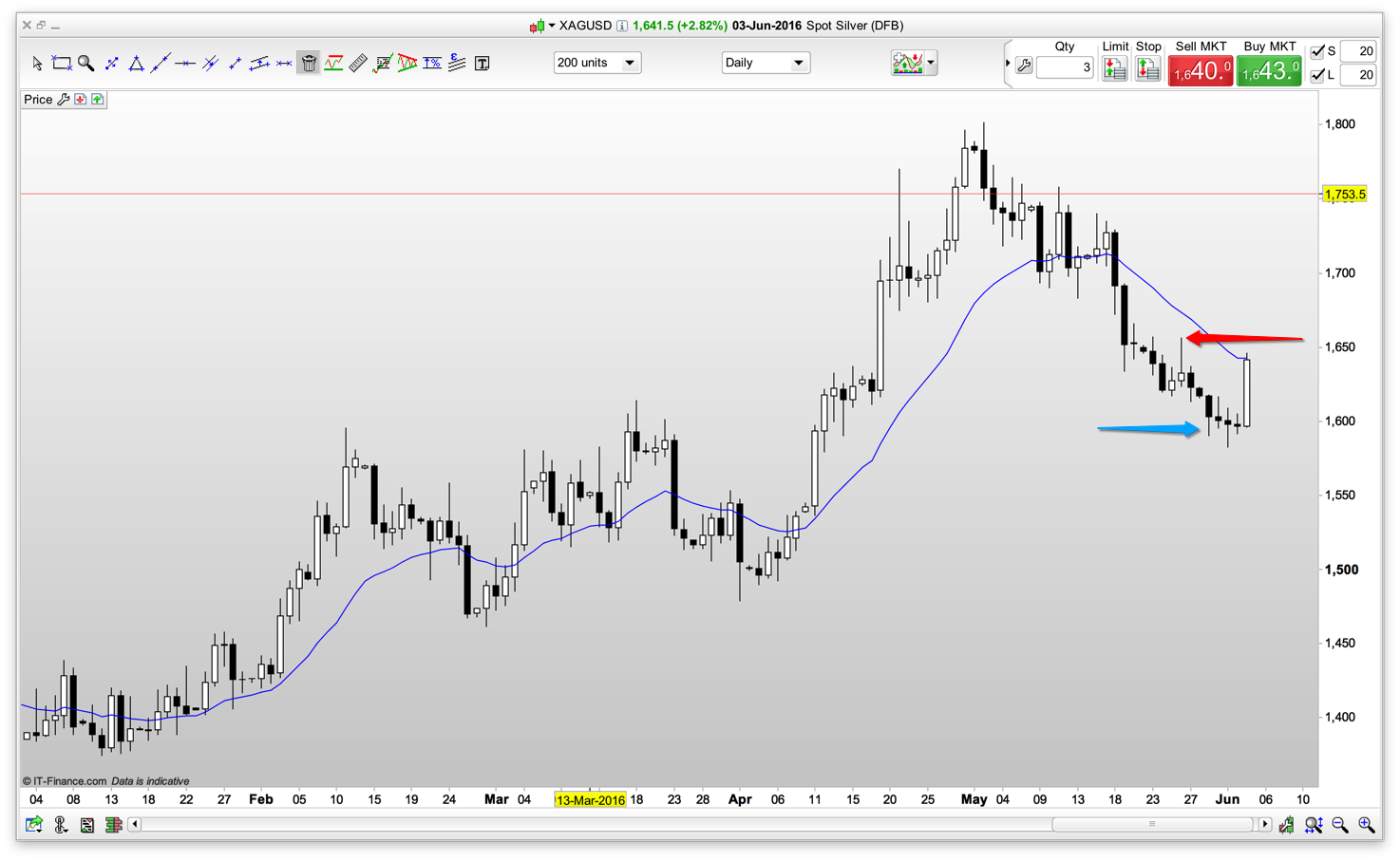
    Before Brexit here’s gold and silver last week.

    You will recall that we are only looking for short positions in gold and silver. We took profits in both nearly 2-weeks ago and have been looking for an opportunity to take a short since then. Although both gold and silver crept down and tempted everyone to jump on board, this would have been hopefulness.

    Here’s silver: silver provided a short signal which I missed, and mentioned last week. That would have given us a profitable move down and exit at the blue arrow. However, without a clear ‘short’ context the danger was always the strong pullback, which happened yesterday, and that is why it was correct to not hold our original short too long. The pull back may just be to the moving average, shown by the blue line, or a move to equal the previous high at 1,800; or, significantly higher with a measured move of the previous leg. We will need more information before acting.

    Snip20160604_1

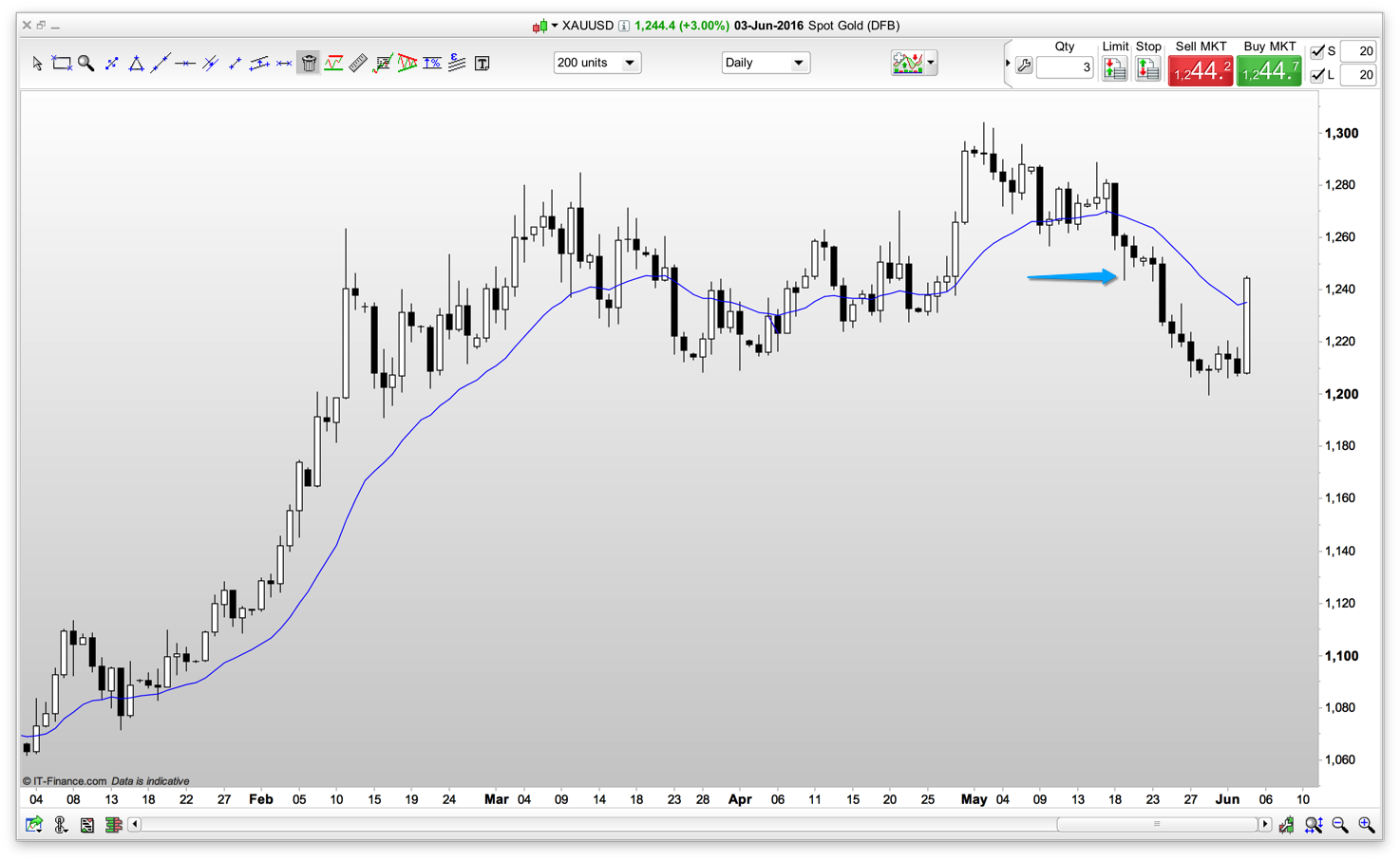
    Gold below shows the short that we exited on 19th May. I was somewhat quick as the second leg down would have doubled our profit. However, the move up yesterday (similar to silver) has brought the price back to our ‘buy back’ position on the 19th. As the climb yesterday has closed above the moving average I’d expect more upwards movement next week before providing a short opportunity.

    Snip20160604_2

    How will Brexit affect our trading? As an aside, one issue we have with trading gold and silver, particularly with a reasonable sized fund, is the size of the average bars (potential movement of price on average over a certain time period) in respect to spread. If you have bought shares in a SIPP before you will know that your broker charges you anything from £5 to £14 per trade. That is why you need to buy a certain amount of shares otherwise your broker’s fee represents too high a percentage against you. The same is true in reverse with spread betting.

    Silver, for example, has a spread of 3 pips. That is, for your buy/sell you will pay 3 pips at whatever price per pip you trade. If you trade £1 per pip, then, from the broker’s perspective, you are charged £3. (Not actually £3, you will notice that your entry line on your chart is 1.5 pips to the negative as will be your eventual exit line – with both together equalling 3 pips). That’s fine at £1 per pip, and actually a good deal. However, you ain’t going to retire soon on £1 per pip in silver. Our fund trades more in the region of £10 to £20 per pip; and that represents a high broker’s fee if the trade goes against us.

    Far more representative of average bar size – when compared to spread, and also compared to the amount we wish to trade – is the currency pairings GBP USD and GBP JPY. The spread on these are about 2 pips and 3 pips respectively (I say ‘about’ because they do fluctuate, particularly in times of high volatility). However, typical corresponding bar sizes of the above currency pairings (GBP JPY being the biggest) are 10 to 20 times bigger than say gold or silver. And that is why we need to move most of our fund trades to the currency pairings.

    That brings me to the initial question, how will Brexit affect our trading? Clearly we all know that it will be a time of high volatility in GBP and anything in association with GBP. To that end, the spread will increase significantly. This will need to be carefully monitored. But spread increase is okay if average bar size increases in unison. Brexit could provide a lot of barbed wire (bars that bounce up and down but close fairly tight and don’t actually go anywhere) or, of course, it could set-up a great trend. My own thought is that it is going to be a bit of both and we need to read the movement well to take advantage. So are we going to trade during Brexit? probably not on the 23rd June, but for the run up – most certainly we are.

  • Slow Trader Diary – week 27

    Our fund, in total, is down 17%. Or £4,842.67 out of the investment of £30,000.

    Those used to a ‘normal’ fund will consider this drastic as it takes an age in a ‘normal’ fund to come back 17%. However, I’m pleased with our recent come back to this level – always more difficult to bring a fund back up – but once we’re over the hump…

    With good money management (not risking too much too quickly) we can bring this back in a few weeks with good trading.

    However, remember that original invested amounts are guaranteed and can be taken back at any time, in any amount, without influence to the fund or fellow investors.

    At some point soon I know, based on our lessons learnt, that we will soar.

    Here are our trade results this week:

    Long interest paid was £10.87 – a reflection of our limited trades due to the Greek issues and subsequent volatility in the markets (shares, stocks and FX). Bonds, and commodities were not adversely affected but I have not had a buy signal for those this week.

    WPP PLC, – £194 loss.

    CLS Holdings PLC, – £471 loss.

    Pace PLC, – £145 loss.

    FX GBP/JPY, + £384 gain.

    Moneysupermarket.com, + £108 gain.

    ITV PLC, + £93 gain.

    Monster Beverage Corp, +£691 gain.

    Elementis PLC, + £160 gain.

    Total losses this week including long interest: £821

    Total gains this week: £1,436

    Not exciting. But considering many (probably all of you) with ‘normal’ long term managed funds would have had a loss this week.

    The Greek issue continues this weekend with the referendum.

    We are out of the market this weekend. We are holding no trades. This is because the markets can ‘gap’ – either up or down – depending on the Greek outcome. A gap is a jump from close of market before the weekend to open of market after the weekend. Those without a guaranteed stop risk a significant hit to their funds.

    Next weeks subsequent volatility could suit us. Looking forward to it!

    B