Tag: day trading

  • Forex trading signal, a high two reversal

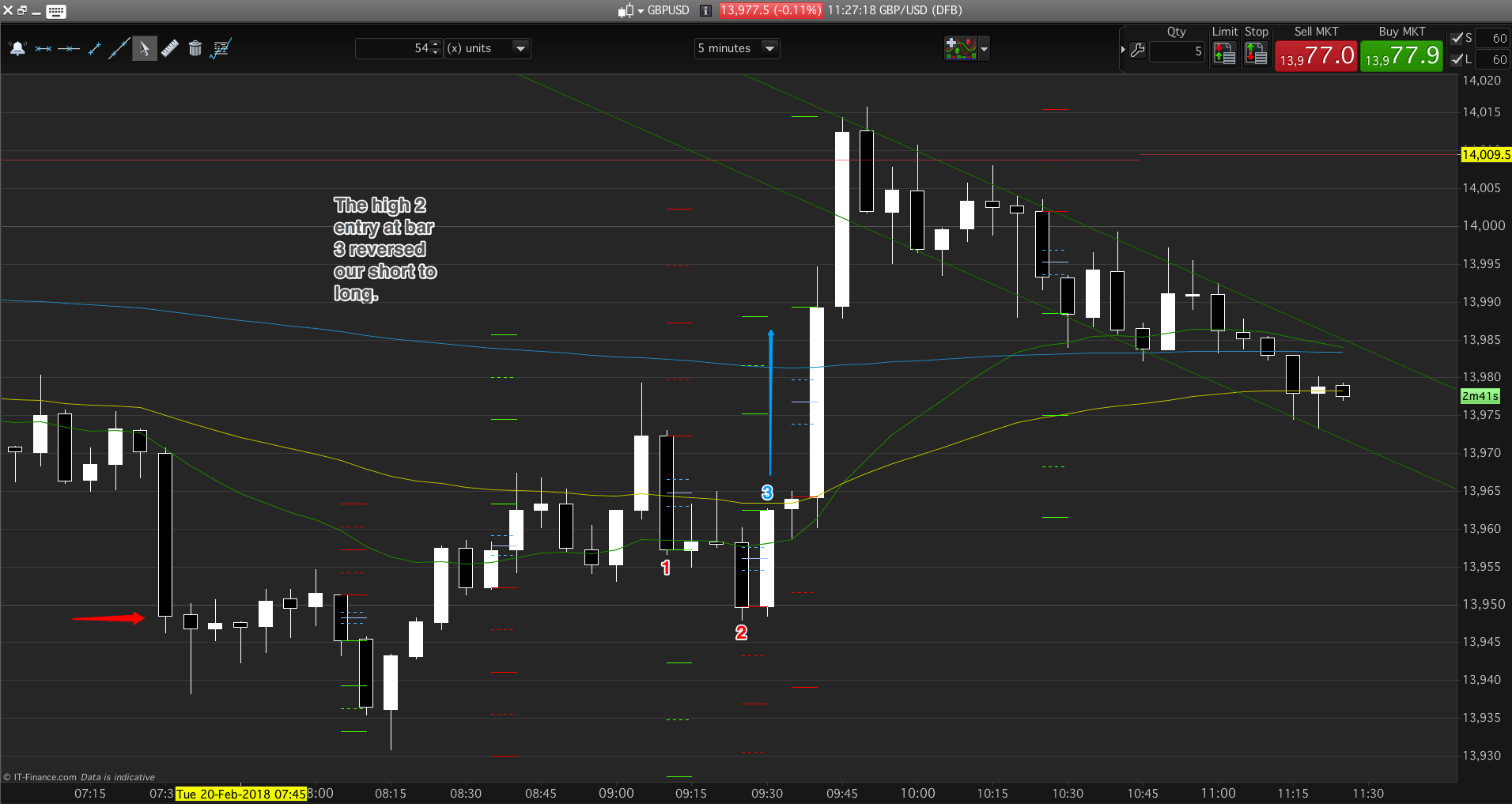
    We entered short at the close of bar one which provided a reasonable probability of a measured move. Tuesday 20th February, 9.30 am.

    The close at bar 2 put us in the money and looked right at this stage to reach our target. We only noticed later that the close of bar 2 equalled the support level at 7:30 marked by the red arrow.

    A high 2 was activated (bar 3) closing above the previous three bars. This required an immediate exit of our short for a small loss and a reversal entry long.

    This we did and were rewarded with the big move for the day so far.

    The reversal entry is often hard to do and one that we do reluctantly and only if we are confident of the Forex trading signal.

  • Forex trading and USA holiday

    Good morning Forex day traders, 8 am Monday 19th February 2018.

    Our first trade of the day was missed. From the close of the bear bar at bar 1, an unassuming engulfed bar, I went for my first pot of tea of the day. I missed the second bear bar, bar 2, which provided a probable entry short of 8 pips.

    8 pips are our minimum entry in the GBP/USA currency market.

    The short went 12 pips below our planned exit, down to Friday’s low and to the significant number of 14000. That, of course, means 1.4 dollars to the pound.

    Trades today will in all likelihood be light being a USA holiday. A trading range day is expected, but occasionally on such holidays, a trend can form.

    Our missed entry looks good on paper, but in reality, I would have not made the short. The spread at the time was double, which is typical for a no-news Monday morning. As I don’t pay the entry spread, I always like to achieve a limit entry, the subsequent pullback at the close of bar 2, and at 2 pips spread, would have not worked.

    We wait patiently for the next opportunity.

  • New funds to trade

    All traders look for an edge, an ideal way to enter, manage and exit a trade.

    It is crucial that a chosen edge suits us individually too.

    The time-critical stress of the day traders world is probably not for everyone. Nor, for others, the weeks or months of being out of the money, as in the longer time frame deals.

    However, if we have the time, the knowledge and the inclination we might be comfortable trading in both disciplines.

    More than this, one helps to condition the other. In day trading we have learnt the art of the identification of a likely trade. In longer-term trades, we appreciate the need for trade management and a requirement to ignore emotion and the uncanny ability to hit targets when we are not necessarily observing the trade moment to moment.

    A big supporter of the commitments of Traders (COT) report, not everyone is as it is infrequent in its signals and notoriously broad in its message. However, with longer bets, as a ‘conditional’ trader, the COT provides arguably the only edge that is not in itself related directly from the price.

    Day trading has provided us with skills that can be coupled very well with the longer term charts and this, in conjunction with the COT, offers an exciting way forward.

    With additional funds coming in to trade, we looked at what would complement our day trades but not emotionally or otherwise interfere.

    Significant commodities and a selection of currencies traded from weekly charts in unison with the COT is our chosen direction.

  • Day trading

    As Jack Welch told us: “change before you have to.”

    Beginners are attracted to day trading because, most of us when we start out, only consider one thing: risk.

    With day trading we’re offered a low-risk and the beginner takes this (usually unsuccessfully) with low probability entries.

    The professional counters by (mostly) taking high probability opportunities.

    This often requires close attention for long periods followed by quick and decisive action.

    Like all the best games, day trading is easy to learn but hard to master.

    As Seth says, “if failure is not an option, neither is (the) success.”

  • Risky

    Readers will know that our chosen trade method is day trading a currency pairing.

    People that are not familiar with how we go about our business will think ‘gosh, that’s risky’. And of course, to a large extent, they are right.

    As with many disciplines that require a great deal of skill and practise (to simply achieve mediocrity), it comes across as risky because most don’t take the time and effort to learn.

    Ironically a principal draw for us to day-trading is the control of risk.

    Our e-book on the subject to be released within the first quarter of next year shows, we think, in some detail how this is possible.

    Day trading, if done well and with practice, can provide a consistent daily or weekly return. So unlike other more traditional trade or investment methods.

    With all worthwhile disciplines, it does not come to us overnight.

    As Seth Godin said:

    “The hard part is ‘steady.’

    Anyone can go slow. It takes a special kind of commitment to do it steadily, drip after drip until you get to where you’re going.”

  • Slow Trader Fund Update

    I was keen on a 30% increase in the fund this year, and I still think we will do this. That sort of increase for a normal fund is very good, if done consistently it can be outstanding, but I’m after achieving a lot more. I also want control of risk.

    When I trade longer term charts I do very well for a while then get hit unexpectedly. It is this uncertainty that prevents me from investing in the traditional sense.

    My passion is day trading. This has come about only over the last 3 years or so. Previously I used a similar trading strategy but with different time frames. The Slow Trader Fund would be traded say from the daily or 4-hour charts, meaning a trade would be held for several days or weeks, and I would concurrently day-trade a small amount of personal money.

    This has changed in that I’m shy of holding money over longer periods in a trade. I’m much more comfortable watching a trade, and be in and out again several times in the day, and never holding overnight.

    The reason that I’m now doing this is that I like to be in control. Particularly if I’ve been given responsibility for other people’s money. To say that I’m day-trading, rather than using a sensible medium term investment strategy, because of my consideration to risk, is barmy to traditional investors. Because they’ve always understood that day-trading is risky.

    They are correct, ordinarily. But it’s like fishing with a rod and line from a boat or free diving with a spear gun. We are not going to survive the first dive if we jump in and are expected to hold our breath for several minutes. We’d be better off and more successful fishing from the boat. But to the conditioned free diver the ability to catch fish from a free dive is far more precise and consistent.

    Cynics would say ‘get a net’. But when the so-called ‘medium risk’ investors with a net hit a storm they can lose the lot. So when they think they’re medium risk they are actually not.

    The day-trader will trade small and often. In contrast, for the medium-term trader the exposure is usually larger and over fewer trades. Rewards from day-trading can be exceptional. But it takes time to learn. This may have been gathered by regular readers of this blog. Like all things, I think worth the wait.

    However, I appreciate that investors may have other ideas. As I’m moving the fund to 100% day-trading the funds are available for transfer at no notice. Well, one day’s notice.
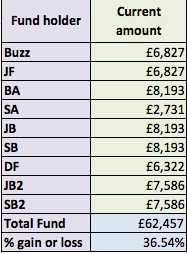
    To a certain extent, I trade at an amount proportional to the fund. That is the intention. But my own competency is the principal measure. For all of this year I’ve traded small. However, the trade amount, when it moves, will increase substantially.

    For instance, risk per trade has recently moved from a few pounds to £150 per trade, and will very soon be £300 per trade. The next step after that is to £600 per trade, where it will stay for some considerable time. I will take half a dozen or more trades per day. Moreover, I will trade twice within the same risk where appropriate.

    If we’ve mastered the day-trade then the potential is clear.
  • Algorithm to trade by

    Nicholas Taleb, in his book ‘fooled by randomness’, suggests that “some psychologists estimate the negative effect for an average (traders) loss to be up to 2.5 the magnitude of a positive one”.

    Therefore in short-term trading, and particularly day-trading, that is a lot of pangs.

    A longer-term investor may check her portfolio, say, once a year. If she averages a 15% gain per year then this investor will have an emotional pang about one in nine years.

    The expert day trader on the other hand (the beginner and intermediate trader are off the scale here) will have 7 to 15 trades per day of which about half will be an emotional drain. Leaving the trader some 250% more emotionally drained – and that’s on a reasonable day!

    Beginners are attracted to day-trading because it sounds cool, and, as a stop order can be closer in a low time frame trade, they can trade for less per trade than on a higher timeframe chart. An individual’s chance of surviving the beginner to intermediate to expert in day trading is slim.

    An expert day trader, someone who was properly coached or who has graduated from the ranks of the higher time frame trades, will, I feel, only survive the emotional pangs of day trading if they develop and follow an (unemotional) algorithm.

    That is why I’ve renamed my page ‘how I trade’ to ‘algorithm to trade by’.

  • Day trading is only for the full timers

    There are so many ways to trade – choosing a way can take forever.

    Broadly speaking, the forms of trading include positional, swing and day trading:

    Most investors through investment banks, pension funds and mutual funds have their savings with positional traders. Positional trading takes the longer term view and is, if not exclusively, based on fundamental information.

    Swing trading, on the other hand, is broadly considered to be trades that take a few days to a few weeks to complete and can be a mix of fundamental and technical.

    Day-trading, by simple definition, is a trade that is completed before the end of a day.  It is based on technical information only. I prefer the term ‘short-term’ trader.

    Some years ago I started with positional trading, fundamental information and how to read financial reports. I then moved onto swing trading and used a combination of fundamental and technical.

    It was only more recently, a couple of years, I made a slow transition over to short-term trading and now find myself exclusively in this area of trading.

    Within each of the above broad categories there are a limitless number of styles, methods and systems to choose from. It is indeed a minefield.

    Many starting out go straight for the ‘day-trading’ category of trading and most don’t last long. If fundamental information is not their bag, then newbie’s should at least start with swing trading. Taking the medium term view. Its more stable than short-term trading simply because of the effect that short-term news has on price and therefore the chart.

    Swing trading can be profitable for the part-time trader, day trading however is only for the full timers.

  • ‘slow trader’ moves to day trading

    I am taking our ‘Slow Trader’ hedge fund out of commodities and any medium or longer term trades. We are going fully into day trading and trading a single item – which at the moment is the currency pairing GBP USD.

    (Medium term trading of commodities is an excellent way to trade, but we need to focus 100% of our efforts and, for us, that is day trading).

    It is not possible to day-trade until a trader reaches a certain stage in his or her ability to read and manage in the lower timeframe charts. I think that we are close enough now to this ‘stage’ that we can touch it.

    To believe that it is possible to day-trade the lower charts is like asking some of us (non athletes) to run a 4-minute mile. If we did not know better, because we can watch the olympic games, we would quickly conclude that the 4-minute mile is unachievable; we would probably give up and defend our egos with comments such as ‘it’s not possible’.

    For those that do achieve the 4-minute mile (incredible as that is) they will get nothing from it other than personal satisfaction. That is because all the wins, the glory (the profit) is being able to go a few seconds under 4 minutes.

    In our day trading we feel that we are now achieving the equivalent of the 4-minute mile. We are now day trading where we can almost guarantee a break even at the end of the week. A shout of ‘well, yippee for you’ is justified, but all the work goes into the foundation. To push the running analogy further – once we see ourselves achieving the 4-minute mile, only then can we believe that we can get a few seconds under.

    Why favour day trades over medium term trades? For us it is because day trading is clear and finite. Trades are completed before the end of the day, and certainly not carried over a weekend. You are not waking up to a real shocker. In Andrew Tobias’ (updated) book ‘The only investment guide you’ll ever need’, he explains how he was in a hedge fund that after 5 years increased his fund 4.5 times – soon after 5 years it was at zero. And that is the thing with hedge funds, the unpredictable explosive nature – both up and down.

    My aim is different to this. I want to increase our fund in a regular (almost predictable) way, week on week. The hard work has been done, all we need to do now is manage those extra seconds.

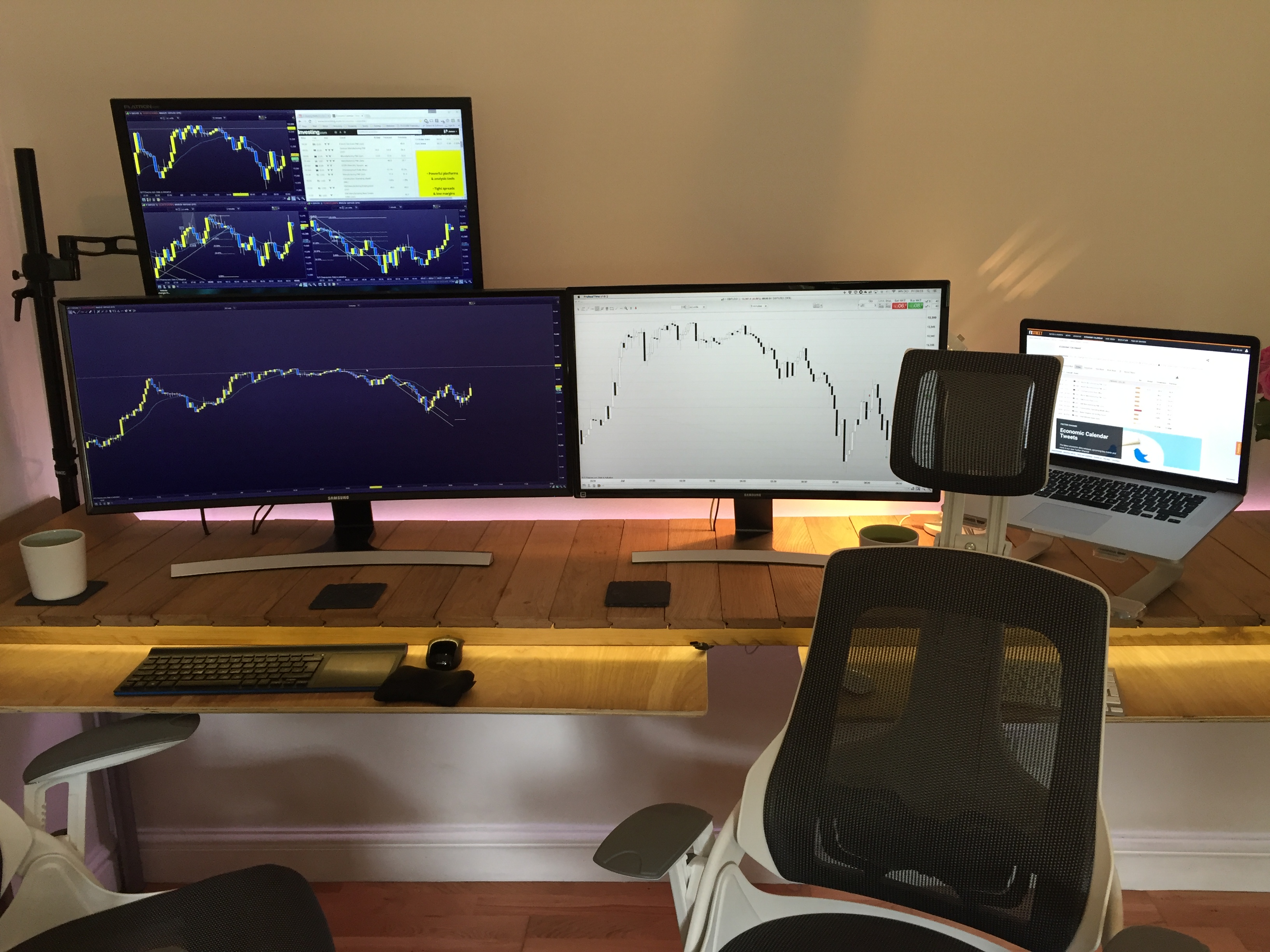
    Our trading desk:

    IMG_1321

  • Monthly Slow Trader Fund update – 5th December 2015

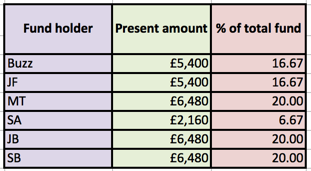
    Slow Trader Fund is up by a total of 8%. Here’s individual positions:

    Snip20151205_29

    You may recall from recent posts that I’m spending more time developing day-trading abilities. That is: trading from the 5 minute chart.

    Slow Trader is a daily chart fund. This has not changed.

    However, development of day trading technique will be of great benefit to the fund.

    That is because price action in each time frame is similar. Trade management, trade frequency, assessment time and pressure are different.

    Trading in the 5 minute chart demands a constant (all day usually) watch of the chart. My style is to watch only one chart when in the 5 minutes. And from this one chart there are usually many opportunities in the day to trade.

    In contrast, far fewer opportunities are available for trades from the daily chart. Therefore, usually a number of different (daily) charts can be analysed.

    A successful day trader (and I mean the 5 minute chart, as the one minute chart is intense and draws a trader down the path of extreme scalping rather than – my prefered – trades which are broad scalps and swings) can profitably trade the daily charts.

    The same is not true in reverse.

    The benefits for the fund in my being able to trade the 5 minute charts is exponential.

    The New Year goal for the Slow Trader Fund is growth at a monthly rate of 5% to 10%. Ambitious but, I think, doable.

    Next fund update is 6th February.

  • Investing or Trading?

    Investing first:

    Investing is buying into something that appreciates. In stocks and shares, any price increase after about a year is 100% because of the fundamentals: the strength of the books, the management, the continued saleability of the underlying product….to mention a few.

    Most of us have investments in pensions or managed funds.

    Over a bunch of years the market goes up about 9% on average. However, somewhere between 7 to 15 years the market crashes. Timing is everything.

    Moreover, most pension and managed funds don’t beat the market, actually an astonishing 95% of them; on top of that, they charge several percent annually to do so.

    If we need our invested funds, 15 years before would be best, move it into something that is not market based, at least not ‘fundamentally’ based.

    Now for trading:

    Trading is generally over a shorter time frame and is mostly technical based: that is, the reaction of price when price reaches a support or resistance. In its simplest form, it is one person’s opinion (or computers) against another.

    And, as a computer does not have an opinion – it is of course emotionless – that presents the biggest obvious challenge to most human traders.

    Some 75% of trades are institutional based (the big money). The remainder is made up from other entities such as high frequency trading (HFT) systems, large hedge funds and the like. Smaller (professional) organisations and home traders represent less than 5% of the market.

    To be clear, when the (small) professional trader or home trader trades she is up against the institutions – computers mainly – so she better know her unemotional stuff.

    That is probably why few home based traders, particularly lower timeframe traders like day traders, make it. Cheery, eh.

    The one factor more than any responsible for successful trading is – no it’s not luck – is trade management, boring as that sounds. Good trade management always provides a positive traders equation of: risk, reward and probability.

    Without a clear calculation of each of these (and probability is often the one that is missed) then we are not trading but doing something else…gambling, maybe.

  • This is boring but its important

    There are so many ways to trade it can take you years to figure out what is right for you. However, we can put all of them into three simple categories.

    Firstly, there is day-trading. Self explanatory. You are in a trade sometime during the day and you are out of the trade before the day ends. Great fun. But few make a profit doing this.

    Secondly, there is short term trading (often referred to as swing trading). My preferred trading style. You follow the rhythm of the share price and try to catch the most lucrative part. You’re in for a few days to a few weeks. Using this style you may miss the big up, but you have a fair chance of missing the big down too!

    Thirdly, longer term trading. This is what most of you have through your mutual fund investments and pension funds. Recall that over the longer period, every 1 percent in charges results in you giving back to the fund some 20 percent of your final amount. So if your fund was worth £100,000 after 40 years of investing the average mutual fund would have cost you between £40,000 to £60,000. Thats a large chunk. Few people realise this and this is why mutual fund managers remain in the top echelons of earners.

    The younger investor would be better placed choosing a low cost index tracker fund. It will win hands down over most mutual or managed funds.

    The mature investor should always consider fixed index annuities – Read Tony Robbins, money master the game. Its only 616 pages! or take my word for it.

    We should consider another problem with the mutual fund (and there are several more) is the equity crash that seems to come around now and again. If you were financially retiring in 2008, your long term investment would be half of what you expected. If you had more than 15 years to retirement your fund could recover if it were in US stocks. Most UK shares have not even yet recovered to the high of 2008.

    Discuss with your independent financial advisor fixed index annuities such as (from Tony Robbins): Barclays Dynamic Balance Index (a mix of stocks and bonds) and Morgan Stanley Dynamic Allocation Index (a mix of 12 different sectors). Your IFA should find you UK index equivalents if you prefer.

    B