Tag: COT report

  • New funds to trade

    All traders look for an edge, an ideal way to enter, manage and exit a trade.

    It is crucial that a chosen edge suits us individually too.

    The time-critical stress of the day traders world is probably not for everyone. Nor, for others, the weeks or months of being out of the money, as in the longer time frame deals.

    However, if we have the time, the knowledge and the inclination we might be comfortable trading in both disciplines.

    More than this, one helps to condition the other. In day trading we have learnt the art of the identification of a likely trade. In longer-term trades, we appreciate the need for trade management and a requirement to ignore emotion and the uncanny ability to hit targets when we are not necessarily observing the trade moment to moment.

    A big supporter of the commitments of Traders (COT) report, not everyone is as it is infrequent in its signals and notoriously broad in its message. However, with longer bets, as a ‘conditional’ trader, the COT provides arguably the only edge that is not in itself related directly from the price.

    Day trading has provided us with skills that can be coupled very well with the longer term charts and this, in conjunction with the COT, offers an exciting way forward.

    With additional funds coming in to trade, we looked at what would complement our day trades but not emotionally or otherwise interfere.

    Significant commodities and a selection of currencies traded from weekly charts in unison with the COT is our chosen direction.

  • Slow Trader Fund, We’re Ready for Action

    Thank you for your patience while I’ve performed a complete overhaul of my short-term trading strategy. Readers will notice the amount of work involved in the ‘how I trade’ page. This has been a great exercise, and one of which I’m confident will be well worth the wait.

    A reason for taking so long is that our strategy, I believe, can only truly be devised under live trading conditions. The way we react to probability trades under live conditions is significantly different to what would otherwise be developed under benign back-testing conditions.

    To that end, I’ve traded and worked on the strategy these last few months with my own account and traded small. The fund has remained in waiting.

    Now I’m at the other end of the strategy development, we will see a gradual build-up to normal fund trade amounts.

    My thoughts on how I see the fund going forward from today:

    Slow Trader allows investors the opportunity to access a short-term trading fund.

    Why an opportunity, and why short-term trading is not possible for most people:

    • Firstly, short-term traded funds are not readily available. Moreover, expert (and hopefully successful) short-term traders charge a lot – up to 50% of profits and large participation fees.
    • Secondly,  short-term trading is a difficult skill to master. It takes several years for a trader to graduate from the ‘beginner’ level, through ‘intermediate’, to ‘expert’. And, expert is where all the capitalised reward is found. In other words, short-term trading, in contradiction to its name, takes a long time to learn.
    • Finally, learning the short-term trading skill is often, through the beginner and intermediate stages, financially penalizing.

    From the 4-hour chart the fund trades:

    1. Nick’s qualifying UK shares – long only.
    2. Currency pairings GBP/USD, EUR/USD, AUD/USD, USD/JPY – long and short.
    3. Commodities Gold and Oil – long and short.

    For each of these I’m looking for an edge:

    1. Nick’s qualifying UK shares already have the fundamentals. And, although fundamentals are normally not a factor for a trade of less than 9-months duration, we nevertheless have them on our side. The principal trading advantages that I use, however, are probability, context and price action.
    2. In our currency pairings we again bring probability, context and price action to the fore.
    3. Commodities also use probability, context and price action but are also traded inline with the COT report.

    The 4-hour chart is used in preference as this provides at least two trading opportunities per day. This means that trades can be open from several hours to several days.

    The page ‘how I trade’ is written with the 5-minute chart in mind but applies equally to the 4-hour chart and is the essence of how I approach probability, context and price action. Nick’s qualifying UK shares are published quarterly through this blog and guidance on the COT will also be given as the COT occasion provides – the COT cycle for each commodity coming round independently a few times a year.

    I provide an annual detailed report on the fund and a semi-annual ‘how goes it’ review.

    The goals of the fund are:

    1. Not to lose money (and this defines our risk level)
    2. Increase the fund by 30% (as a minimum year on year)
    3. Compound the fund year on year
  • Slow Trader Diary – week 33

    With USDJPY we are several hundred pounds up this week, and still in (but as I’ve mentioned before we cannot count these until they’re cashed). Small down of £100 with NZDUSD. Small up of £35 with DTE Energy Co. And, IG (our broker) costs for the week of £3.28.

    As an aside, how this affects you (the fund investor) personally will be shown as we move into overall profit. Until then it is pointless. Your initial investment into the fund is guaranteed. Okay, it is sensible to allow a few years for a fund to grow but, like me, with patience, we are all wanting a massive gain.

    This has been an exciting week for me in terms of being comfortable with goals and strategies. I am gradually completing my ‘how I trade’ page which will soon give you the strategies that I use. These strategies will seem simple to the novice trader, but execution takes time, dedication and effort to do properly and consistently.

    I’ve coined the abbreviation CrUP, meaning: Conditional, recent Up and Price. Each part is equally important. Missing any one and we are at a greater risk of getting the trade wrong. Each aspect of CrUP will be covered in detail soon under ‘how I trade’.

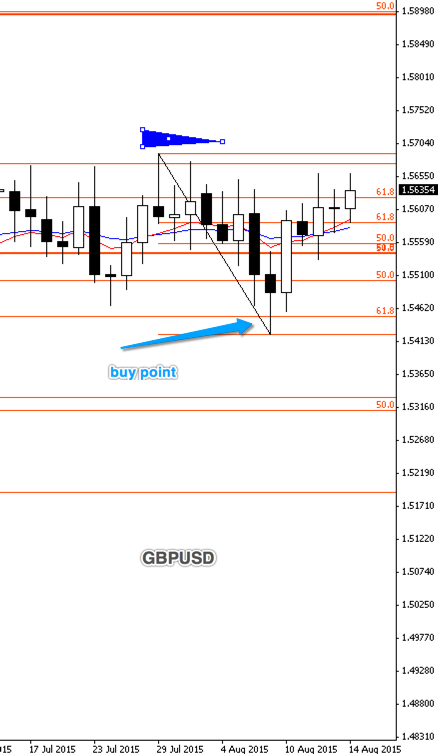
    One aspect, however, under Price, that cannot be learned is the method by which we buy or short. We have three choices: on market, on stop or on limit. Again, these will be covered in more detail in my ‘how I trade’ section, but in the mean time I will show you an example from this week. Firstly, the reason it cannot be taught is because it needs instinct, or gut feel.
    Snip20150815_18

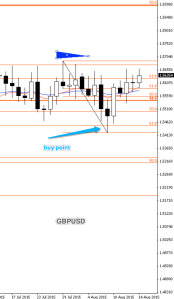
    Above is GBPUSD, which I narrowly missed. You may recall that we caught the last swing up of GBPUSD the previous week. Looking at a chart in hindsight makes it seem obvious. To get the trade right, however, takes understanding (instinct) of ‘how to buy’, i.e. on market, on stop or on limit. My buy was on-limit, at the exact lower pin position (the arrow marked ‘buy point’ shows this). However, the spread is a couple of pips (these are points up or down measured by the right hand axis, the spread is the brokers profit and if we don’t allow for it then we don’t get in). In my case I had allowed for the spread, so it was my buy position, my instinct, that was out). Having missed this, the following day provided an equally, arguably better, buy opportunity with a retrace down from the previous days close.

    I appreciate that those not familiar with this form of trading then the explanation is double dutch. However, it is a diary for me as much as for you so you will have to allow me this one.

    I have a couple of other examples from this week where, similarly, the buy was either too ambitious (in the case of GBPUSD) or not ambitious enough – hence the £100 loss in NZDUSD.

    But as I said at the start, noticing this outcome and being able to gain from the experience is what counts for the future. And the future is this week coming with great opportunities looming.

    I mentioned a watchful eye on gold. Both gold and silver have climbed against the long term trend as indicated by the COT report. I’m waiting for a retrace of the price before buying. Also, NZDUSD could be in for a move upwards. Sharpen the instinct!
     

  • Is it a good time to buy coffee?

    For the longer term traders, here’s a consideration.

    Keurig Green Mountain Inc. Formerly Green Mountain Coffee Roasters Inc. a specialty coffee and coffeemaker company founded in 1981 and headquartered in the U.S.

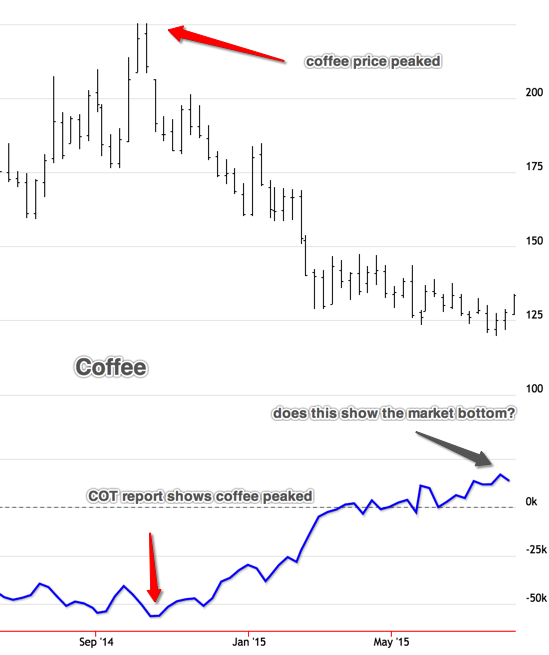
    The coffee maker has had a share price drop since late 2014. Analysts say it is due to the popularity of the coffee maker’s product. However, the price drop coincides well with the drop in coffee value, as shown on the COT report.

    Snip20150811_15

    Green Mountain has good fundamentals. I believe that the share price drop is associated more closely with the commodity price of coffee rather than anything that Green Mountain have, or have not, done.

    The question is “is this a good time to buy”? It could be absolutely perfect as a buy point, or it could be too early.

    Trying to find the bottom of a market is not fun. Mostly we get stopped out trying to do this. The recent trend is most certainly against us and, although the COT shows a possible bottom to the market, the COT could turn higher and force the price of coffee (and therefore possibly Green Mountain share price) even lower – as it did in 2013.

    The answer: let us wait until the price trends upwards, and with the COT on coffee showing the same, we could have a long-term winner.

    I will blog when I get a buy signal for Green Mountain (GMCR).