Category: Slow Trader Hedge Fund

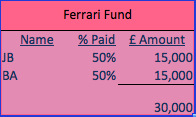
  • Ferrari Fund, 17th November 2015.

    Ferrari started 17th November 2014.

    This fund, similar to Slow Trader, will be run as a hedge and will concentrate on FTSE 350 and S&P 500 equities.

    Ferrari will also buy and sell commodities via ETFS.

    As with Slow Trader, this fund is closed to new investors until its anniversary.

    Screenshot 2014-11-25 12.59.16

  • 23rd July, Slow Trader Hedge Fund – 4th Month

    We are down 4%

    During the period we were up a maximum of 15% and it has been a big drop to take us back to -4%.

    The emotions are difficult during these times, particularly as you are trading other peoples money. I traded very well at the beginning of the period to take us 15% up. And then – well there is no hiding or making excuses – I didn’t follow my own strategy and, by-and-large, made a series of poor trades on the short side.

    If I can liken spread betting accounts to climbing Everest: we started at base camp, got blow down the mountain initially then made a charge up the mountain – 15% up. We hit a crevasse and, as your guide, I got the abseil ropes out instead of the crampons and possibly a couple of ice picks.

    crevasse-glacier-mclain-700972-xl

    We have slipped all the way back, just down from base camp. To consider a new guide is understandable. This guide – me – has had a few years climbing other, more forgiving, share ranges. This is the 4th year on this mountain, meaning spread betting. I got to the top – well, slightly above the top if you want to picture a short vertical helicopter ride. Another year I got half way up the mountain and another almost 2/3rd of the way up the mountain.

    During each of these attempts I’ve re-visited base camp, and once quite late in the year. So all is not lost in our attempt to get to the top – which is the same as doubling our money.

    I’ve studied the issue hard over the last two weeks and readjusted to help move with the change of the market. I’ve also reaffirmed my own strategy and operation. In this game when you get it right your financial reward is good but when you get it wrong the hit always seems higher.


  • Open a Slow Trader Fund

    How our fund works and what it costs.

    Trading cycle: from buy to sell (or sell to buy if we are short) is anything from a few days to a few weeks.

    Lets say you have £30,000 to trade. In this example, we will trade no more than £600 on any one stock or share. And during any one cycle we will trade some 10 to 15 times concurrently.

    Our strategy is to find intermediate trends. We get that right about 8 times out of 10. That sounds okay, but is spoiled by activation of our stop loss by larger than acceptable fluctuations in the share price; and by spikes in share price, including so-called ‘tree-shakers’ – don’t forget the hoops and loops – they can also be devils! The last two I made up, but you get the idea.

    However, where the spikes and the like are going to affect us a couple of times a year, to our advantage, we will have occasion to surf an intermediate trend. Hopefully, two or three times a year. In other words, we will stay in a trend for more than one cycle. Maybe for several cycles, and this is where the true profits are. Such a trend, even with one trade, can pay for all those pesky spikes and whatnots in one go.

    Our operation is three fold:

    1.   Find correct entry and exit points primarily from stocks and shares within the S&P 500 and FTSE 350.

    2.   Trade with regard to the share value or, as Warren Buffet calls it, the ‘margin of safety’. In other words, if we are taking a long then we want the share to be undervalued. Conversely, if we are taking a short we want the share to be overvalued.

    3.   Trade within our money management criteria.

    Trading vehicle:

    Our trading vehicle of choice is a spread betting account. We use IG. Unlike a normal share trading account, a spread betting account is tax-free. (Many people use these accounts to bet rather than trade. Those that bet, I have read somewhere, lose some 8 or 9 times out of 10).

    What it costs you:

    As the account is leveraged we pay a fee when we trade over a single day. This is called a daily fund bet (DFB). A DFB is our trade of choice due to the trading time frame we follow. To help cover this we deduct 2.5% of the final fund amount.

    Also, we deduct the same percentage of profits up to a maximum of 20% (For example, if profits are 15% we will deduct 15% of those profits. If, on the other hand, profits are 50% we will deduct only 20% of those profits).

    In other words, let’s again say your fund starts with £30,000 and, after one year, is at £50,000. Your costs are: £1,250 (to help cover the DFB), and £4000 (which is 20% of your profits). What you would get back is £44,750 (£50,000: less £1,250 less £4,000).

    For buy (long) trades IG charge the one-month LIBOR plus or minus 2.5%. This applies for sell (short) trades together with a borrowing fee. Dividends are credited if long and debited if short. For simplicity, we deduct a flat 2.5% of total end-of-year fund. This is less than the true costs to us and therefore in the case of an account that finishes even, or slightly above even, this will normally be a loss to us in terms of costs.

    How long does the fund run?

    A fund runs for one year. Two months before expiry you can decide to cash-in or rollover. In either case costs are subtracted annually.

    We can trade only 4 funds not including our own. A fund can be made-up from a group or from an individual. Each fund is to be a minimum of £30,000.

    A margin call is not your responsibility. However, your attention is drawn to the disclaimer page in slowtrader.com

    Note: Slow Trader Fund, 23rd July 2015, only has the DFB 2.5% charge. However, going forward from 23rd July 2015 the profit charge will also apply for those that wish to rollover and or place additional funds.

  • Finding the Trend

    Consistently finding the trend is possibly one of the most difficult things to do when trading.

    One idea is to use a single 260 day moving average. This represents about a year in trading days. If trading long then the lows of the chart for at least a week prior are to be above the 260 day moving average.

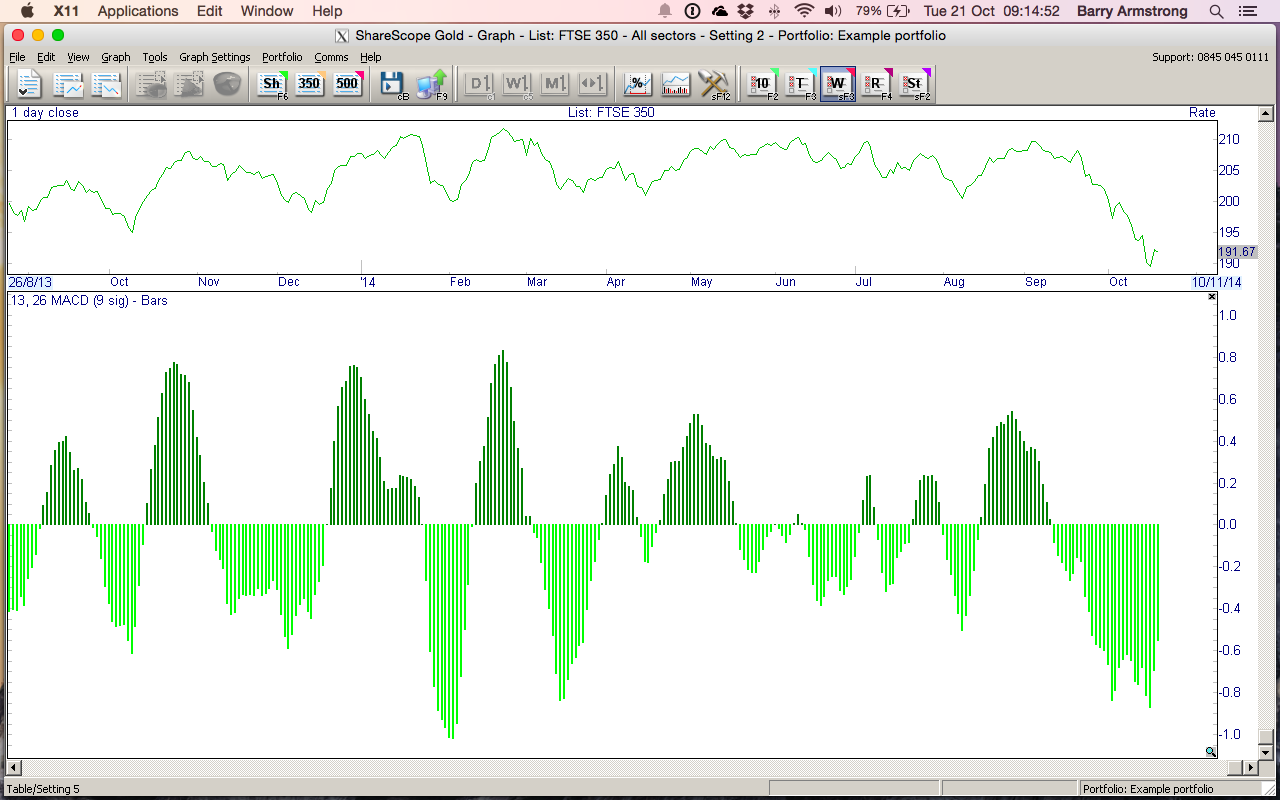
    However, only trade long when you have this together with your chosen market as a whole moving long. This is important and the opposite is true if trading short. The figure below shows the current FTSE 350 in MACD histogram weighted by cap. This market is tentatively moving long, i.e. moving into a tentative buy regime. I say tentative because of the shape and depth of the histogram.

    Screenshot 2014-10-21 09.14.55

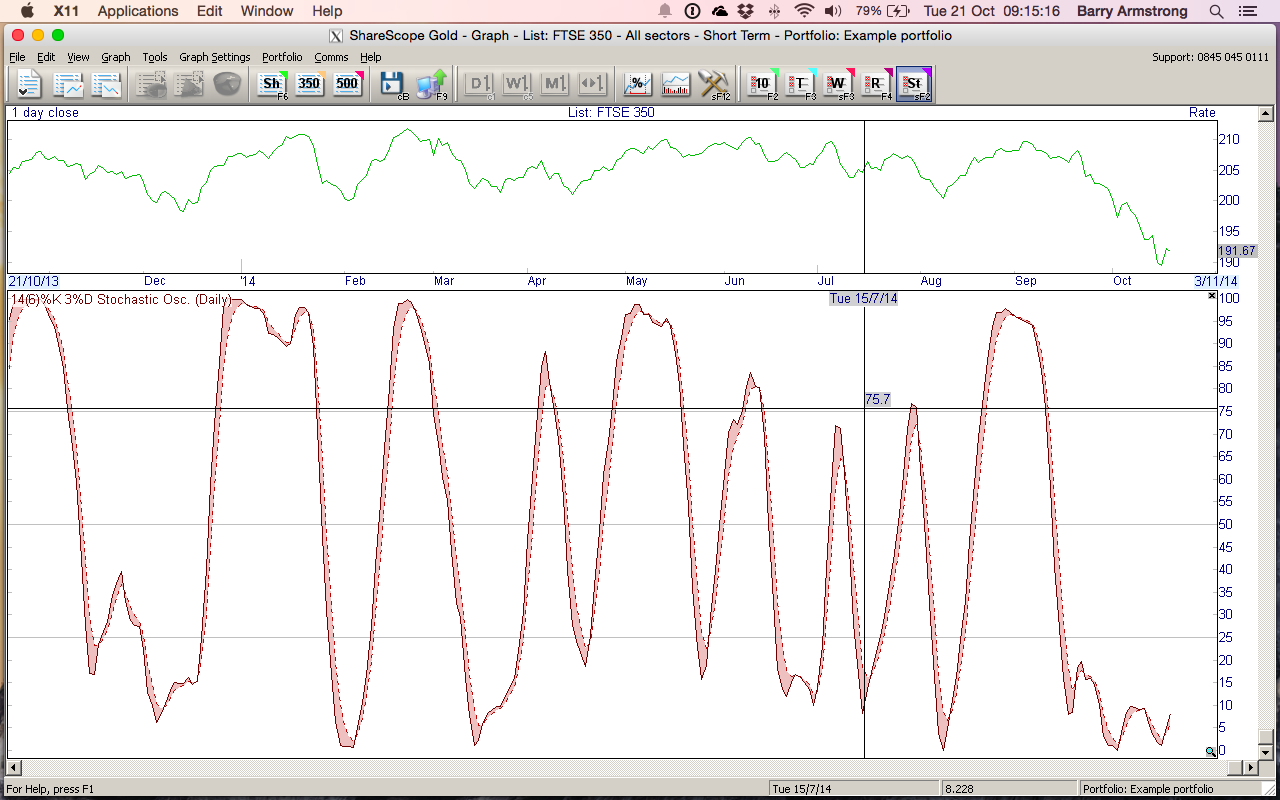
    Together with the histogram, if trading long, the stochastic, or similar indicator, must show an over sold:

    Screenshot 2014-10-21 09.15.16


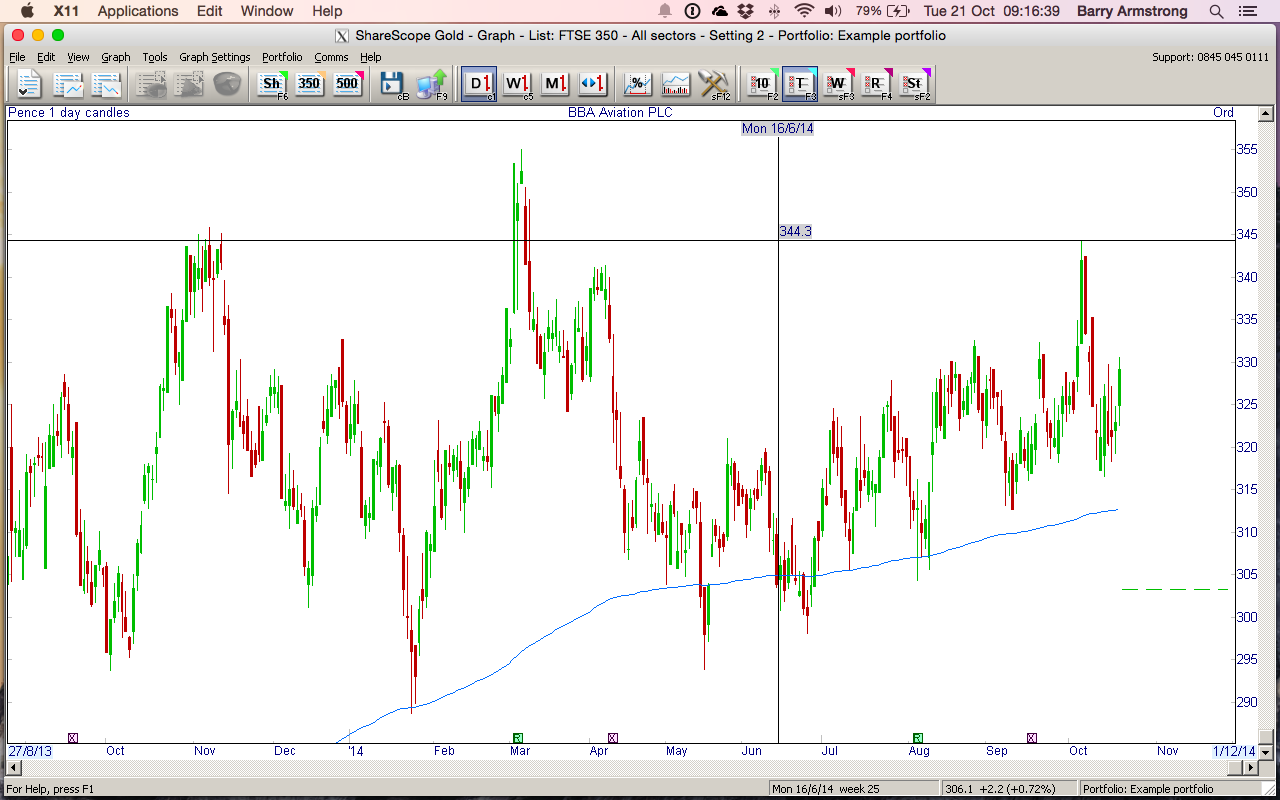
    Here are a few shares that currently meet the 260 day moving average criteria:

    Screenshot 2014-10-21 09.16.29

    Screenshot 2014-10-21 09.16.39Screenshot 2014-10-21 09.16.29


    The individual share must also meet the MACD and Stochastic requirements. As an added assurance, the calculated Margin of Safety is to be acceptable, depending on whether you are long or short.

    Happy trading

    B

  • 23rd July 15, Slow Trader Hedge Fund – 3rd month

    We are up 5%.

    The markets have been interesting. We were right to go short for this trading period. A few lessons along the way. Soon after I blogged last month, within a couple of hours actually, we took a hit from Carnival. You can see below how the share spiked up. Marked by the arrow.

    Screenshot 2014-10-20 09.15.31


    Our stop was just at the top of this spike. However, I immediately re-traded the share to go short and as you can see, this was correct. The lesson for me wasn’t necessarily the stop position, that was one of those things, it was more that I had invested in Carnival PLC (London Stock Exchange) and Carnival Corp (S&P 500). Both shares are intrinsically linked. So when one spiked the other spiked. This meant our risk wasn’t 2% but 4%.

    Our fund dropped to 8% below. From this low we have achieved about a 16% increase this month to be 5% up. Without the Carnival error we would have been much higher. To that end, I have taken it a step further and, unless a good reason not to, only trade one share per sub sector at anyone time. This is because shares within sub sectors tend to be similar. If one drops quickly the whole sub sector often drops quickly. Its all about risk management.

    Here are a few other trades we took this period: (We went short so entered at the top arrow and exited at the bottom arrow)

    Screenshot 2014-10-20 09.40.08 Screenshot 2014-10-20 09.42.10 Screenshot 2014-10-20 09.45.11

    You will notice that we don’t try to judge the tops and the bottoms. I did, however, exit too early on many, this is a skill I am working on. But a profit is still a profit! Each of the trades made us more than £350.

    As the market neared the end of the downward period we sold out completely. We are now, albeit with some caution, only taking trades to go long, i.e. the market is moving, rather hesitantly, into an upward phase. This upward phase may be brief or prolonged. But as we are short to intermediate trading that is not so much a factor.

    All the best, see you next month.

    B

  • 23rd July 15, Slow Trader Hedge Fund – 2nd month

    We are down 4%

    To be clear, the down (or up when we get it) is always reference to the initial amount. So, last month we were down 6% and this month we have gained and we are now down 4%. Wow.

    That is a point in itself: and why it is important not to be down too much. If we lost, say, 50% of the portfolio then we would need to double whats left (i.e. achieve a 100% gain) just to bring the fund back to its starting point.

    The previous month we were invested primarily in the UK (FTSE 350) and I placed stops too close for the quick change that happened. All our trades last month were for the market to short (go down).

    Early this month we made a number of winning trades, again all from short positions. But the amounts were mostly small. Probably because I was wary of our recent loss and kept the trades light. Those winning trades took us back almost to even in the fund. I have tidied up the fund (let go of some trades that did not go as planned) which has brought the fund down to the -4%.

    More lately this month we are invested primarily with the US (S&P 500). Again all short trades.

    I am not predicting the market going down, these days I don’t get involved in those sort of long term thoughts. I am simply following my own indicators for each individual share and I’m only finding shorts. There are a few longs to be had but they don’t show strong enough on my indicators to consider buying. So short it is.

    As an aside, whist on holiday recently I devoured one of Larry Williams books – Long term secrets to short term trading. Not that I’m short term, more short to intermediate. Mr Williams’ lessons on entering a trade to gain best results has helped. His book also reinforced my already established strategy.

    Strategy: find intermediate trends to trade.

    Sounds easy but most people get this bit wrong. Again that is why we are short at the moment. I cannot find suitable long intermediate trends.

    As part of our money management, I have moved our maximum investment per trade from 1.5% to 2% of total funds. Again, if you think about it, this is another reason to gain money as this has an exponential effect on each 2% traded as the 2% is relative to the amount in the fund at the time.

    Also, we will be looking at a maximum of 55% equity used. We are presently at 43%. For those that think I should be fully invested, remember that this is a leveraged account. Its like taking out a mortgage, you get a lot more for your pound. And we need a buffer as we don’t want a margin call.

    More next month, and see you soon.

    B

  • 23rd July 15, Slow Trader Hedge Fund – 1st month

    We are down 6%.

    The mistake I made was a simple one, I set stops too close.

    A stop is a safety net.

    If a share price goes the wrong way then you can set where you say ‘thats it, I’m out’. This stop does not protect you, however, from a rapidly moving share price. to do that you need a guaranteed stop. But thats another story.

    Without getting into technical detail, I have learnt a lesson on stop setting. This is the second time I have learnt this lesson so hopefully this time it sticks.

    The first time was in February when the market made an unexpected large turn downwards. My stops were, in my opinion, too close as I stopped out over several trades only for the market to reverse and carry on nicely in my chosen direction, but without me!

    A similar thing happened in early August. My stops are now wider but still maintaining not more than 1.5% risk in any one share. I have already seen the benefit of this recently.

    We are 6% down. However, that does not include shares that are currently active. We are short at the moment with about 45 separate trades. That means all our trades are for share values to go down. Most of these trades are in credit or moving into credit.

    Trading and logging this fund, together with my own funds, has been easier than I anticipated.

    Talk to you next month.

    B

  • SlowTrader Fund 23rd July 2015

    The SlowTrader fund until 23rd July 2015 is up and running. We are already trading through about 14 shares at present. More or less equally split between US and UK trades. Also, more or less equally split between longs and shorts. You will trade some 400 to 600 shares during the 12 months.

    Here is the funds percentage ownership:


    Screenshot 2014-07-22 15.58.25

  • Be a pessimist

    It breaks with convention but in trading its okay to be a pessimist.

    I’m not saying procrastinate. Far from it. All I suggest is that when you see your buy (or short) opportunity don’t picture the pound signs increasing. Don’t see the share going in the direction you’re hoping.

    Instead, see it reversing, doing the opposite. See it stopped out.

    About half the time, even for professional traders, it will anyway.

    This simple twist in thinking helps decide the amount you risk.


  • Watch em, don’t stalk em

    I refer, of course, to your share watch list.

    This change can greatly multiply your success.

    Most of us keep a number of shares constantly in our watch list.

    By doing this we are in danger of seeing long or short opportunities on a favoured share where, actually, there isn’t one.

    Better to keep a watch list that contains only active or open shares and shares that you feel, from your main list, could soon provide an opportunity.

    Anything else stays in your main list.

    I now only trade from the FTSE 350 and S&P 500. And thats it. I view all 850 shares a couple of times a week or as often as I can.

    When an open share is closed it is removed from the watch list and put back into the main list.

    This ensures that all shares in my watch list are there for good current reasons and not nostalgia!

    Hope this helps, it has for me.

  • “The Trend is your Friend”

    Your first screen ensures the trend is in your favour. I have found that three exponential trend lines of 50, 100 and 150 days helps. If trading long then the blue (50 day line) above the green (100 day line) is best. If the blue line is between the green and amber (150 day line) then that is okay but carries more risk.

    Long trades with the blue line on or below the amber line should be avoided. The reverse applies to short trades.

    Screenshot 2014-06-19 13.24.00

  • Before you trade try this exercise

    Viewing the MACD Histogram for the previous year is a good idea before you trade. Have fun with it and look to see where you would have traded over the last year and the subsequent results. Usually you will find 2 to 4 trade points regardless of whether it is a share you are trading long or trading short.

    If you would have been successful at your chosen trade points then great, go ahead and trade now. However, if you would have been unsuccessful then rethink your present trade.

    ABCAM, a share we trade long, has, to my mind, provided 3 trade points over the last year. The first on 28/1/2014 would have provided a small upside but if you were not quick to sell a few days later on 3/2/2014 you would have stopped out.

    Screenshot 2014-05-31 08.27.58

    The second trade point would have been very wrong on 26/2/2014. That also would have resulted in a stop a couple of days later with almost no notice.

    The third trade point on 23/5/2014 has already shown a small upside.

    However, running through this exercise puts you in a clear frame of mind as to the risks of trading this company.


  • UK market about to turn up?

    Since mid April the market has been variable. The UK probably more down and the US has stayed level. Traditionally, May is a poor month for shares.

    I notice that new highs are hard to find and many shares seem to be slowly dropping in value. However, the UK market could turn upwards, probably for about the next few weeks, and the US market is hovering wondering which way to go.

    I remain with an almost equal number of shorts (that is shares that I think are going to go down) and longs (shares that I think are going to go up). This worked reasonably well over the last few weeks with good gains in Green Mountain Coffee (GMRC) long and Thomas Cook Group (TCG) and Carnival (CCL) both short. Each I have now sold.

    Rightmove (RMV) and Playtech (PTEC) have been good climbers over the last few days and I still hold them.

    For the next few weeks I like Advanced Medical Solutions (AMS) long.

    On the lower priced shares Globo (GBO), one of our long time bets, has recently made a move up.

    Something different to consider is Quindell (QPP). Quindell only has 4-years of figures and was considered a fast grower. Price climbed rapidly to 44 pence. However, targeted by an (possible rogue) internet report. The price dropped to about 20 pence. The figures I have for this company are good. Also many of its directors bought shares at about 21 pence.

    Of course, I cannot predict the market although I personally feel that a large drop is a real probability. Until recently it seemed hard to make profits from shorts. But lately that has changed and good profits can be now made from these. Or maybe I’m just now choosing better companies!


  • Long and short

    Long – eBay (NASDAQ: EBAY) buy order 5056 stop 4520.

    Short – Cable & Wireless Communications PLC (LSE: CWC) sell 54.1 stop 58.1.

  • An Overview

    HorowitzAn informative American weekly podcast is ‘The Disciplined Investor’ by Andrew Horowitz. The style of presentation is, well, American. However, most weeks the guest speaker is worth a listen.

    dentThe last episode included Harry S Dent Jr. His new book, ‘Demographic Cliff’, predicts a big drop in the share market sometime between mid 2014 and late 2016. I like Dent’s arguments, however, he comes in for bad press saying he is good at selling books rather than good at stock market predictions. So you have to make-up your own mind.

    LynchConversely, reading Peter Lynch, arguably the most successful fund manager in recent times, he says he was not able to predict the market. He didn’t let this concern him overly. He just found great companies at great prices and invested in them.

    I have found my own style of trading alter. As I embrace both arguments I find that I trade shorter term, generally of a few weeks. I also keep a balance of finding both long and short trades. This is because I spread bet rather than invest.

    MotelyFor investors, the Motely Fool proverb ‘to double your profits, just double your investment time’ is a good one. My recommendations are good for investments but are more geared towards spread betting.

    My principles remain the same. Based on my charts (or technicals as it is called), I trade long in companies that provide good fundamentals. It is said that fundamentals don’t count if trading shorter term. But I like to have both the charts and the fundamentals agreeing.

    1.pngThe starter Slow Trader fund I mentioned last week now has £5,000. This should begin in a few weeks and I intend to blog, where I can, simply when I’m taking a long or short position. This is putting my money where my mouth is! You can follow these positions through your personal fund.