Tag: strategy

  • One strategy at a time

    Patience is a virtue, is a phrase that is true in trading.

    Trader seminars often provide many strategies based around a trading method. An attendee then looks for a trade, from all of the strategies provided, all of the time.

    A recipe for a series of stressful losses.

    From all of the strategies taught at the seminar, probably only a few are worth the risk; and of those a single strategy might stand out.

    It is better to find that ‘one’ strategy and work it until we’re consistently profitable.

    Only then are we to consider another strategy.

  • Our medium term strategy holds good, for now

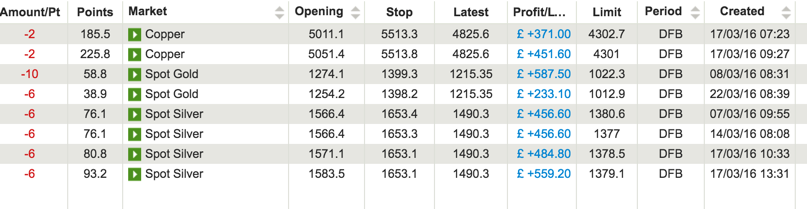
    Here is a snapshot of  our (open) results for the last week. I won’t normally show this detail as it can be misleading when we have a mix of recent and longer term open trades. But as all our trades have similar creation dates, I felt it was okay to include.

    Snip20160401_2

    We have a medium term strategy for these trades. Meaning from 6 to 12 weeks, we are 10 or so days in. Part of the strategy is to open the trade early. If an early trade is not close enough to the extreme (a top or bottom) then we will manage the trade to achieve better entries. Being early is difficult for many as it is nearly always contrary to popular opinion. Also, being early can provide excellent gains only to see those gains retrace to a loss – which is emotionally difficult and the reason why many traders cash-in too soon.

    By early trade, I should mention that we should also not be unreasonably early (it’s never that easy!). Patience is still key. For example, I think, a short in crude oil, currently, is too early. Crude has started to decrease in price this week from a recent up; but to take crude short now is premature. The picture is Similar for long-term treasury bonds that have a potential near term short opportunity.

  • How goes it? Week 25

    For simplification, I’ve combined Slow Trader and Ferrari into one fund which we will refer to as Slow Trader Fund.

    Our strategy in Slow Trader is to short term trade (using, primarily, daily close bars rather than intra day bars) shares in the FTSE 350, stocks in the S&P 500 and major foreign exchange (FX) currency pairings.

    Arm Holdings. We came out at a little over break even. I moved our stop as I was not happy with the possible trend change of this share price. The share price did move below our buy point but has subsequently moved up again. We are out for the time being.

    Halliburton Co. We set this share stop also to a little over break even. This took us out without lose and the share price has continued to drop. A good move on our part.

    BT Group. Moving the stop too early is usually not a good thing. I feel that the stop  should only be moved if something happens to make you change your mind about the share or the share price has climbed sufficiently to put you into a different price bracket. I got this wrong with BT. I moved the stop and got stopped out for £17 profit but the share turned and continued up!

    Ashtead Group. – £311 lose. On reflection, not a good share to take. A ranging share price, rather than my strategy of taking trending prices, this share dropped well below my entry price – but has subsequently turned up again.

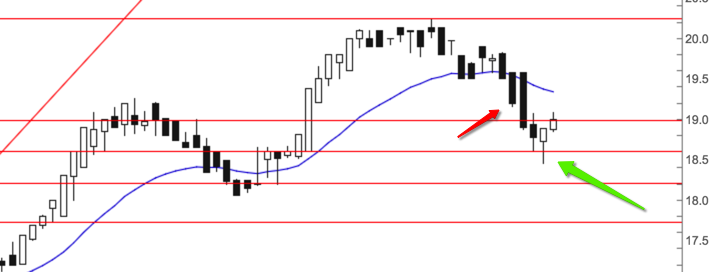
    CLS Holdings.  – £325 lose. I made fundamental mistakes with this one. Incorrect retracement level without price action. If I had waited (patience is the virtue of a good trader) and measured the retrace correctly this could have been a winner.

    Snip20150620_7I bought at the red arrow, the green arrow was of course the correct buy point.

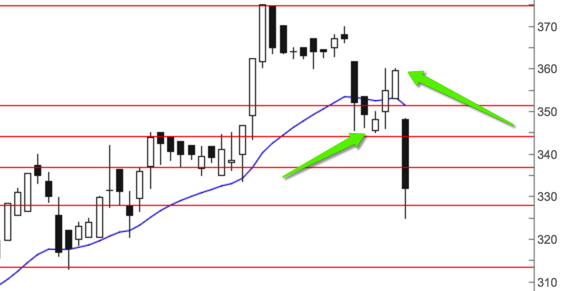
    Card Factory. – £311 lose. This is a relatively new share. Only 5 years of fundamental information, I prefer 10 years.

    Snip20150620_8

    We were in credit – having bought at the lower green arrow – but a sharp drop took us out. You will notice that I sell a share for a lose (or more accurately, I’m stopped out if a share price drops below what I think is acceptable).

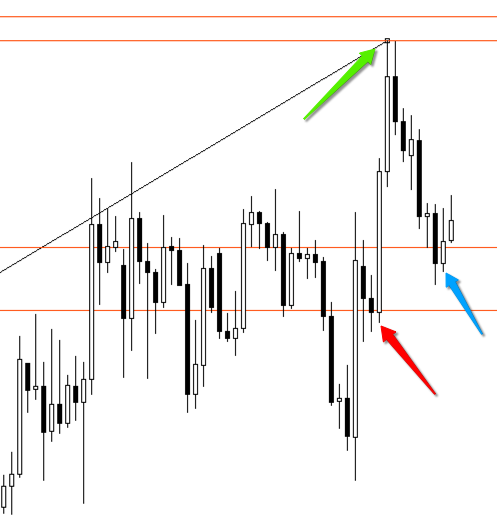
    FX AUD/USD. + £394. This is the first time you have been introduced to FX. This is on an intra day 4-hour chart so you can see the move.

    Snip20150620_9

    We bought at the red arrow, we sold at the green arrow and we bought again (and we are still in) at the blue arrow. Easy! Okay, sometimes it goes ideally like this.

    We also had interest charges (mostly for carrying shares over the weekend) of – £32.

    We are currently in:

    CLS Holdings. We bought again at the green arrow on the CLS chart above. Although the price has moved up we are still -3.7 points as this is the spread. The spread is how the broker (in our case IG) make their money. It is the same as when you go on holiday and change your sterling for euros, you have a buy and a sell rate.

    ITV PLC. + 2.6 points.

    Money supermarket. + 12.1 points.

    Monster Beverage. + 568 points.

    Underarmour. + 464 points.

    WPP PLC. – 9 points.

    FX AUS/USD. – 20.9 points.

    Finally, anyone wishing to short term trade for themselves I am trialling a notification system to help you. You will get my information direct to your smart phone so you will need an account that you can action through your phone. More later.

    B

  • 23rd July, Slow Trader Hedge Fund – 4th Month

    We are down 4%

    During the period we were up a maximum of 15% and it has been a big drop to take us back to -4%.

    The emotions are difficult during these times, particularly as you are trading other peoples money. I traded very well at the beginning of the period to take us 15% up. And then – well there is no hiding or making excuses – I didn’t follow my own strategy and, by-and-large, made a series of poor trades on the short side.

    If I can liken spread betting accounts to climbing Everest: we started at base camp, got blow down the mountain initially then made a charge up the mountain – 15% up. We hit a crevasse and, as your guide, I got the abseil ropes out instead of the crampons and possibly a couple of ice picks.

    crevasse-glacier-mclain-700972-xl

    We have slipped all the way back, just down from base camp. To consider a new guide is understandable. This guide – me – has had a few years climbing other, more forgiving, share ranges. This is the 4th year on this mountain, meaning spread betting. I got to the top – well, slightly above the top if you want to picture a short vertical helicopter ride. Another year I got half way up the mountain and another almost 2/3rd of the way up the mountain.

    During each of these attempts I’ve re-visited base camp, and once quite late in the year. So all is not lost in our attempt to get to the top – which is the same as doubling our money.

    I’ve studied the issue hard over the last two weeks and readjusted to help move with the change of the market. I’ve also reaffirmed my own strategy and operation. In this game when you get it right your financial reward is good but when you get it wrong the hit always seems higher.


  • Open a Slow Trader Fund

    How our fund works and what it costs.

    Trading cycle: from buy to sell (or sell to buy if we are short) is anything from a few days to a few weeks.

    Lets say you have £30,000 to trade. In this example, we will trade no more than £600 on any one stock or share. And during any one cycle we will trade some 10 to 15 times concurrently.

    Our strategy is to find intermediate trends. We get that right about 8 times out of 10. That sounds okay, but is spoiled by activation of our stop loss by larger than acceptable fluctuations in the share price; and by spikes in share price, including so-called ‘tree-shakers’ – don’t forget the hoops and loops – they can also be devils! The last two I made up, but you get the idea.

    However, where the spikes and the like are going to affect us a couple of times a year, to our advantage, we will have occasion to surf an intermediate trend. Hopefully, two or three times a year. In other words, we will stay in a trend for more than one cycle. Maybe for several cycles, and this is where the true profits are. Such a trend, even with one trade, can pay for all those pesky spikes and whatnots in one go.

    Our operation is three fold:

    1.   Find correct entry and exit points primarily from stocks and shares within the S&P 500 and FTSE 350.

    2.   Trade with regard to the share value or, as Warren Buffet calls it, the ‘margin of safety’. In other words, if we are taking a long then we want the share to be undervalued. Conversely, if we are taking a short we want the share to be overvalued.

    3.   Trade within our money management criteria.

    Trading vehicle:

    Our trading vehicle of choice is a spread betting account. We use IG. Unlike a normal share trading account, a spread betting account is tax-free. (Many people use these accounts to bet rather than trade. Those that bet, I have read somewhere, lose some 8 or 9 times out of 10).

    What it costs you:

    As the account is leveraged we pay a fee when we trade over a single day. This is called a daily fund bet (DFB). A DFB is our trade of choice due to the trading time frame we follow. To help cover this we deduct 2.5% of the final fund amount.

    Also, we deduct the same percentage of profits up to a maximum of 20% (For example, if profits are 15% we will deduct 15% of those profits. If, on the other hand, profits are 50% we will deduct only 20% of those profits).

    In other words, let’s again say your fund starts with £30,000 and, after one year, is at £50,000. Your costs are: £1,250 (to help cover the DFB), and £4000 (which is 20% of your profits). What you would get back is £44,750 (£50,000: less £1,250 less £4,000).

    For buy (long) trades IG charge the one-month LIBOR plus or minus 2.5%. This applies for sell (short) trades together with a borrowing fee. Dividends are credited if long and debited if short. For simplicity, we deduct a flat 2.5% of total end-of-year fund. This is less than the true costs to us and therefore in the case of an account that finishes even, or slightly above even, this will normally be a loss to us in terms of costs.

    How long does the fund run?

    A fund runs for one year. Two months before expiry you can decide to cash-in or rollover. In either case costs are subtracted annually.

    We can trade only 4 funds not including our own. A fund can be made-up from a group or from an individual. Each fund is to be a minimum of £30,000.

    A margin call is not your responsibility. However, your attention is drawn to the disclaimer page in slowtrader.com

    Note: Slow Trader Fund, 23rd July 2015, only has the DFB 2.5% charge. However, going forward from 23rd July 2015 the profit charge will also apply for those that wish to rollover and or place additional funds.