Tag: Spread

  • Margin to increase for retail traders

    We have been awarded professional client status by our brokerage.

    To be classified as a professional client the qualification is 2 out of the following 3 statements below:

    1. Carried out CFD, spread betting or forex, in signicant size, at an average frequency of 10 per quarter over the previous four quarters
    2. An investment portfolio (including cash deposits and financial instruments) exceeding €500,000
    3. Work or have worked in the financial sector for at least one year in a professional position, which requires knowledge of CFDs, spread betting or forex

    Why is professional client status a big deal? Because margin requirements will increase substantially for ‘retail traders’; for professional clients they will not.

    What is ‘margin’?

    • It is a good faith deposit that a trader puts up for collateral to hold open a position.
    • It is not a transaction cost, but a portion of our account equity set aside and allocated as a margin deposit.
    • When trading with margin the amount of margin needed to hold open a position is determined by trade size. As trade size increases, margin requirement increases.

    This has no effect, however, on our usual spread payment: which we consider as a true identification of a retail trader. If we pay a standard spread then by definition we are retail traders.

    Institutional proprietary traders (or ‘prop’ traders as they are known) trade the firms money (not clients money) and often at a reduced spread cost, or no cost at all. They are, to our mind, non-retail traders.

    But to be considered a professional client, and thereby maintain a desirable margin commitment, is great.

  • Financial spread betting

    For my day trading I use a financial spread betting company.

    Don’t get bothered by the word ‘betting’, it could quite easily be called financial spread trading. However, putting the ‘betting’ word in there qualifies for no tax (under the current rules).

    My opinion on why no CGT, stamp duty or explicit trading commissions:

    • It is well-known that most (and I mean most) people lose at financial spread betting. It’s not the spread betting that people lose at per se, it’s trading in general and particularly day-trading.
    • Therefore, if financial spread betting were taxed, then the large majority would be claiming tax offsets for their losses.
    • Spread betting companies, on the other hand, make money (they operate like the casino) and the government are better off leaving the pundit who is attracted to and enjoying tax-free trading (losses) and taxing the profitable companies.

    Financial spread betting is a derivative based trading which simply means that we don’t own the physical product. This does give us the advantage (not necessarily always an advantage) of being able to buy, go long, or sell, go short.

    We also, unlike an ISA trade, don’t pay a fee for our trades. (I’m considering short-term trades from a DFT here). However, we do pay a spread. A spread being the difference between the buy and the sell-price.

    It might be noticed in my ‘algorithm to trade by’ page that I make repeated reference to the spread – in particular half-spread. The beginner doesn’t fully appreciate the importance of managing the spread. Furthermore, both the beginner and the intermediate, particularly if the latter drops into the dip, don’t fully understand the importance of managing margin and leverage.

    Spread:

    • On selecting a spread betting company probably my biggest criteria is the tightness of the spread.
    • A spread of, say, 2.5 pips for GBP/JPY is not a lot when we are trading at the minimum of £1 per pip. (As an aside, my amount per trade is always based on my reward/risk measurement which, in turn, is based on a consistent potential loss per trade).
    • If we entered a trade and exited immediately then for the £1 per pip example this would cost us £2.5 for the joy of trading.
    • Okay, that sounds very reasonable particularly as the average ISA has a ‘in/out’ trade cost of £24. (An ISA also has a spread, but lets keep it simple)
    • An expert’s (retailers) account may take them to the region of £60 per pip. An immediate ‘in/out’ in this example would cost £150. And they wouldn’t want to do that too often.
    • So, as we can see spread is a definite factor in financial spread betting; in my day-trading I measure to 0.1 of a pip so the spread is very closely included in my measurements.

    The real benefit of spread betting is leverage – for the expert at least who has learnt how to manage leverage and margin. The beginner, and often the intermediate trader, will misuse leverage (only having to commit 1% to 10% of funds to a trade). There is an enquiry ongoing to protect the inexperienced trader by a substantial reduction in leverage allowed. Particularly if a trader has less than 3-years experience. The effect of which will probably kill financial spread betting as an attractive trading vehicle for the expert.

  • What we call a ‘controlled trading technique’

    Slow Trader fund up over 10% for the year.

    We’ve moved away from the trade and hold philosophy. A philosophy that ambitiously has the account gaining 30% in a month (sometimes a few days) but worryingly has the ability to go the other way even quicker.

    We’ve moved to what we consider to be a controlled trading technique.  The gains so far with this technique have not been so great as it’s a reflection, clearly, of successful trades and then a reflection of the amount traded.

    Previously we would set a trade and let it ride for days or weeks. That gives the trade good opportunity to profit within a trend. The issue with our new ‘controlled’ trading system is that we only hold a trade for as long as we’re sitting watching the trade.

    However, controlled trading for us wins hands down over the ‘hold and hope’ system.

    What we will do now is increase our amount per trade. We’re confident (and it’s all about confidence) to do this. As we move into October (more of why October next) we will double the amount placed on each trade.

    I’m needed to manage the Hotel for a couple of weeks, as key staff are away, and then I’m away myself thereafter for a couple of weeks in Majorca. That brings us to mid September whereby we’ll start back with a few days of back-testing. We will then have a week of trading at our present risk per trade and to then trade with the more substantial amounts as we move into October.

    This is an exciting (controlled) stage of trading that we are about to embark upon. Thank you for staying aboard.

  • Slow Trader Diary – week 32

    No trades cashed-in this week.

    We also had no costs against us.

    This week we entered Pace PLC and DTE Energy Co, both on a December quarterly trade.

    We are mostly short term swing traders: so are our trades taken as DFB (Daily Fund Bets) or quarterly futures trades?

    The DFB gives us a tight spread (the difference between the buy and the sell price) but has a daily interest cost. A quarterly futures bet (near, mid or far quarter) has a larger spread the more distant the quarter but carries no interest charge. So which one to take – a DFB or a future quarterly – depends on time. In other words, it depends on the duration we think we will hold the trade.

    Currency pairs (FX) can only be traded through a DFB. With shares and stocks, however, we have the option of a DFB, or a quarterly futures trade; I will look to take a mid quarterly trade where possible.

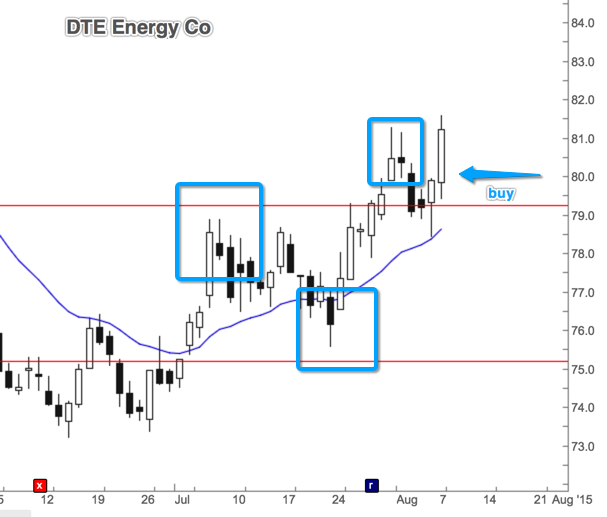
    Here is our trade with DTE Energy Co:

    Snip20150808_13


    DTE Energy is conventional electricity. Our conditional is simply a consistent ten years of positive earnings per share (EPS) percentage growth. As for recent trend, the stock is trending up which we can see from higher highs and higher lows. The 21 day moving average supports this. Our price, for us in this example, as there are many personal ways of determining price, is the confluence of a support line (a 61.8% fibonacci retracement line to be exact) and the pin bar the day before. We took the trade on limit, which meant the price did come down to a more favourable price before we bought automatically. We have set a target limit at 90.67. That gives us a risk reward of nearly 4 times.

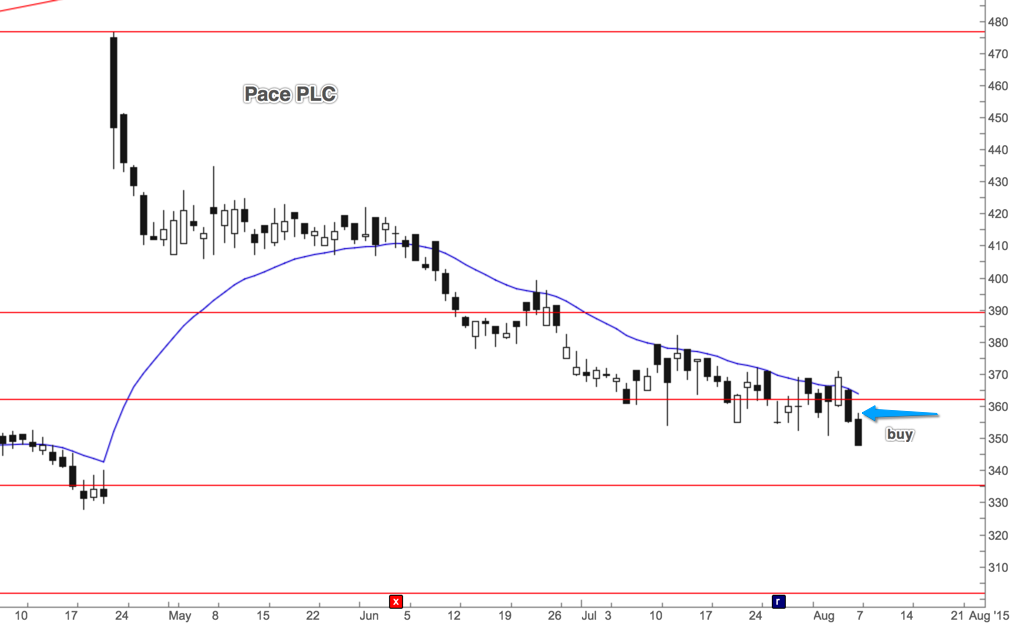
    Here is our trade with Pace PLC:

    Snip20150808_14

    Pace PLC is telecommunications equipment. This trade has gone against us slightly and I’m not happy with my decision to take this trade. Our conditional, again, is ten years of positive EPS percentage growth. However, it is the trend that is our weak link. Over the last 18 months, except for a large gap up, the trend is down. This is made more so with the drop in price yesterday. A closer look at the recent trend confirms this. Our price, a confluence of support level and price action is fine but is secondary to the trend. Also, our price action, being the pin, in hindsight, is black where a white pin would have been preferable. I will tighten our stop to minimise any loss and if we get a rebound I will sell early at, or close to, break-even price.

    No buy or short signals in FX this week. FX requires a regular watch so as not to miss the opportunities. By regular I mean a once daily detailed review of daily bars. This can be done, because of the timing of the FX New York close daily bars, at 9pm or 10pm, depending on UK/US time difference; or, as is my preference, early, before 7am, UK time. Then a look every 4 hours where possible, to match the 4-hour bar close times. However, I find that as we get close to a buy or short opportunity the best way is to set an automatic (ambitious) entry.

    Particularly looking this coming week for a buy opportunity in GBP/USD.