Tag: Mark Douglas

  • A traders engine is….

    What best helps us make money as a financial trader?

    Is it:

    1. a fantastic strategy
    2. time on our hands to be able to trade
    3. enough money to trade at the level we desire
    4. an environment without distraction
    5. the correct equipment and support software
    6. to be able to trade objectively, all the time

    The list could go on. And of course, we could argue that all the above have a part to play, to some degree or other.

    However, from our lessons, it is the final item that takes the biscuit.

    To trade objectively (or in the zone, or from a ‘now’ moment perspective) is the engine of the whole process.

    I have read ‘Trading in the Zone’ by the late Mark Douglas several times and it was only the last read where, for me, the so-called ‘light’ came on.

    This may mean that I’m a bit slow in this regard. Or it could be that we need to gain a certain level of traders experience before we can properly grasp what Douglas was telling us.

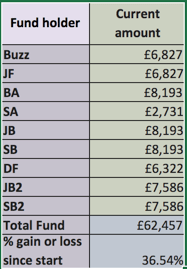
  • Slow Trader Fund

    Our Slow Trader fund has sat on the fence for a few months waiting for me. Not being a boom and bust trader, I have traded small whilst developing our ‘probability trading’ technique.

    A level of profitability through consistency has to be achieved before increasing trade size. The technique provides that, now it is up to me.

    It may seem a bit odd that I’ve moved away from trading a market, US stocks, that has increased this year as an index 20 percent or so. UK shares not so much at 6 or 8 percent as an index.

    To day-trade profitably I need to give it (day trading) all my attention. Having trades open in other areas and time frames were definitely a distraction for me.

    Why have I chosen day trading despite the many stories that tell us not to trade this way? Bizarrely, it is control. As a ‘probability’ trader, we accept that we are trading a market that is random. In other words, we accept that anything can happen.

    If we except that anything can happen, then we accept the risk. We accept that the market is only about a price that can go either up or down. In ‘probability trading’ we also accept that certain effects happen when lots of traders trade. Things happen that can give an observant trader an edge.

    Despite the simplicity described, it has taken me a couple of years to combine price action trading and money management, specific entry and exit techniques, and group it all together, test it exhaustively and call it probability trading.

    Fund contributors that think the share market, and particularly the US stock market, are to continue climbing throughout 2018 ought to withdraw their funds from Slow Trader and head that way.

    After all, that is the market, with you, that Slow Trader originally entered.

    If you stay in the Slow Trader fund, and to do so you don’t need to do anything else, you become part of a probability day-trader fund. Our advantage: we are not concerned about a good or a bad year for stocks and shares; we trade a currency pairing in the short-term, with an edge; with (to quote Mark Douglas) rigid rules and flexible expectations.

    We have developed a day trading strategy that allows us to take money consistently – day in, day out.  We scale-up though when we’re ready.
  • Trading in the Zone

    I read Mark Douglas’ book ‘Trading in the Zone’ some years ago, when I was at the beginner stage of my current trading strategy, and I didn’t get it.

    Yes, the principles that Douglas provides are simple and easy to grasp, but to truly relate to what he is saying, and how it applies to what Douglas calls the ‘traders mindset’ is another thing altogether.

    I think that a trader needs to be at, or in the early stages of, the ‘expert’ level as a trader to properly grasp Douglas’ lessons.

    A beginner tries every kind of strategy going, which is fine, as long as the trader can settle on a particular way forward without a great deal of variation in the overall principle of a chosen strategy; to do so is the only way that a trader can move from beginner to intermediate.

    The expert level is the cumulative refinement of ones strategy and a complete acceptance in that strategy. And that’s the easy bit. The hard work then comes with mastering Douglas’ traders mindset.

    If we are a beginner or intermediate we ain’t going to get the importance of Douglas’ concept because, at the beginner and intermediate levels, we haven’t yet fully accepted responsibility for our strategy. In other words, we have not yet emotionally matured as a trader and fully accepted the probability of our trading strategy.

    You see what I mean, all you beginners, you probably have no idea what I’m talking about! Read Douglas, and read it again when your foot goes on the first rung of the expert ladder – believe me, its like a light coming on.