Tag: fibonacci retracement

  • The stabilisers have to come off, eventually

    Who takes up retail financial market trading? I initially imagined that it would be young adults, the ones we see on the sports betting adverts, but I was wrong. It’s primarily professional people: engineers, doctors, dentists, lawyers and well-to-do retirees. But unlike our usual work, we struggle to be successful at financial trading.

    Because, unlike our usual work, we are now dealing with uncertainty; and in this world, because we don’t understand the future, it is not possible to work rationally. To overcome this we look at the future by naive projection of the past.  We are now in a world where 60% certainty (if we’re very good) is as good as it gets. We therefore look to a method and indicators to help make what is irrational seem more rational.

    That brings me onto the decision of how to trade. The ‘how to’ question is probably one of the most difficult and important decisions a financial trader makes. However, as with choosing a career when we’re young, we do not have the experience to be sure we are making the right choice. Therefore, we are overly influenced by those around us.

    In trading we tend to go with the method that we learnt from the first seminar we attend. We try that to the point of financial exhaustion and either quit, or if we’re particularly determined, we will venture to try another seminar and another method. And so the cycle continues until we achieve expert or get lost in the ‘dip’ somewhere.

    With a little thought it does not need to be so difficult. We first need to find the broad category of trading method that suits us. If we stay away from the ‘get rich quick’ merchants (those advertising the secret or ‘the one thing’) then there are a lot of excellent tutors available.

    We do need to find that broad category first however: no point in learning chess when what we really enjoy is the simpler pace of draughts (checkers). Once we have that broad method that we determine is the one for us, we can then go to work on the finer detail.

    It took me a long time to find ‘price action’ as my prefered trading method. I notice also, looking through the internet, at great beginner introductions to price action that are available. Many however provide confluence ideas of price action with indicators: moving averages, Fibonacci retracement, stochastic overbought and oversold to mention a few.

    That’s fine, we all start with all of these; they’re supports and we feel, and were told, we would be foolish to attempt to trade without them. However, price action is much more than this (or I should say much less because with true price action indicators are a distraction at best). Once price action is learnt we can deal very well with the irrationality of it all and we can strip away the supports. After all, even Bradley Wiggins, probably earlier than most, had to take the stabilisers off at some point.
  • Slow Trader Diary – week 32

    No trades cashed-in this week.

    We also had no costs against us.

    This week we entered Pace PLC and DTE Energy Co, both on a December quarterly trade.

    We are mostly short term swing traders: so are our trades taken as DFB (Daily Fund Bets) or quarterly futures trades?

    The DFB gives us a tight spread (the difference between the buy and the sell price) but has a daily interest cost. A quarterly futures bet (near, mid or far quarter) has a larger spread the more distant the quarter but carries no interest charge. So which one to take – a DFB or a future quarterly – depends on time. In other words, it depends on the duration we think we will hold the trade.

    Currency pairs (FX) can only be traded through a DFB. With shares and stocks, however, we have the option of a DFB, or a quarterly futures trade; I will look to take a mid quarterly trade where possible.

    Here is our trade with DTE Energy Co:

    Snip20150808_13


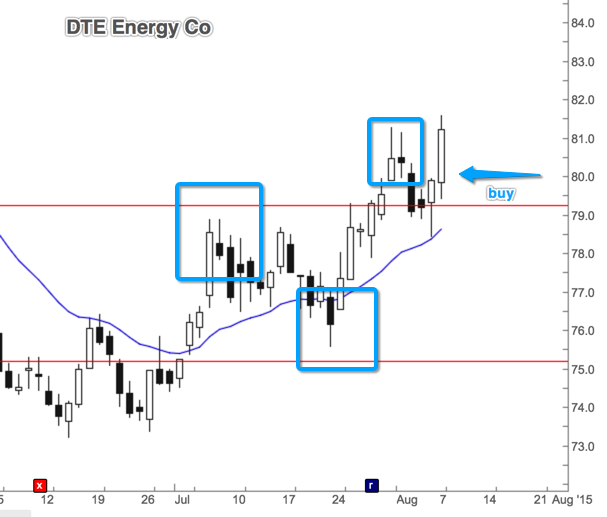
    DTE Energy is conventional electricity. Our conditional is simply a consistent ten years of positive earnings per share (EPS) percentage growth. As for recent trend, the stock is trending up which we can see from higher highs and higher lows. The 21 day moving average supports this. Our price, for us in this example, as there are many personal ways of determining price, is the confluence of a support line (a 61.8% fibonacci retracement line to be exact) and the pin bar the day before. We took the trade on limit, which meant the price did come down to a more favourable price before we bought automatically. We have set a target limit at 90.67. That gives us a risk reward of nearly 4 times.

    Here is our trade with Pace PLC:

    Snip20150808_14

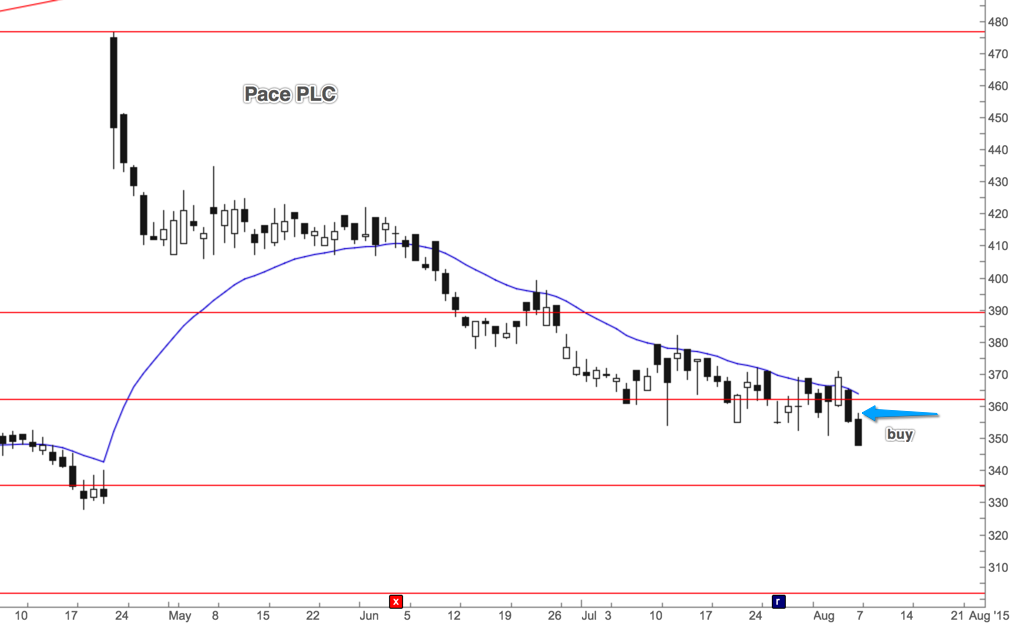
    Pace PLC is telecommunications equipment. This trade has gone against us slightly and I’m not happy with my decision to take this trade. Our conditional, again, is ten years of positive EPS percentage growth. However, it is the trend that is our weak link. Over the last 18 months, except for a large gap up, the trend is down. This is made more so with the drop in price yesterday. A closer look at the recent trend confirms this. Our price, a confluence of support level and price action is fine but is secondary to the trend. Also, our price action, being the pin, in hindsight, is black where a white pin would have been preferable. I will tighten our stop to minimise any loss and if we get a rebound I will sell early at, or close to, break-even price.

    No buy or short signals in FX this week. FX requires a regular watch so as not to miss the opportunities. By regular I mean a once daily detailed review of daily bars. This can be done, because of the timing of the FX New York close daily bars, at 9pm or 10pm, depending on UK/US time difference; or, as is my preference, early, before 7am, UK time. Then a look every 4 hours where possible, to match the 4-hour bar close times. However, I find that as we get close to a buy or short opportunity the best way is to set an automatic (ambitious) entry.

    Particularly looking this coming week for a buy opportunity in GBP/USD.

  • Slow Trader Diary – week 29

    An early diary entry as I’m going away for a few days to where there is no internet and probably no mobile signal.

    Lets take a look at short term swings.

    Snip20150715_5

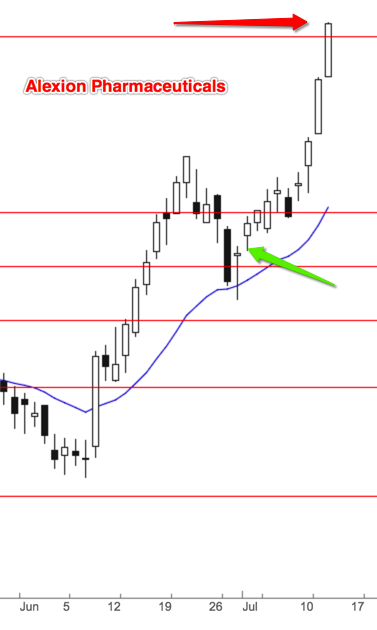
    We mentioned Alexion Pharmaceuticals in the last blog. The green arrow represents the buy point. This is because the share price has pulled back, in this case to a 50% retrace of a previous move, and provided a buy signal – the pin pointing down is a clear buy signal.

    The red arrow represents my sell point. The horizontal lines are drawn using the fibonacci retracement tool provided with most software and were drawn weeks before. This does not mean we can look into the future with share price but if certain things happen it does give us an advantage in determining probability.

    The catch is if you miss the move – which I did being too concerned about Greece – then there are signals that allow you to get into the swing once it has started. But another concern is the index, in this case the S&P 500 index.

    Snip20150715_7

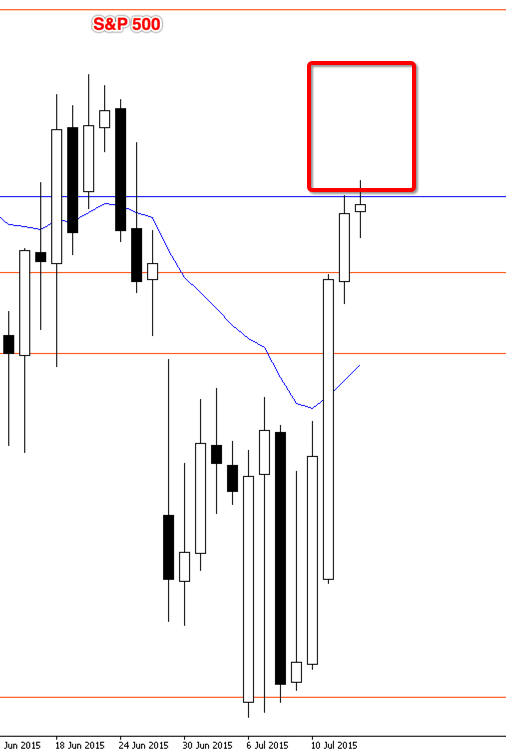
    The index is of course an average price of all the stocks within the index. Some stocks being much larger than others means that the price change to individual stocks is not well defined but its a handy guide. If the index goes up, by definition, many of the stocks go up – and vice versa.

    There is a good probability that the S&P index will bounce down when price reaches somewhere within the red box. Not long therefore. So to take a buy now from one of our stocks would be the wrong time for a short term swing trader. Or any trader. Better to be patient and wait for the index to swing back down again and provide a more profitable entry point.

    I don’t use the index as a buy/sell signal, the individual stocks do that for us. Price swings are a factor in all charts to some extent: be it stocks, shares, FX or commodities. Reading those swings is the art.