Tag: 5-minute charts

  • The short the medium and the long

    What is new for 2017?

    Firstly, for my day trading from 5-minute charts I’ve chosen:

    EUR/USD  AUD/USD  GBP/JPY  GBP/USD and Gold

    I trade these most days (half day Friday) from 8am to 6pm. With an hour or two off here and there for good behaviour. I will report day trading ideas from time to time through this weekly blog.

    Secondly, for the ‘slow Trader fund’ from daily charts I’ve chosen:

    The UK top 200 shares

    This was after reflection over the holiday period. Trading currency pairings on a higher term chart, when probably taking the opposite view on a lower term chart, is difficult. Therefore, we needed a home for the fund and the UK top 200 shares fits the bill. Why not US stocks? There is a change in tax on US stocks and also we consider that later this year a large move in the dollar is likely. There is enough going on trying to pick share direction – we don’t need to have to factor in major currency changes too.

    I’m excited about this move of the fund. We will trade both long and short based on ‘price action’ technical analysis. It will provide stability and the increase that we’re looking for. I review all qualifying shares every trading day morning. Entries are based on daily charts, however, best entries may be found on lower time frame charts. Ideally we are looking for entries to last a few days out to a maximum of a few weeks.

    I’ve chosen a selection of the top 200 shares that have what I’m looking for in terms of price, liquidity and stability. I will blog the complete list later and keep members updated of results through this blog.

    Finally, we also want to provide information for the best UK pension ever. That is long-term (many years) investment via a UK share ISA.

    This is a reintroduction to Slow Trader of fundamental analysis. Nick has kindly agreed to provide regular information from his spreadsheet on which UK shares are great performers and available at the right price. Nick will be reviewing the FTSE 350 (that is the FTSE 100 and 250 combined) and I will keep you updated from this list. I won’t provide a description of companies, as I’ve done before, but simply the essentials from the spreadsheet. These are for long only consideration.

    This is all about the fundamentals and the incredible analysis tool that Nick has created. However, James and I will add our long-term (weekly and monthly chart) technical slant. More of this soon.
     

  • Keep it simple and adapt

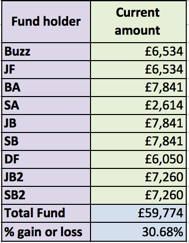
    We are up 30% since the start and 21% so far this year.

    snip20160924_2

    Over my holidays I read all eight trading books by Laurentiu Damir. Seven of which are short e-books written about four years ago. He teaches simple, conservative trades. His more recent book ‘Price Action Breakdown’ provides a good trading concept.

    Laurentiu recommends the higher timeframe charts – such as 4-hour or daily charts. This, as he explains, is because of the effect that multiple news events throughout most days has on the lower (such as 5 minutes) time frame charts.

    Laurentiu teaches reading a chart that is a time frame appropriately above your price action chart. For example, He would take the ‘bigger picture’ from the daily chart but use the 4-hour chart for price action set-ups.

    We use (and reading between the lines I think Laurentiu does too because trading is what he does) the 1-hour chart for market cycle and the 5-minute chart for our price action – and we keep a good eye on the news events that can affect us.

    As Laurentiu explains: the thing with trading is that all of this is a guide. Flexibility based around a solid concept is key. It may be the 1-hour chart but on the day it may be the 30-minute chart. Price action may be 5-minutes but again this may be from the 15-minute or even the 3-minute chart. It’s whatever fits.

    We cannot trade by numbers and be successful, we have to know and understand a lot and, of course, practise a lot – then keep it simple and adapt.


  • The cool headed, eagle-eyed trader

    To win consistently at day trading we need to love what we do, because it involves a lot of screen time.

    Day trading is our prefered trading timeframe because we are in control, on a moment by moment basis – we do not wander off and leave our trade to ‘hope’.

    That said, day trading, more so than the higher, trade and hope, timeframe of trading requires a cool, well rested head. Any sign of tiredness, or distractedness, will show, as clear as day, in our trading results.

    This week, and the coming few weeks, with the opening of our extension to our family business, the distraction and the tiredness is there and we have modulated our trading to balance this.

    Our primary trading timeframe is the 5 minute chart. However, we will use as low as one minute charts to get a better read on a 5 minute chart entry.

    Whenever we see a complete chart the entry and exit points can quite easily be given by an 8-year old. However, to find good entry and exit points consistently, in real-time, requires at least 10,000 hours of dedicated chart time.

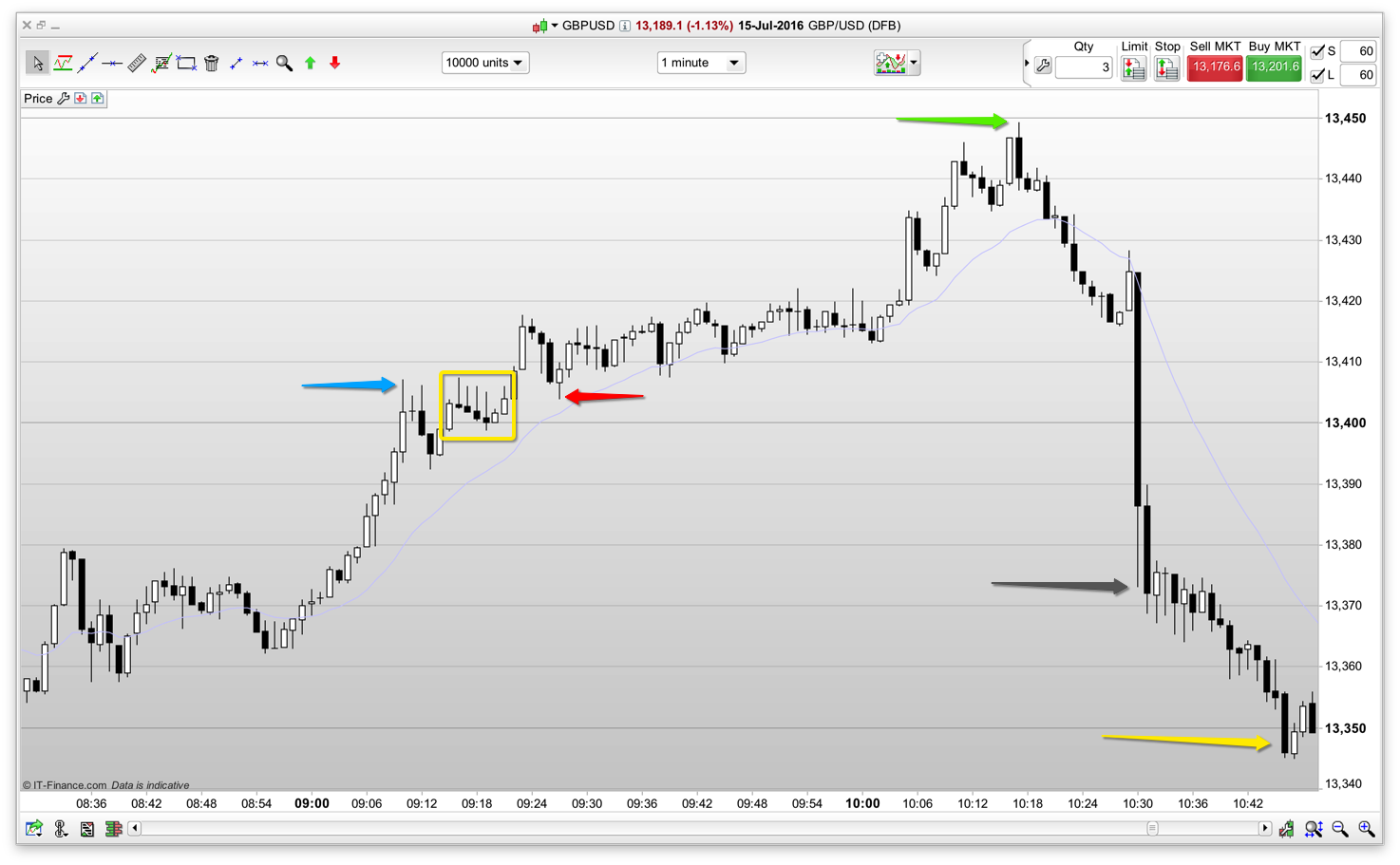
    Below is a trade we took yesterday on the one-minute chart. The trade went against us initially, but our wide stop and reading of the chart left us with a profit. Any other trader would have traded differently, and on another day with the same trade we probably would too, but this is how it ‘panned out’ for us.

    Snip20160716_4

    We entered the trade short (that is for the price to go down) with a scalp and a swing at the blue arrow (I’ve saved you from the multiple trend lines and measurements that go into finding this entry). We had a wide stop of 60 pips.

    To the eagle-eyed trader, the ‘price action’, shown in the yellow box, was a signal to get out of the trade. However, we held and it was only at the red arrow (actually, it was slightly higher than the red arrow shows, and therefore slightly slower than the eagle eye!) that I got out of our scalp at a small loss.

    The swing portion of the trade went against us for over an hour where another scalp entry was presented at the green arrow. The scalp entry would be taken off at the grey arrow and the swing at the yellow arrow. In actuality, we did not take the green arrow entry and took the original swing off a little above the grey arrow.

    When a trade does not go our way immediately  (and the law of trading probability says that sometimes they won’t) it needs a cool, well rested, head to deal with it and achieve a profitable outcome.