Blog

  • Do fundamental and technical analysis mix?

    Of my fifteen years of trading the first ten years were spent on reading fundamentals. I don’t regret this one bit. Fundamentals are what drive the price of a stock over the longer period; and I do mean longer period. Fundamentals to me are great if we’re talking more than 20 years, and I prefer 30 years plus.

    However, for clarity over the near term (presumably from my thought above, near term is anything less than 20 years) technical traders hold the key. That is a bold statement as every magazine or commercial pundit tells us its fundamentals all the way.

    Can we combine both technical and fundamental? Yes, of course, and some traders report to be doing this successfully. To some degree, I do this with the Slow Trader Fund when I trade from daily charts. In this case I will take commodity trades when the COT report is in agreement with the trade. However, the fundamentals of a stock do not mix well with technical analysis over the shorter period. One simply confuses the other, and that is never a good basis for a successful trade.

  • To master the game takes time

    IBM’s computer “DeepBlue” has been beating the very best chess players for some time. Now Google’s computer “DeepMind” is beating professional players in the ancient Chinese game of Go.

    We have likened chess to trading before. In his book “think, fast and slow” Daniel Kahneman explains how chess is like learning a language, but more so. There are a good deal more chess moves than there are letters in any alphabet.

    Trading, and the number of trading signals, is another level again. Also institutional traders can afford the very best computers, and more importantly, the very best programmers of algorithms. The big difference, however, is that, unlike Chess or Go, in trading we are not competing against the computers, but with them. With them we win, against them, we lose. We need to think in terms of algorithms, we need to be very precise. That involves our system two (logical) thinking not our system one (instinctive) thinking.

    Kahneman explains that it takes about 6 – 10 years, 5 hours a day amounting to about 10,000 hours, to become a master chess player. We know that this is true for other skills: a junior doctor about 7 years, a tennis player takes a similar time (the 17 year old that wins Wimbledon started at age 7, or earlier) and as a fighter pilot I considered myself no more than competent after 7 years.

    Trading has three distinct areas that need to be mastered: trade knowledge (is price to go up or down and over what time frame), the management of a trade and the emotion of trading. Each of which need to be mastered equally.

  • Think like a trader

    A Trader, unlike an investor, will calculate very clearly how much they are prepared to lose; and that has to be an amount that does not alter a traders objectivity.

    All trades are somewhere between a 40% to 60% probability. There is no certainty in trading.

    However, the lower probability trades need at least double the reward to risk. In such a trade if our trade amount is say £200 we would expect to achieve a reward of at least £400. If not, we don’t take the trade. In such trades, however, a reward many times the risk is possible. If managed consistently well such trades can be profitable with only 30% of trades being winners.

    In the higher 60% probability trades we need a reward at least one times the risk. Therefore, if our trade amount is again £200 then we would need to achieve at least a £200 reward. Even if managed well, such trades still require better than a 70% success rate to be profitable.

    Achieving a profitable traders equation is vital. And determining what is a low or high probability trade, and therefore determining the reward required, is a necessary skill.

    How do I decide the trade amount? I simply use a 44th of the fund amount and trade half that amount on intraday chart trades and the full amount on daily chart trades. I would consider 3 to 9 trades a day on intraday charts, and 1 to 3 trades a week on daily charts, to be an average.

    I have traded the last month with a low risk amount of £20 per trade. This I find is a good amount to prove back tested strategies and still remain objective. The results are exciting and we are ready now for a gradual increase again to full amount trades.

  • Trading is logical not intuitive

    An essential lesson to learn, as a trader, is not to use instinct.

    Beginners (traders and investors) rely almost entirely on intuition. We buy stocks based on the image we have of a company, or we take a trade based on a chart pattern; a pattern that has poor context.

    In his book, “Think Fast and Slow”, by Nobel Prize-winner Daniel Kahneman, he explains the two systems that drive our way of thinking, system one and system two. System one being fast and intuitive and system two being lazy, slow and logical.

    The intuitive trader, the beginner, will interpret trades from patterns that merely feel right –  but they are patterns not based on contextual logic and not based on system two thinking. A profitable trader, however, will look at a trade through system two, a trade based on “good old” slow logic.

    To overcome system one we need to force ourselves to employ lazy system two.

  • New Money

    New money: Some of you (investors in the slow trader fund) have asked about adding to your fund.

    This is a good time if you wish to do so, and before the end of next month. I’m away for a week soon so anticipate that it will be the end of February before our trades are again proportional to the fund amount.

    Additional funds will have no effect on the investments of those not adding in. Our amount risked per trade is a simple (moving) percentage of the total fund. Therefore your percentage gain on a trade is much the same regardless of the size of the fund. Moreover, combining our funds allows us to trade more fully than we would otherwise be able to do with the amounts we have invested individually in the fund.

    Costs: The only measurable cost to us is a small interest charge by the broker for each consecutive day that we hold a trade. There are no charges from me.

    What to do with your medium term stocks: consider holding for a while. Stocks have taken a battering recently, particularly the banks, but a recovery over the next few weeks is a reasonable probability. Whether we see a new high – or, just as probable, a retrace in a few months to a lower low – is too early to tell.

    New software: I explained in a previous blog my need to backtest, that is now coupled with a change of charting software that has taken a few weeks to sort. The new software provides a greater degree of trade placement accuracy and is, we now know, a good improvement on our previous system.

  • Is the medium-term market prediction a coin toss?

    There are any number of ways to tell us what the market is going to do next.

    1. We could consider market cycles. This is a big favourite of Larry Williams. And within reasonable tolerances he does seem to get it right.
    2. We could use fundamentals. Which is looking at the books to determine a companies economic well-being.
    3. We could use technical analysis. Which doesn’t care one bit about the ‘value’ of a company but uses charts to show predictable patterns.
    4. We could listen to the, more often than not, short-term media comments, and panic!

    We all favour one method or another. I’ve tried all of them, but I do stay well away these days from number 4.

    The current probability of the market going significantly up or down, over the medium term, is 50/50. That is the same as betting on a coin toss. I wouldn’t do it.

    (….okay, I do take trades that have no better than a 40/60 probability of success. But that is because the reward to risk is so good. And if we consistently play the 40/60 rules correctly, and let them run, when we catch one…. voilà.)

    As a trading style, I favour the very short-term stuff, it’s based on technical analysis, and it is how I manage the slow trader fund. I also favour the very long stuff (30-years plus) based primarily on fundamentals with the buy timing helped by technical analysis.

    Everything in between, I leave to the coin tosses.

  • Monthly Slow Trader Fund update – 13th January 2016

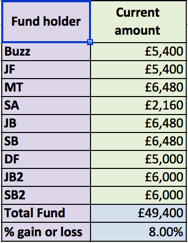
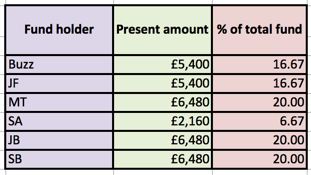
    The fund remains up by 8%.

    Snip20160113_1

    The last month has been a time for what can be called ‘backtesting’. In other words, development of trading strategies by using historical charts. As in any practise, most benefit is gained when tests are as realistic as possible. And I would say that in many ways, backtesting is more exhausting because the equivalent of several days of trading can be done in just a few hours. But backtesting is an essential part of a traders life.

    For the fund, live trading starts again this Monday. Its starts slowly, that is with a small risk and builds as proficiency builds. The build-up is subjective but I would expect to go to full fund entries within 2 to 3 weeks.

    My aim, is to achieve a monthly gain of 5% to 10% going forward. I use this simply as a guide to help me balance risk. No trading day is the same but it is reasonable to expect to find between 5 and 15 good trades per day. My maximum risk (for our fund size) starts out small but builds to about £400 maximum risk per trade. More often than not I will take half risk (£200) on most trades.

    I provide this information so you can see how a traders day is a constant consideration of gaining an edge through good chart reading and awareness of risk, reward and probability. And as this gains in momentum, day after day, the 5% to 10% monthly gain is not ambitious but very achievable.

    Taking a month to backtest can be frustrating to (you) the investor. It is certainly a luxury that most fund managers do not have. However, most funds lost more than 10% last month….  just a thought.


  • 2016 forecast

    Larry Williams provides an annual stock market forecast – it’s considered one of the most reliable.

    My own trading, as I read charts bar-by-bar, does not require a forecast. However, I’ve used Larry’s forecasts in the past. Larry’s comment for 2016 starts with:

    ….”It looks like it’s begun; a 2016 bear market. Hold on though… my cycles studies clearly point to a decline this year that will punish long-term investors – but NOT right now. In fact cycles say we have a spirited rally not far away; then a decline that will hurt the bulls and take cash away from investors and traders.”

    It’s because of such uncertainty that I now stay away from the mid-term investing timeframes, that is trades/investments held for a few months to a few years. I focus on short-term stuff and, occasionally, out to a few weeks.

    The only other investment timeframe, in my view, is 30 years or more via great fundamentals.

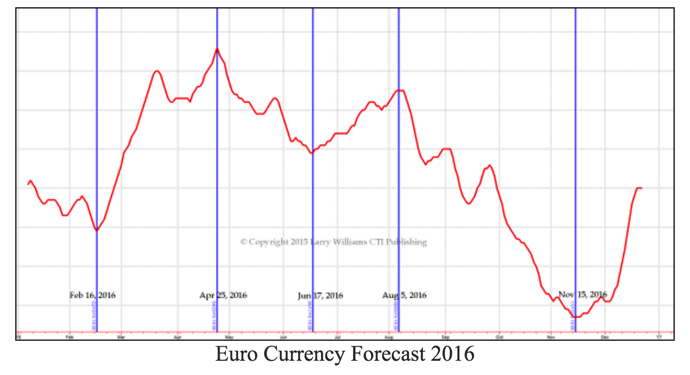
    Here’s Larry’s forecast for the EUR for 2016. Larry provides this one free. The full report is $195.

    Snip20160108_8


  • Books I’m glad I found

    Books that had an influence on me last year:

    Snip20160107_4

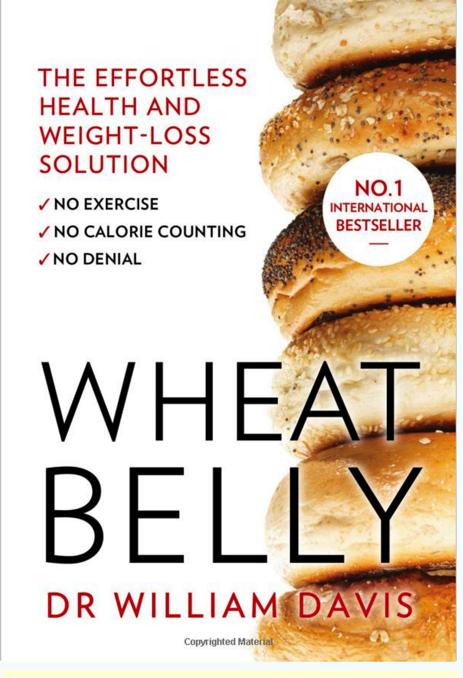
    I noticed this while browsing the book store early last year. My son, a serious tennis player, was considering a gluten-free diet. I read it cover to cover (twice) and it changed what I eat.

    Snip20160107_5

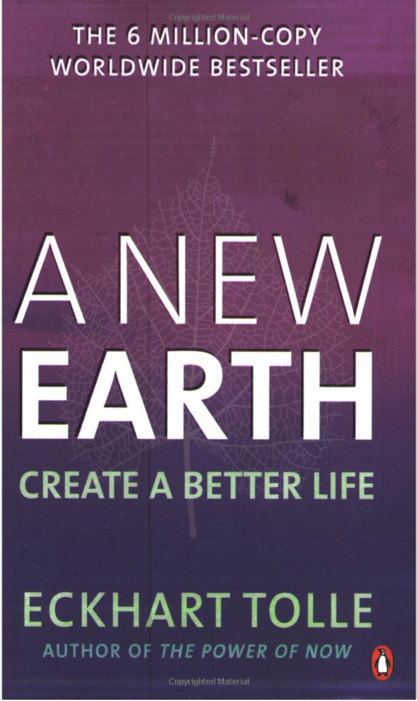
    I read ‘the power of now’ first, but the above book is (I think) better. As Eckhart says early in the book, this is either an idea we’re ready for or we’re not. A principle taught since The Buda.

    Snip20160107_7

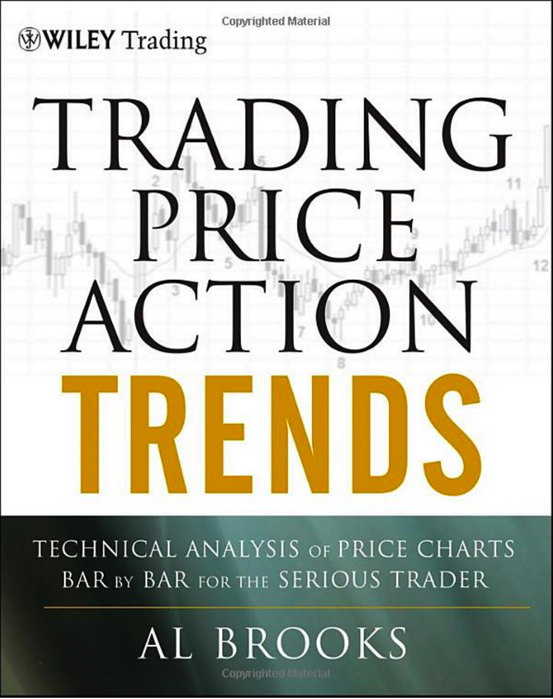
    I have read, watched and listened (several times probably) to most of what Al Brooks has produced. It is material for the serious trader. It doesn’t come easy, several hundred hours of work, but its the best I’ve found on price action trading.

    ….not entirely obvious, but each of these have helped (one way or another) with my trading.

  • How big is the currency market?

    Just how big again is the currency market, the one that we, mainly, trade?

    Glad you asked. Lets take a brief look.

    As we know the currency market trades 3 to 5 (could be more) trillion every day. But what does that look like…

    As a thought, if everyone on the planet liquidated their assets, that is cashed-in all their worldly possessions (a foolish notion I know, because when a certain amount of people cashed-in, the remaining processions would quickly become worthless – but play along)

    And processions were taken at current value, property etc., and all debt was repaid, then the cash value on the planet would be in the region of 247 trillion. So we can see that 5 trillion on the currency market, on a good day, is not unsubstantial.

    Indeed, every 10 to 16 trading weeks the entire monetary value of the planet is traded via currency markets.

    On a weak trading day we said that 3 trillion is traded daily. So what does that amount look like. In approximations, it’s a little more than the combined value of all domestic property in the UK.

    Thanks to Nick for the information.

  • Be a trader, or a 30 year investor

    Let me be clear as to where we should put our money and over what time frames. Here are the options:

    1. Put invested money into shares with a view of keeping it there for 30 years or more
    2. Have a traders account, intraday out to a few weeks
    3. Between a traders account and the 30 year hold, invest in accounts that are balanced with stocks and bonds

    There we are, it is really that simple. The 30 year option means that if we choose a great company to invest into, and we buy that company’s stock at a great price, then all of that, coupled with compound interest, will give us a wonderful return. Moreover, we are not overly concerned by market crashes at this hold timeframe. Indeed a market crash simply provides an opportunity to add more stock to the portfolio.

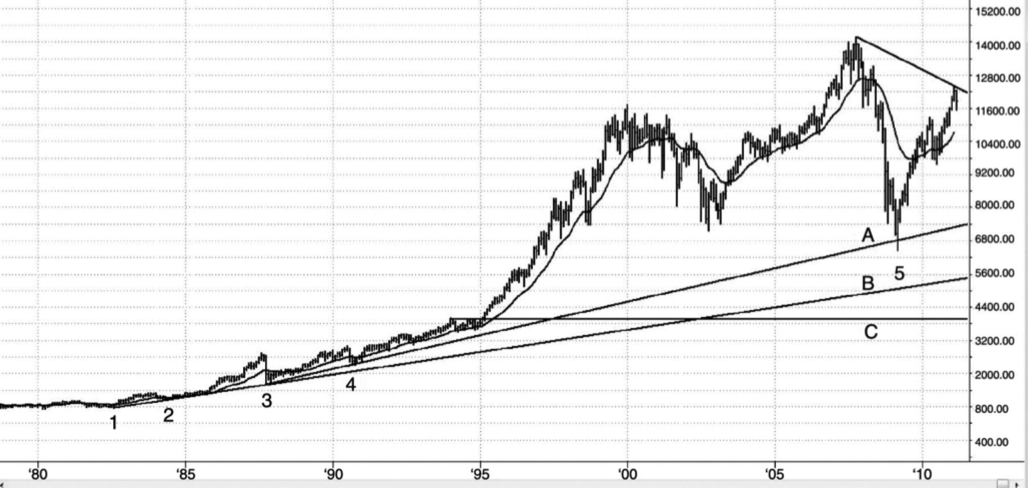
    Here’s a simple chart the shows how the market often returns to trend lines:

    Snip20151230_3

    Not so obvious on this scale, but the market crash shown at points 1 and 2, with a trend line drawn between them (B) was touched by the 1987 crash at point 3.

    The trend line (A) drawn between the 1987 crash and the 1990 low was touched by the 2009 bear market before it reversed up.

    The market may very well gain a new high, that is above the high of 2007, however, a pull back to a trend line, either line A or even line B, is a 60% probability. A pull back to line C is unlikely.

    A 30 year investor, in great companies bought at a wonderful prices, will not be effected. Also, a good trader will mostly find profitable trades in such a scenario.

    The in-between investor, between a traders timeframe and that of the 30 year investor, that has not got a balanced portfolio of stocks and bonds, is, well…screwed!

    Happy New Year

  • Reading music simile

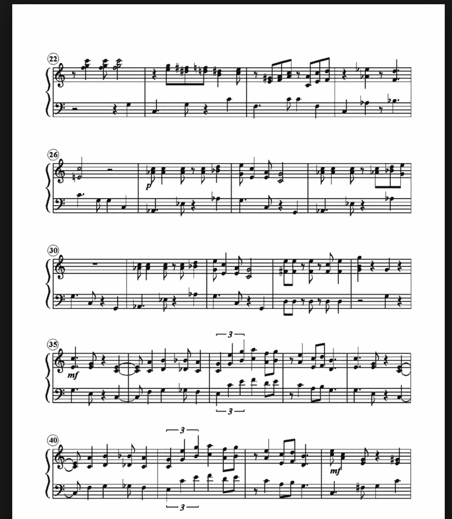
    If I were to liken trading to music then the trade chart (entry) would be the sheet of music and the trade management would be the chosen instrument, tempo and volume.

    Snip20151219_1Snip20151219_2

    If the next note were hidden then the probability that a musician could play a few follow-on notes, based on melody and rhythm, would be high.

    The same is true of price action trading or raw chart reading. There is a context to the chart that could be considered similar to music. That is the trade entry.

    How big an instrument we choose, drum or flute, and how much we bash or blow is representative of trade management.

    Understanding the flow of the music is necessary (the trade entry), but if we are to stay for an encore, then the point above (the trade management simile) is more important.

    One other consideration however, if a trade chart were music then, more often than not, it would be acid jazz.

  • What is our edge?

    Bernadette Jiwa wrote in her wonderful book Meaningful, “everything you’re striving for is a by-product of something else – something bigger”.

    A traders profit is a by-product of:

    1. Trade management
    2. Trade entries

    And it’s in that order. Management of a trade is more important than knowing where, when and how to enter a trade.

    A beginner will find this hard to grasp; they will alternatively concentrate all efforts on finding a good trade entry and largely disregard the management of the trade.

  • Chess and trading bars

    Trading can be compared more easily to chess than to…  say, poker. That is because, as with chess, trades are made with all the previous moves in clear view.

    Also, as in chess, all previous moves when trading have a certain degree of relevance and effect –

    ….moreover, each trading bar has a certain characteristic, a certain force, a certain power; as do individual chess pieces – the pawn versus the queen for example. The chart below asks: are there simularities to chess?

    Snip20151211_30

    Trading bars don’t, of course, have nice horse’s heads on them, to let us easily differentiate between the knight and the less capable pawn. However, each trading bar is, in its own way, just as distinctive as the carved chess piece.

    When we know these trading bar distinctions we have a chance at winning. But, as in chess, a game is not won by just knowing the capabilities of individual chess pieces. We need, more importantly, to know how the individual pieces (or bars in trading) support each other – the context – the confluence.

  • How to invest

    I have written about investments before. But it is worth going over again.

    The problem is the medium term investment area. Where most of us have our investments. Mutual funds, pensions and the like. This is the near term to 25 year investment timeframe.

    The investment area that works, if done correctly, is following Warren Buffet’s example of investing in undervalued stocks and holding for more than 30 years, indeed he doesn’t sell.

    The other area that works, but is difficult to master, is the very short-term stuff. I cover this every week in this blog.

    Okay, we have only two time-frames that we can invest with confidence: the very long and the very short.

    Why does the middle investment area not work? because of market volatility and the probability of a market crash within that time frame.

    A market crash for the Warren Buffet model, the very long-term investors, is just a blip in the big scheme of things. Not a problem. In the Buffet model we go through many crashes and use them as opportunities to add more stocks.

    A market crash for the day traders and daily chart readers (like myself) is not normally an issue because the signals of a crash will show on the day and get out stops are very tight for these type of investors. Actually, for these guys, if they’re good, a crash is a big payday. They’re taking it all from the mutual funds.

    For the Warren Buffet followers among us we need excellent fundamental information which we review annually. This information we’ll cover in another blog.

    On the other extreme, the short-term investors, day trading and daily chart reading, is not for everyone.

    So that leaves us back with what to do about the middle timeframe investing problem.

    If we have to be a middle term investor then avoid the traditional, heavily biased towards stocks, mutual funds.

    Watch carefully where the mutual fund invests. Few funds balance investments between cash, stocks, bonds and commodities. Funds that do this, and not being more than 25% invested in stocks, are extremely steady funds and good medium term investments.

    If we do have to go the mutual route then costs are a big factor. For every 1% that we pay a mutual fund will result in 20% to the fund managers over the medium time frame. Look for a cost of around 0.5%, no more. Same goes for pension funds.

    The majority of mutual funds, however, invest more heavily in stocks and most don’t beat the index. These mutual funds are in the danger zone. When a stock crash happens the fund profit and much of the capital is wiped out. Allow several years to get back to neutral. Not a lot of fun.

    So, if we have to invest in the middle term investments then look for: a fund (mutual and pension) that has low fund costs; and an investment portfolio that balances bonds, cash, commodities and stocks – and is particularly light on stocks.