Tag: zero-sum game

  • Don’t fiddle

    I’m sure there are few things that provide more frustration than that of financial trading. The need, that we often have, to make the price on a chart move in a desired direction. We try to move price by will alone. The same as when we see a golfer on the TV try to move the path of a ball after the swing with body language.

    We therefore commit, but constantly fiddle as we go. We do this in sports, we’ve done this in our professional lives – If we do this with our trades we don’t do so well.

    Maybe it’s because we consider price, and therefore the chart, to be predictable and considerate. But the chart is active through the cumulative input of lots of lives, (not true, it’s mostly computers but they’re programmed so stay with me) built-up from inputs from multiples of institutions, agencies and individuals, each making their own interpretation of the outcome of price, working from multiple time frames and criteria.

    Price is therefore without emotion, price does not care about our trade. Self pity about a failed trade is pointless, other than the valuable lesson it generally always provides.

    Moreover, price is a ‘zero sum game’, meaning that price will only move if enough institutions, agencies or individuals are on the other side of the trade to accept the alternative trade, which builds uncertainty.

    Therefore any plan for price that we have is going to seem, at some point or other, more often than not, floored; a pure fantasy. However, if we don’t trade to a strategy then we will be in and out of trades like a jack-in-the-box with small to medium losses that destroy our confidence, our resolve and our account quicker than we think possible.

    So, what is the answer? Well, maybe: clarity, boldness and acceptance help.

    Clarity is clarity of strategy, which means a way to trade that is so clear to us that we’re almost embarrassed to mention its simplicity. Anything more than that is too complicated and unclear to us that we will dither when we need to take a trade.

    Boldness is boldness in our commitment to a strategy. No questions asked. Commit to the risk and no half measures… like reducing (or much worse increasing) the stop position, or exiting before target without good reason.

    Acceptance is acceptance of change. We cannot win every trade. To try to do so clashes with clarity of strategy and boldness and the loop will quickly collapse. Acceptance in our strategy, acceptance that it works most of the time; or at least some of the time.

    And if we manage correctly (rather than fiddle) then that is enough to be profitable.
  • Most important, but often ignored

    Probability is something we understand very clearly when it comes to sports, but it seems to be a concept that we struggle with as a trader.

    We realise (because it’s been mentioned a few times) that the difference between a trader and a gambler – if we where to picked one thing – is adding or not adding probability into the mix of reward and risk.

    Some sports lend themselves very well to the example of probability. Basketball, tennis and (particularly) golf come to mind. I mentioned basketball last week because the point scoring matches well the traders multiples of reward to risk.

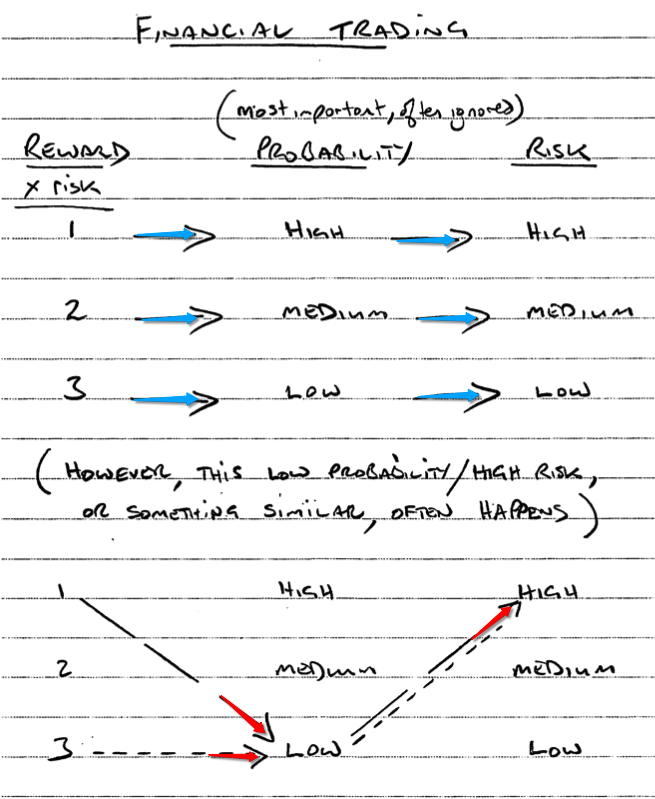
    In basketball we can score 3 points from a shot taken from outside of the defenders area; 2 points from inside the area; and 1 point from a free shot, if the opponent commits a foul. As a trader we often look to achieve a minimum target that is 3, 2 and 1 times our actual risk. (I like this to be planned risk but it is actual risk that the traders equation depends).

    We could suggest that a basketball shot taken from outside the defenders area has a probability of success that is low (it’s a long way to throw it!); however, the risk is also low as the defending team have little chance of a quick, undefended, attack in reply.

    A 2-pointer attempt is medium in probability as the (6’7″) defenders are there with us in the shooting area. It is also medium in risk as it is a dynamic manoeuvre and often with the full commitment to the shot from most, if not all, of the team; a quick steal and counter attack is possible.

    A free shot is never available in trading, therefore, I’d equate the 1-point attempt, in basketball terms, to the lob up court to a teammate in the hope of a quick score. The risk of interception is high but the probability, if our own team member catches it, of scoring quickly is also high.

    All well and good, but where does this take us in financial traders terms? As a trader, and regardless of which timeframe of chart we trade, we’re all looking to take trades where the probability, reward and risk make good sense. To do otherwise is, as we’ve said, gambling.

    As an aside, as a trader we’re always participating in the basketball equivalent of the NBA championships because the trading professionals (institutions and the like) make up most of the opposition and in this ‘zero sum game’ they’re always-in.

    In our basketball match, if we lob the ball up court but we don’t have a team member to receive it we have given the ball away; if we take a 3 point shot at basket when we have no defenders between us and the basket we have merely reduced our probability for no good reason.

    Our judgement of probability in sports is generally very good – instinctively making a workable probabilistic assessment; but as a trader we often ignore this all important aspect.

    Technical trading is a financial ‘sport’ where we can only participate against the professional league. At that level we cannot get probability, reward and risk confused. To do so is the same as chucking the ball up court without a receiver.  As want-to-be traders however we seem to do this all the time (ignore probability) and wonder why we don’t win.

  • Retail traders stay out!

    What a week….and, no, we didn’t make a killing on the pound but nor did we lose anything.

    Retail traders (people who trade their own money) were strongly advised – and correctly so – not to trade the early morning of the vote results. Here’s why:

    Snip20160625_1

    Firstly, a trade we took late morning of the day before the vote results, the 23rd.

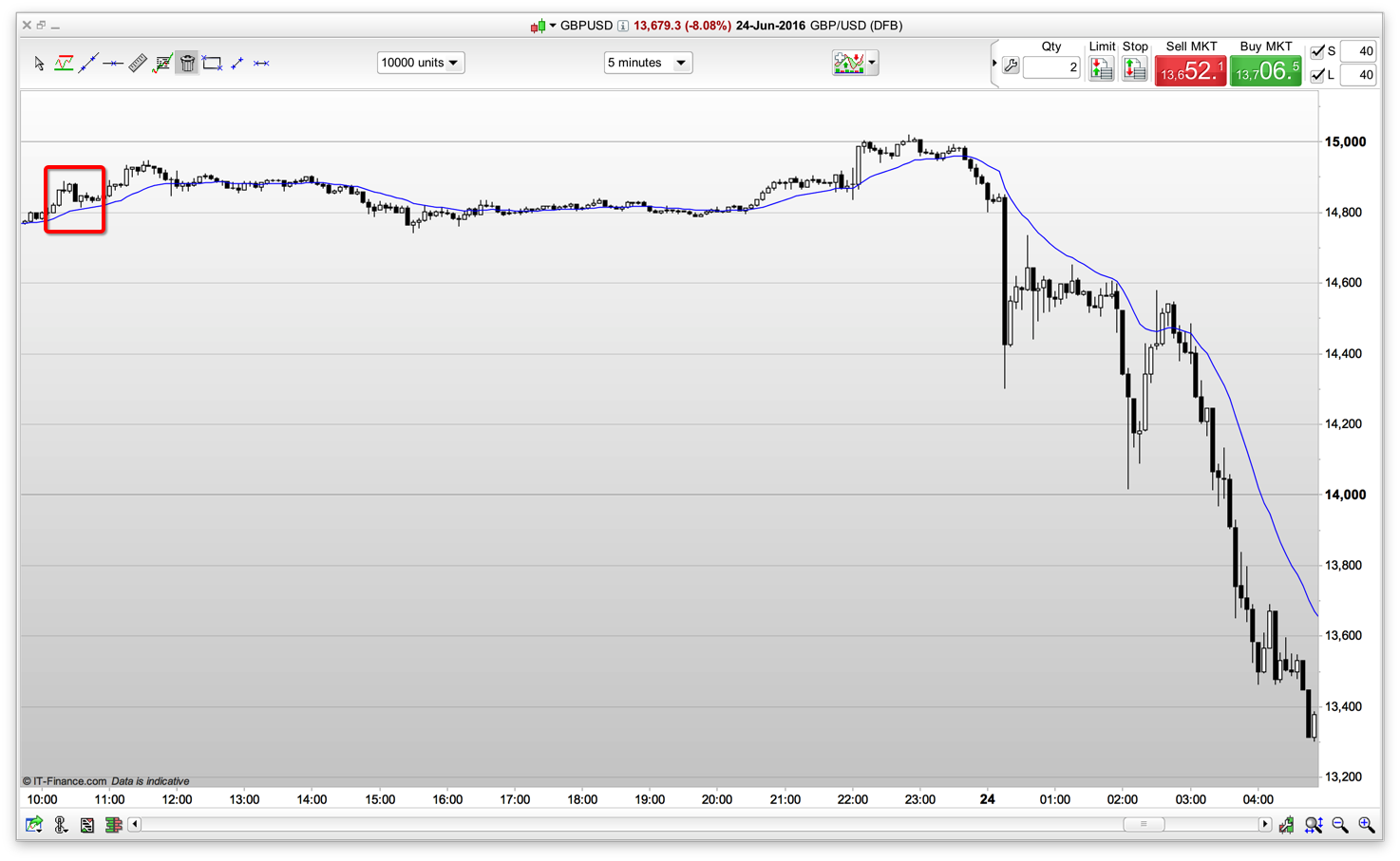
    When you see a chart after the event you wonder how you didn’t realise that it wasn’t going to go up. We went short (to say the price was going to go down) at the green arrow. One of our strategies is to short at the top of a ‘trading range’. The green arrow was the top of a wide trading range.

    The price, however, broke out long. Our stop, as per our strategy, was equal to the height of the trading range which was over 65 pips. The break-out long went over 50 pips before it pulled back, very suddenly, to give us a break-even out.

    I mention this to put things into perspective. Usually, in GBP USD, our stops are between 20 and 40 pips away. Even early on the 23rd we were up at over a 60 pip stop. Not only that, margins change so that the leverage that you get to know is now different which means if you get it wrong your whole trade can be cashed out very quickly by your broker. Spreads (we mentioned these a couple of blogs back) go through the roof and, most importantly, we have the great probability of slippage where, simply put, you can ‘lose your shirt’.

    We do not trade the monthly FOMC report because price can bounce 150 pips one way and, often, immediately reverse over 150 pips the other way. The early hours of the 24th the market moved over 1,700 pips with over 500 pips of pull back.

    Trading is a ‘zero-sum game’ which means that one person’s gain is another person’s loss. Institutions lost many billions the other night and retail traders trading could have blown out their accounts and more. If you use a retail trader that made money through the big move down then get rid of them as they are gambling and next time might not be so pretty.

    In the chart below, to put things into context, the red box was the time of the large bars shown in the chart above.

    Snip20160625_2

    Gold

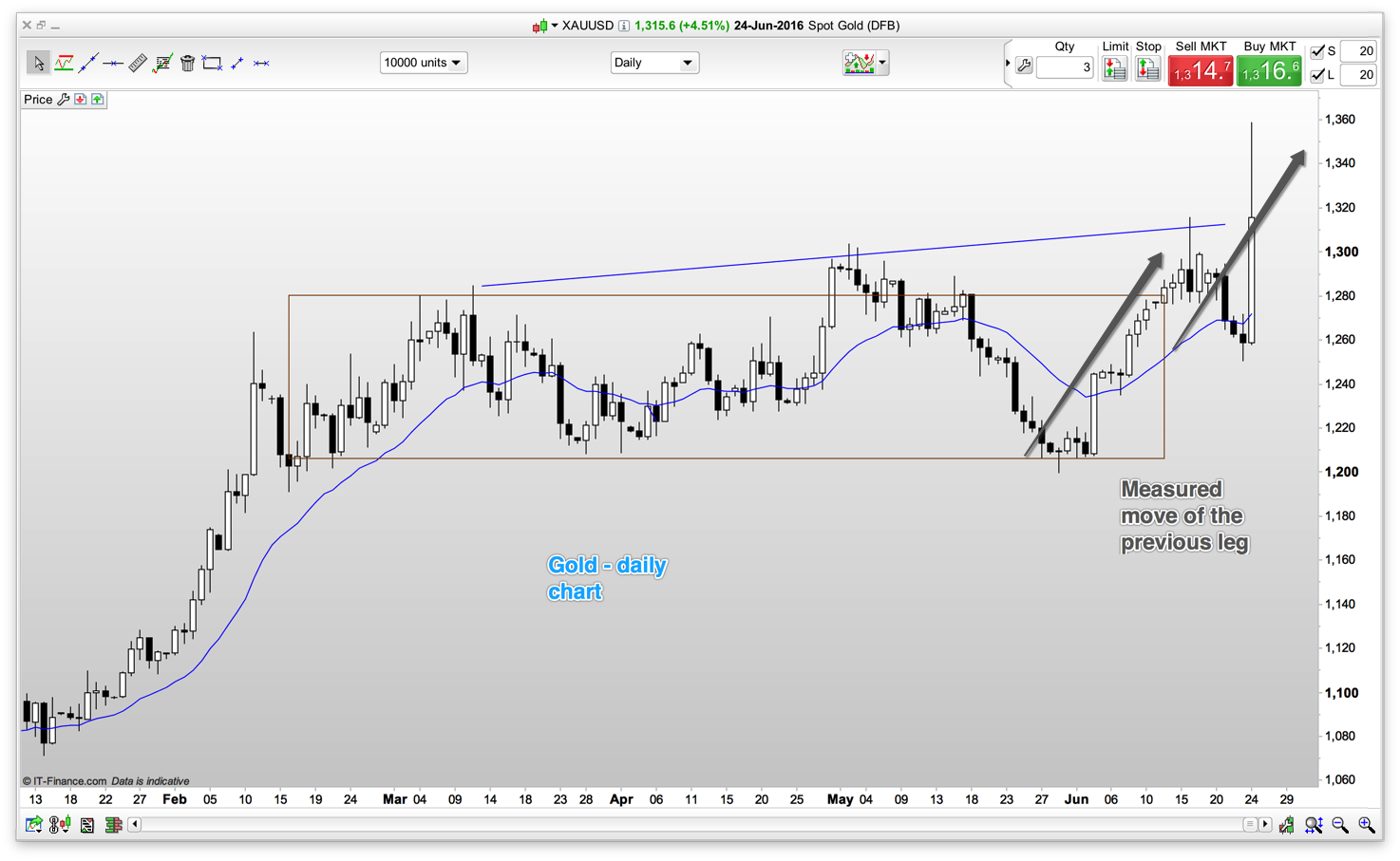
    For the next few weeks, due to the expansion of our family business coming on-line, I’m only trading between 8am and 1pm. This allows me time to trade the currency pairing GBP USD only. For the time being I’m monitoring the commodities. Gold moved up to an exact measured move of the previous leg. Something James had spotted – and I’d relayed the possibility of, a few blogs back – and thus providing a great short opportunity. Over the next few days we may get a second (and therefore more secure) opportunity to short gold. But I need more evidence that the price will not go up further.

    Snip20160625_3