Tag: trading strategy

  • Trade by rules, not emotion and intuition

    Those of us that want to technically trade the financial markets for a living, or simply make a profit doing so, have undoubtedly invested a lot of time, money and emotional effort into the process.

    There are, however, certain aspects that, no matter what our chosen trading method, seem to be hurdles for us all.

    Trading, for example, is full of contradictions: we need to hold our winning trades, but we need to know when to take profits; we need to make a traders equation, but we need wide stops; and we need to wait for a clear signal, but the so-called clear signals often don’t work.

    A few trading conditions that I struggled with, and still do from time to time, include: not holding the trade all the way to target; entering on a whim of a signal, or worse no signal at all; and, my unfortunate favourite, trying to reverse a trade too early.

    The latter is probably the single reason most traders struggle. I have an example trade from yesterday where (this time) I correctly held the trade from the currency pairing USD/JPY.

    Firstly, I have to say that context is a big part of my trading strategy. When I show these snips we are not showing the overall context. That is: what price was doing leading up to the few bars we show on the chart. Five minute bars in this case. In this instance over the last two days the market had been in a steep descent, or bear trend.
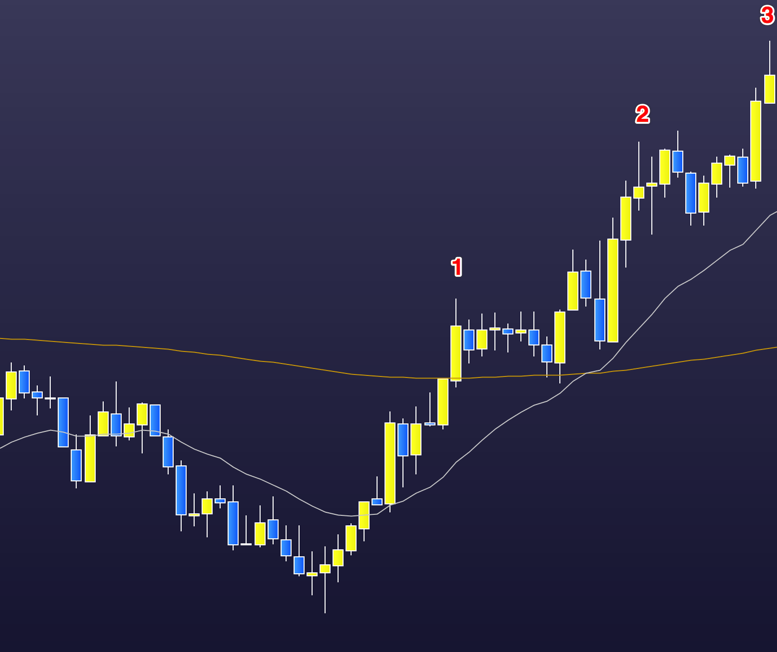
    We can see that the market turned bullish and went long in what seems to be three pushes (marked on the chart). After three pushes the market often reverses. For me the market was always in long after the 1st push and I looked for opportunities to get long.

    At this point a novice trader, influenced by the prior two-day bear market, and not trading in the moment, would be entering short at the top of both push 1 and 2 hoping for a resumption of the bear.
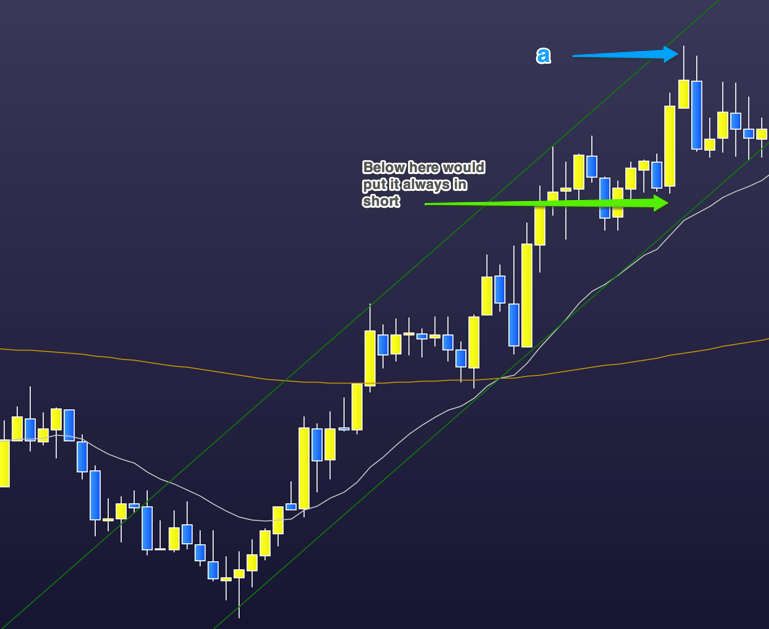
    I exited my long at the blue arrow marked ‘a’. Choosing the exact exit from my long position was, of course, fortuitous. I thought, correctly this time, that price may reverse early and before price could hit the green channel line which I’ve drawn.

    However, price did not pull back as expected and at the yellow circle, which I’ve marked on the chart, I re-entered long. I exited that long, at a measured distance of the previous leg, for a reasonable additional profit. This turned out to be a ‘final flag’ long.

    Reading the chart correctly, with the whole chart available, always seems obvious. However, reading bar by bar in a live trade is another thing altogether.

    We are wary about entering long because of the steep bear trend on the higher time frame chart; and, to continue long when the bars are in the top right hand corner of our screen, provides its own psychological block.

    To trade, as in this example, is often counter intuitive. Whether we use price action, indicators or a combination of both we can only make a profit if we trade by (expert) rules and not by emotion and intuition.
  • Downside, like Steve Jobs

    Let us chat strategy for a moment. Wikipedia says strategy “is a high level plan to achieve one or more goals under conditions of uncertainty.”

    Many that provide trading strategies have it wrong. What they are actually providing is a way to trade, or a  method, or a system. The way that I trade is contained within my ‘algorithm to trade by’ page and this is something I tinker with all the time. (I call it an algorithm so that I keep in mind that I’m up against algo-trading which is unemotional, timely and precise).

    What I don’t tinker with, however, is my strategy; well, at least not without a great deal of consideration. A strategy is to be clear:

    • Multiple swing
    • Swing
    • Swing/scalp
    • scalp

    (traders interpret a swing and a scalp differently, see ‘algorithms to trade by’ in the paragraph clarification)

    I may use a multiple swing strategy for very long-term value investing such as with Nick’s top FTSE 350 shares; a swing only strategy is perfect for intermediate traders or experts not intraday or unable to watch the trade; swing/scalp (my passion) is the full-time experts choice; and scalp only is, well, a difficult strategy because of the often poor reward/risk ratio.

    As I’m a swing/scalp strategist I also sub-divide that strategy into swing/scalp or scalp/swing; taking the first more determinedly than the second, but that’s for another time.

    Each strategy requires little understanding, just rationality in comparing two outcomes (price up, price down), exercising the better option and holding for the desired target. I get out at break even if my algorithm tells me to. It’s about control of the downside and then about the maximisation of the upside.

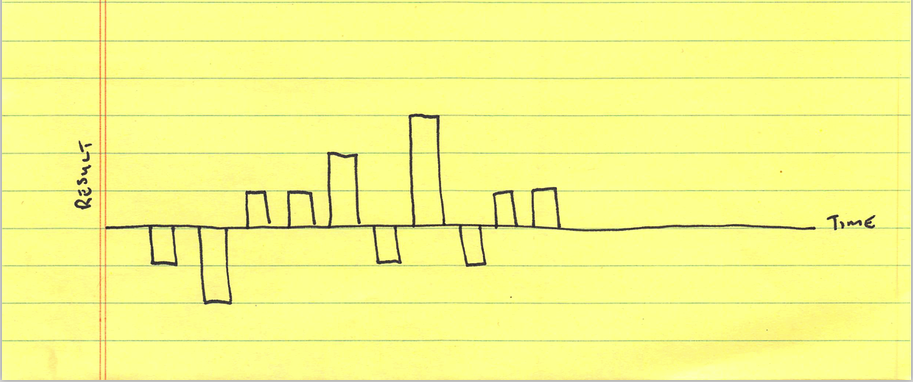
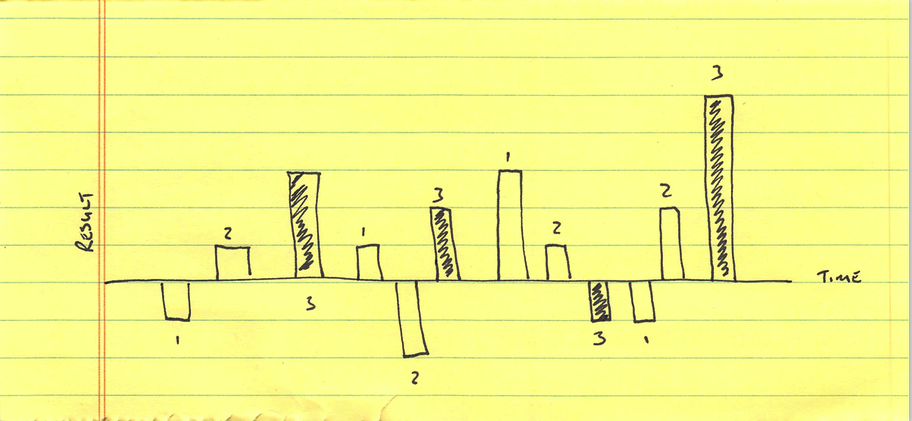
    The first sketch below was used by Steve Jobs at one of his presentations to show how he took (many) minimal downsides before he eventually got the big upside.

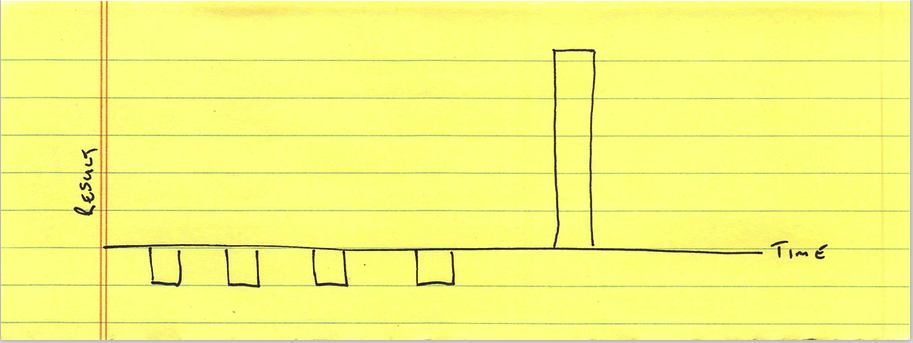
    The same is for good trading. The next sketch might represent how much was made or lost each year with a longer term investment. If we checked the results, say, every three years we would only once see a decrease in our year on year portfolio results, therefore minimising emotional drain.  Each blue horizontal line might represent a £1,000 (or multiples of) year on year profit or loss.

    Finally, a sketch of a day traders result for the day. A single blue horizontal line up or down represents a scalp win or loss; two horizontal lines is a swing. The bar with three horizontal bars up was a swing that was entered early and provided the extra profit. We should never see more than two bars at any one time to the downside. Each swing and scalp, therefore each horizontal blue bar, is the same in value whether the scalp was 10 pips or 30 pips. Each horizontal line represents the traders risk. A traders risk (each horizontal line) might be £60, or £600, or £6,000 – or any figure in between – depending on the traders account. But it has to be consistent.

    The point here is that any downside (for the sake of emotional drain and our pocket) has to be known, acceptable and controlled. This is something most of us don’t understand when we start out. Steve Jobs understood this and he did okay.