Okay, as promised, here it is, the secret to making money from trading. And, you will not be surprised to learn that as a quick solution to getting rich – it’s not.
There are so many ways to trade it would be near impossible to compile a comprehensive list of them all. However, there are three broad categories that most would agree on.
(1) Trading through company figures is known as fundamental trading. It’s generally considered as long-term trading and is probably the original bedrock of all trading. I love fundamental trading and developed my own knowledge of it over several years. Through Nick’s spread sheets we have a great solution to choosing long-term trades. Personally, I did mess this up when I tried to use the fundamental information we generated for short to medium term trades. That was an expensive lesson.
(2) Trading through the use of charts is known as technical trading. It is often difficult for a ‘fundamental trader’ to accept that charts can be read. And for good reason too, there is a lot of guff provided about reading charts that make it difficult to accept as a viable trading method. Nor does a fundamental trader need the confusion of technical data messing up her fundamental decision. Again, I’d like to put my hand up and admit to trying most technical systems and finding that I couldn’t, until recently, get any of them to work consistently.
(3) The third consideration is a mixture of both basic trading structures. As if it wasn’t confused enough already. Yes, tried that. Not a great success story.
In very broad terms, holding a trade for anything outside of nine months is probably best left to the fundamental trader and anything inside of that time is technical territory. We know that long-term fundamental trading works, ask Mr Buffett. But even he tells us of the multitude of mistakes that he had made. But in the end he certainly had the edge.
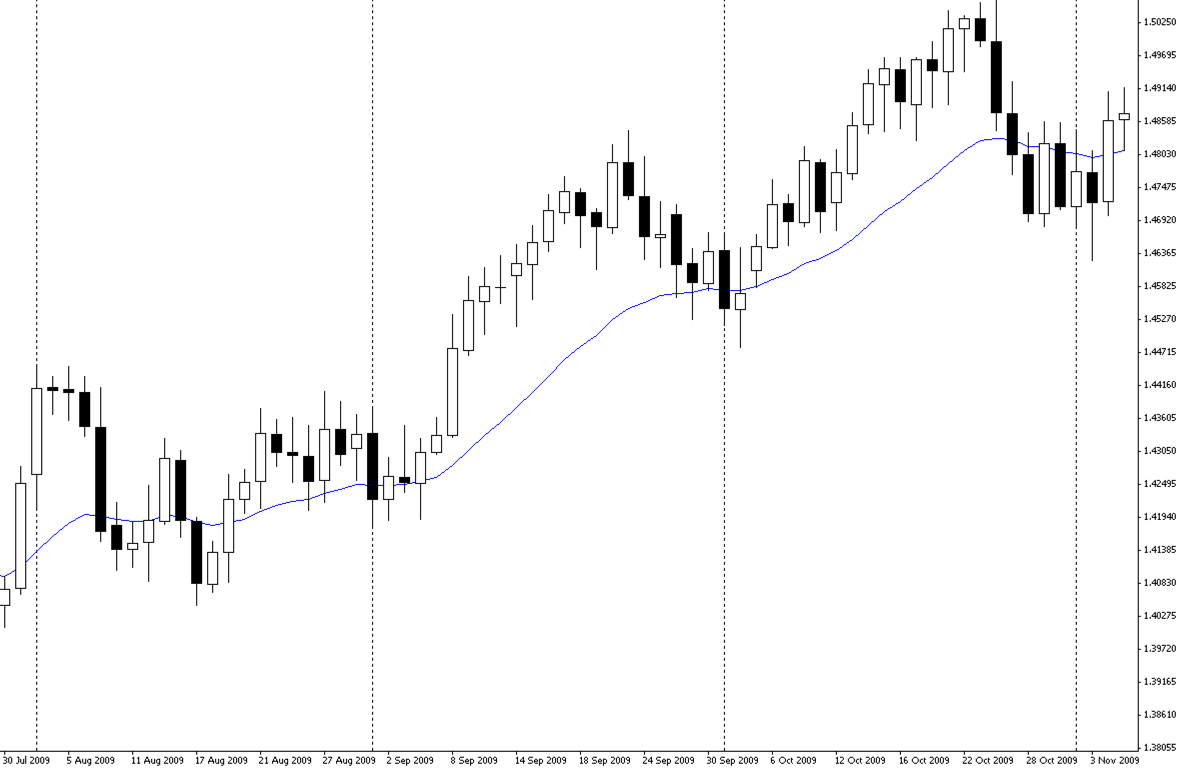
Therefore, for the shorter term stuff, the technical trading, trading from charts, is it realistic to expect it to work. Without any doubt at all, I can say technical trading works. But we have to know how to tap into it. Anyone wanting the secret, so they can immediately adapt it, are going to be disappointed. Because, I think, the first thing for any trader is that they have to do the work first. They have to learn the ropes. And, I guess, it doesn’t matter which ropes we learn as long as it works for us and we fully understand it. Personally, again having gone the long way round and tried almost every technical method going and failed at each one, I’ve settled on technical trading by ‘price action’.
This sounds fancy but couldn’t be simpler. It involves basic charts only. No indicators to speak off and a couple of basic drawing tools. If you can read music or play chess to the ‘grand master’ level you will appreciate where I’m coming from when I say that it is possible to read the flow of things.
How long does it take to become a price action ‘grand master’? All I know is that it took me several years, but I’ve worked with someone recently that grasped it to a high degree within a few months. Price action, however, is only one part. Probably the more important part, and this goes for any style of trading, is the management of a trade. Learning that is a different ‘kettle of fish’. That is because it involves controlling emotion. That comes with experience and trading maturity.
However, once all this is grasped to a very high degree the ambitious trader will not be pleased to know that it is not enough. It comes up short. After all that, a trader will still, over a period of time, lose money. And it is at this point that traders, having persevered for so long and having invested so much in trading losses, time and emotion – give up.
To become a consistently profitable trader we have to go through all the learning lessons and then press on through the ‘gap’ to find our edge. And that, dear reader, is the secret. We have to find an edge. What is the edge? It is personal to each trader. The point to grasp, however, is that we do the work first, we learn the trading ropes in whichever trading method undoubtedly suits us. Once we get to that point we all have to go through the ‘gap’ and discover our own edge.
An edge can, for some traders, be their ability to anticipate trade direction with short-term news. For others it may be slightly longer term trading but only trading a specific set-up or cycle. Even high frequency trading, mostly done through computer algorithms, can be seen as an edge. I cannot stress this enough however – we will not make money trading without an edge.
My own edge, I’ve quite recently come to realise, is the ability to measure risk, reward and probability to a very accurate level. The effect this has had on my trading ambition going forward we will discuss next time.


 Slow Trader