Tag: technical trading

  • What I expect from a chart

    I’m often asked, with reference to my ‘fighter pilot’ days, if I ever miss it? Meaning, do I miss the flying. Mostly I don’t, and the person asking the question seems surprised by my answer.

    That is because they didn’t ask the right question. Flying the aircraft, once learnt, is the easy bit. The operation, leading the 8-ship of fighters at ultra low-level through heavily defended areas to engage a target hundreds of miles away to within a margin of a few seconds, is the hard part.

    And, it is the operation that I miss. Okay, not true, I watched the Red Arrows perform at Holkham this week and lived the moment, briefly.

    Technical trading has similarities, albeit only two-dimensional. Familiarity with a chart, and a chart that does everything we want of it, is like flying an aircraft – when we can fly one we can have a confident go at flying anything. How to trade, develop and implement strategies is the operational equivalent.

    I lost some confidence in my usual chart and broker last week when I was unable to exit a trade after the price moved rapidly, fortunately in my favour. With high volatility occasionally a broker is unable to provide a desired exit price and leaves the trade open. This, however, was not that. I was simply locked-into the trade. In hindsight the initial clue that all was not right, was the breakdown in the representation of some of my charts that I monitor on a higher time-frame.

    Why, as I was in a favourable direction, was it a problem to be locked-into the trade? It is disconcerting, moreover, I had tried to exit with a scalp, and before the bar bounced, and then would have held a portion of the trade for a swing target. When I discovered that I was ‘locked-in’ my whole concentration was on getting out (completely) which I achieved some way up the bounce. This was for a profit but a good way short of the target potential.

    Because of this, several days were taken to revisit other brokers to find a stable platform that does everything I want. Time consuming, but a worthwhile exercise. As a day-trader on lower time-frame charts the following are important to me: (1) spread; (2) reliable, clear charts linked to the broker that provide on chart dealing – importantly on-chart ‘limit’ entries with the ability, on chart, to set target and stop positions (3) as well as a chart zoom capability, I like to be able to grab and move the collective bars so I can quickly view stop and target positions (4) and, finally, the only indicators I use are a 21 and 55 exponential moving average but I do like a couple of easy to apply tools namely: my GLEM and a rule. (My GLEM is a modification of a fibonacci retracement tool and the rule, preferably, has to have a mirroring capability).

    The above provides everything I need for me to happily trade within my strategies. Anything less is a compromise. I tried most brokers and charts and a great way to do this is to open a demo account, load the charts and try them out. I got to the stage of finding a possible contender and opened a live account. This account provided some great additions over and above. Such as: being able to part exit a trade (i.e. take some profit off without closing out the whole trade); bid/ask lines on the chart; and, the ability to simply change between single and multiple chart screen presentation.

    However, after much perseverance I came back to my original broker and charts. I made many fresh tweaks to my layout and technique that were generated from my doing the exercise.

    The best fighter I have personally flown would be the F-16. Okay, it’s a single engine fighter and if that engine misses a beat every now and then we could be in trouble, but (operationally) it still beat the socks off everything else – I now feel the same way about my original charts!
  • Trade by rules, not emotion and intuition

    Those of us that want to technically trade the financial markets for a living, or simply make a profit doing so, have undoubtedly invested a lot of time, money and emotional effort into the process.

    There are, however, certain aspects that, no matter what our chosen trading method, seem to be hurdles for us all.

    Trading, for example, is full of contradictions: we need to hold our winning trades, but we need to know when to take profits; we need to make a traders equation, but we need wide stops; and we need to wait for a clear signal, but the so-called clear signals often don’t work.

    A few trading conditions that I struggled with, and still do from time to time, include: not holding the trade all the way to target; entering on a whim of a signal, or worse no signal at all; and, my unfortunate favourite, trying to reverse a trade too early.

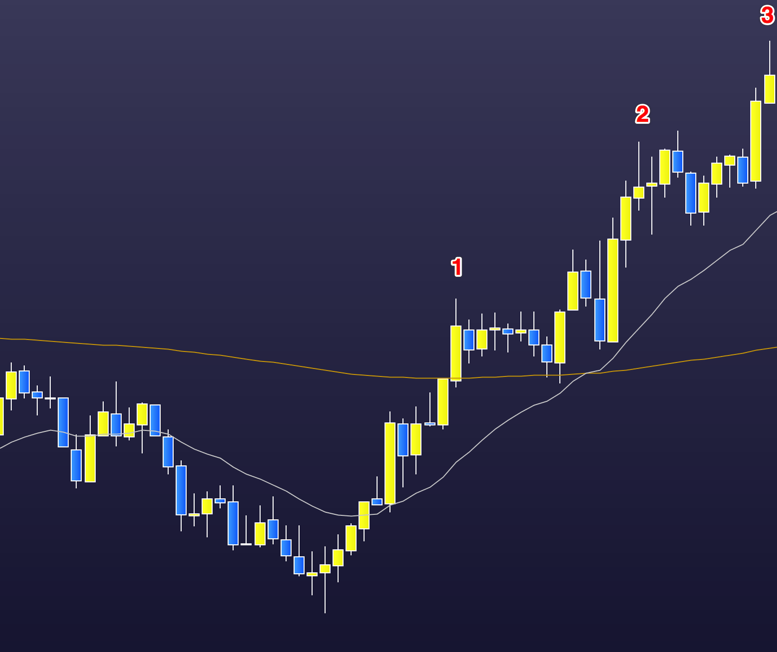
    The latter is probably the single reason most traders struggle. I have an example trade from yesterday where (this time) I correctly held the trade from the currency pairing USD/JPY.

    Firstly, I have to say that context is a big part of my trading strategy. When I show these snips we are not showing the overall context. That is: what price was doing leading up to the few bars we show on the chart. Five minute bars in this case. In this instance over the last two days the market had been in a steep descent, or bear trend.

    We can see that the market turned bullish and went long in what seems to be three pushes (marked on the chart). After three pushes the market often reverses. For me the market was always in long after the 1st push and I looked for opportunities to get long.

    At this point a novice trader, influenced by the prior two-day bear market, and not trading in the moment, would be entering short at the top of both push 1 and 2 hoping for a resumption of the bear.

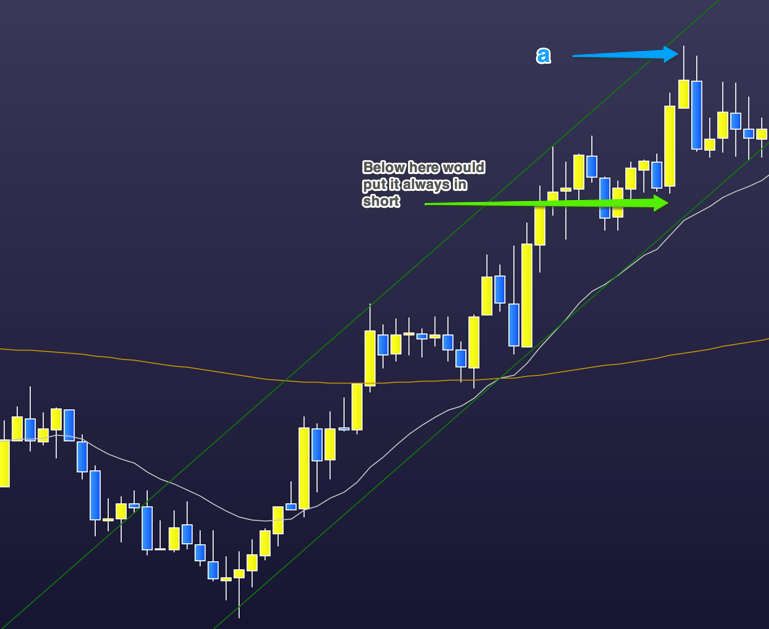
    I exited my long at the blue arrow marked ‘a’. Choosing the exact exit from my long position was, of course, fortuitous. I thought, correctly this time, that price may reverse early and before price could hit the green channel line which I’ve drawn.

    However, price did not pull back as expected and at the yellow circle, which I’ve marked on the chart, I re-entered long. I exited that long, at a measured distance of the previous leg, for a reasonable additional profit. This turned out to be a ‘final flag’ long.

    Reading the chart correctly, with the whole chart available, always seems obvious. However, reading bar by bar in a live trade is another thing altogether.

    We are wary about entering long because of the steep bear trend on the higher time frame chart; and, to continue long when the bars are in the top right hand corner of our screen, provides its own psychological block.

    To trade, as in this example, is often counter intuitive. Whether we use price action, indicators or a combination of both we can only make a profit if we trade by (expert) rules and not by emotion and intuition.

  • Most important, but often ignored

    Probability is something we understand very clearly when it comes to sports, but it seems to be a concept that we struggle with as a trader.

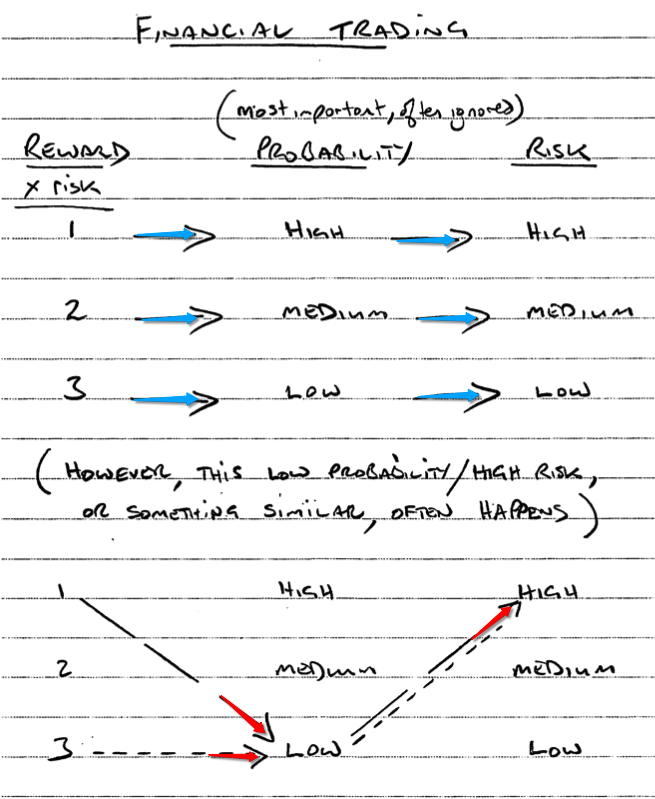
    We realise (because it’s been mentioned a few times) that the difference between a trader and a gambler – if we where to picked one thing – is adding or not adding probability into the mix of reward and risk.

    Some sports lend themselves very well to the example of probability. Basketball, tennis and (particularly) golf come to mind. I mentioned basketball last week because the point scoring matches well the traders multiples of reward to risk.

    In basketball we can score 3 points from a shot taken from outside of the defenders area; 2 points from inside the area; and 1 point from a free shot, if the opponent commits a foul. As a trader we often look to achieve a minimum target that is 3, 2 and 1 times our actual risk. (I like this to be planned risk but it is actual risk that the traders equation depends).

    We could suggest that a basketball shot taken from outside the defenders area has a probability of success that is low (it’s a long way to throw it!); however, the risk is also low as the defending team have little chance of a quick, undefended, attack in reply.

    A 2-pointer attempt is medium in probability as the (6’7″) defenders are there with us in the shooting area. It is also medium in risk as it is a dynamic manoeuvre and often with the full commitment to the shot from most, if not all, of the team; a quick steal and counter attack is possible.

    A free shot is never available in trading, therefore, I’d equate the 1-point attempt, in basketball terms, to the lob up court to a teammate in the hope of a quick score. The risk of interception is high but the probability, if our own team member catches it, of scoring quickly is also high.

    All well and good, but where does this take us in financial traders terms? As a trader, and regardless of which timeframe of chart we trade, we’re all looking to take trades where the probability, reward and risk make good sense. To do otherwise is, as we’ve said, gambling.

    As an aside, as a trader we’re always participating in the basketball equivalent of the NBA championships because the trading professionals (institutions and the like) make up most of the opposition and in this ‘zero sum game’ they’re always-in.

    In our basketball match, if we lob the ball up court but we don’t have a team member to receive it we have given the ball away; if we take a 3 point shot at basket when we have no defenders between us and the basket we have merely reduced our probability for no good reason.

    Our judgement of probability in sports is generally very good – instinctively making a workable probabilistic assessment; but as a trader we often ignore this all important aspect.

    Technical trading is a financial ‘sport’ where we can only participate against the professional league. At that level we cannot get probability, reward and risk confused. To do so is the same as chucking the ball up court without a receiver.  As want-to-be traders however we seem to do this all the time (ignore probability) and wonder why we don’t win.

  • Trade without bias

    “No data yet!….It is a capital mistake to theorise before you have all the evidence, it biases the judgement.”                            Sherlock Holmes

    We’ve previously touched on an issue that: doctors, engineers, solicitors etc may have when they try to trade – and I was no exception.

    For a long time we have, through professional good habit, been comfortable predicting the way ahead based on our experience, good judgement and assumptions.

    In technical trading, however, such attributes do not help. Having a preconceived idea of what the market will do blinds us to reading the market in the moment. Or, as Arthur Conan Doyle wrote, “it biases the judgement”.

    We have previously considered (from Joshua Foer) that a grand master chess player does not look several moves ahead, as we all assume, but rather is coldly reacting, more or less, to the opposition pieces presented in that moment.

    A form of trading, which I like a lot, is what I call “always in” trading. This is best done on a single market and timeframe. Always-in provides the dual meaning of direction of trade and committing to a trade direction wherever possible.

    Whenever we are confident of an always-in trade direction, then we are to do everything we can to enter the trade.

    In a neutral, or 50/50, event the trader waits. But as soon as the always-in is defined with some probability then the trader enters the trade.

    Okay, there is more to it than that and why ‘always-in’ is a method, I think, for the experienced trader only – but bizarrely all beginners seem to start out with this or a similar methodology.

    To do the same in my previous career, it would be like joining the Red Arrows before completing flying training.


  • The secret to profitable trading

    Okay, as promised, here it is, the secret to making money from trading. And, you will not be surprised to learn that as a quick solution to getting rich – it’s not.

    There are so many ways to trade it would be near impossible to compile a comprehensive list of them all. However, there are three broad categories that most would agree on.

    (1) Trading through company figures is known as fundamental trading. It’s generally considered as long-term trading and is probably the original bedrock of all trading. I love fundamental trading and developed my own knowledge of it over several years. Through Nick’s spread sheets we have a great solution to choosing long-term trades. Personally, I did mess this up when I tried to use the fundamental information we generated for short to medium term trades. That was an expensive lesson.

    (2) Trading through the use of charts is known as technical trading. It is often difficult for a ‘fundamental trader’ to accept that charts can be read. And for good reason too, there is a lot of guff provided about reading charts that make it difficult to accept as a viable trading method. Nor does a fundamental trader need the confusion of technical data messing up her fundamental decision. Again, I’d like to put my hand up and admit to trying most technical systems and finding that I couldn’t, until recently, get any of them to work consistently.

    (3) The third consideration is a mixture of both basic trading structures. As if it wasn’t confused enough already. Yes, tried that. Not a great success story.

    In very broad terms, holding a trade for anything outside of nine months is probably best left to the fundamental trader and anything inside of that time is technical territory. We know that long-term fundamental trading works, ask Mr Buffett. But even he tells us of the multitude of mistakes that he had made. But in the end he certainly had the edge.

    Therefore, for the shorter term stuff, the technical trading, trading from charts, is it realistic to expect it to work. Without any doubt at all, I can say technical trading works. But we have to know how to tap into it. Anyone wanting the secret, so they can immediately adapt it, are going to be disappointed. Because, I think, the first thing for any trader is that they have to do the work first. They have to learn the ropes. And, I guess, it doesn’t matter which ropes we learn as long as it works for us and we fully understand it. Personally, again having gone the long way round and tried almost every technical method going and failed at each one, I’ve settled on technical trading by ‘price action’.

    This sounds fancy but couldn’t be simpler. It involves basic charts only. No indicators to speak off and a couple of basic drawing tools. If you can read music or play chess to the ‘grand master’ level you will appreciate where I’m coming from when I say that it is possible to read the flow of things.

    How long does it take to become a price action ‘grand master’? All I know is that it took me several years, but I’ve worked with someone recently that grasped it to a high degree within a few months. Price action, however, is only one part. Probably the more important part, and this goes for any style of trading, is the management of a trade. Learning that is a different ‘kettle of fish’. That is because it involves controlling emotion. That comes with experience and trading maturity.

    However, once all this is grasped to a very high degree the ambitious trader will not be pleased to know that it is not enough. It comes up short. After all that, a trader will still, over a period of time, lose money. And it is at this point that traders, having persevered for so long and having invested so much in trading losses, time and emotion – give up.

    To become a consistently profitable trader we have to go through all the learning lessons and then press on through the ‘gap’ to find our edge. And that, dear reader, is the secret. We have to find an edge. What is the edge? It is personal to each trader. The point to grasp, however, is that we do the work first, we learn the trading ropes in whichever trading method undoubtedly suits us. Once we get to that point we all have to go through the ‘gap’ and discover our own edge.

    An edge can, for some traders, be their ability to anticipate trade direction with short-term news. For others it may be slightly longer term trading but only trading a specific set-up or cycle. Even high frequency trading, mostly done through computer algorithms, can be seen as an edge. I cannot stress this enough however – we will not make money trading without an edge.

    My own edge, I’ve quite recently come to realise, is the ability to measure risk, reward and probability to a very accurate level. The effect this has had on my trading ambition going forward we will discuss next time.