Tag: technical

  • Price action or fundamentals

    As previously mentioned, I’m presently focused on trading 5-minute charts EUR USD. To master price action trading, and with a low time chart such as the 5 minute, takes all my undistracted concentration. I think that, most, professional traders use price action. Some may voice that they also use fundamentals and certain indicators, but when it comes down to the profits it’s usually price action, in some form, that’s responsible.

    My trades on the 5 minute charts last from a few minutes to usually no more than an hour. Therefore, fundamentals have no influence. Although some traders consider fundamentals, they are generally the ‘go to’ consideration of the investor rather than the trader. An investor can be considered as a longer-term commitment, a duration where the fundamentals have time to take effect – many months to years. I studied fundamentals for several years. However, I now feel that even the highest term charts, such as weekly’s or monthly’s, are (primarily) influenced by price action and therefore ‘technical’ rather than ‘fundamental’ reasons. That is because price action is a measure of psychology in the market – such as: fear, greed and confidence.

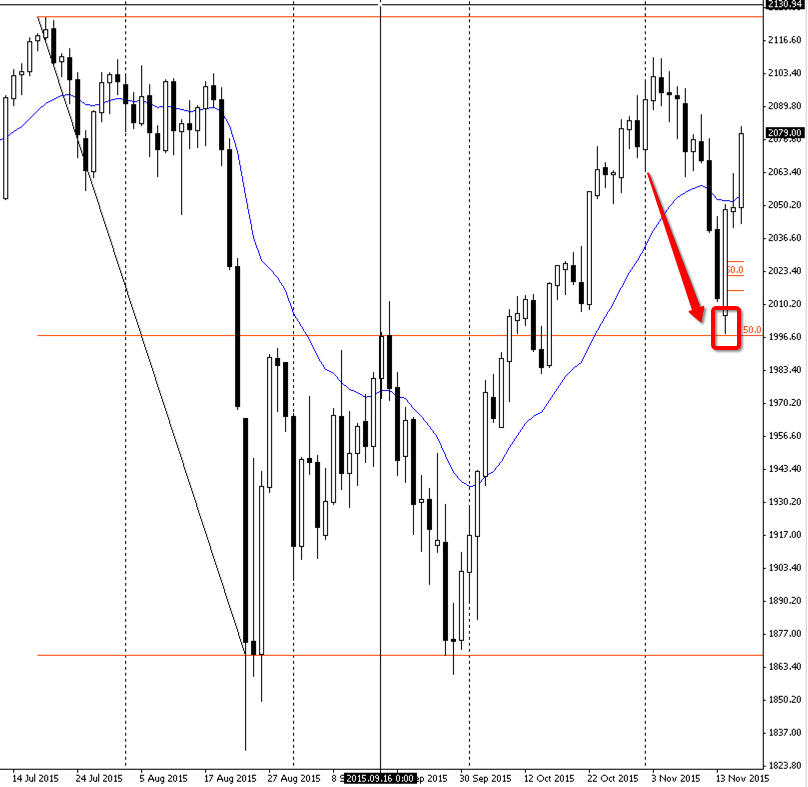
    Notice below how the recent attacks in France effected the S&P 500. Notice also that the drop, before the S&P’s quick recovery, bounced off a 50% retrace line. A line that I had drawn on the chart several weeks ago. This is a part of price action, the context, and is known as a measured move. Often this measured move is exact – whether it’s a 5 minute chart or a daily chart as the one below. The news (France) moved the market, but price action told it where to go too.
    Snip20151118_22

  • Investing or Trading?

    Investing first:

    Investing is buying into something that appreciates. In stocks and shares, any price increase after about a year is 100% because of the fundamentals: the strength of the books, the management, the continued saleability of the underlying product….to mention a few.

    Most of us have investments in pensions or managed funds.

    Over a bunch of years the market goes up about 9% on average. However, somewhere between 7 to 15 years the market crashes. Timing is everything.

    Moreover, most pension and managed funds don’t beat the market, actually an astonishing 95% of them; on top of that, they charge several percent annually to do so.

    If we need our invested funds, 15 years before would be best, move it into something that is not market based, at least not ‘fundamentally’ based.

    Now for trading:

    Trading is generally over a shorter time frame and is mostly technical based: that is, the reaction of price when price reaches a support or resistance. In its simplest form, it is one person’s opinion (or computers) against another.

    And, as a computer does not have an opinion – it is of course emotionless – that presents the biggest obvious challenge to most human traders.

    Some 75% of trades are institutional based (the big money). The remainder is made up from other entities such as high frequency trading (HFT) systems, large hedge funds and the like. Smaller (professional) organisations and home traders represent less than 5% of the market.

    To be clear, when the (small) professional trader or home trader trades she is up against the institutions – computers mainly – so she better know her unemotional stuff.

    That is probably why few home based traders, particularly lower timeframe traders like day traders, make it. Cheery, eh.

    The one factor more than any responsible for successful trading is – no it’s not luck – is trade management, boring as that sounds. Good trade management always provides a positive traders equation of: risk, reward and probability.

    Without a clear calculation of each of these (and probability is often the one that is missed) then we are not trading but doing something else…gambling, maybe.