Tag: Tape reading

  • Get in, get green, get out.

    My thought process is: get in, get green, get out.

    Get in:

    The first thing I notice is an appropriate stock coming up on my scanner. A scanner is software that searches for stocks based on predefined momentum criteria, such as relative high volume (number of shares traded), price, and price movement (how quickly and strongly the price is changing).

    Within the scanner, I check the float, which is the total number of shares available for public trading, along with the day’s volume (the number of shares traded so far today).

    If these numbers look good, I check the ‘about’ page (company description). Then I check for any recent news catalyst—a major event or announcement that could significantly affect the stock price.

    I then glance at the ownership section, which shows who owns the company’s shares and their stake size, to see how it is distributed among investors.

    If all looks good, I enter the ticker symbol (the stock’s unique identification code) to open the tape. The tape displays Level 2 (real-time order book with bids and asks) and Time & Sales (a list of every actual trade as it happens).

    Volatility—the degree and speed of price movement—can also be measured from time-and-sales data, which records every completed trade, including price (trade value) and size (number of shares per trade).

    Next, I scan the chart for price action, trading volume, RSI oversold signals, and the price’s position relative to the 50- and 200-day simple moving averages. RSI shows momentum by comparing gains and losses. Moving averages indicate the average closing price over 50 or 200 days.

    I then review the chart’s timeframes—specific periods displayed, such as 1-minute, 5-minute and 4-hour views—to learn about recent and historical price movements. I also mark key resistance levels, which are price points where the stock has had trouble moving higher in the past, before proceeding.

    Get green:

    Around 30 seconds in, if it’s an in-play stock (one with high volume and interest) and IWM sentiment is positive, I start looking for a buy setup (a trade entry opportunity).

    Finding a setup, which means identifying a favourable condition to make a trade depending on what’s happening in the market, may be instant, take an hour, or never come.

    A setup is a trade opportunity identified by analysing both the stock chart and the tape. Once buying starts, my focus shifts mainly to reading the tape to gauge the activity and strength of buyers and sellers.

    Get out:

    While the chart often provides a potential sell price by indicating patterns and key levels, my exit decision is ultimately based on reading the tape—watching real-time trades and orders for signals that the stock price may reverse direction.

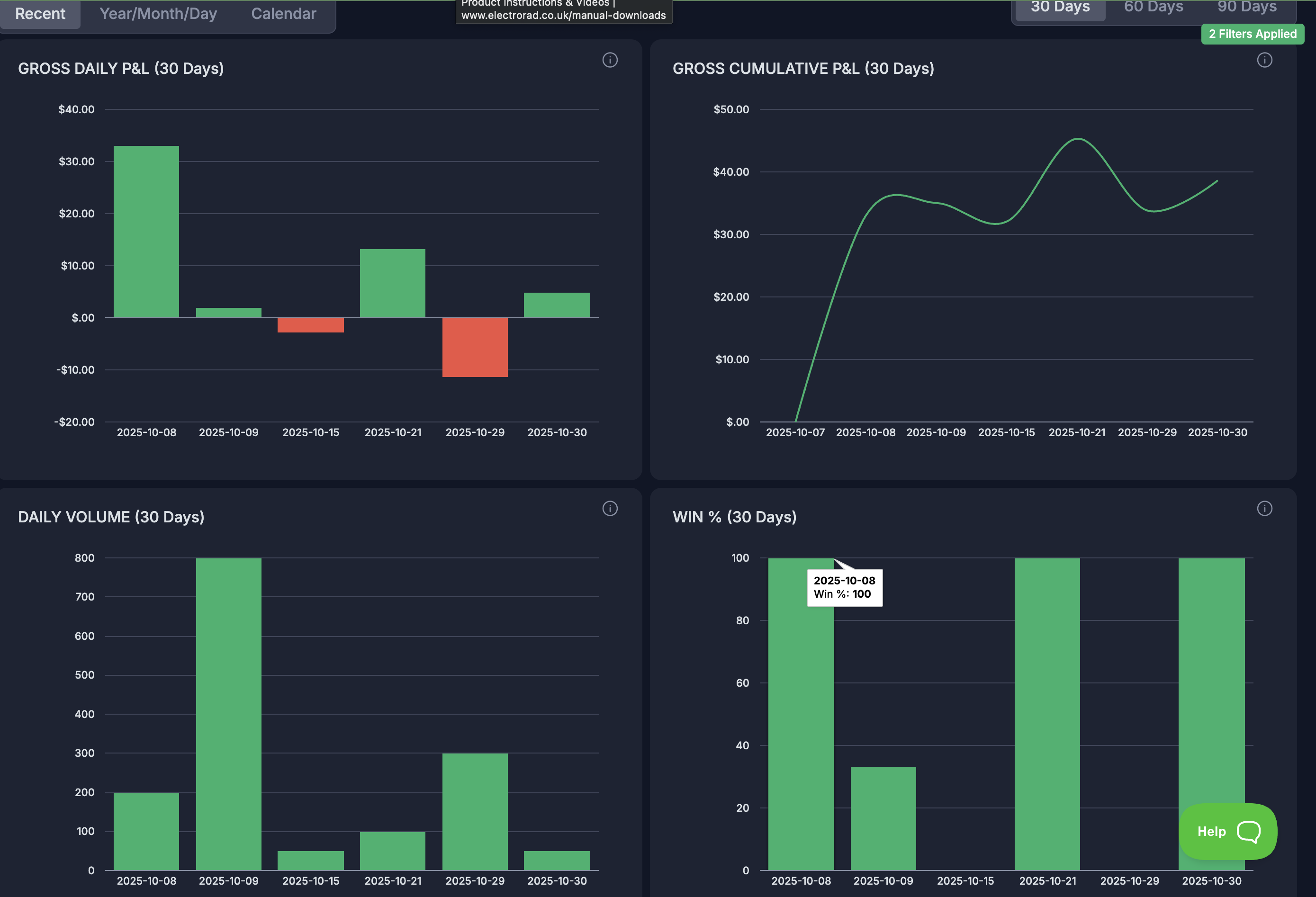
  • 1st month of the 12 month challenge.

    I am trading US stocks through the Lightspeed platform. Although there are commissions to pay with Lightspeed, it is a solid platform, and trades execute immediately, unlike many commission-free sites. As a day trader, the immediacy of trade execution is essential.

    October was a relatively slow month. Additionally, I had a project to complete: redesigning an area of the business into a guest gym. However, I still managed to trade for at least half of the month, and took trades on only six of those days.

    In my preferred trading range of $2 to $20 per share, movement, apart from one stock that skyrocketed and I missed, has been light.

    As I build the fund, starting with only $2,500, I must be cautious that fees do not significantly exceed the profits; this requires me to consider my trading style carefully.

    Please note that I am buying and selling actual shares, which differs considerably from leveraged derivative trading. Once I enter a trade, even if I hold it for only a few seconds, the full cash commitment is not available again until the following day, regardless of whether the trade is a win or a loss.

    Selectivity in trades is crucial, but so is commitment. Not all trades are equal. Where able, I try to gradually build my commitment to a trade as its suitability becomes clearer—a much more challenging skill than it seems, which is why most of us tend to make a single entry.

    Additionally, I try not to overstay my welcome in a trade. I focus on exiting when the trade weakens, but I always look for a re-entry if the market conditions suggest it—a challenging balance to keep.

    My results, however, indicate that I tend to exit trades that are likely to maintain momentum too early, which is an area I need to improve.

    To that end, I have recently shifted my focus away from price action trading. As someone who has long advocated for this approach, I found myself prioritising candlestick patterns and price movements over the tape.

    By “tape,” I mean both level 2 data and time and sales information. By eliminating candlestick charts and instead using exponential moving averages, along with a session volume-weighted average price across several timeframes, I could still identify a justifiable entry signal, while entirely focusing on analysing the tape.

    Furthermore, focusing more clearly on the tape has significantly reduced my drawdowns, but it is still early days.

    The profit results from last month are inconsequential, but we are prepared to capitalise on any long-only volatility that may emerge.

    The lower screen shows three Lightspeed level 2 displays and their associated time and sales. The upper screen displays four charts of the same stock over different time frames, absent the usual bar chart.

    Fund at $2,588, a 3.4% increase. It’s a start!