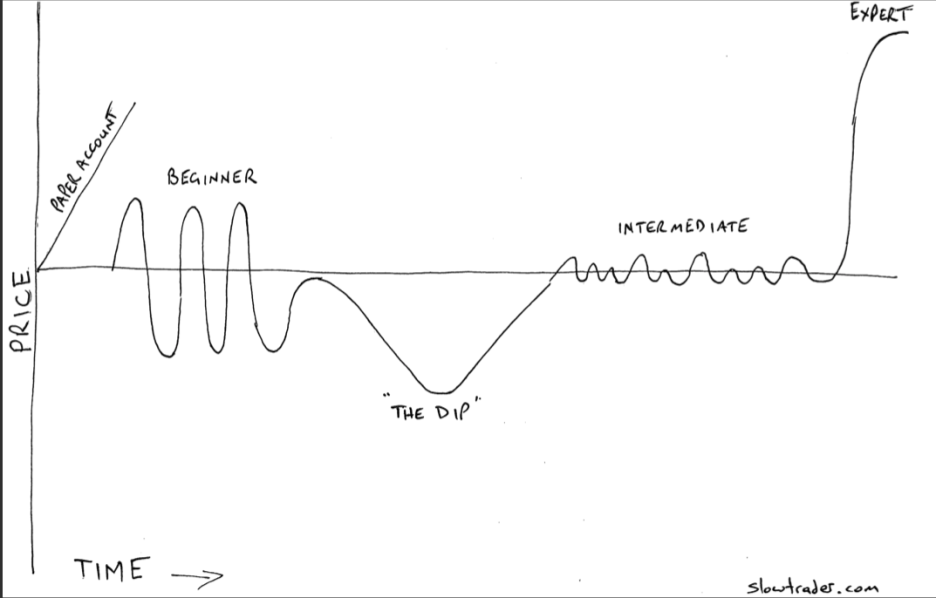
Knowing the timeline above would save traders £15,000, on average.
Paper Account:
Most people start trading with a paper account. That always goes well. However, it is not reality. Pip Maven recommends that a paper or dummy account should be for no more than 4 weeks, enough time to get familiar with the broker’s site.
Beginner:
We then become a ‘beginner’ trader. We trade small, and to survive this stage trading small is vital. During this phase we try many strategies, follow many teachers. One minute we think we’ve got it, the next we haven’t. It’s also the rollercoaster phase.
“The Dip”:
The Dip, by Seth Godin, is well worth a read. A short book but explains how the dip applies to everything we try. And trading is no exception. We can enter the dip at any point, not necessarily at the end of the beginner phase and before the intermediate phase. It could be half way through the intermediate or just before expert – but go through it we will.
Intermediate:
This, as Pip Maven explains, is where a trader has settled down to the grind of it all. No longer looking and changing to everyone else’s system, but focusing on our own, unique, way of trading. Managing our trades with attention to the smallest of detail.
My drawing above is not to scale. If we picture the beginner phase compressed into the goal area of a football pitch, the remainder of the field is the intermediate phase. This, as a minimum, would be more representative.
Expert:
If we survive the intermediate phase, or the grind, then we have a chance of achieving expert level. And, of course, that is where all the benefit is.
Save £15,000
How do we save £15,000? Simply by being aware of the above phases. When and if we make the intermediate phase we realise that this grind is part of the game. We do not get frustrated and do something daft. On average traders do something daft during the intermediate phase – it’s a long time after all – and lose £15,000. Now that we are aware – instead – we stay with the programme, whatever it takes, to achieve expert.
 Slow Trader