Tag: risk

  • Slow Trader Fund Update

    I was keen on a 30% increase in the fund this year, and I still think we will do this. That sort of increase for a normal fund is very good, if done consistently it can be outstanding, but I’m after achieving a lot more. I also want control of risk.

    When I trade longer term charts I do very well for a while then get hit unexpectedly. It is this uncertainty that prevents me from investing in the traditional sense.

    My passion is day trading. This has come about only over the last 3 years or so. Previously I used a similar trading strategy but with different time frames. The Slow Trader Fund would be traded say from the daily or 4-hour charts, meaning a trade would be held for several days or weeks, and I would concurrently day-trade a small amount of personal money.

    This has changed in that I’m shy of holding money over longer periods in a trade. I’m much more comfortable watching a trade, and be in and out again several times in the day, and never holding overnight.

    The reason that I’m now doing this is that I like to be in control. Particularly if I’ve been given responsibility for other people’s money. To say that I’m day-trading, rather than using a sensible medium term investment strategy, because of my consideration to risk, is barmy to traditional investors. Because they’ve always understood that day-trading is risky.

    They are correct, ordinarily. But it’s like fishing with a rod and line from a boat or free diving with a spear gun. We are not going to survive the first dive if we jump in and are expected to hold our breath for several minutes. We’d be better off and more successful fishing from the boat. But to the conditioned free diver the ability to catch fish from a free dive is far more precise and consistent.

    Cynics would say ‘get a net’. But when the so-called ‘medium risk’ investors with a net hit a storm they can lose the lot. So when they think they’re medium risk they are actually not.

    The day-trader will trade small and often. In contrast, for the medium-term trader the exposure is usually larger and over fewer trades. Rewards from day-trading can be exceptional. But it takes time to learn. This may have been gathered by regular readers of this blog. Like all things, I think worth the wait.

    However, I appreciate that investors may have other ideas. As I’m moving the fund to 100% day-trading the funds are available for transfer at no notice. Well, one day’s notice.
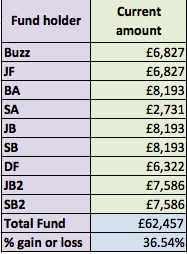
    To a certain extent, I trade at an amount proportional to the fund. That is the intention. But my own competency is the principal measure. For all of this year I’ve traded small. However, the trade amount, when it moves, will increase substantially.

    For instance, risk per trade has recently moved from a few pounds to £150 per trade, and will very soon be £300 per trade. The next step after that is to £600 per trade, where it will stay for some considerable time. I will take half a dozen or more trades per day. Moreover, I will trade twice within the same risk where appropriate.

    If we’ve mastered the day-trade then the potential is clear.
  • Most important, but often ignored

    Probability is something we understand very clearly when it comes to sports, but it seems to be a concept that we struggle with as a trader.

    We realise (because it’s been mentioned a few times) that the difference between a trader and a gambler – if we where to picked one thing – is adding or not adding probability into the mix of reward and risk.

    Some sports lend themselves very well to the example of probability. Basketball, tennis and (particularly) golf come to mind. I mentioned basketball last week because the point scoring matches well the traders multiples of reward to risk.

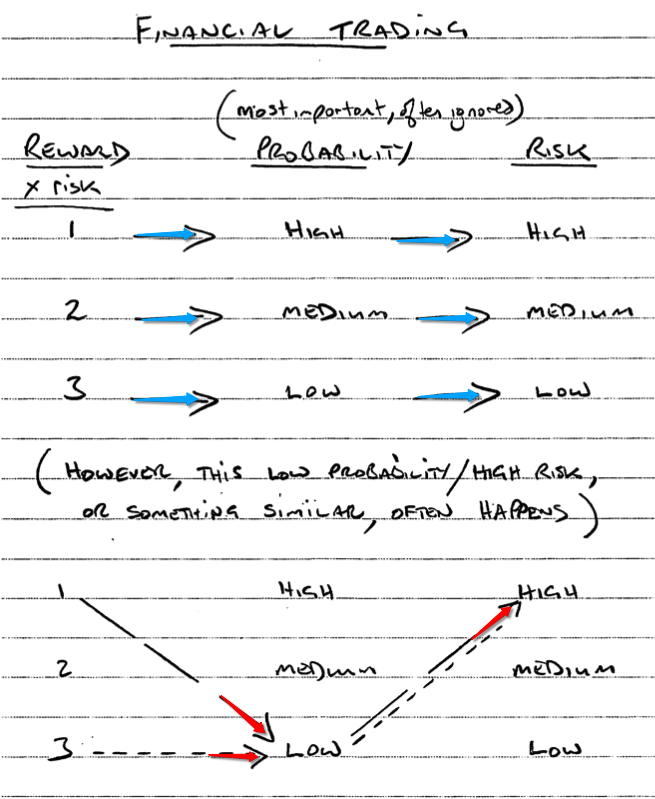
    In basketball we can score 3 points from a shot taken from outside of the defenders area; 2 points from inside the area; and 1 point from a free shot, if the opponent commits a foul. As a trader we often look to achieve a minimum target that is 3, 2 and 1 times our actual risk. (I like this to be planned risk but it is actual risk that the traders equation depends).

    We could suggest that a basketball shot taken from outside the defenders area has a probability of success that is low (it’s a long way to throw it!); however, the risk is also low as the defending team have little chance of a quick, undefended, attack in reply.

    A 2-pointer attempt is medium in probability as the (6’7″) defenders are there with us in the shooting area. It is also medium in risk as it is a dynamic manoeuvre and often with the full commitment to the shot from most, if not all, of the team; a quick steal and counter attack is possible.

    A free shot is never available in trading, therefore, I’d equate the 1-point attempt, in basketball terms, to the lob up court to a teammate in the hope of a quick score. The risk of interception is high but the probability, if our own team member catches it, of scoring quickly is also high.

    All well and good, but where does this take us in financial traders terms? As a trader, and regardless of which timeframe of chart we trade, we’re all looking to take trades where the probability, reward and risk make good sense. To do otherwise is, as we’ve said, gambling.

    As an aside, as a trader we’re always participating in the basketball equivalent of the NBA championships because the trading professionals (institutions and the like) make up most of the opposition and in this ‘zero sum game’ they’re always-in.

    In our basketball match, if we lob the ball up court but we don’t have a team member to receive it we have given the ball away; if we take a 3 point shot at basket when we have no defenders between us and the basket we have merely reduced our probability for no good reason.

    Our judgement of probability in sports is generally very good – instinctively making a workable probabilistic assessment; but as a trader we often ignore this all important aspect.

    Technical trading is a financial ‘sport’ where we can only participate against the professional league. At that level we cannot get probability, reward and risk confused. To do so is the same as chucking the ball up court without a receiver.  As want-to-be traders however we seem to do this all the time (ignore probability) and wonder why we don’t win.

  • A sucker game

    A point worth serious thought from Nassim Taleb from his book “Antifagile: things that gain from disorder”.

    Yes, he creates, I think, an appropriate new word (antifragile) to help get his meaning across. In one area Taleb presents his argument on medium risk (referral to a financial portfolio) and how he considers there to be no such thing as “moderate” risk.

    His point is that in the event of a “Black Swan”, that is a catastrophic negative event, then all – low, medium and high – risk is going to get hit. (As an aside, I consider that a negative Black Swan, to an expert intraday trader, can become a positive Black Swan).

    Fully committed to a “moderate” risk account is, actually, at full risk; at best, this provides medium upside potential but with all the possible downside. That is because medium risks can be subjected to huge measurement errors.

    Taleb points out that: rather than being fully committed to a “moderate” risk portfolio (and in the event of a negative Black Swan, a potentially emotionally draining experience); better to be 90 or 80 percent in a boring, inflation proof, no risk cash (or: bond, cash, share mix – my words) account and 10 to 20 percent in a very high risk account. (Taleb uses 10 percent very high risk, I’m simply following Pareto’s law)

    The 80/20 example means that we have little downside – assuming that 10 to 20 percent downside is acceptable – whilst still exposed to massive upside.

    To finish, Taleb writes: “Someone with 100 percent in so-called ‘medium’ risk securities has a risk of total ruin from the miscomputation of risks”…..”that in fact is a sucker game”.

  • Probability

    Most are aware that I took losses at the end of Trump week. No blame to the US president-elect, the responsibility is all mine. Ironically, it came after my boastful ‘fulfilment’ blog. Hey-ho.

    Losses always take ten times longer to make back. But they’re lessons we’ve paid for so we should heed them. To that end, the basics of what we do have not changed; however, entries and targets most certainly have changed.

    We’re all familiar with the concept of risk and reward. However, we rarely consider the third equal partner – probability. In general, the smaller the risk the smaller the probability.

    Therefore, we’ve increased managed risk but also increased probability by taking trades that meet our “always in” criteria. This is not simply trend but a trade taken with context in the direction of a trend bar that has broken a premise point.

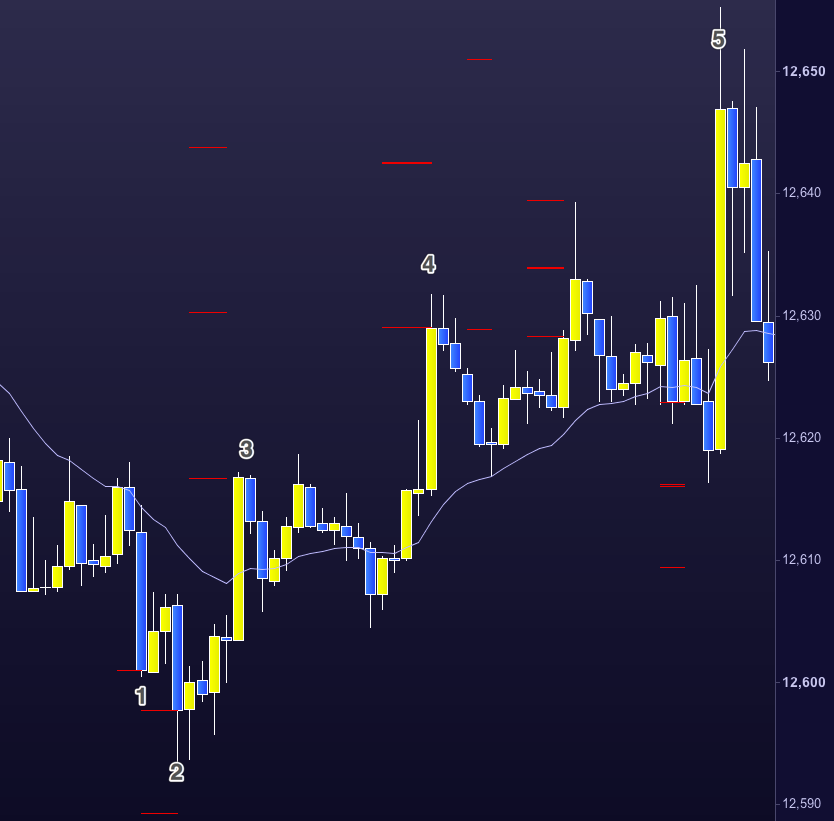
    Here’s an example from yesterday of what I mean:

    snip20161203_1

    Left of frame is a down trend with a classic 3 push down. Three measured pushes usually means a reversal. Previously we’d be looking to take the bottom of bar number 1 long, as it’s the third leg down. However, bar number 2 was a ‘final flag’ or a final extension down. Our stop may have previously been set close below bar number 1. Thereby providing a low risk but also a low probability trade. In this example we’d have been stopped out at bar number 2.

    We now, as we did yesterday, enter the trade long at the top of bar number 3. This is arguably a higher risk but higher probability entry. We can see that this bar has also closed above a line of premise. Meaning above the previous high bars to the left.

    The red dashes are my measured targets. My target was close to the top of bar number 5. However, in this instance I came out earlier as bar number 5 was a news based US monthly non-farm payroll announcement – and they can be quite another thing.

  • The most important thing is…

    60% probability of success is the best we can expect from a trade. Even if we think it’s a cert.

    If we look at a trade and say, ‘yeah, I think that will definitely work,’ then the probability is still, at best, 60% that it will happen as we want it to happen.

    On the other hand, if we look at a trade and say, ‘yeah, I think there is a chance of that working,’ then it’s a 40% probability.

    In other words, the best we can expect is between 60% to 40% of being right in any one trade.

    Therefore, our reward needs to be at least twice our risk in a 40% probability trade and at least equal to our risk for a 60% probability trade. Each of these make a positive traders equation.

    Striving for trades that give a positive traders equation is the way to make money over a series of trades.

    Achieving a positive traders equation is the most important thing to grasp, and do, as a trader. 

  • Investing or Trading?

    Investing first:

    Investing is buying into something that appreciates. In stocks and shares, any price increase after about a year is 100% because of the fundamentals: the strength of the books, the management, the continued saleability of the underlying product….to mention a few.

    Most of us have investments in pensions or managed funds.

    Over a bunch of years the market goes up about 9% on average. However, somewhere between 7 to 15 years the market crashes. Timing is everything.

    Moreover, most pension and managed funds don’t beat the market, actually an astonishing 95% of them; on top of that, they charge several percent annually to do so.

    If we need our invested funds, 15 years before would be best, move it into something that is not market based, at least not ‘fundamentally’ based.

    Now for trading:

    Trading is generally over a shorter time frame and is mostly technical based: that is, the reaction of price when price reaches a support or resistance. In its simplest form, it is one person’s opinion (or computers) against another.

    And, as a computer does not have an opinion – it is of course emotionless – that presents the biggest obvious challenge to most human traders.

    Some 75% of trades are institutional based (the big money). The remainder is made up from other entities such as high frequency trading (HFT) systems, large hedge funds and the like. Smaller (professional) organisations and home traders represent less than 5% of the market.

    To be clear, when the (small) professional trader or home trader trades she is up against the institutions – computers mainly – so she better know her unemotional stuff.

    That is probably why few home based traders, particularly lower timeframe traders like day traders, make it. Cheery, eh.

    The one factor more than any responsible for successful trading is – no it’s not luck – is trade management, boring as that sounds. Good trade management always provides a positive traders equation of: risk, reward and probability.

    Without a clear calculation of each of these (and probability is often the one that is missed) then we are not trading but doing something else…gambling, maybe.