Tag: retail traders

  • Margin, a big deal?

    Margin, or deposit requirement, in financial trading, is the good faith amount that we need in our trade account to cover a deal. The margin is not a loan, but rather a means to cover a loss.

    If we wanted to purchase a stock or share from a traditional broker, and the value of that purchase is £5,000, then we’d need £5,000 available in our account to complete the deal.

    A financial spread bet, or derivative based account, is a leveraged account and only a ‘margin’ of the full-trade amount is needed.

    Take Sterling versus the dollar for example, a trade of £5 per pip, at the current value of this market, without a leveraged account, would cost £67,500.

    However, we are only required to cover the broker’s margin.

    (A margin rate of: 0.5% to 1.5% is common in FOREX and 5% in stocks and shares; but each of these can vary significantly if a market becomes non-liquid or volatile)

    A margin rate of say 1% would require an account to hold £675 for the £5 per pip example.

    £5 x 13500 x 1% = £675 margin (This is a non-stop calculation, a with-stop calculation reduces the amount)

    If the trade goes against us, however, the margin requirement increases. Therefore, a good amount more than £675 is required to comfortably cover the trade.

    It is easy to see how novice traders could get into financial trouble if they lose sight of the overall risk of such trades.

    Probably why margin rates are on the increase to retail traders.

  • The super tanker of markets

    Can we move the market? Possibly, certain markets. But we want to trade a market that has particularly high liquidity. In other words, the ability to buy and sell an asset easily and quickly.

    We trade major currency pairings for this reason. But how big is the currency pairing that we trade, and can we influence it a bit?

    If we consider the market we trade as the biggest super tanker – the one that is more than four football pitches set end to end – then to move this super tanker the retail trader is as if spitting (horrible habit) at the hull.

    Ah, but now we are a professional trader surely we have more influence at the level we trade. Yes, we do, we now don’t spit too often, we have graduated to a feather duster.

    To move our chosen currency pairing market, (particularly during the period of the Frankfurt, London and New York trade times where several trillion are traded daily) there are probably millions of spitters, many thousand feather duster types and everything in between right up to dozens of tug boats.

    The tugs, in this analogy, represent the financial institutions – banks, pension funds, big hedge funds and the like. A few tugs need to push or pull in the same direction to move the market.

    Our job is to determine, before hand, which way.

  • Retail traders stay out!

    What a week….and, no, we didn’t make a killing on the pound but nor did we lose anything.

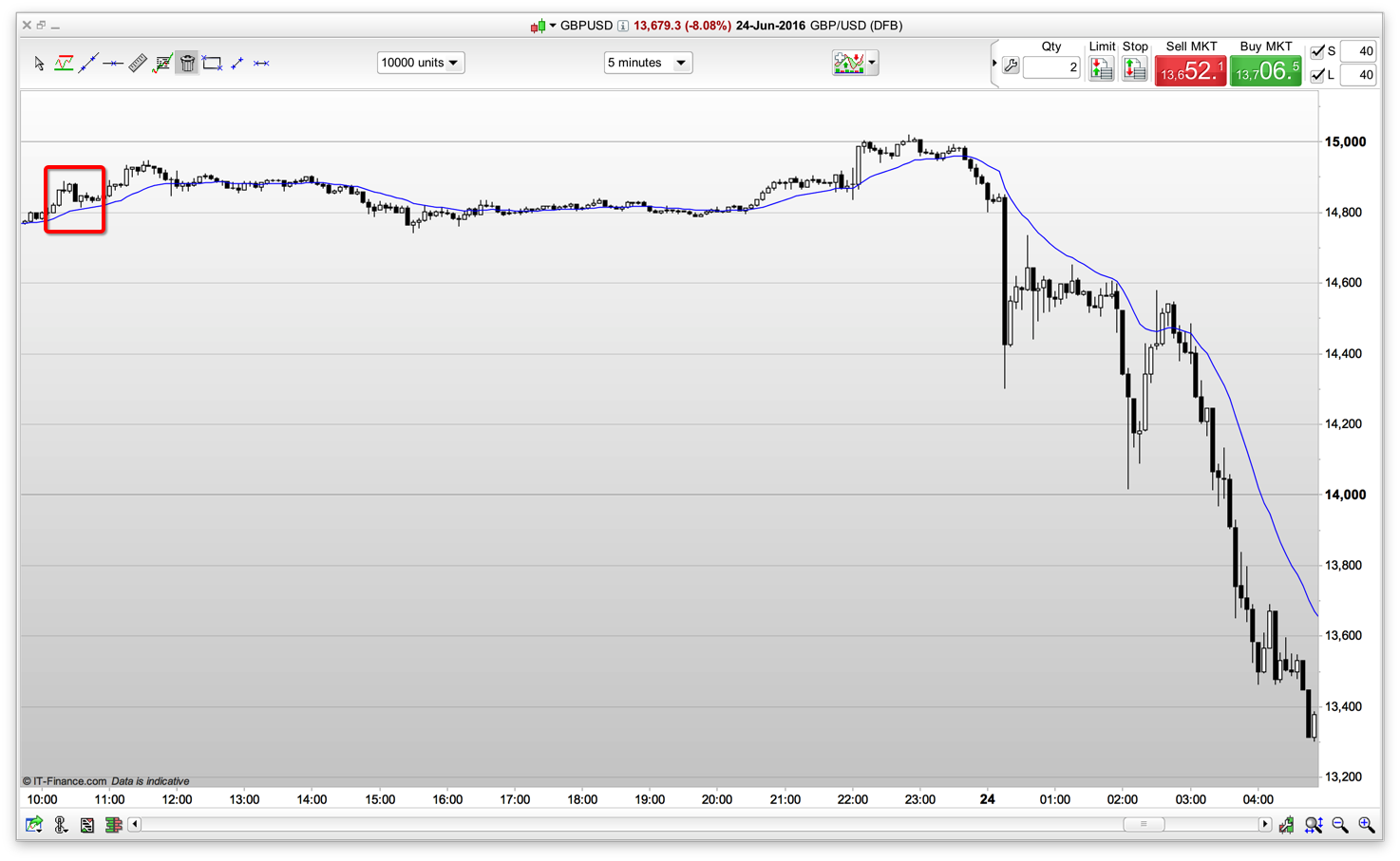
    Retail traders (people who trade their own money) were strongly advised – and correctly so – not to trade the early morning of the vote results. Here’s why:

    Snip20160625_1

    Firstly, a trade we took late morning of the day before the vote results, the 23rd.

    When you see a chart after the event you wonder how you didn’t realise that it wasn’t going to go up. We went short (to say the price was going to go down) at the green arrow. One of our strategies is to short at the top of a ‘trading range’. The green arrow was the top of a wide trading range.

    The price, however, broke out long. Our stop, as per our strategy, was equal to the height of the trading range which was over 65 pips. The break-out long went over 50 pips before it pulled back, very suddenly, to give us a break-even out.

    I mention this to put things into perspective. Usually, in GBP USD, our stops are between 20 and 40 pips away. Even early on the 23rd we were up at over a 60 pip stop. Not only that, margins change so that the leverage that you get to know is now different which means if you get it wrong your whole trade can be cashed out very quickly by your broker. Spreads (we mentioned these a couple of blogs back) go through the roof and, most importantly, we have the great probability of slippage where, simply put, you can ‘lose your shirt’.

    We do not trade the monthly FOMC report because price can bounce 150 pips one way and, often, immediately reverse over 150 pips the other way. The early hours of the 24th the market moved over 1,700 pips with over 500 pips of pull back.

    Trading is a ‘zero-sum game’ which means that one person’s gain is another person’s loss. Institutions lost many billions the other night and retail traders trading could have blown out their accounts and more. If you use a retail trader that made money through the big move down then get rid of them as they are gambling and next time might not be so pretty.

    In the chart below, to put things into context, the red box was the time of the large bars shown in the chart above.

    Snip20160625_2

    Gold

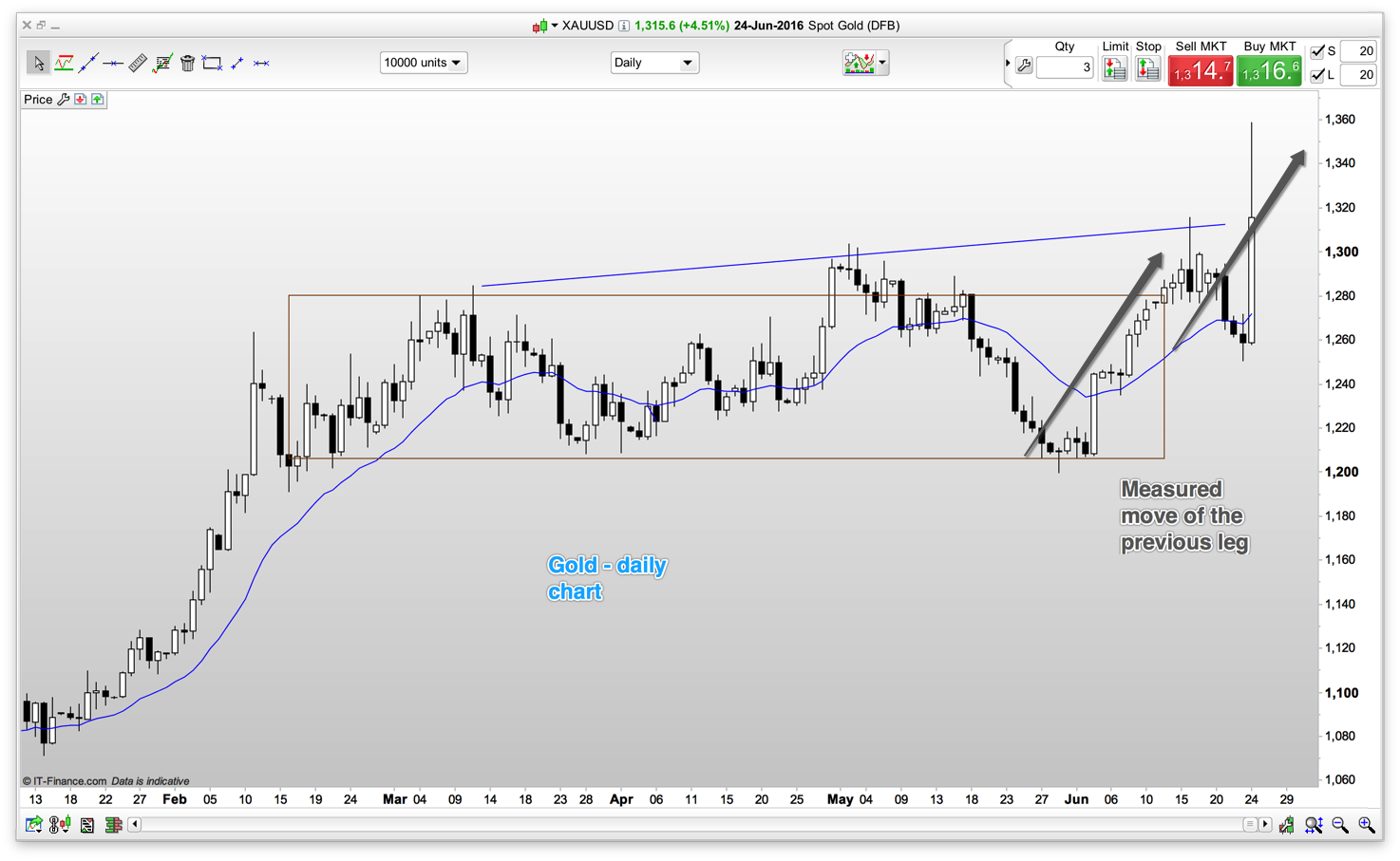
    For the next few weeks, due to the expansion of our family business coming on-line, I’m only trading between 8am and 1pm. This allows me time to trade the currency pairing GBP USD only. For the time being I’m monitoring the commodities. Gold moved up to an exact measured move of the previous leg. Something James had spotted – and I’d relayed the possibility of, a few blogs back – and thus providing a great short opportunity. Over the next few days we may get a second (and therefore more secure) opportunity to short gold. But I need more evidence that the price will not go up further.

    Snip20160625_3