Tag: Professional traders

  • The super tanker of markets

    Can we move the market? Possibly, certain markets. But we want to trade a market that has particularly high liquidity. In other words, the ability to buy and sell an asset easily and quickly.

    We trade major currency pairings for this reason. But how big is the currency pairing that we trade, and can we influence it a bit?

    If we consider the market we trade as the biggest super tanker – the one that is more than four football pitches set end to end – then to move this super tanker the retail trader is as if spitting (horrible habit) at the hull.

    Ah, but now we are a professional trader surely we have more influence at the level we trade. Yes, we do, we now don’t spit too often, we have graduated to a feather duster.

    To move our chosen currency pairing market, (particularly during the period of the Frankfurt, London and New York trade times where several trillion are traded daily) there are probably millions of spitters, many thousand feather duster types and everything in between right up to dozens of tug boats.

    The tugs, in this analogy, represent the financial institutions – banks, pension funds, big hedge funds and the like. A few tugs need to push or pull in the same direction to move the market.

    Our job is to determine, before hand, which way.
  • Price action or fundamentals

    As previously mentioned, I’m presently focused on trading 5-minute charts EUR USD. To master price action trading, and with a low time chart such as the 5 minute, takes all my undistracted concentration. I think that, most, professional traders use price action. Some may voice that they also use fundamentals and certain indicators, but when it comes down to the profits it’s usually price action, in some form, that’s responsible.

    My trades on the 5 minute charts last from a few minutes to usually no more than an hour. Therefore, fundamentals have no influence. Although some traders consider fundamentals, they are generally the ‘go to’ consideration of the investor rather than the trader. An investor can be considered as a longer-term commitment, a duration where the fundamentals have time to take effect – many months to years. I studied fundamentals for several years. However, I now feel that even the highest term charts, such as weekly’s or monthly’s, are (primarily) influenced by price action and therefore ‘technical’ rather than ‘fundamental’ reasons. That is because price action is a measure of psychology in the market – such as: fear, greed and confidence.

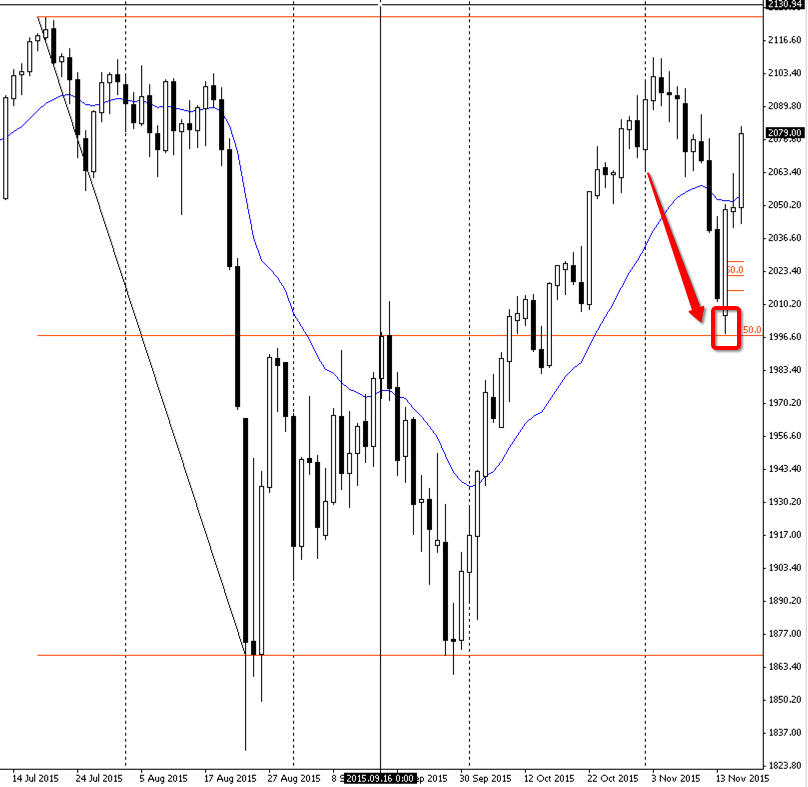
    Notice below how the recent attacks in France effected the S&P 500. Notice also that the drop, before the S&P’s quick recovery, bounced off a 50% retrace line. A line that I had drawn on the chart several weeks ago. This is a part of price action, the context, and is known as a measured move. Often this measured move is exact – whether it’s a 5 minute chart or a daily chart as the one below. The news (France) moved the market, but price action told it where to go too.

    Snip20151118_22