Tag: price action trading

  • The secret to profitable trading

    Okay, as promised, here it is, the secret to making money from trading. And, you will not be surprised to learn that as a quick solution to getting rich – it’s not.

    There are so many ways to trade it would be near impossible to compile a comprehensive list of them all. However, there are three broad categories that most would agree on.

    (1) Trading through company figures is known as fundamental trading. It’s generally considered as long-term trading and is probably the original bedrock of all trading. I love fundamental trading and developed my own knowledge of it over several years. Through Nick’s spread sheets we have a great solution to choosing long-term trades. Personally, I did mess this up when I tried to use the fundamental information we generated for short to medium term trades. That was an expensive lesson.

    (2) Trading through the use of charts is known as technical trading. It is often difficult for a ‘fundamental trader’ to accept that charts can be read. And for good reason too, there is a lot of guff provided about reading charts that make it difficult to accept as a viable trading method. Nor does a fundamental trader need the confusion of technical data messing up her fundamental decision. Again, I’d like to put my hand up and admit to trying most technical systems and finding that I couldn’t, until recently, get any of them to work consistently.

    (3) The third consideration is a mixture of both basic trading structures. As if it wasn’t confused enough already. Yes, tried that. Not a great success story.

    In very broad terms, holding a trade for anything outside of nine months is probably best left to the fundamental trader and anything inside of that time is technical territory. We know that long-term fundamental trading works, ask Mr Buffett. But even he tells us of the multitude of mistakes that he had made. But in the end he certainly had the edge.

    Therefore, for the shorter term stuff, the technical trading, trading from charts, is it realistic to expect it to work. Without any doubt at all, I can say technical trading works. But we have to know how to tap into it. Anyone wanting the secret, so they can immediately adapt it, are going to be disappointed. Because, I think, the first thing for any trader is that they have to do the work first. They have to learn the ropes. And, I guess, it doesn’t matter which ropes we learn as long as it works for us and we fully understand it. Personally, again having gone the long way round and tried almost every technical method going and failed at each one, I’ve settled on technical trading by ‘price action’.

    This sounds fancy but couldn’t be simpler. It involves basic charts only. No indicators to speak off and a couple of basic drawing tools. If you can read music or play chess to the ‘grand master’ level you will appreciate where I’m coming from when I say that it is possible to read the flow of things.

    How long does it take to become a price action ‘grand master’? All I know is that it took me several years, but I’ve worked with someone recently that grasped it to a high degree within a few months. Price action, however, is only one part. Probably the more important part, and this goes for any style of trading, is the management of a trade. Learning that is a different ‘kettle of fish’. That is because it involves controlling emotion. That comes with experience and trading maturity.

    However, once all this is grasped to a very high degree the ambitious trader will not be pleased to know that it is not enough. It comes up short. After all that, a trader will still, over a period of time, lose money. And it is at this point that traders, having persevered for so long and having invested so much in trading losses, time and emotion – give up.

    To become a consistently profitable trader we have to go through all the learning lessons and then press on through the ‘gap’ to find our edge. And that, dear reader, is the secret. We have to find an edge. What is the edge? It is personal to each trader. The point to grasp, however, is that we do the work first, we learn the trading ropes in whichever trading method undoubtedly suits us. Once we get to that point we all have to go through the ‘gap’ and discover our own edge.

    An edge can, for some traders, be their ability to anticipate trade direction with short-term news. For others it may be slightly longer term trading but only trading a specific set-up or cycle. Even high frequency trading, mostly done through computer algorithms, can be seen as an edge. I cannot stress this enough however – we will not make money trading without an edge.

    My own edge, I’ve quite recently come to realise, is the ability to measure risk, reward and probability to a very accurate level. The effect this has had on my trading ambition going forward we will discuss next time.
  • Weekly Diary – Slow Trader Fund 28th November 2015

    Here’s a potential trade from the middle of this week that, for one reason or another, I did not take but one that I think illustrates the potential of Price Action Trading when done well:

    Snip20151128_26

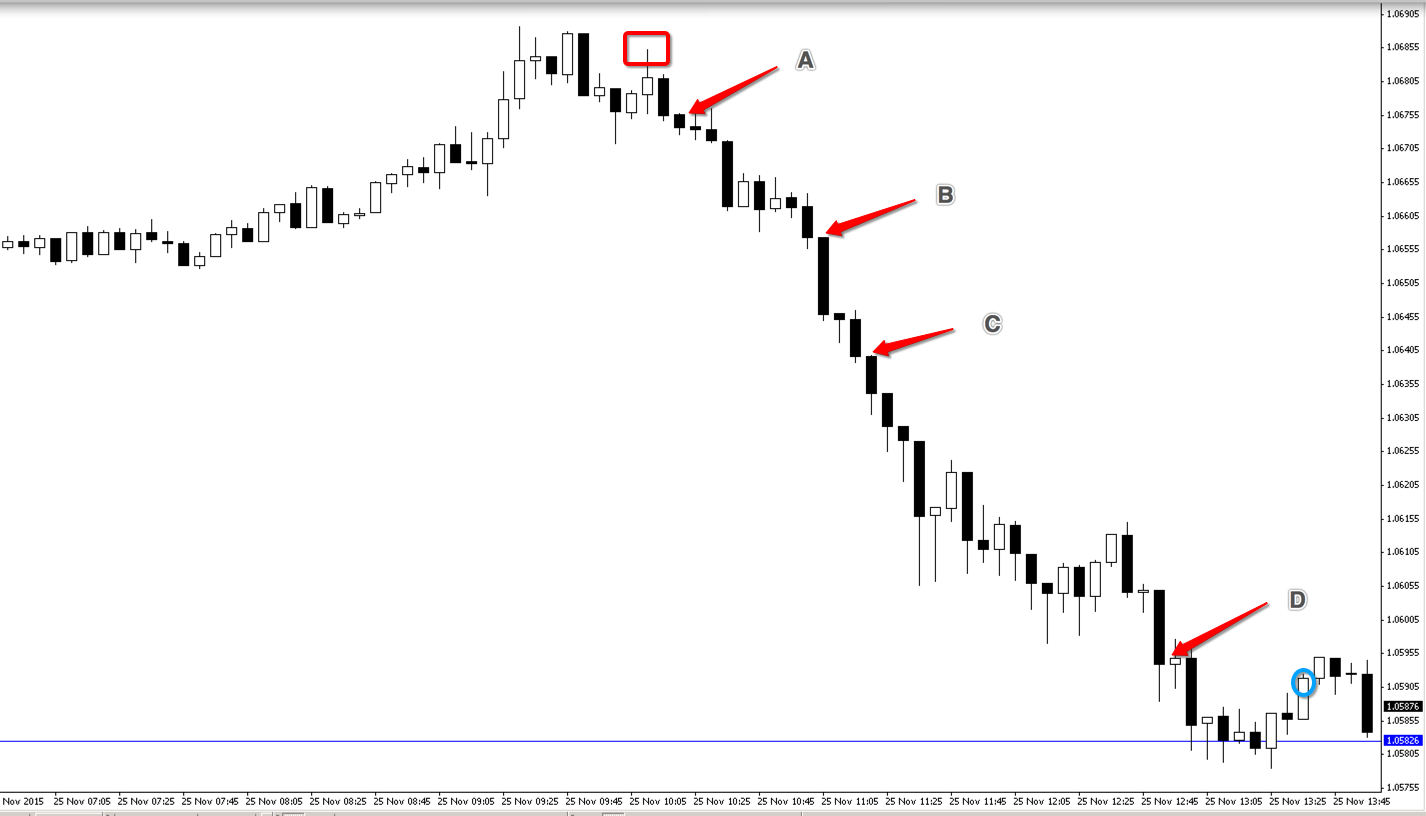
    This is the EUR USD 5 minute chart for Wednesday 25th November. The red square was at 8 am (UK time). For the watchful this showed itself as a major trend reversal (MTR) or a lower double top. (There is nothing major about a MTR because in a higher time frame, say the daily chart, this is just a medium-sized doji bar of no spectacular context).

    However, on the 5 minute chart a good sell (or short) position was shown at position ‘A’. MTR’s, such as we have here, have a probability of about 40% in working. Therefore it is more than likely that we will lose our money. With this in mind, we need to manage our trade accordingly. That is, trade an amount that we can afford to lose. Placing a trade at ‘A’ we would have a stop (a position we will get out with a maximum loss) just above the highest bar. About 20 pips away. Lets say our maximum trade in this situation is £9 per pip, therefore we have a 60% chance of losing £180 – plus the spread so we’ll call it an even £200 risk.

    We have to be confident with our read of the charts. At position ‘B’ we are provided with an opportunity to add to our trade. If we do so we could place an additional £9 trade with our stop now for both the ‘A’ trade and the ‘B’ trade at the opening (original) position of our trade at ‘A’. That is: we have a break-even stop for our first trade and again about a £200 risk for our second, or ‘B’, trade.

    We then follow the same sequence of events at ‘C’ and possibly again at ‘D’. We would exit the whole lot at the blue circle. To be fair I would probably have managed the trade on the way down and exited some of my trade earlier, just below ‘C’. However, you probably get the message.

    Trading a MTR is only one of many strategies. A MTR is high risk, no better than a 40% chance of success, but the reward compared to the risk is high. In this case the reward was 4 to 1 for the initial trade. The potential return from this trade, if managed correctly, and with entries as I’ve suggested, was in the region of £1700. That is assuming that the trades were held all the way to the blue circle and that the trade at ‘D’ was exited at break even.

    Not a bad return for a mornings concentration.

  • Weekly Diary – Slow Trader Fund 7th November 2015

    I will provide the fund amount the first Saturday of each month, or close to it.

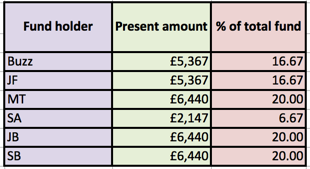
    We are 7% up on our original investment:

    Snip20151107_8

    The name Slow Trader refered to my trading style. Namely my steadiness in terms of: ‘the tortoise and the hare’. It was not intended to refer to the pace at which the fund will grow. I’ve moved from indicator based trading to raw charts and price action trading. This is definitely a trading style where the stabilisers have been taken off. And, as with that analogy, once we are comfortable without the stabilisers we can achieve so much more.

    I have been very cautious only trading with small amounts over many months. We have not missed opportunities because in price action trading there are several opportunities daily. What is important is that we learn how to read the charts with a high level of confidence. Moreover, we need to be able to manage our trades correctly varying our approach, depending, for example, on the trade scenario: trend (breakout or channel) or trading range, swing trade or scalp, scaling in or not, scaling out or not, and on each trade we need to consider a positive traders equation.. only to mention a few.

    The trading amount will build naturally. I wouldn’t like to say if it will take a couple of weeks or a couple of months. It will just happen at the right time. A professional price action trader to go from okay (that is if her fund survives the learning stages) to successful would take 3 to 7 years. I feel that this timeline has been reduced for us due to: my previous trading experience (I wasn’t going in cold to price action trading) my full-time dedication to the process (a luxury most traders starting out cannot do) and sharing my day-to-day learning with my son (James) where we have been able to bring each other along much more quickly than someone working alone would be able to do.

    Snip20151107_11

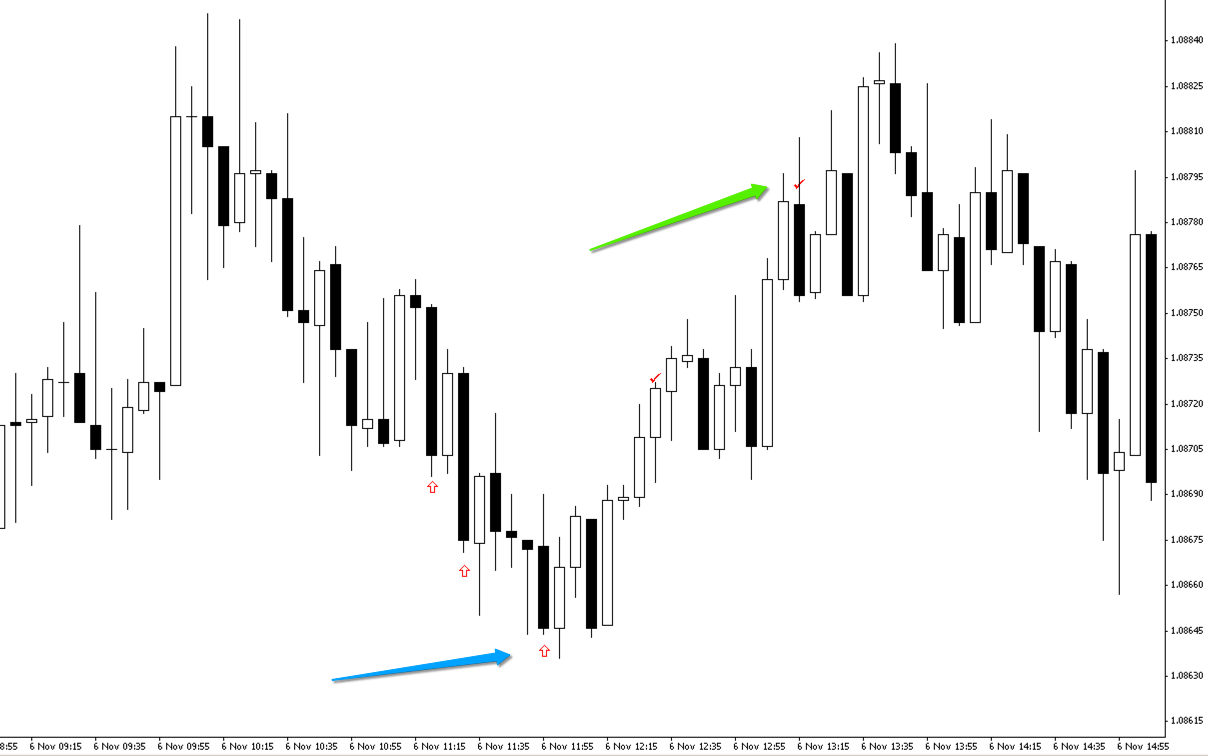
    Above is the 5 minute chart of the EUR USD from yesterday. As we can see, we took a buy at the blue arrow and sold at the green arrow. Actually, we scaled in and scaled out but the result overall is the same. We had done this eleven times over the last couple of days without a loss. However, what I’m about to show proves the need to maintain an overall awareness to what is happening in the market.

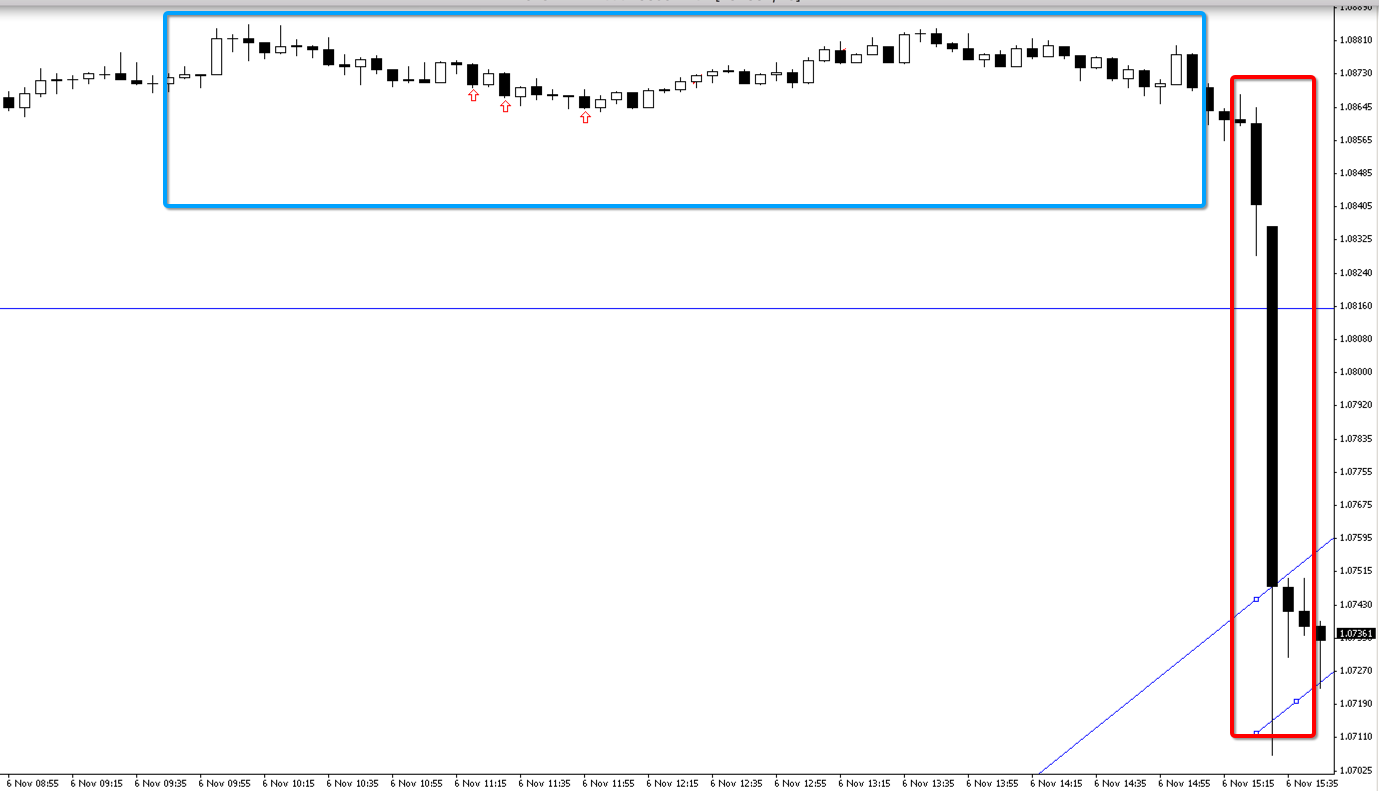
    Snip20151107_16

    The blue box above is the same chart information as the first chart. The reason it looks all squashed up is because of what happened a few minutes later: the announcement of the monthly nonfarm payroll in the USD. This large movement distorts the vertical (y-axis). I don’t trade these announcements. They are difficult to predict. Often moving significantly one way only to reverse. The S&P 500 weakened due to the announcement but in the chart above the US dollar strengthened. Also, short or long spreads (the spread is where a broker makes her profit) increases dramatically during these volatile moments. The bottom line is that it is essential to know about these events and if we don’t have a stratergy – stay out.