Tag: Lightspeed

  • The new PDT rules mean more trades

    Lightspeed will implement updated Pattern Day Trading (PDT) rules on 4 June.

    For me, it is not so much the 4x leverage, but the intraday rather than next-day share renewal that makes a significant difference for day traders.

    Lightspeed is offering 4x leverage on accounts with an initial balance of at least $5,000, which they call margin 2. However, not all stocks are suitable for full leverage; suitability depends on their risk and volatility.

    Many low float stocks fall into this category and are often not available with full or even partial leverage.

    The other, and my preferred option with Lightspeed, using the same account size, is called Margin 1. This option does not provide leverage, but like Margin 2, it allows intraday recycling of shares traded, meaning your buying power is immediately restored after closing a trade, so you can use those funds for additional trades on the same day.

    (With OTC accounts, funds are also returned immediately after closing a position. However, OTC accounts are decentralised and don’t offer reliable market depth or Level 2 information.)

    Equities and futures provide usable Level 2, or “tape,” and depth-of-market displays, respectively.

    I have chosen to day trade low float equities, which are generally low-CAP NYSE-listed shares.

    Before 4 June 2026, the significant disadvantage of trading NYSE equities was the next-day settlement, particularly for a lower-funded account.

    These new PDT rules create significant opportunities for profitable traders, as more trades can be made in a session if opportunities arise.

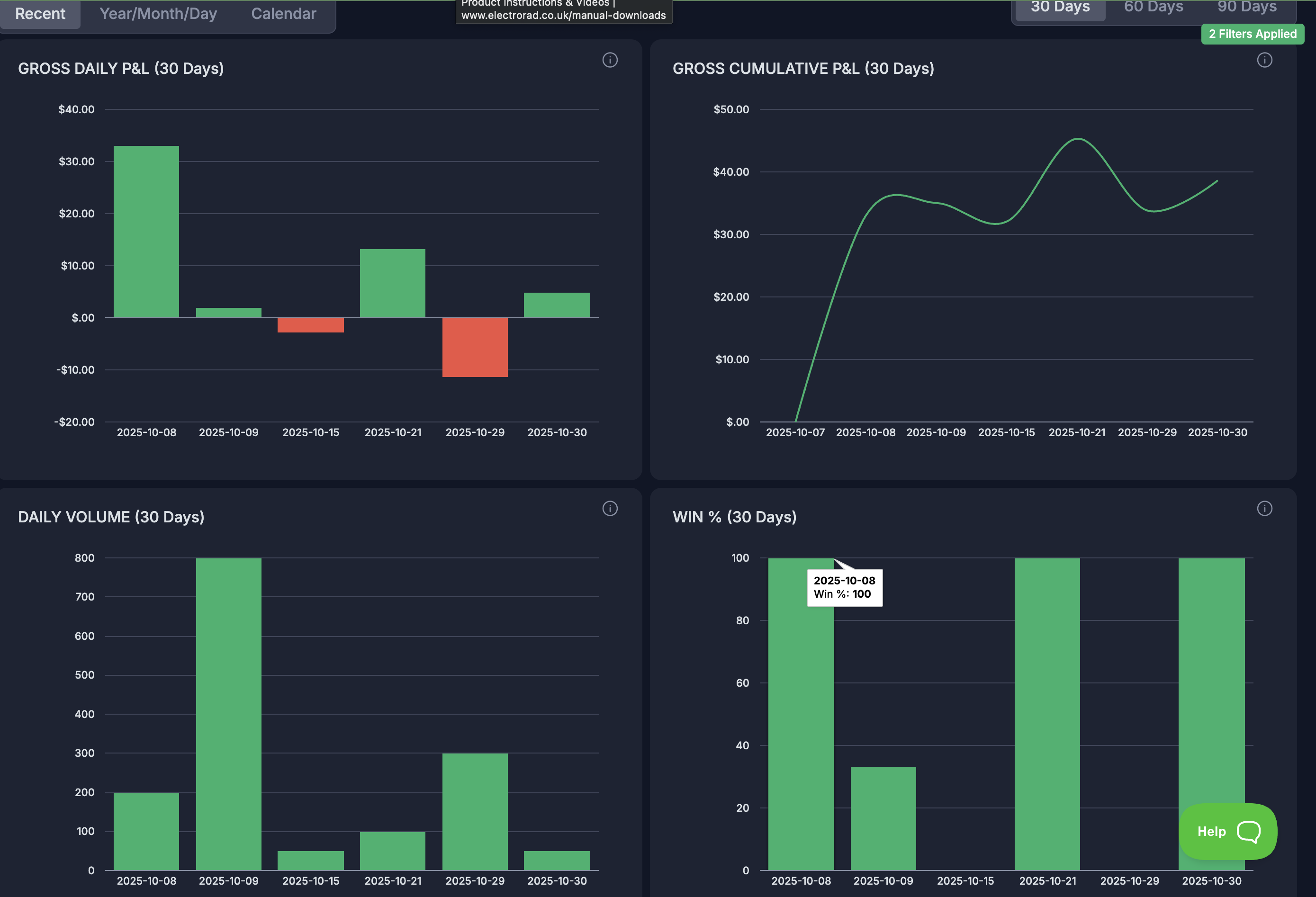
  • 1st month of the 12 month challenge.

    I am trading US stocks through the Lightspeed platform. Although there are commissions to pay with Lightspeed, it is a solid platform, and trades execute immediately, unlike many commission-free sites. As a day trader, the immediacy of trade execution is essential.

    October was a relatively slow month. Additionally, I had a project to complete: redesigning an area of the business into a guest gym. However, I still managed to trade for at least half of the month, and took trades on only six of those days.

    In my preferred trading range of $2 to $20 per share, movement, apart from one stock that skyrocketed and I missed, has been light.

    As I build the fund, starting with only $2,500, I must be cautious that fees do not significantly exceed the profits; this requires me to consider my trading style carefully.

    Please note that I am buying and selling actual shares, which differs considerably from leveraged derivative trading. Once I enter a trade, even if I hold it for only a few seconds, the full cash commitment is not available again until the following day, regardless of whether the trade is a win or a loss.

    Selectivity in trades is crucial, but so is commitment. Not all trades are equal. Where able, I try to gradually build my commitment to a trade as its suitability becomes clearer—a much more challenging skill than it seems, which is why most of us tend to make a single entry.

    Additionally, I try not to overstay my welcome in a trade. I focus on exiting when the trade weakens, but I always look for a re-entry if the market conditions suggest it—a challenging balance to keep.

    My results, however, indicate that I tend to exit trades that are likely to maintain momentum too early, which is an area I need to improve.

    To that end, I have recently shifted my focus away from price action trading. As someone who has long advocated for this approach, I found myself prioritising candlestick patterns and price movements over the tape.

    By “tape,” I mean both level 2 data and time and sales information. By eliminating candlestick charts and instead using exponential moving averages, along with a session volume-weighted average price across several timeframes, I could still identify a justifiable entry signal, while entirely focusing on analysing the tape.

    Furthermore, focusing more clearly on the tape has significantly reduced my drawdowns, but it is still early days.

    The profit results from last month are inconsequential, but we are prepared to capitalise on any long-only volatility that may emerge.

    The lower screen shows three Lightspeed level 2 displays and their associated time and sales. The upper screen displays four charts of the same stock over different time frames, absent the usual bar chart.

    Fund at $2,588, a 3.4% increase. It’s a start!