Tag: IG

  • Slow Trader Diary – week 33

    With USDJPY we are several hundred pounds up this week, and still in (but as I’ve mentioned before we cannot count these until they’re cashed). Small down of £100 with NZDUSD. Small up of £35 with DTE Energy Co. And, IG (our broker) costs for the week of £3.28.

    As an aside, how this affects you (the fund investor) personally will be shown as we move into overall profit. Until then it is pointless. Your initial investment into the fund is guaranteed. Okay, it is sensible to allow a few years for a fund to grow but, like me, with patience, we are all wanting a massive gain.

    This has been an exciting week for me in terms of being comfortable with goals and strategies. I am gradually completing my ‘how I trade’ page which will soon give you the strategies that I use. These strategies will seem simple to the novice trader, but execution takes time, dedication and effort to do properly and consistently.

    I’ve coined the abbreviation CrUP, meaning: Conditional, recent Up and Price. Each part is equally important. Missing any one and we are at a greater risk of getting the trade wrong. Each aspect of CrUP will be covered in detail soon under ‘how I trade’.

    One aspect, however, under Price, that cannot be learned is the method by which we buy or short. We have three choices: on market, on stop or on limit. Again, these will be covered in more detail in my ‘how I trade’ section, but in the mean time I will show you an example from this week. Firstly, the reason it cannot be taught is because it needs instinct, or gut feel.
    Snip20150815_18

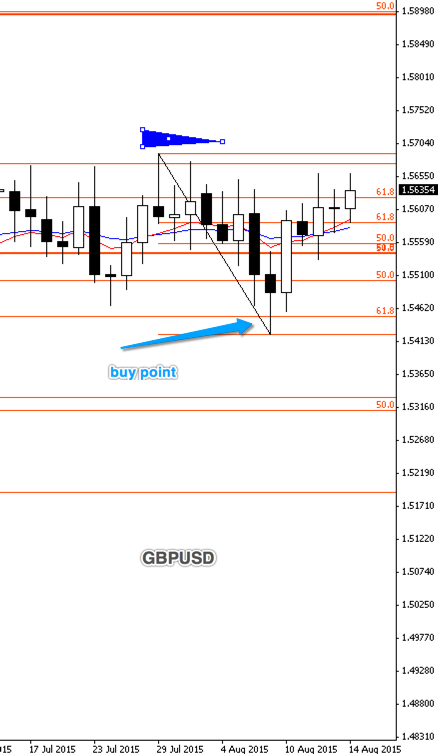
    Above is GBPUSD, which I narrowly missed. You may recall that we caught the last swing up of GBPUSD the previous week. Looking at a chart in hindsight makes it seem obvious. To get the trade right, however, takes understanding (instinct) of ‘how to buy’, i.e. on market, on stop or on limit. My buy was on-limit, at the exact lower pin position (the arrow marked ‘buy point’ shows this). However, the spread is a couple of pips (these are points up or down measured by the right hand axis, the spread is the brokers profit and if we don’t allow for it then we don’t get in). In my case I had allowed for the spread, so it was my buy position, my instinct, that was out). Having missed this, the following day provided an equally, arguably better, buy opportunity with a retrace down from the previous days close.

    I appreciate that those not familiar with this form of trading then the explanation is double dutch. However, it is a diary for me as much as for you so you will have to allow me this one.

    I have a couple of other examples from this week where, similarly, the buy was either too ambitious (in the case of GBPUSD) or not ambitious enough – hence the £100 loss in NZDUSD.

    But as I said at the start, noticing this outcome and being able to gain from the experience is what counts for the future. And the future is this week coming with great opportunities looming.

    I mentioned a watchful eye on gold. Both gold and silver have climbed against the long term trend as indicated by the COT report. I’m waiting for a retrace of the price before buying. Also, NZDUSD could be in for a move upwards. Sharpen the instinct!


  • Open a Slow Trader Fund

    How our fund works and what it costs.

    Trading cycle: from buy to sell (or sell to buy if we are short) is anything from a few days to a few weeks.

    Lets say you have £30,000 to trade. In this example, we will trade no more than £600 on any one stock or share. And during any one cycle we will trade some 10 to 15 times concurrently.

    Our strategy is to find intermediate trends. We get that right about 8 times out of 10. That sounds okay, but is spoiled by activation of our stop loss by larger than acceptable fluctuations in the share price; and by spikes in share price, including so-called ‘tree-shakers’ – don’t forget the hoops and loops – they can also be devils! The last two I made up, but you get the idea.

    However, where the spikes and the like are going to affect us a couple of times a year, to our advantage, we will have occasion to surf an intermediate trend. Hopefully, two or three times a year. In other words, we will stay in a trend for more than one cycle. Maybe for several cycles, and this is where the true profits are. Such a trend, even with one trade, can pay for all those pesky spikes and whatnots in one go.

    Our operation is three fold:

    1.   Find correct entry and exit points primarily from stocks and shares within the S&P 500 and FTSE 350.

    2.   Trade with regard to the share value or, as Warren Buffet calls it, the ‘margin of safety’. In other words, if we are taking a long then we want the share to be undervalued. Conversely, if we are taking a short we want the share to be overvalued.

    3.   Trade within our money management criteria.

    Trading vehicle:

    Our trading vehicle of choice is a spread betting account. We use IG. Unlike a normal share trading account, a spread betting account is tax-free. (Many people use these accounts to bet rather than trade. Those that bet, I have read somewhere, lose some 8 or 9 times out of 10).

    What it costs you:

    As the account is leveraged we pay a fee when we trade over a single day. This is called a daily fund bet (DFB). A DFB is our trade of choice due to the trading time frame we follow. To help cover this we deduct 2.5% of the final fund amount.

    Also, we deduct the same percentage of profits up to a maximum of 20% (For example, if profits are 15% we will deduct 15% of those profits. If, on the other hand, profits are 50% we will deduct only 20% of those profits).

    In other words, let’s again say your fund starts with £30,000 and, after one year, is at £50,000. Your costs are: £1,250 (to help cover the DFB), and £4000 (which is 20% of your profits). What you would get back is £44,750 (£50,000: less £1,250 less £4,000).

    For buy (long) trades IG charge the one-month LIBOR plus or minus 2.5%. This applies for sell (short) trades together with a borrowing fee. Dividends are credited if long and debited if short. For simplicity, we deduct a flat 2.5% of total end-of-year fund. This is less than the true costs to us and therefore in the case of an account that finishes even, or slightly above even, this will normally be a loss to us in terms of costs.

    How long does the fund run?

    A fund runs for one year. Two months before expiry you can decide to cash-in or rollover. In either case costs are subtracted annually.

    We can trade only 4 funds not including our own. A fund can be made-up from a group or from an individual. Each fund is to be a minimum of £30,000.

    A margin call is not your responsibility. However, your attention is drawn to the disclaimer page in slowtrader.com

    Note: Slow Trader Fund, 23rd July 2015, only has the DFB 2.5% charge. However, going forward from 23rd July 2015 the profit charge will also apply for those that wish to rollover and or place additional funds.