Tag: GBP USD

  • Sterling’s spike down – from a traders perspective

    You will probably have heard on the news that Sterling (GBP) spiked down massively.

    This happened 5 minutes after midnight yesterday morning. The reason is speculated.

    Technically, from a 50 year – or so – chart it is entirely expected for sterling to drop at this point. Indeed, we would consider a drop down to 1076, rather than 1118 that it did reach, appropriate. But it’s easy for the technical trader (or anyone) to say that after the event. And certainly it wouldn’t have been expected within a 2 minute period.

    Here’s how it looked on a short-term chart for GBP USD.

    Bars on a chart are normally represented relative to the biggest bar. Here we can see the 5-minute bar chart before the dip.
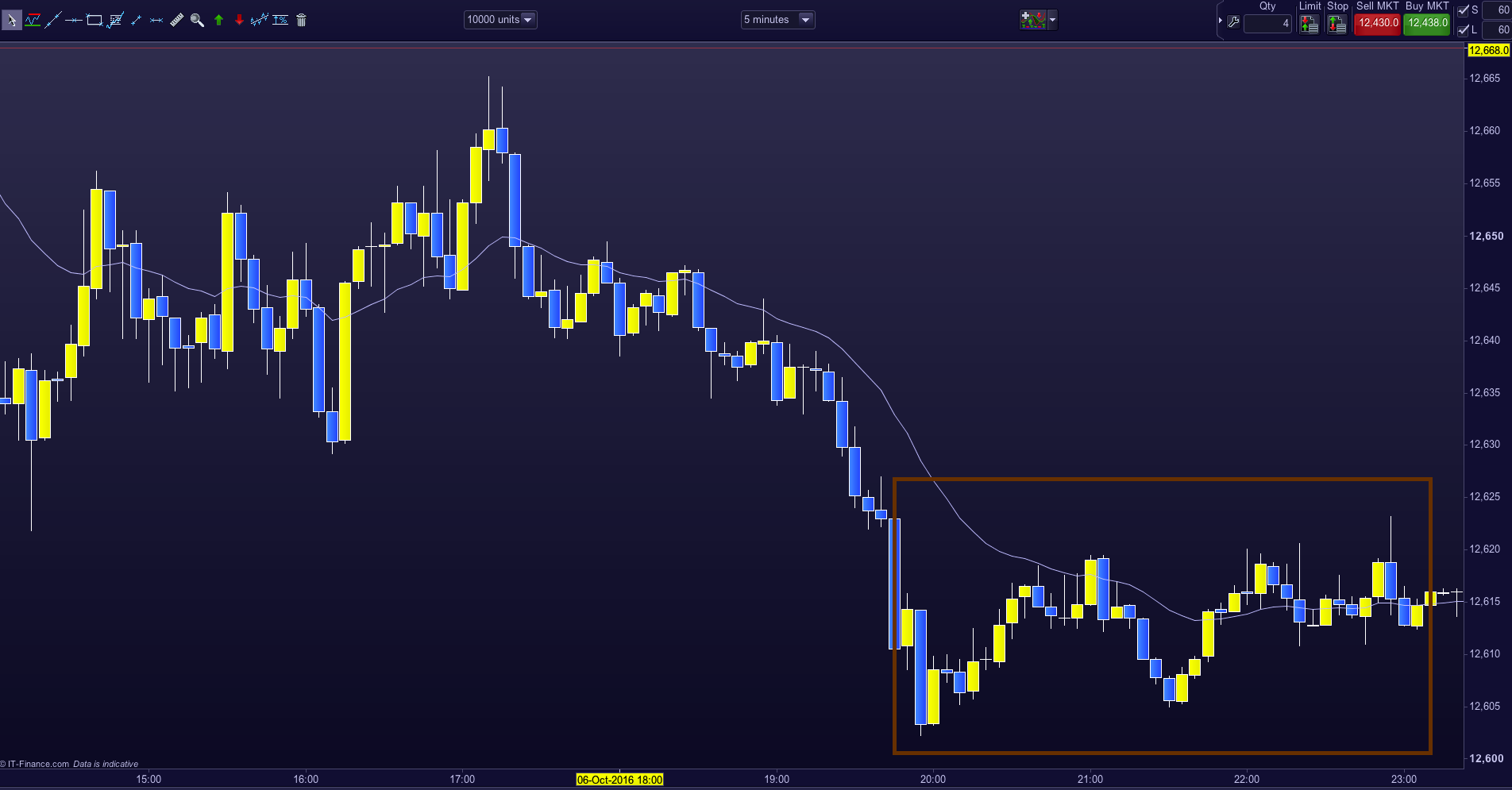
    snip20161008_1

    In contrast, here is the same chart moved forward in time by about an hour. The bars in the reddish box are the same bars on both charts – and provides an idea of how far the dip extended from the perspective of the short-term trader.
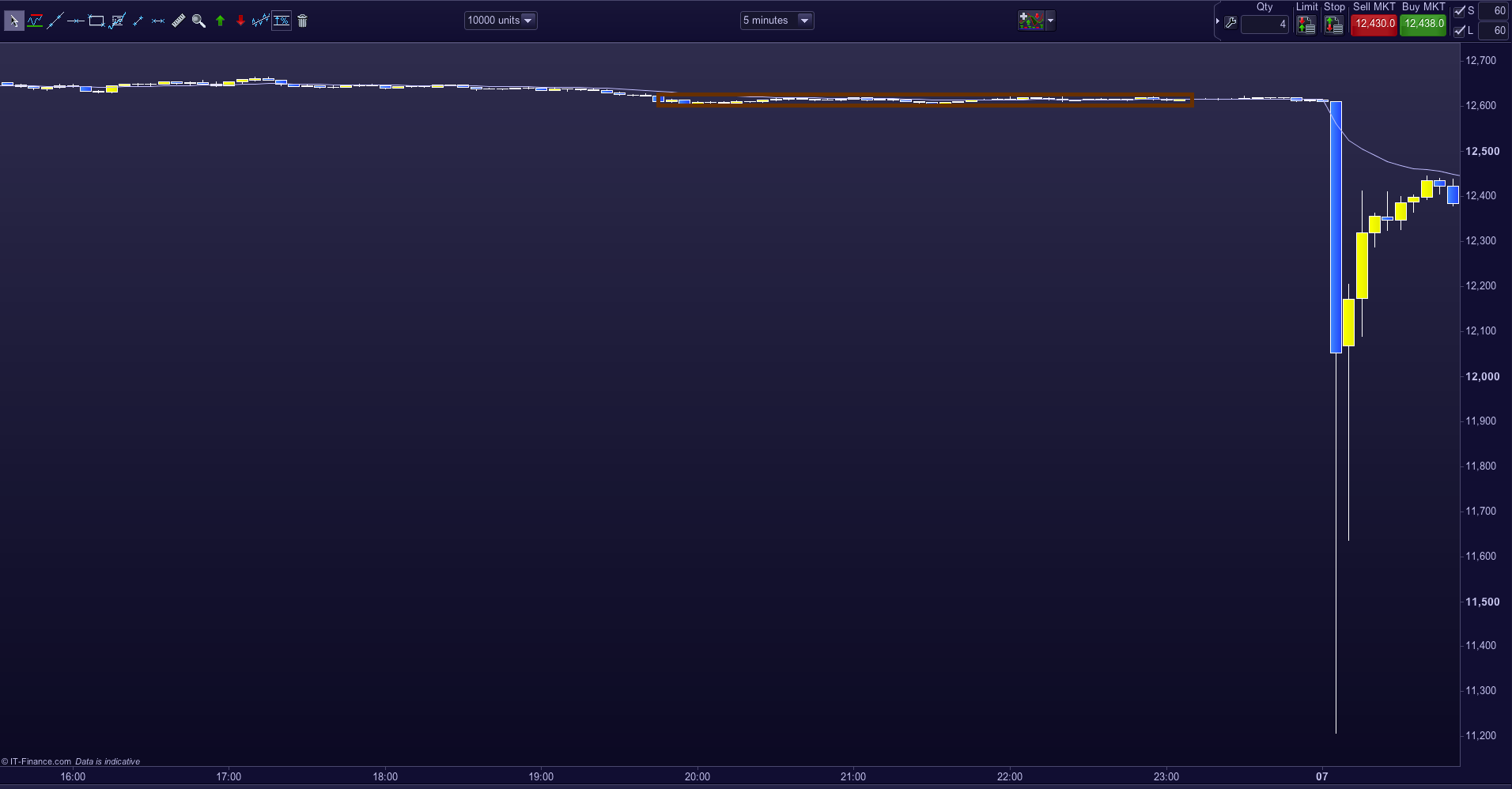
    snip20161008_3

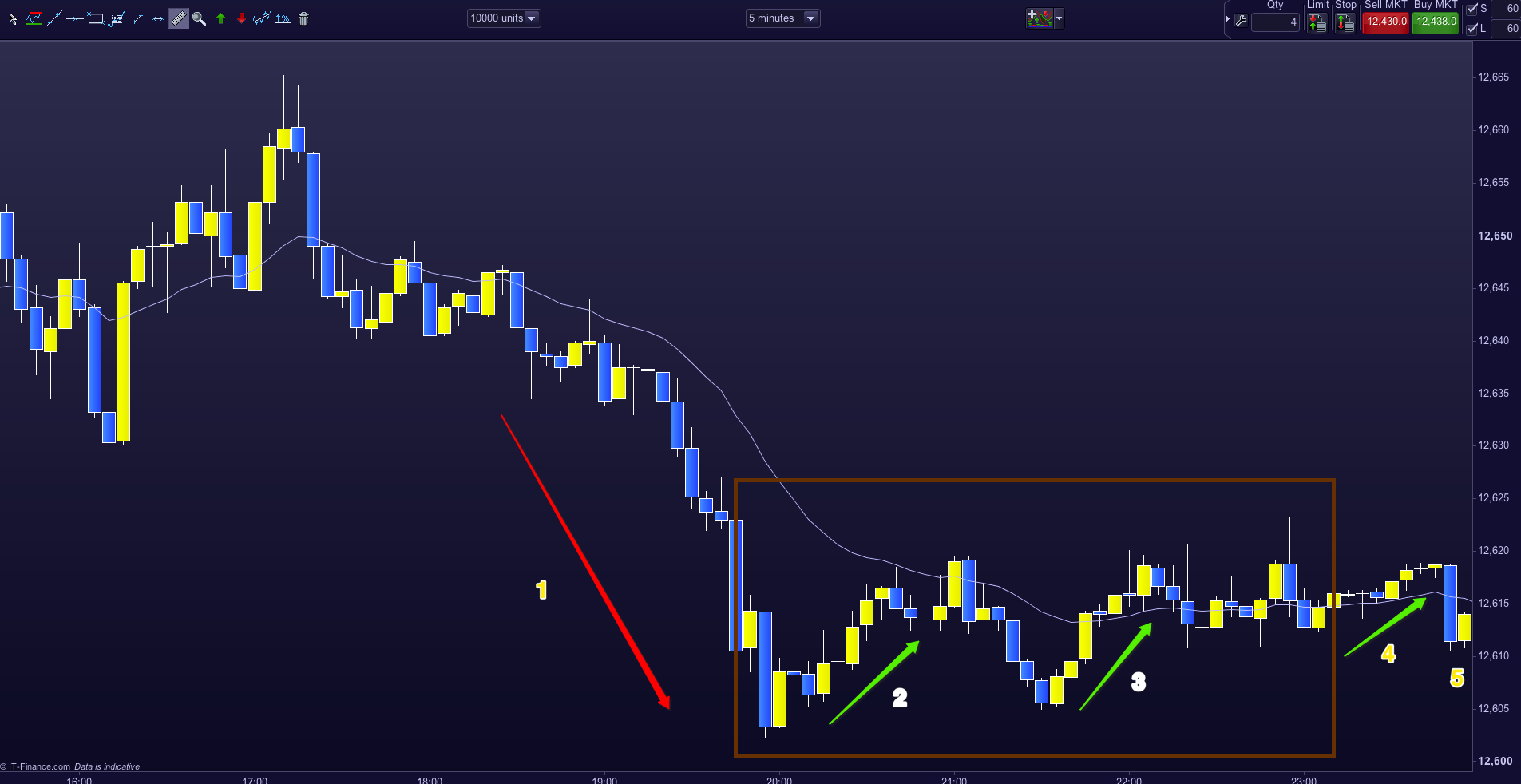
    If a (competent) short-term trader were trading this chart at the time how would the trader have fared? Okay, I think. here’s why:
    snip20161008_4

    The red arrow (1) indicates a clear downtrend and therefore only shorts (price going down) should be considered. Without going into price action talk the green arrows 2, 3 and 4 show that any significant attempt at a pull back is weak. The blue bar (5) is a definite trend bar short, not least of which it closes strongly down and lower than the previous two dozen bars. I would enter short here, or more likely, because of prior price action, before bar 5 formed.

    Ten minutes later price dropped 1,400 pips in 2 minutes. However, it’s all meaningless because if I had traded the drop I’d have made 30 pips (60 pips at the most) as short-term trading is precise and that is where my pre set target would have been.
  • Amount per trade

    A disjointed week of trading. Monday is for back testing, at least for us for the near future. Tuesday was a day of local teacher strikes, so, as I’m considered as not having a ‘proper job’ I’m asked to look after the grand kids. Of course I say yes. Wednesday went well with a full win (I explain full win next). Thursday was not so good with a half loss brought about mainly through poor communication between James and me. We spent the afternoon of Thursday resolving this through back test and practise. Friday was the ‘non farm payroll’ day which comes around every first Friday of every month and which, at present, we don’t trade. The week can be quickly eaten into if we don’t concentrate and dedicate ourselves to the task.

    What do I mean by a full win? This comes from the average size of a market. Normally, we can trade the currency pair GBP USD with between a 20 (near) and a 60 (far) pip stop. (During a non farm Friday up to 240 pip stop may be required).

    We normally have a distant stop of 60 pips and a near stop of 20 pips, and we trade anything in between. We take two concurrent trades per trade entry. The first trade is a scalp (a reward that is at least one times the risk) and the second and concurrent trade which is also a scalp or, wherever possible, converted to a swing (a reward that is at least twice the risk).

    Putting on two trades each time or taking partial profits from a single trade, if your broker allows this, amount to the same thing. Two separate and concurrent trades have advantages but can be difficult to manage.

    Back to our example, the minimum we can trade on the GBP USD is £1 per pip. Therefore, with a stop at 60 pips and two concurrent trades: that’s £60 + £60 = £120 per trade. Each trade must be the same in terms of management and potential loss. With this in mind, a closer trade with a 20 pip stop would require £3 per trade ((20 x £3) + (20 x £3) = £120).

    That is why for GBP USD we have a minimum trade of £120. If our stop is, say, 30 pips or 40 pips then we have to do a quick mental calculation to know how much to trade to retain the same potential, pre agreed, loss per trade.

    Trades for us grow exponentially. As confidence in our trades grows, and if we can retain the ability to trade without the amount on each trade emotionally affecting our decisions, then our trades will build as follows: £120 per trade (£60 + £60 risk), £240 (£120 + £120 risk), £480 (£240 + £240 risk), £960 (£480 + £480 risk) ……and so on and so forth – but then we need to consider spread and the effect this has.

    Each of the above represents a full win. At present we trade £240 (£120 + £120 risk) per trade.

  • ‘slow trader’ moves to day trading

    I am taking our ‘Slow Trader’ hedge fund out of commodities and any medium or longer term trades. We are going fully into day trading and trading a single item – which at the moment is the currency pairing GBP USD.

    (Medium term trading of commodities is an excellent way to trade, but we need to focus 100% of our efforts and, for us, that is day trading).

    It is not possible to day-trade until a trader reaches a certain stage in his or her ability to read and manage in the lower timeframe charts. I think that we are close enough now to this ‘stage’ that we can touch it.

    To believe that it is possible to day-trade the lower charts is like asking some of us (non athletes) to run a 4-minute mile. If we did not know better, because we can watch the olympic games, we would quickly conclude that the 4-minute mile is unachievable; we would probably give up and defend our egos with comments such as ‘it’s not possible’.

    For those that do achieve the 4-minute mile (incredible as that is) they will get nothing from it other than personal satisfaction. That is because all the wins, the glory (the profit) is being able to go a few seconds under 4 minutes.

    In our day trading we feel that we are now achieving the equivalent of the 4-minute mile. We are now day trading where we can almost guarantee a break even at the end of the week. A shout of ‘well, yippee for you’ is justified, but all the work goes into the foundation. To push the running analogy further – once we see ourselves achieving the 4-minute mile, only then can we believe that we can get a few seconds under.

    Why favour day trades over medium term trades? For us it is because day trading is clear and finite. Trades are completed before the end of the day, and certainly not carried over a weekend. You are not waking up to a real shocker. In Andrew Tobias’ (updated) book ‘The only investment guide you’ll ever need’, he explains how he was in a hedge fund that after 5 years increased his fund 4.5 times – soon after 5 years it was at zero. And that is the thing with hedge funds, the unpredictable explosive nature – both up and down.

    My aim is different to this. I want to increase our fund in a regular (almost predictable) way, week on week. The hard work has been done, all we need to do now is manage those extra seconds.

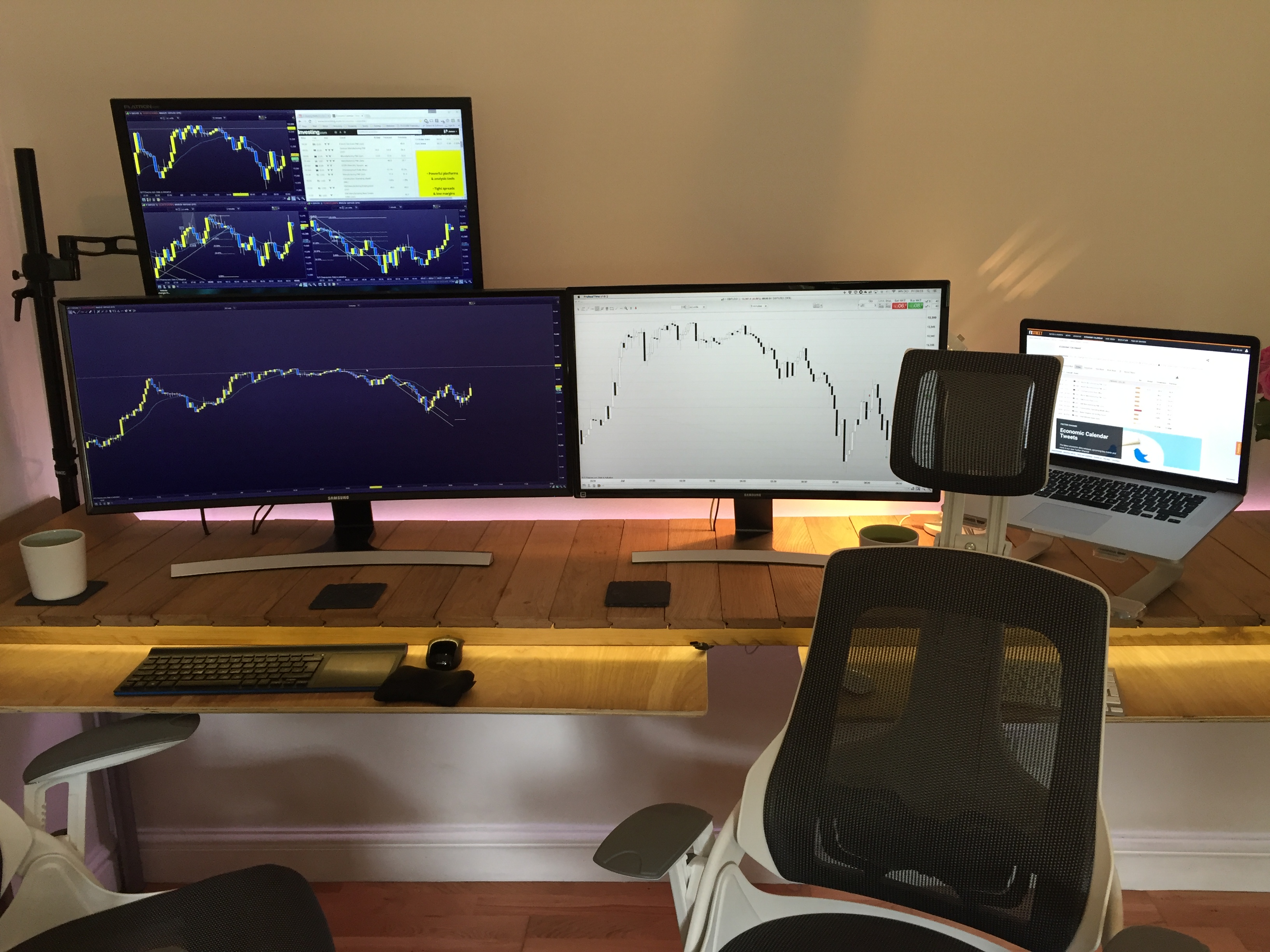
    Our trading desk:

    IMG_1321