No trades cashed-in this week.
We also had no costs against us.
This week we entered Pace PLC and DTE Energy Co, both on a December quarterly trade.
We are mostly short term swing traders: so are our trades taken as DFB (Daily Fund Bets) or quarterly futures trades?
The DFB gives us a tight spread (the difference between the buy and the sell price) but has a daily interest cost. A quarterly futures bet (near, mid or far quarter) has a larger spread the more distant the quarter but carries no interest charge. So which one to take – a DFB or a future quarterly – depends on time. In other words, it depends on the duration we think we will hold the trade.
Currency pairs (FX) can only be traded through a DFB. With shares and stocks, however, we have the option of a DFB, or a quarterly futures trade; I will look to take a mid quarterly trade where possible.
Here is our trade with DTE Energy Co:
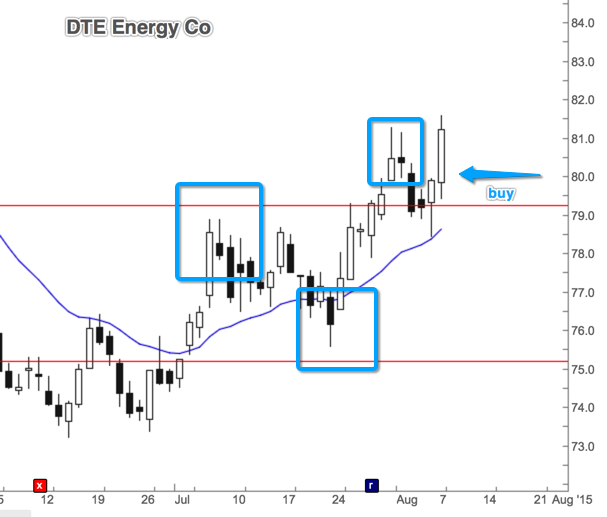
DTE Energy is conventional electricity. Our conditional is simply a consistent ten years of positive earnings per share (EPS) percentage growth. As for recent trend, the stock is trending up which we can see from higher highs and higher lows. The 21 day moving average supports this. Our price, for us in this example, as there are many personal ways of determining price, is the confluence of a support line (a 61.8% fibonacci retracement line to be exact) and the pin bar the day before. We took the trade on limit, which meant the price did come down to a more favourable price before we bought automatically. We have set a target limit at 90.67. That gives us a risk reward of nearly 4 times.
Here is our trade with Pace PLC:
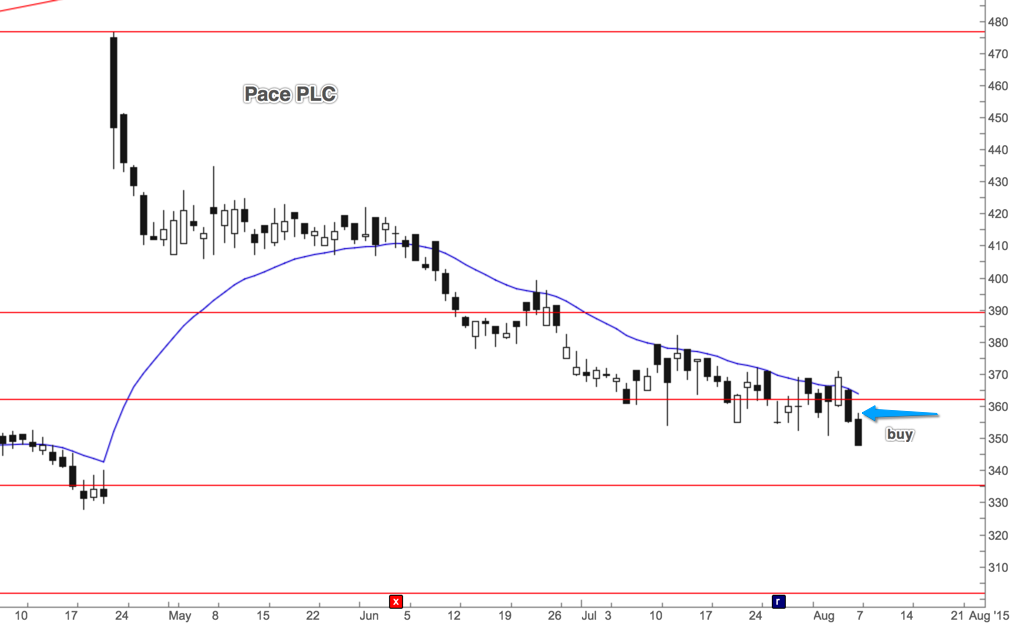
Pace PLC is telecommunications equipment. This trade has gone against us slightly and I’m not happy with my decision to take this trade. Our conditional, again, is ten years of positive EPS percentage growth. However, it is the trend that is our weak link. Over the last 18 months, except for a large gap up, the trend is down. This is made more so with the drop in price yesterday. A closer look at the recent trend confirms this. Our price, a confluence of support level and price action is fine but is secondary to the trend. Also, our price action, being the pin, in hindsight, is black where a white pin would have been preferable. I will tighten our stop to minimise any loss and if we get a rebound I will sell early at, or close to, break-even price.
No buy or short signals in FX this week. FX requires a regular watch so as not to miss the opportunities. By regular I mean a once daily detailed review of daily bars. This can be done, because of the timing of the FX New York close daily bars, at 9pm or 10pm, depending on UK/US time difference; or, as is my preference, early, before 7am, UK time. Then a look every 4 hours where possible, to match the 4-hour bar close times. However, I find that as we get close to a buy or short opportunity the best way is to set an automatic (ambitious) entry.
Particularly looking this coming week for a buy opportunity in GBP/USD.
 Slow Trader