Tag: currency pairings

  • The super tanker of markets

    Can we move the market? Possibly, certain markets. But we want to trade a market that has particularly high liquidity. In other words, the ability to buy and sell an asset easily and quickly.

    We trade major currency pairings for this reason. But how big is the currency pairing that we trade, and can we influence it a bit?

    If we consider the market we trade as the biggest super tanker – the one that is more than four football pitches set end to end – then to move this super tanker the retail trader is as if spitting (horrible habit) at the hull.

    Ah, but now we are a professional trader surely we have more influence at the level we trade. Yes, we do, we now don’t spit too often, we have graduated to a feather duster.

    To move our chosen currency pairing market, (particularly during the period of the Frankfurt, London and New York trade times where several trillion are traded daily) there are probably millions of spitters, many thousand feather duster types and everything in between right up to dozens of tug boats.

    The tugs, in this analogy, represent the financial institutions – banks, pension funds, big hedge funds and the like. A few tugs need to push or pull in the same direction to move the market.

    Our job is to determine, before hand, which way.
  • Trade without bias

    “No data yet!….It is a capital mistake to theorise before you have all the evidence, it biases the judgement.”                            Sherlock Holmes

    We’ve previously touched on an issue that: doctors, engineers, solicitors etc may have when they try to trade – and I was no exception.

    For a long time we have, through professional good habit, been comfortable predicting the way ahead based on our experience, good judgement and assumptions.

    In technical trading, however, such attributes do not help. Having a preconceived idea of what the market will do blinds us to reading the market in the moment. Or, as Arthur Conan Doyle wrote, “it biases the judgement”.

    We have previously considered (from Joshua Foer) that a grand master chess player does not look several moves ahead, as we all assume, but rather is coldly reacting, more or less, to the opposition pieces presented in that moment.

    A form of trading, which I like a lot, is what I call “always in” trading. This is best done on a single market and timeframe. Always-in provides the dual meaning of direction of trade and committing to a trade direction wherever possible.

    Whenever we are confident of an always-in trade direction, then we are to do everything we can to enter the trade.

    In a neutral, or 50/50, event the trader waits. But as soon as the always-in is defined with some probability then the trader enters the trade.

    Okay, there is more to it than that and why ‘always-in’ is a method, I think, for the experienced trader only – but bizarrely all beginners seem to start out with this or a similar methodology.

    To do the same in my previous career, it would be like joining the Red Arrows before completing flying training.


  • Slow Trader Fund, We’re Ready for Action

    Thank you for your patience while I’ve performed a complete overhaul of my short-term trading strategy. Readers will notice the amount of work involved in the ‘how I trade’ page. This has been a great exercise, and one of which I’m confident will be well worth the wait.

    A reason for taking so long is that our strategy, I believe, can only truly be devised under live trading conditions. The way we react to probability trades under live conditions is significantly different to what would otherwise be developed under benign back-testing conditions.

    To that end, I’ve traded and worked on the strategy these last few months with my own account and traded small. The fund has remained in waiting.

    Now I’m at the other end of the strategy development, we will see a gradual build-up to normal fund trade amounts.

    My thoughts on how I see the fund going forward from today:

    Slow Trader allows investors the opportunity to access a short-term trading fund.

    Why an opportunity, and why short-term trading is not possible for most people:

    • Firstly, short-term traded funds are not readily available. Moreover, expert (and hopefully successful) short-term traders charge a lot – up to 50% of profits and large participation fees.
    • Secondly,  short-term trading is a difficult skill to master. It takes several years for a trader to graduate from the ‘beginner’ level, through ‘intermediate’, to ‘expert’. And, expert is where all the capitalised reward is found. In other words, short-term trading, in contradiction to its name, takes a long time to learn.
    • Finally, learning the short-term trading skill is often, through the beginner and intermediate stages, financially penalizing.

    From the 4-hour chart the fund trades:

    1. Nick’s qualifying UK shares – long only.
    2. Currency pairings GBP/USD, EUR/USD, AUD/USD, USD/JPY – long and short.
    3. Commodities Gold and Oil – long and short.

    For each of these I’m looking for an edge:

    1. Nick’s qualifying UK shares already have the fundamentals. And, although fundamentals are normally not a factor for a trade of less than 9-months duration, we nevertheless have them on our side. The principal trading advantages that I use, however, are probability, context and price action.
    2. In our currency pairings we again bring probability, context and price action to the fore.
    3. Commodities also use probability, context and price action but are also traded inline with the COT report.

    The 4-hour chart is used in preference as this provides at least two trading opportunities per day. This means that trades can be open from several hours to several days.

    The page ‘how I trade’ is written with the 5-minute chart in mind but applies equally to the 4-hour chart and is the essence of how I approach probability, context and price action. Nick’s qualifying UK shares are published quarterly through this blog and guidance on the COT will also be given as the COT occasion provides – the COT cycle for each commodity coming round independently a few times a year.

    I provide an annual detailed report on the fund and a semi-annual ‘how goes it’ review.

    The goals of the fund are:

    1. Not to lose money (and this defines our risk level)
    2. Increase the fund by 30% (as a minimum year on year)
    3. Compound the fund year on year
  • A bigger list needs a higher timeframe

    Traded on behalf of friends and family, the ‘slow trader’ fund has taken on a few changes over its time. We have achieved a gain of over 15% a year, reasonable but short of my ambition for the fund. Over 30% a year is acceptable. We had ventured into equities, taken on the commodities and, more recently, we mixed with the currency markets. Yet, what is more important is the system by which we trade. That is the area that has seen the biggest change. And rightly so, these things don’t develop overnight. Therefore it’s not so much the ‘what’ but more about the ‘how’. The how is already in our ‘how we trade’ page. This page gives a glimpse only and is meaningless to anyone that is not a price action trader, and even ‘they’ differ wildly in approach. It is understanding charts through context, set-ups and price action. And it works.

    My own trading time has been delayed over the last 12 months as James and I traded very small for many hours a day learning the ropes of this form of trading. Pop-in a major renovation of our family business and, well no excuses, but time goes. Moreover, I trade three accounts. A small account for grandchildren, a payment account and the slow trader fund. I trade the grand kids account at the beginning of the month until I achieve the return I’m after and then do the same with the payment account. Only then do I move onto the fund. This may or may not leave much of the month left for the fund. This is not making best use of our trading time. Being only so many trading hours in the day.  The best way to provide more trading time for the fund is to trade a higher timeframe. Obvious, but I didn’t want the distraction of this as I was developing and remodeling my price action system.

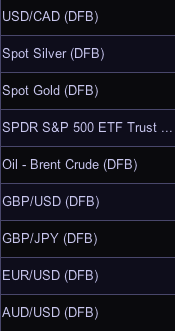
    Currently we trade a 5-minute chart and on one item. This provides several trades a day on average. I scale-in on some of the trades which increases entries but, nonetheless, is essentially within the umbrella of one trade. If we trade the fund on a higher time frame – a daily chart being our most sensible option – then we will need more items to trade. Price action can trade anything. Using daily charts our in-trade duration would be a few days to the extreme of a few weeks. Equities would require the consideration of annual results and other business calendar events. I’m therefore favouring a commodity, S&P and currency trading list. As follows:

    snip20161214_2

    These provide us with enough items to give ample trading opportunities from a daily perspective. More importantly, through this higher chart we are not jostling for trading time with the other accounts. Our risk, probability and reward criteria will not change. I think we are ready for this, and look forward to its introduction at the start of the New Year, 2017.

    Merry Christmas and a happy (which for us means prosperous) New Year