Tag: commitment of traders

  • Trading on news events – good luck on that one.

    We have touched on this term that we have called ‘conditional’ and its importance as a starting point to give us the best chance of making profitable trades.

    Conditional, it can be argued, is what moves markets. It is the foundation upon which we determine which way the trade will go. It beats guessing.

    We all know by now that I favour the COT (commitment of traders) report for my conditional; for information to help the probability of a trade being successful. However, a simple long term or weekly trend is also a good conditional. The conditional is something that gives us an advantage.

    For many (the crowd) the conditional is news events and/or the trading suggestions found in popular trading or investing publications. Good luck on that one. Most trade decisions made by small speculators, the crowd, everyday people like you and me, get it wrong. A contrarian trader, someone who takes the opposite trade to the crowd – if that were the only conditional method available – would be significantly more successful than the crowd.

    The ‘get it wrong’ bit is no better for large speculators. The hedge and fund managers. Indeed, their record is little better than the crowd. The commercials, however, are correct most of the time. Commercials, depending on which categories we are talking about, are the producers or end users of the commodity or futures market. The big money.

    Speaking metaphorically, commercials tell us which way the trade winds might blow. They don’t tell us how hard it will blow. And we are not sure from the commercials whether it will blow next week or next month. But the commercials do tell us that the blow will happen sometime and in what direction it will favour.

    Good enough. All we have to do is be patient and match the commercials, our conditional, with the specific recent trend and buy or short using our chosen price system.
    Snip20150804_10

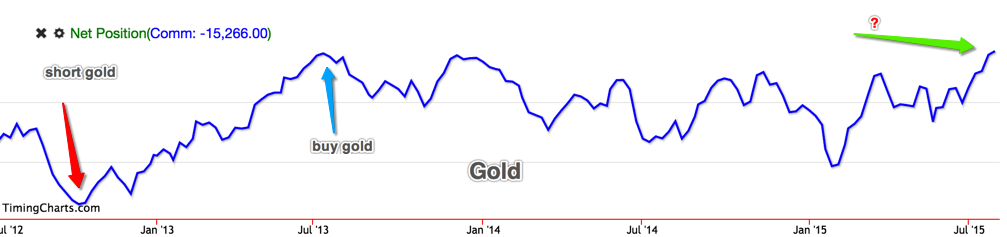
    Here is the past 3-year Gold net position of the Commercials. The October 2012 short position was clearly shown. Notice where we are now, the green arrow. However, its early to buy gold as the recent trend needs to establish. But you probably get the general idea behind it all. The importance of conditional before anything else. Its something that gives us that needed advantage when we trade.
     

  • Slow Trader Diary – week 31

    Here are our cashed-in trades for week 31: Healthcare Partners Inc + £89, GBP/USD + £687

    IG is our broker, costs for the week were – £25.17

    Lets take a look at GBP/USD.

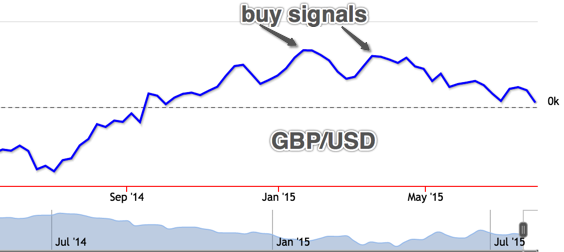
    Conditional: this is a graphed COT (commitment of traders) report giving us a buy condition.

    Snip20150801_2

    This graph represents several months so gives us the condition only, important as that is. From left to right, the first arrow is against the trend. Therefore we would not take that as a positive buy opportunity. However, the second arrow, and second buy indication, is good as it is with the recent trend. The buy condition should remain if the blue line on the chart continues to descend to a new low.

    The COT report is completed for the previous week on the following Tuesday and is published on Friday. It is therefore about two weeks old by the time we get it. However, it is like the oil tanker analogy where you move the rudder but it takes several miles to turn. Often that is the case with the COT. Even though it is old information it gives us a solid hint at the conditional.

    Once we have the conditional we need a matching recent trend. I’ll talk more on the (elusive) trend in follow up blogs.

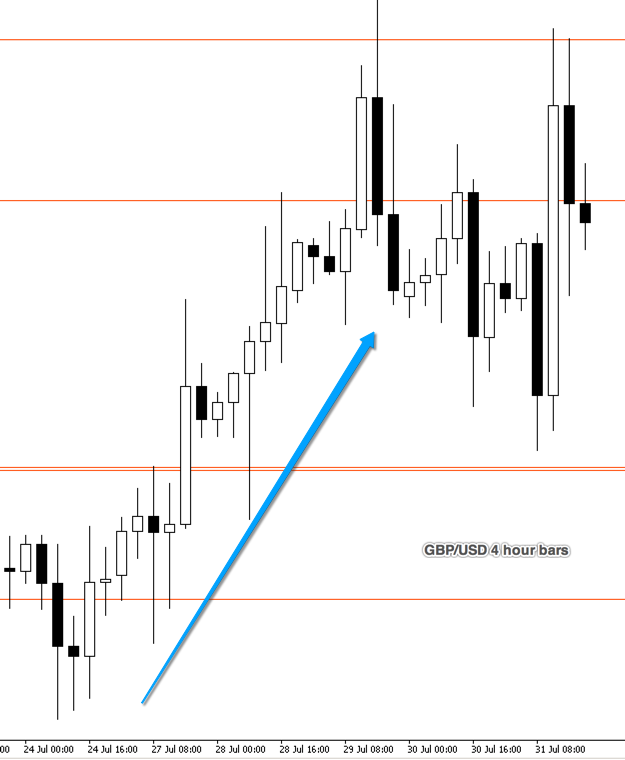
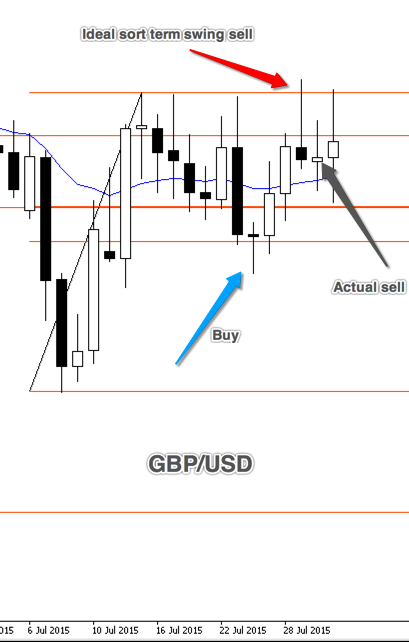
    After trend we concentrate on price – in other words a buy signal. Here is our buy signal for GBP/USD this week. The first graph is in daily bars and the second is the same trade from bottom to top but in 4-hour bars. The second chart gives us a different view as to the dynamic of the trade.

    Snip20150801_3Snip20150801_4

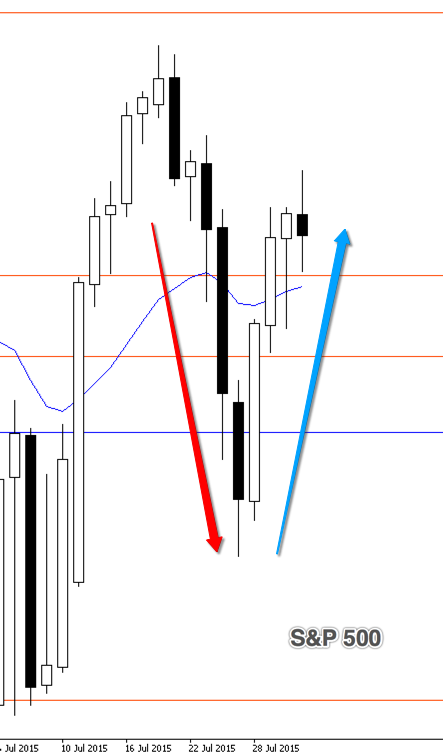
    Moving on. You may have noticed the S&P. Here it is today:

    Snip20150801_7

    Knowing what the S&P is doing is not a trading conditional for individual stocks (or shares in the case of the FTSE). That would be too broad a statement. Interestingly, the movement however of the S&P was more or less mirrored by the stocks on my short list. Even being confident of the future movement of my selected stocks I still missed most of them. ‘How is this possible, B’? I hear you say.

    This is an example of what happened.

    Snip20150801_8

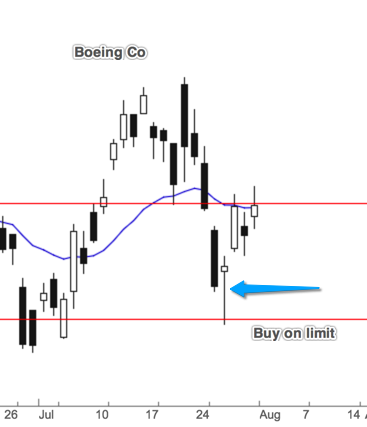
    This is Boeing, We notice by the date that the bottom (blue arrow) coincides with the predicted bottom of the S&P. This pin, at a 50% retrace, is a great buy signal. (Again, we will cover price in more detail in future blogs for those that are interested).

    If we choose to: buy on market, that is buy now at current price – or buy on stop, that is buy at a higher future price – or buy on limit, that is wait and buy at a lower price – is a judgment call. And one, on this occasion, I got wrong. You will notice that the bounce was so hard that after the pin the next days opening price gapped up. Only a buy on market would have worked. I went for buy on limit and missed it. “C’est la vie.”

    This was the same this week for four trades that I set.

    For the coming week we are keeping a sharp eye on gold. The commercials (that is the COT report) are warming up nicely to a buy signal. Beware of the trend however and remember, as well as recent trend, we also need price or more accurately price action. But more on this later.

  • Being conditional helps us win the pub quiz

    With the possible exception of day trading, all trades or investments follow a simple process:

    • Conditional
    • Trend
    • Price

    This applies no matter what my preferred method.

    Conditional is something that gives us a clue as to the probability of something happening in a defined way. In other words, its like taking a sneaky peak at an answer sheet before a pub quiz.

    Conditional can be any number of things. For example, our conditional could be as simple as knowing how popular a product is, or how well somewhere is managed, or we have a particular take on how to calculate a future value of a company, or we might have a particular talent in astrology!

    Whatever it is, we need something conditional to give us an advantage. Without it, with regards to the big picture, we’re guessing.

    I use different conditional guides for different items. For shares and stocks over the shorter term its consistent EPS (earnings per share) percentage growth over the past 10 years. Sounds complicated but is easy to obtain with most trading software.

    For longer term buys its future value, what Benjamin Graham coined Margin of Safety (MOS). I couple the MOS with consistency of growth.  If you’ve seen my early blogs this is difficult to do well. However, you would be daft to trade (invest) long term without it – or something that gives us a similarly advantageous condition. Maybe Nick, the author of the calculations I use, can provide this information on-line in the future.

    Also, a current favourite of mine in the medium term time frame for foreign exchange pairings (FX) and commodities is the COT (commitment of traders) report. A simple chart but one, I have learnt ,through lots of trial and error, that takes many consistent weeks and months to understand properly and use well.

    Ask yourself (or your fund manager) what ‘conditional’ you (fund manager) use. Are you happy with it. Does it work. Or are we guessing?