Tag: Brexit

  • Do we trade the news?

    Finding the right currency pair to trade is key to success. We want steady movement of price but not unpredictability or undue volatility.

    We also don’t want to move between currencies too often because, as a short-term trader, we get familiar with the flow (the news) of the currency.

    We traded GBP/USD up until Brexit and then moved to USD/JPY. Since the recent North Korean influence we moved back to GBP.

    In what detail do we follow the news of a currency? here’s an overview:

    • Since November 2015 the pound (GBP) has depreciated by over 15% against other currencies, mainly because of worries caused by last year’s Brexit referendum.
    • As the cost of imports has risen, inflation has jumped.
    • At the last release, Consumer-price inflation (CPI) was 3%, the joint-highest level since 2012.
    • But inflation may soon be on its way down again.
    • The annual rate of CPI has averaged almost exactly 2%, in line with the bank’s target.
    • Of note, as an open economy with a fairly volatile currency, GBP is prone to short-term spikes in inflation.
    • The effect of the GBP plunge last year will, it is considered by reports, soon fade.
    • Import prices will therefore not continue to rise sharply.
    • There has been a close correlation between movements in sterling and the “core” rate of inflation (a measure which excludes the most volatile components). If that correlation continues, then within a few months, reports suggest, the headline rate of inflation should near 2%, assuming sterling holds steady.
    • But the pound suffers whenever there is bad news about Brexit, and there is a fair chance that the months ahead will contain plenty of that.
    • But for now, at least, inflation looks more likely to fall than to rise much further.

    News is the first consideration on our pre-trade list. For a news release that we consider could provide volatility or unpredictability we are trade ‘flat’ a few minutes before release of the news, and usually much earlier than that.

    We have an awareness of the news and importantly the possible volatility a certain news release can provide.

    But we do not:

    1. second guess the effect of a news release, or
    2. trade with a certain trade direction in mind due to news or fundamental considerations.
  • “We seem to be living in the riskiest moment of our lives”

    Richard Thaler, a behavioural economist, received a Nobel prize. Speaking by phone on Bloomberg TV, he said:

    “We seem to be living in the riskiest moment of our lives, and yet the stock market seems to be napping, I admit to not understanding it.”

    From our fund point of view, we have a couple of lightly traded shares awaiting conclusion, otherwise we are 100% short-term (both long and short) trading of a chosen currency pairing.

    We have traded GBP/JPY, changed to USD/JPY and currently we trade GBP/USD. Another consideration for us is AUD/USD.

    We moved from GBP during Brexit and for the months after.  With regard to price, JPY is consistent, a requirement of our strategy; unexpected volatility is not, therefore the decision, for the time being, to move back to GBP.

    We do not hold overnight, so poor liquidity during this period, and an increased probability in a spike in price, is not a consideration.

    Trading equities can be very different to currencies, specialization is appropriate.

  • Brexit, are we going to trade it?

    Before Brexit here’s gold and silver last week.

    You will recall that we are only looking for short positions in gold and silver. We took profits in both nearly 2-weeks ago and have been looking for an opportunity to take a short since then. Although both gold and silver crept down and tempted everyone to jump on board, this would have been hopefulness.

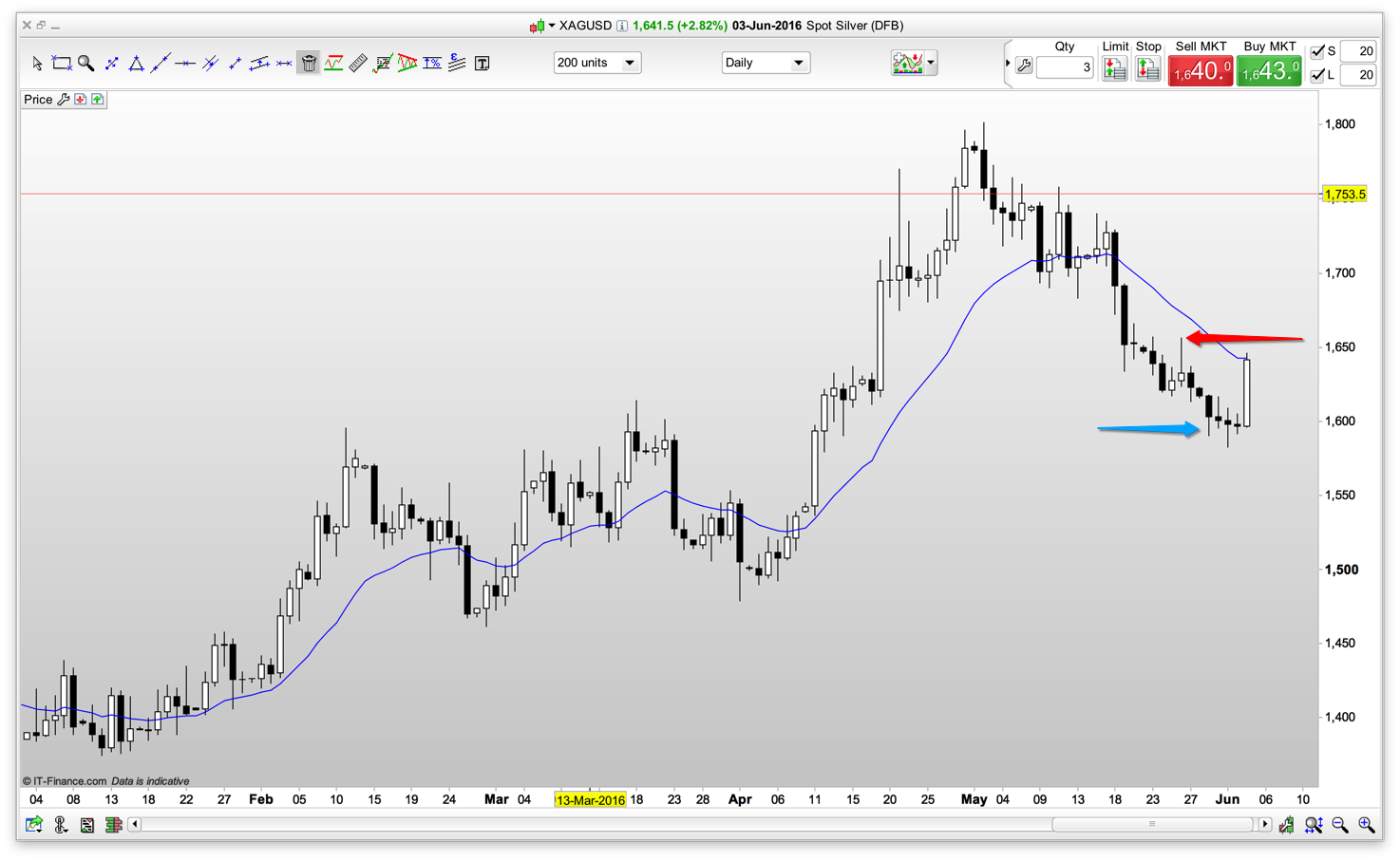
    Here’s silver: silver provided a short signal which I missed, and mentioned last week. That would have given us a profitable move down and exit at the blue arrow. However, without a clear ‘short’ context the danger was always the strong pullback, which happened yesterday, and that is why it was correct to not hold our original short too long. The pull back may just be to the moving average, shown by the blue line, or a move to equal the previous high at 1,800; or, significantly higher with a measured move of the previous leg. We will need more information before acting.

    Snip20160604_1

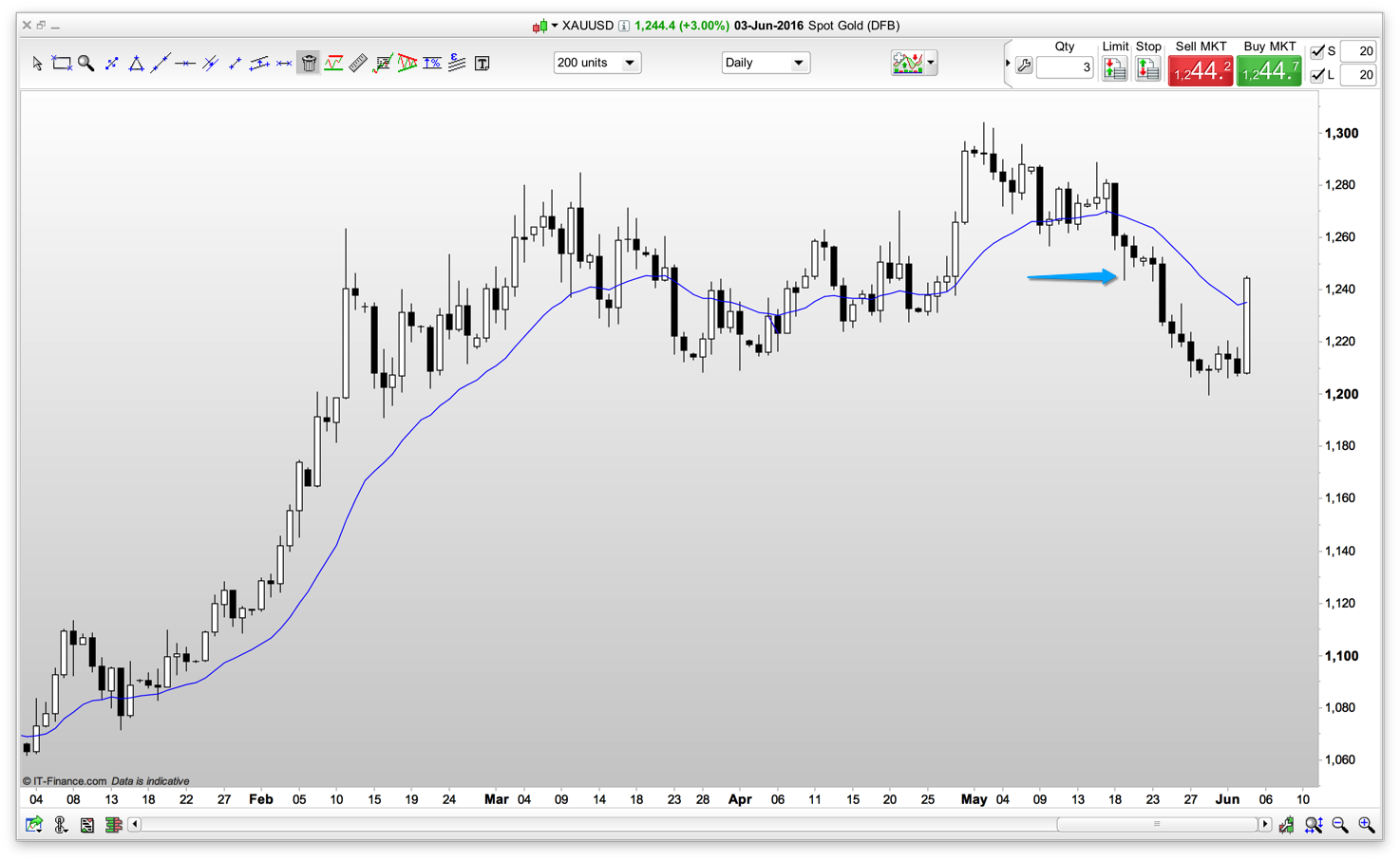
    Gold below shows the short that we exited on 19th May. I was somewhat quick as the second leg down would have doubled our profit. However, the move up yesterday (similar to silver) has brought the price back to our ‘buy back’ position on the 19th. As the climb yesterday has closed above the moving average I’d expect more upwards movement next week before providing a short opportunity.

    Snip20160604_2

    How will Brexit affect our trading? As an aside, one issue we have with trading gold and silver, particularly with a reasonable sized fund, is the size of the average bars (potential movement of price on average over a certain time period) in respect to spread. If you have bought shares in a SIPP before you will know that your broker charges you anything from £5 to £14 per trade. That is why you need to buy a certain amount of shares otherwise your broker’s fee represents too high a percentage against you. The same is true in reverse with spread betting.

    Silver, for example, has a spread of 3 pips. That is, for your buy/sell you will pay 3 pips at whatever price per pip you trade. If you trade £1 per pip, then, from the broker’s perspective, you are charged £3. (Not actually £3, you will notice that your entry line on your chart is 1.5 pips to the negative as will be your eventual exit line – with both together equalling 3 pips). That’s fine at £1 per pip, and actually a good deal. However, you ain’t going to retire soon on £1 per pip in silver. Our fund trades more in the region of £10 to £20 per pip; and that represents a high broker’s fee if the trade goes against us.

    Far more representative of average bar size – when compared to spread, and also compared to the amount we wish to trade – is the currency pairings GBP USD and GBP JPY. The spread on these are about 2 pips and 3 pips respectively (I say ‘about’ because they do fluctuate, particularly in times of high volatility). However, typical corresponding bar sizes of the above currency pairings (GBP JPY being the biggest) are 10 to 20 times bigger than say gold or silver. And that is why we need to move most of our fund trades to the currency pairings.

    That brings me to the initial question, how will Brexit affect our trading? Clearly we all know that it will be a time of high volatility in GBP and anything in association with GBP. To that end, the spread will increase significantly. This will need to be carefully monitored. But spread increase is okay if average bar size increases in unison. Brexit could provide a lot of barbed wire (bars that bounce up and down but close fairly tight and don’t actually go anywhere) or, of course, it could set-up a great trend. My own thought is that it is going to be a bit of both and we need to read the movement well to take advantage. So are we going to trade during Brexit? probably not on the 23rd June, but for the run up – most certainly we are.