Tag: Benjamin Graham

  • Is it time to worry?

    The Economist have an article this week that asks “prices are high across a range of assets. Is it time to worry?”

    Before the 2007-08 financial crash I managed to cash-in everything that would have been exposed to the crash. This, I’m sure, was luck. I was, at the time, financing a business build; fortuitously, I went much further than cashing-in assets required to support the business.

    Some lost up to 50% of their worth during the 2007-08 crash. (I learnt recently, on their son’s visit to the UK, that this had happened to someone who I had known very well and who now resides in Australia.)

    As the Economist alludes, should we be concerned now?

    I spent nearly a year in the development of fundamental formulae based on Benjamin Graham’s ideas. His method principally determined a ‘margin of safety’. As the Economist article explains: “the price paid for a stock or a bond should allow for human error, bad luck or, indeed, many things going wrong at once”.

    In my technical trading, which is the only trading I now do, ‘margin of safety’ is everything: (1) I do not carry a trade overnight and certainly not over a weekend. (2) The risk of each trade does not exceed a maximum. (3) I cannot multi task, so I trade only one thing, watch it in the moment and with awareness of what (news) might affect it.

    Not many have the will, the time or the inclination to do what I do. I understand that. So we use traditional fund managers.

    Graham’s ‘margin of safety’ was buying a share at a 50% discount or better. can we get that deal today? If not, fund managers may become increasingly incautious in their dealings.

    Buffett said this week, as reported by the Economist, “stocks would look cheap in three years’ time if interest rates were one percentage point higher, but not if they were three percentage points higher”.

    In the meantime, for my fund investors, I’m very happy to take ‘margin of safety’ into my own hands.

    P.S. My articles are few and far between currently as I work on a strategy e-book and of course my trading.

  • Buffett, an investing dinosaur?

    I appreciate that we don’t have much time to read a blog, often on a mobile device and while we’re busy concentrating on something else. Meanings are easily misinterpreted. Moreover, true longer term ‘value’ investing is not a popular investment method. We want gratification earlier.

    Someone close to me this weekend considered me wrong with the longer term investing methodology, suggesting that: (1) the market has changed and a five years investment model is long enough, (2) Buffett is an investing dinosaur and (3) proceeded to tell me why Blackberry really failed.

    My initial explanation (blog) must have been poor, so I hope I can provide more clarification.

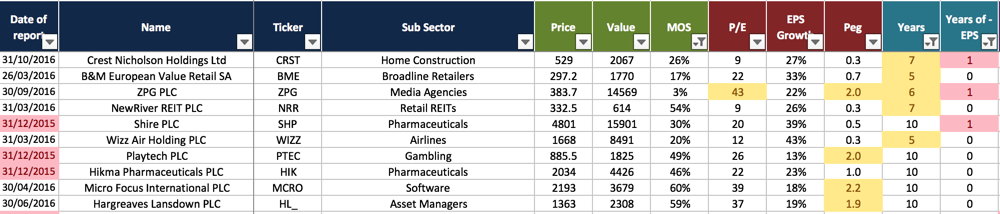
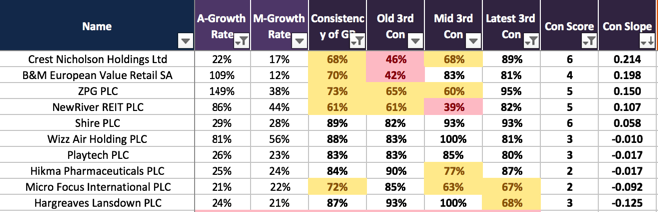
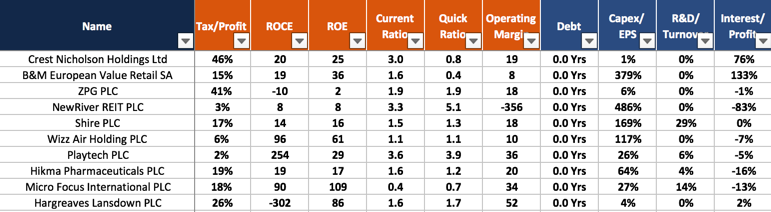
    The numbers that we provided to back up the top ten shares can be confusing. We are looking for companies that ideally have ten years of reports showing no debt, a great consistency in growth and are available at the bargain price of fifty pence on the pound.

    The latter refers to the margin of safety (MOS) that Graham coined. That is the same as being able to go to a BMW garage and purchase a £40,000 car for £20,000. A good deal. That is what the MOS is telling us. What it is not telling us is how good the car is.

    All the many books available on how to calculate the MOS can be obtained and studied closely and it would still be very difficult (and I’m not kidding here) to find a solution for the MOS. That is why what Nick provided us with is a gift.

    Because we don’t know how to work out the MOS, many times we are buying shares at £2 or £3 on the pound. That is like going back to that BMW garage and buying that same car, but now for £80,000 or even £120,000. That sounds like a silly thing to do, but we do it when we buy shares!

    I was wrong to provide a suggested timeframe for longer term shares. It seems that some have latched onto that guidance I gave – when really it’s an individual interpretation of what is longer. My suggestion allowed for a purchase at any point in the market cycle. But I don’t know, and nor does the buyer probably, at what point in a market cycle they are at time of purchase.

    As for Buffett being an investing dinosaur, the methodology comes from Graham, and he was the generation before Buffett. But in any case, it’s nothing to do with either of them really. Buying something for fifty cents on the dollar is as good a market trading philosophy today as it was in Babylonian times.

    As for Blackberry, this was given as an example only of what to watch out for. Kodak is another. It doesn’t matter here about these companies. I was merely trying to say that such companies can show up on Nick’s list but are about to crash. That is why Nick has provided the 1st, 2nd and 3rd periods of measured consistency to help us spot such companies. And for those who think it’s easy to see such companies coming, sure it is after the fact, but most of the brightest analysts in the world didn’t at the time.

    Market cycle is worth a further mention here. I’m not a doom and gloom thinking guy, quite the opposite actually. Benjamin Graham gave up at one point because he couldn’t find companies that provided value, a MOS. This was prior to the great depression. From 350 companies we would expect to find about 10% with a qualifying MOS. On the last run 3% qualified, and some of those are questionable as they don’t have the 10 years of reports.

    I don’t recall any of my chart analysis providing a ‘buy me now signal’ either. Moreover, once the daily press has front page news telling us it’s a great time to buy – well, you know what I think about that.

    With 5-minute bar charts I deal with a major trend reversal a few times a week. With such a chart it would not be possible without the X/Y values showing to tell the difference between this and, say, the 2008 market crash on a weekly chart. So the short-term trader gets a lot of experience with market reversals.

    More often than not, a beginner trader will trade a reversal too early (this is the case for both short and long-term trading/investing). Only to be stopped out at a higher price – in the case of a bull reversal – and watch from the sidelines as the market eventually drops. On a 5-minute chart such a reversal can take hours, on a weekly or monthly chart it is years – or at the very least many months.

    As a final thought, value investing, or the interpretation of fundamentals, is not generally considered a suitable methodology for mid-term investing. There are alternatives. For example: taking advantage of IPOs, share splits or runaway news, events, fads and fashions. I particularly like the interpretation of the COT report with commodities for mid-term investment.

    I hope this helps.
  • Top ten companies that are selling at a discount – FTSE 350

    On the previous blog, also dated 25th February 2017, Nick has provided the list of companies from the FTSE 350 that made the grade for our long-term investment.

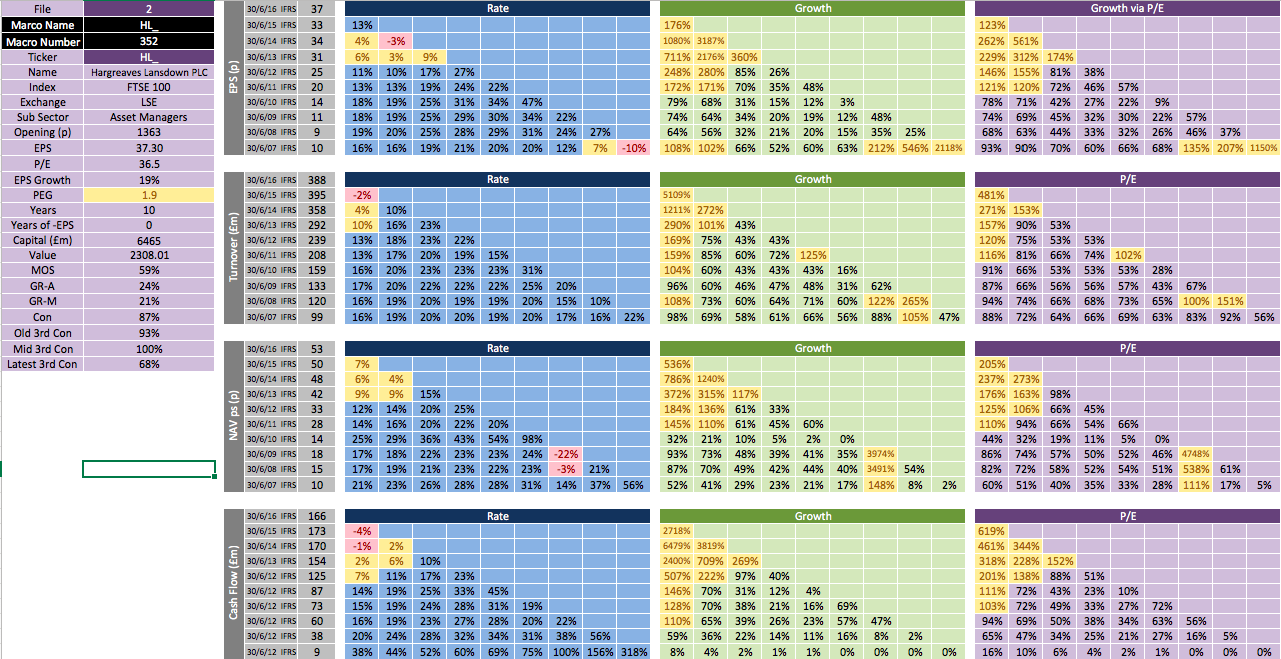
    The spreadsheet was the cumulation of focused effort by Nick and me over a 9-month period a few years back. Nick, spent, subsequently, a considerable amount of time improving the calculation.

    Here’s an example of the back sheet of information that is taken for up to 10 years of figures for each company in the FTSE 350 – and this does not show the mind numbing calculations that are used within each of these boxes.

    screenshot-2017-02-24-11-15-36

    We must emphasise that this is meant for longer term investment. The principles of which use many ideas from the great investors, but primarily that of Benjamin Graham and Warren Buffett – and, if you know these investors, we are talking longer term.

    Nick has only provided FTSE 350 as the information is aimed at UK ISA or SIPP investors.

    Here is a synopsis of the filters of the principal figures used: “and, we have to say, principal figures that cannot be found anywhere else” 

    Margin of Safety: price is less than 60% of value

    Age: more than 4-years trading with less than 2-years of negative earnings

    Growth: a growth rate greater than 10% to ensure a reasonable rate of return

    Consistency: 10% growth rate in all variables – consistency score greater than 60%

    (Blackberry conundrum: consistency of growth improves over time)

    You will notice, in the more detailed sheets below, that annual report dates can be over 12 months old. That is because of the release time of annual report information. Although we are long-term investors with this information, Nick will run the calculations every few months to capture annual result information reasonably early.

    Here is the more detailed, and most up to date annual report information, on each of our companies that made the cut:

    snip20170225_2

    snip20170225_4

    snip20170225_5

    Finally, anyone using this information to invest we must, of course, point you to our disclaimer page. Also, it is important that individuals do their own due diligence. It is important that, as investors, we understand the company we are investing into. The information above is detailed but we must determine for ourselves if we think a company has legs for the longer term.

  • Long-term buys

    For those that can save for 20 to 30 years consider this pension idea. Based around a UK ISA and investing in companies within the FTSE 350.

    It’s an idea developed around Benjamin Graham’s (Warren Buffett’s mentor) principles of intrinsic value.

    We take 10-years of annual results and determine key numbers of consistency of growth, growth rate and present value as a percentage of value projected: i.e. is our chosen company a bargain?

    Here’s a snapshot of some figures a few years back.

    snip20170107_1

    This analysis is for the long view. The figures are a vital starting point but does not take into consideration the longevity of the company nor the ability of those managing the company.

    That is why we should only invest in companies that we understand, or are prepared to do the work to understand. For example, Blackberry scored highly on the above figures, right up until it fell off a ‘technological’ cliff.

    That means, even with the figures, it is important that we do our due diligence and are happy that a company has legs.

    Similarly, and often subjective, motivation and reimbursement of the individuals responsible for driving a company forward helps our decision to buy.

    But having said that, thanks to Nick, the hard stuff, the figures, will be provided here soon.

    We also intend to provide a ‘price action’ analysis from long-term charts to help with buy decisions.

    Finally, those looking for a home for a stocks & shares ISA we thought that Charles Stanley Direct came out well. Their charges are some of the lowest and all seems clear and easy to follow. Unlike many ISA providers we found.

  • Being conditional helps us win the pub quiz

    With the possible exception of day trading, all trades or investments follow a simple process:

    • Conditional
    • Trend
    • Price

    This applies no matter what my preferred method.

    Conditional is something that gives us a clue as to the probability of something happening in a defined way. In other words, its like taking a sneaky peak at an answer sheet before a pub quiz.

    Conditional can be any number of things. For example, our conditional could be as simple as knowing how popular a product is, or how well somewhere is managed, or we have a particular take on how to calculate a future value of a company, or we might have a particular talent in astrology!

    Whatever it is, we need something conditional to give us an advantage. Without it, with regards to the big picture, we’re guessing.

    I use different conditional guides for different items. For shares and stocks over the shorter term its consistent EPS (earnings per share) percentage growth over the past 10 years. Sounds complicated but is easy to obtain with most trading software.

    For longer term buys its future value, what Benjamin Graham coined Margin of Safety (MOS). I couple the MOS with consistency of growth.  If you’ve seen my early blogs this is difficult to do well. However, you would be daft to trade (invest) long term without it – or something that gives us a similarly advantageous condition. Maybe Nick, the author of the calculations I use, can provide this information on-line in the future.

    Also, a current favourite of mine in the medium term time frame for foreign exchange pairings (FX) and commodities is the COT (commitment of traders) report. A simple chart but one, I have learnt ,through lots of trial and error, that takes many consistent weeks and months to understand properly and use well.

    Ask yourself (or your fund manager) what ‘conditional’ you (fund manager) use. Are you happy with it. Does it work. Or are we guessing?