Tag: An edge

  • Slow Trader Fund

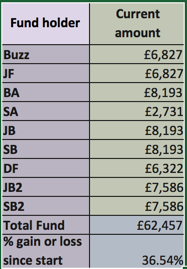
    Our Slow Trader fund has sat on the fence for a few months waiting for me. Not being a boom and bust trader, I have traded small whilst developing our ‘probability trading’ technique.

    A level of profitability through consistency has to be achieved before increasing trade size. The technique provides that, now it is up to me.

    It may seem a bit odd that I’ve moved away from trading a market, US stocks, that has increased this year as an index 20 percent or so. UK shares not so much at 6 or 8 percent as an index.

    To day-trade profitably I need to give it (day trading) all my attention. Having trades open in other areas and time frames were definitely a distraction for me.

    Why have I chosen day trading despite the many stories that tell us not to trade this way? Bizarrely, it is control. As a ‘probability’ trader, we accept that we are trading a market that is random. In other words, we accept that anything can happen.

    If we except that anything can happen, then we accept the risk. We accept that the market is only about a price that can go either up or down. In ‘probability trading’ we also accept that certain effects happen when lots of traders trade. Things happen that can give an observant trader an edge.

    Despite the simplicity described, it has taken me a couple of years to combine price action trading and money management, specific entry and exit techniques, and group it all together, test it exhaustively and call it probability trading.

    Fund contributors that think the share market, and particularly the US stock market, are to continue climbing throughout 2018 ought to withdraw their funds from Slow Trader and head that way.

    After all, that is the market, with you, that Slow Trader originally entered.

    If you stay in the Slow Trader fund, and to do so you don’t need to do anything else, you become part of a probability day-trader fund. Our advantage: we are not concerned about a good or a bad year for stocks and shares; we trade a currency pairing in the short-term, with an edge; with (to quote Mark Douglas) rigid rules and flexible expectations.

    We have developed a day trading strategy that allows us to take money consistently – day in, day out.  We scale-up though when we’re ready.
  • Trading methods that suit

    A serious trader or investor has to use a method that they understand and that gives them an advantage, an edge – no matter how small.

    That method, or way of trading, has to suit the traders personality. The method could be fast-moving, lower time frame, or slow-moving, higher timeframe. Or a combination of both.

    Emotionally, the method has to suit too. For example, most traders are comfortable trading relatively large positions on slower moving, higher time frame trades such as daily, weekly or monthly charts; however, are less objective with such trades on lower time frame situations such as intraday (day-trading) opportunities.

    Once we sort our emotional tolerance we then need to consider our ability to manage such trades. Do we have the time and the skills necessary to trade lower time frame situations. This is where a trade entry and exit on say a ‘swing’ trade can play out in 10 chart bars or less – which on a 2-minute chart is 20 minutes. The same trade using a daily chart would take some 2 weeks.

    I use three clear trading methods with clear time frames. I feel that in each of the methods I have a small edge, and that is vital. The methods are:

    1. 30-year investing using detailed fundamental analysis of company figures. I’m primarily looking here at finding a company that is selling at half price or less and one that has been consistently excellent for many years (usually 10 years). The company, importantly, needs to be a company that will still be here, and profitable, in 30 years. The calculations took Nick and me over 9-months to develop.
    2. I trade gold, silver, copper, crude oil, treasury bonds and USD/CAD both long and short, and only trade on very specific signals. Each trade is held for several weeks. This is where I mainly trade the Slow Trader fund. The strategy here is sound, tested and profitable.
    3. Intraday trading of any stock, commodity, index or FX that suits – my favourite is GBP/USD. Skilfully, managerially and emotionally intraday trades are the most difficult. Intra day is also immensely time-consuming and takes many years to become consistently profitable.

    You will notice that each method avoids the market crash timeframe of 5 to 15 years. Where most investment and pension portfolios are positioned. Yes, the 30-year method will go through a few crashes during its investment period, but over 30 years the crashes simply provide a ‘dollar-cost-averaging’ opportunity to invest more. The only important crash in the 30-year method that is of concern is the last one. I appreciate that as its 30-years it may not be me making this decision!