Category: Short-term trading

  • Margin, a big deal?

    Margin, or deposit requirement, in financial trading, is the good faith amount that we need in our trade account to cover a deal. The margin is not a loan, but rather a means to cover a loss.

    If we wanted to purchase a stock or share from a traditional broker, and the value of that purchase is £5,000, then we’d need £5,000 available in our account to complete the deal.

    A financial spread bet, or derivative based account, is a leveraged account and only a ‘margin’ of the full-trade amount is needed.

    Take Sterling versus the dollar for example, a trade of £5 per pip, at the current value of this market, without a leveraged account, would cost £67,500.

    However, we are only required to cover the broker’s margin.

    (A margin rate of: 0.5% to 1.5% is common in FOREX and 5% in stocks and shares; but each of these can vary significantly if a market becomes non-liquid or volatile)

    A margin rate of say 1% would require an account to hold £675 for the £5 per pip example.

    £5 x 13500 x 1% = £675 margin (This is a non-stop calculation, a with-stop calculation reduces the amount)

    If the trade goes against us, however, the margin requirement increases. Therefore, a good amount more than £675 is required to comfortably cover the trade.

    It is easy to see how novice traders could get into financial trouble if they lose sight of the overall risk of such trades.

    Probably why margin rates are on the increase to retail traders.

  • The Long, the Medium and the Short

    There are many different views, for lots of good reasons, as to what defines a trade period. But let’s try this:

    Day trading, as the word suggests, is a trade that is entered and exited within the same day. Mostly this will be technical trading, but could be news or event based.

    Short-term trading is again primarily technical; but could include fundamental, news and event based criteria. Usually one day out to several months.

    Medium term could be 9 months (as defined by Peter Lynch as the period beyond which fundamental information provides all the influence) out to several years.

    Between medium term and long-term we see a gap. A sort of no man’s (or women’s) land.

    A large correction, substantial pull-back or crash (call it what you will) happens between 7 and 15 years. Historically not before 7 years, but could be more than 15 years.

    So, lets take 15 years as a guide. For our ‘long term’ investments to survive, to grow, they may have to outlast a couple of crashes. That takes the longer term to 30 years, or thereabouts, depending on the date of purchase of the investment relative to a previous crash.

    It makes sense therefore that investment money that is needed for a pension ought not to be invested over the medium term some 7 to 15 years from a previous crash.

    2008 was our last crash, so between 2015 and 2023, or until the next one, it might be prudent to only invest short-term or longer term.

    And, we would say long-term only with excellent value equities probably purchased prior to 2015.

  • The super tanker of markets

    Can we move the market? Possibly, certain markets. But we want to trade a market that has particularly high liquidity. In other words, the ability to buy and sell an asset easily and quickly.

    We trade major currency pairings for this reason. But how big is the currency pairing that we trade, and can we influence it a bit?

    If we consider the market we trade as the biggest super tanker – the one that is more than four football pitches set end to end – then to move this super tanker the retail trader is as if spitting (horrible habit) at the hull.

    Ah, but now we are a professional trader surely we have more influence at the level we trade. Yes, we do, we now don’t spit too often, we have graduated to a feather duster.

    To move our chosen currency pairing market, (particularly during the period of the Frankfurt, London and New York trade times where several trillion are traded daily) there are probably millions of spitters, many thousand feather duster types and everything in between right up to dozens of tug boats.

    The tugs, in this analogy, represent the financial institutions – banks, pension funds, big hedge funds and the like. A few tugs need to push or pull in the same direction to move the market.

    Our job is to determine, before hand, which way.

  • Margin to increase for retail traders

    We have been awarded professional client status by our brokerage.

    To be classified as a professional client the qualification is 2 out of the following 3 statements below:

    1. Carried out CFD, spread betting or forex, in signicant size, at an average frequency of 10 per quarter over the previous four quarters
    2. An investment portfolio (including cash deposits and financial instruments) exceeding €500,000
    3. Work or have worked in the financial sector for at least one year in a professional position, which requires knowledge of CFDs, spread betting or forex

    Why is professional client status a big deal? Because margin requirements will increase substantially for ‘retail traders’; for professional clients they will not.

    What is ‘margin’?

    • It is a good faith deposit that a trader puts up for collateral to hold open a position.
    • It is not a transaction cost, but a portion of our account equity set aside and allocated as a margin deposit.
    • When trading with margin the amount of margin needed to hold open a position is determined by trade size. As trade size increases, margin requirement increases.

    This has no effect, however, on our usual spread payment: which we consider as a true identification of a retail trader. If we pay a standard spread then by definition we are retail traders.

    Institutional proprietary traders (or ‘prop’ traders as they are known) trade the firms money (not clients money) and often at a reduced spread cost, or no cost at all. They are, to our mind, non-retail traders.

    But to be considered a professional client, and thereby maintain a desirable margin commitment, is great.

  • Do we trade the news?

    Finding the right currency pair to trade is key to success. We want steady movement of price but not unpredictability or undue volatility.

    We also don’t want to move between currencies too often because, as a short-term trader, we get familiar with the flow (the news) of the currency.

    We traded GBP/USD up until Brexit and then moved to USD/JPY. Since the recent North Korean influence we moved back to GBP.

    In what detail do we follow the news of a currency? here’s an overview:

    • Since November 2015 the pound (GBP) has depreciated by over 15% against other currencies, mainly because of worries caused by last year’s Brexit referendum.
    • As the cost of imports has risen, inflation has jumped.
    • At the last release, Consumer-price inflation (CPI) was 3%, the joint-highest level since 2012.
    • But inflation may soon be on its way down again.
    • The annual rate of CPI has averaged almost exactly 2%, in line with the bank’s target.
    • Of note, as an open economy with a fairly volatile currency, GBP is prone to short-term spikes in inflation.
    • The effect of the GBP plunge last year will, it is considered by reports, soon fade.
    • Import prices will therefore not continue to rise sharply.
    • There has been a close correlation between movements in sterling and the “core” rate of inflation (a measure which excludes the most volatile components). If that correlation continues, then within a few months, reports suggest, the headline rate of inflation should near 2%, assuming sterling holds steady.
    • But the pound suffers whenever there is bad news about Brexit, and there is a fair chance that the months ahead will contain plenty of that.
    • But for now, at least, inflation looks more likely to fall than to rise much further.

    News is the first consideration on our pre-trade list. For a news release that we consider could provide volatility or unpredictability we are trade ‘flat’ a few minutes before release of the news, and usually much earlier than that.

    We have an awareness of the news and importantly the possible volatility a certain news release can provide.

    But we do not:

    1. second guess the effect of a news release, or
    2. trade with a certain trade direction in mind due to news or fundamental considerations.
  • “We seem to be living in the riskiest moment of our lives”

    Richard Thaler, a behavioural economist, received a Nobel prize. Speaking by phone on Bloomberg TV, he said:

    “We seem to be living in the riskiest moment of our lives, and yet the stock market seems to be napping, I admit to not understanding it.”

    From our fund point of view, we have a couple of lightly traded shares awaiting conclusion, otherwise we are 100% short-term (both long and short) trading of a chosen currency pairing.

    We have traded GBP/JPY, changed to USD/JPY and currently we trade GBP/USD. Another consideration for us is AUD/USD.

    We moved from GBP during Brexit and for the months after.  With regard to price, JPY is consistent, a requirement of our strategy; unexpected volatility is not, therefore the decision, for the time being, to move back to GBP.

    We do not hold overnight, so poor liquidity during this period, and an increased probability in a spike in price, is not a consideration.

    Trading equities can be very different to currencies, specialization is appropriate.

  • The twenty minuters

    … “Why are you called the Twenty Minuters”? Was Captain Darling’s question to Lord Flashheart in a Blackadder series.

    Major Bill March, a historian with the Royal Canadian Air Force, is quoted as saying of the early pilots “they used to call themselves the 20-Minute Club because the life expectancy of a new pilot in combat in 1916-17 was 20 minutes.”

    I understand that in the early part of the war pilots were being sent into combat with less that 9 hours flying time – basically, they knew how to take-off. But of course, we all know that there is a lot more to it than that, being able to land is probably optimistic, but useful if the need presented itself.

    In financial trading, many strategies in price action trading are sold through seminar attendance, or online packages. But we are sold the equivalent of the take-off lesson only.

    And actually that is fine. To know how to apply such things as a morning star pattern (and its many siblings), maybe throw in a good understanding of trend (much more difficult than it sounds), the use of the important support and resistance including pivot points, round numbers, possibly fibonacci levels and moving averages, then we are ready for trading action.

    But only in none intra-day trades. Meaning daily or weekly bars only. If we stay with that we have a chance…sort off.

    The problem is that we encourage ourselves, and possibly by the seminar or online package, to dive into the intraday bars, the ‘exciting’ day-trading stuff.

    This, however, is very wrong. At this stage we are not (and maybe never will be) equipped to deal with lower time frame trades. We may get away with the 4-hour bar chart and, at a pinch, the 1-hour, but moving lower with the relatively limited knowledge and experience we have gained we risk joining the traders equivalent of the twenty minuters.

    I trade the lower charts and I wish someone had told me this those many years ago, it would have saved me a lot of money and frustration. There is an easier way than the one I chose: simply never come below reading daily bars (New York close, of course) until we’re ready.

    In financial trading we want to be like this chap, he looks like he knows how to land!

  • A chart mix

    My mother missed her step coming off a pavement and fell and broke her hip. She is doing remarkably well and I look forward next week to getting back to my trading, I’m a couple of weeks behind.

    Trading GBP/JPY on the 5 minute charts works well for me. I like the size of this market and on many days GBP/JPY can be quite defined. Anyone familiar with EUR/USD or even GBP/USD will find GBP/JPY quite lively.

    Many that trade major pairings will not take the spread into consideration, a mistake I think, but not a big one. Particularly if they trade from 15 minute charts or higher. GBP/JPY however, on a lower time frame, teaches us the necessity to consider the spread. To do otherwise, and be consistently profitable, is more difficult – I think.

    To make the best of both possibilities I’m happy with my results of concurrently trading GBP/JPY on the 5 minutes chart (as the priority chart) with a watch on USD/CAD, Gold and EUR/USD – each of which are on the 15 minute chart. I tried many possibilities but these choices give me good opportunity, diversity, liquidity and a spread value that I prefer.

    For example, GBP/JPY does not work with GBP/USD as both react almost in unison. Moreover, oil is often a mirror image of USD/CAD: so to trade one would have too much influence on the other. I do find that Gold and EUR/USD often have similar movements and on such days I consider a swap to AUD/USD or (and I’m in the early stages of this) the US 500 SPTRD.

    Other FX pairings, and particularly exotics, are not considerations for me. Primarily due to spread but also we are dealing with randomness and probability, and we don’t need big uncertainty too. As already mentioned, I’ve looked carefully at the US 500 SPTRD and this is a possibility on the 15 minute chart with good liquidity once the US market has opened.

    To trade the fund on the 4-hour charts is not possible (for me anyway) with already four intraday charts to manage. If my results are what I know they can be (and so far so good) over the next few weeks I will consider how to join the slow trader fund within this – more intensive – methodology.

  • The stabilisers have to come off, eventually

    Who takes up retail financial market trading? I initially imagined that it would be young adults, the ones we see on the sports betting adverts, but I was wrong. It’s primarily professional people: engineers, doctors, dentists, lawyers and well-to-do retirees. But unlike our usual work, we struggle to be successful at financial trading.

    Because, unlike our usual work, we are now dealing with uncertainty; and in this world, because we don’t understand the future, it is not possible to work rationally. To overcome this we look at the future by naive projection of the past.  We are now in a world where 60% certainty (if we’re very good) is as good as it gets. We therefore look to a method and indicators to help make what is irrational seem more rational.

    That brings me onto the decision of how to trade. The ‘how to’ question is probably one of the most difficult and important decisions a financial trader makes. However, as with choosing a career when we’re young, we do not have the experience to be sure we are making the right choice. Therefore, we are overly influenced by those around us.

    In trading we tend to go with the method that we learnt from the first seminar we attend. We try that to the point of financial exhaustion and either quit, or if we’re particularly determined, we will venture to try another seminar and another method. And so the cycle continues until we achieve expert or get lost in the ‘dip’ somewhere.

    With a little thought it does not need to be so difficult. We first need to find the broad category of trading method that suits us. If we stay away from the ‘get rich quick’ merchants (those advertising the secret or ‘the one thing’) then there are a lot of excellent tutors available.

    We do need to find that broad category first however: no point in learning chess when what we really enjoy is the simpler pace of draughts (checkers). Once we have that broad method that we determine is the one for us, we can then go to work on the finer detail.

    It took me a long time to find ‘price action’ as my prefered trading method. I notice also, looking through the internet, at great beginner introductions to price action that are available. Many however provide confluence ideas of price action with indicators: moving averages, Fibonacci retracement, stochastic overbought and oversold to mention a few.

    That’s fine, we all start with all of these; they’re supports and we feel, and were told, we would be foolish to attempt to trade without them. However, price action is much more than this (or I should say much less because with true price action indicators are a distraction at best). Once price action is learnt we can deal very well with the irrationality of it all and we can strip away the supports. After all, even Bradley Wiggins, probably earlier than most, had to take the stabilisers off at some point.

  • Reward/risk has to be right

    Rather embarrassingly on my part, I discovered something simple but fundamentally wrong with my trading. I made the adjustment today, and amended the ‘algo to trade by’ page. Even a tweak, if it is a fundamental tweak, can make a profound difference.

    As in many things, but I feel particularly in trading, I cannot be so keen on my backtest work that I’m not prepared to take a fresh look once I’m in the trading room for real. As Yogi Berra said, “in theory there is no difference between theory and practise; in practise there is.”

    My foundation is my reward/risk, or what is referred to as R. To achieve a planned 2R (actual R can be much better) means that my planned reward is twice my planned risk. I had the minimum acceptable R as too small. Again, in theory (or backtest) it’s fine but in practise – often with a less precise entry point and a variable spread – working with less than 1R is not viable for me.

    I call a 1R a scalp and a 2R a swing. My strategy, because of my abundance of less than 1R scalp opportunities, was scalp/swing. And this provided me with few swings. Moreover, the scalp element (less than 1R) required an 80% (win/loss) success rate to see accumulation of reward.

    Changing to swing/scalp and limiting scalp to not less than 1R is greatly preferable. Profitable scalp percentage is now 60% – still high but that’s the issue with scalping. And the swing percentage to be profitable is 40%; anyone suggesting less does not have a spread to contend with (prop trader rather than retail trader) or they’ve ignored it.

    To a non trader this all seems a lot about nothing. But it’s like a golfer playing a match without the long clubs and therefore having to take too many hits on the par 5 holes.

  • Downside, like Steve Jobs

    Let us chat strategy for a moment. Wikipedia says strategy “is a high level plan to achieve one or more goals under conditions of uncertainty.”

    Many that provide trading strategies have it wrong. What they are actually providing is a way to trade, or a  method, or a system. The way that I trade is contained within my ‘algorithm to trade by’ page and this is something I tinker with all the time. (I call it an algorithm so that I keep in mind that I’m up against algo-trading which is unemotional, timely and precise).

    What I don’t tinker with, however, is my strategy; well, at least not without a great deal of consideration. A strategy is to be clear:

    • Multiple swing
    • Swing
    • Swing/scalp
    • scalp

    (traders interpret a swing and a scalp differently, see ‘algorithms to trade by’ in the paragraph clarification)

    I may use a multiple swing strategy for very long-term value investing such as with Nick’s top FTSE 350 shares; a swing only strategy is perfect for intermediate traders or experts not intraday or unable to watch the trade; swing/scalp (my passion) is the full-time experts choice; and scalp only is, well, a difficult strategy because of the often poor reward/risk ratio.

    As I’m a swing/scalp strategist I also sub-divide that strategy into swing/scalp or scalp/swing; taking the first more determinedly than the second, but that’s for another time.

    Each strategy requires little understanding, just rationality in comparing two outcomes (price up, price down), exercising the better option and holding for the desired target. I get out at break even if my algorithm tells me to. It’s about control of the downside and then about the maximisation of the upside.

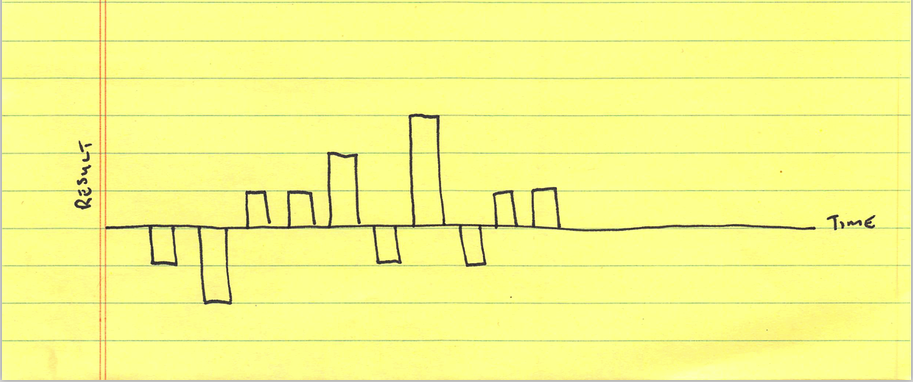
    The first sketch below was used by Steve Jobs at one of his presentations to show how he took (many) minimal downsides before he eventually got the big upside.
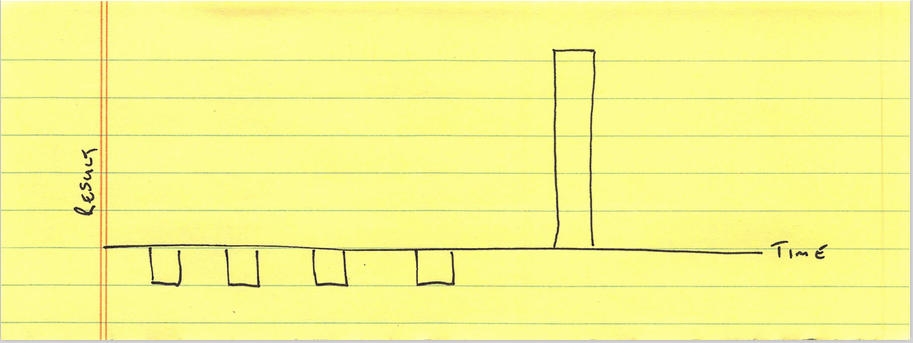
    The same is for good trading. The next sketch might represent how much was made or lost each year with a longer term investment. If we checked the results, say, every three years we would only once see a decrease in our year on year portfolio results, therefore minimising emotional drain.  Each blue horizontal line might represent a £1,000 (or multiples of) year on year profit or loss.
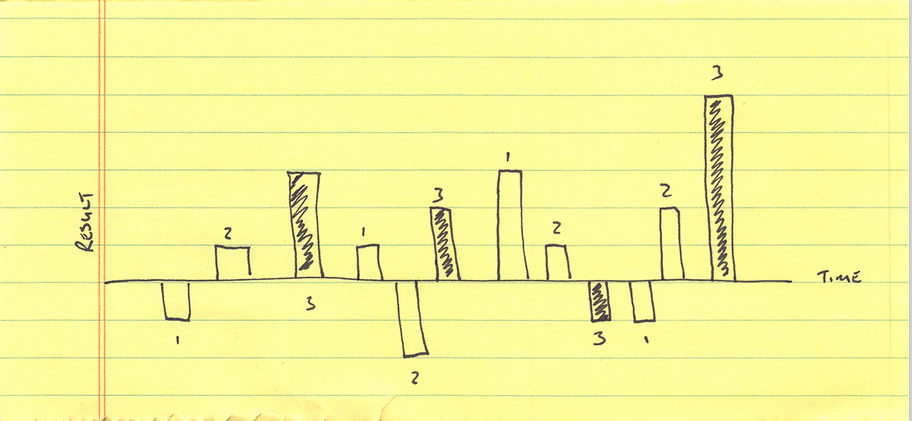
    Finally, a sketch of a day traders result for the day. A single blue horizontal line up or down represents a scalp win or loss; two horizontal lines is a swing. The bar with three horizontal bars up was a swing that was entered early and provided the extra profit. We should never see more than two bars at any one time to the downside. Each swing and scalp, therefore each horizontal blue bar, is the same in value whether the scalp was 10 pips or 30 pips. Each horizontal line represents the traders risk. A traders risk (each horizontal line) might be £60, or £600, or £6,000 – or any figure in between – depending on the traders account. But it has to be consistent.
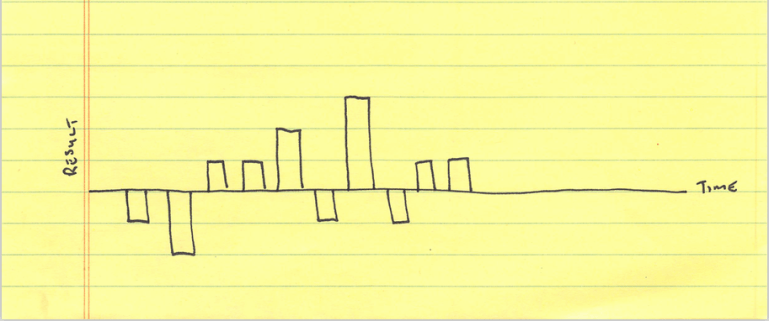
    The point here is that any downside (for the sake of emotional drain and our pocket) has to be known, acceptable and controlled. This is something most of us don’t understand when we start out. Steve Jobs understood this and he did okay.