Category: Long-term trading or investing

  • The Long, the Medium and the Short

    There are many different views, for lots of good reasons, as to what defines a trade period. But let’s try this:

    Day trading, as the word suggests, is a trade that is entered and exited within the same day. Mostly this will be technical trading, but could be news or event based.

    Short-term trading is again primarily technical; but could include fundamental, news and event based criteria. Usually one day out to several months.

    Medium term could be 9 months (as defined by Peter Lynch as the period beyond which fundamental information provides all the influence) out to several years.

    Between medium term and long-term we see a gap. A sort of no man’s (or women’s) land.

    A large correction, substantial pull-back or crash (call it what you will) happens between 7 and 15 years. Historically not before 7 years, but could be more than 15 years.

    So, lets take 15 years as a guide. For our ‘long term’ investments to survive, to grow, they may have to outlast a couple of crashes. That takes the longer term to 30 years, or thereabouts, depending on the date of purchase of the investment relative to a previous crash.

    It makes sense therefore that investment money that is needed for a pension ought not to be invested over the medium term some 7 to 15 years from a previous crash.

    2008 was our last crash, so between 2015 and 2023, or until the next one, it might be prudent to only invest short-term or longer term.

    And, we would say long-term only with excellent value equities probably purchased prior to 2015.

  • The least dirty shirt on offer

    An article featured in this weeks “The Economist” is about the cyclically adjusted earnings ratio, (CAPE) as calculated by Robert Shiller of Yale University.

    The CAPE averages profits over ten years and is now used by many as an important valuation indicator. The article explains that currently the indicator shows that American shares have hitherto been more highly valued only in 1929 and the late 1990s, periods that were followed by big crashes.

    But the article is also balanced in explaining that CAPE valuations are for the longer term view; and that over-value can exist for quite some time.

    The CAPE is a similar method developed by Nick and me in 2010 on individual equities. More recently however we have not traded with this method due to there being few suitable valuations on offer.

    The CAPE is for the long-term but it is, of course, advantageous to purchase, even for the longer term, at particularly good value.

    The article concludes with fund managers being nervous about equity valuations but they (fund managers) find government bonds deeply unattractive. They are therefore  stuck with the stock market as the “least dirty shirt” on offer.

  • Is it time to worry?

    The Economist have an article this week that asks “prices are high across a range of assets. Is it time to worry?”

    Before the 2007-08 financial crash I managed to cash-in everything that would have been exposed to the crash. This, I’m sure, was luck. I was, at the time, financing a business build; fortuitously, I went much further than cashing-in assets required to support the business.

    Some lost up to 50% of their worth during the 2007-08 crash. (I learnt recently, on their son’s visit to the UK, that this had happened to someone who I had known very well and who now resides in Australia.)

    As the Economist alludes, should we be concerned now?

    I spent nearly a year in the development of fundamental formulae based on Benjamin Graham’s ideas. His method principally determined a ‘margin of safety’. As the Economist article explains: “the price paid for a stock or a bond should allow for human error, bad luck or, indeed, many things going wrong at once”.

    In my technical trading, which is the only trading I now do, ‘margin of safety’ is everything: (1) I do not carry a trade overnight and certainly not over a weekend. (2) The risk of each trade does not exceed a maximum. (3) I cannot multi task, so I trade only one thing, watch it in the moment and with awareness of what (news) might affect it.

    Not many have the will, the time or the inclination to do what I do. I understand that. So we use traditional fund managers.

    Graham’s ‘margin of safety’ was buying a share at a 50% discount or better. can we get that deal today? If not, fund managers may become increasingly incautious in their dealings.

    Buffett said this week, as reported by the Economist, “stocks would look cheap in three years’ time if interest rates were one percentage point higher, but not if they were three percentage points higher”.

    In the meantime, for my fund investors, I’m very happy to take ‘margin of safety’ into my own hands.

    P.S. My articles are few and far between currently as I work on a strategy e-book and of course my trading.

  • Downside, like Steve Jobs

    Let us chat strategy for a moment. Wikipedia says strategy “is a high level plan to achieve one or more goals under conditions of uncertainty.”

    Many that provide trading strategies have it wrong. What they are actually providing is a way to trade, or a  method, or a system. The way that I trade is contained within my ‘algorithm to trade by’ page and this is something I tinker with all the time. (I call it an algorithm so that I keep in mind that I’m up against algo-trading which is unemotional, timely and precise).

    What I don’t tinker with, however, is my strategy; well, at least not without a great deal of consideration. A strategy is to be clear:

    • Multiple swing
    • Swing
    • Swing/scalp
    • scalp

    (traders interpret a swing and a scalp differently, see ‘algorithms to trade by’ in the paragraph clarification)

    I may use a multiple swing strategy for very long-term value investing such as with Nick’s top FTSE 350 shares; a swing only strategy is perfect for intermediate traders or experts not intraday or unable to watch the trade; swing/scalp (my passion) is the full-time experts choice; and scalp only is, well, a difficult strategy because of the often poor reward/risk ratio.

    As I’m a swing/scalp strategist I also sub-divide that strategy into swing/scalp or scalp/swing; taking the first more determinedly than the second, but that’s for another time.

    Each strategy requires little understanding, just rationality in comparing two outcomes (price up, price down), exercising the better option and holding for the desired target. I get out at break even if my algorithm tells me to. It’s about control of the downside and then about the maximisation of the upside.

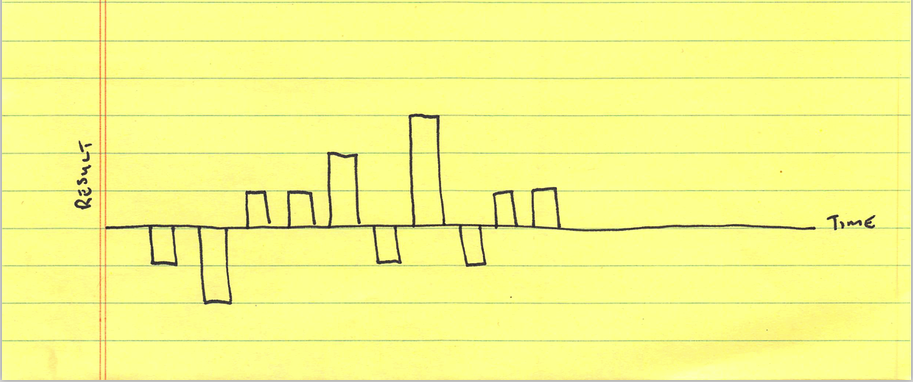
    The first sketch below was used by Steve Jobs at one of his presentations to show how he took (many) minimal downsides before he eventually got the big upside.
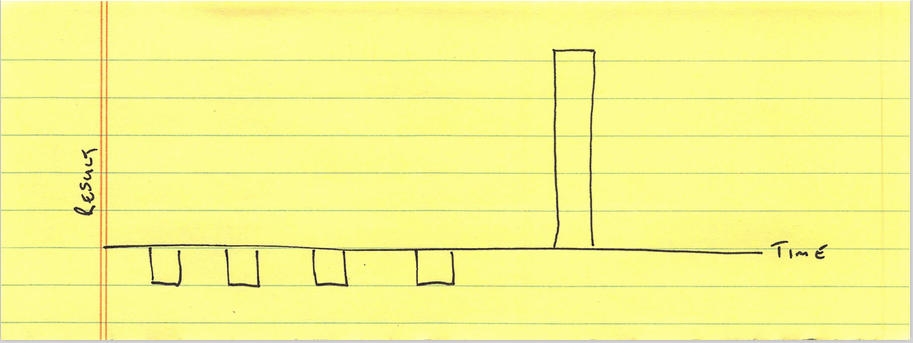
    The same is for good trading. The next sketch might represent how much was made or lost each year with a longer term investment. If we checked the results, say, every three years we would only once see a decrease in our year on year portfolio results, therefore minimising emotional drain.  Each blue horizontal line might represent a £1,000 (or multiples of) year on year profit or loss.
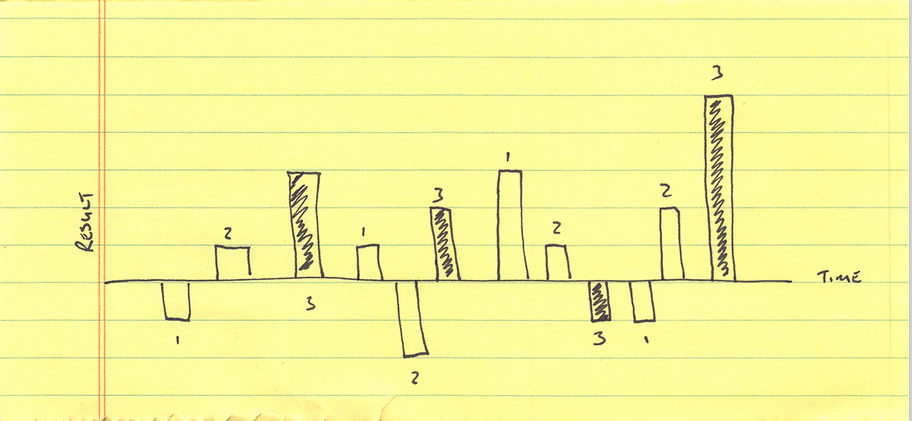
    Finally, a sketch of a day traders result for the day. A single blue horizontal line up or down represents a scalp win or loss; two horizontal lines is a swing. The bar with three horizontal bars up was a swing that was entered early and provided the extra profit. We should never see more than two bars at any one time to the downside. Each swing and scalp, therefore each horizontal blue bar, is the same in value whether the scalp was 10 pips or 30 pips. Each horizontal line represents the traders risk. A traders risk (each horizontal line) might be £60, or £600, or £6,000 – or any figure in between – depending on the traders account. But it has to be consistent.
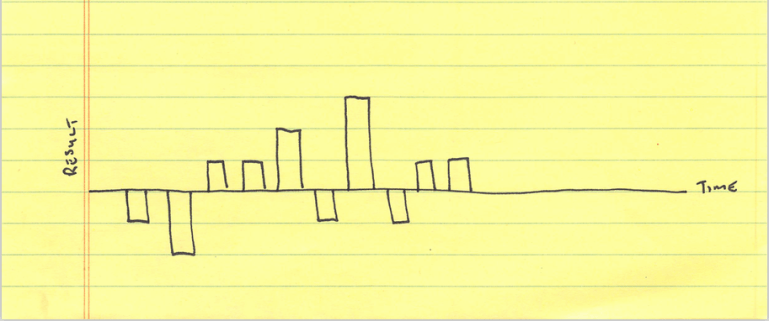
    The point here is that any downside (for the sake of emotional drain and our pocket) has to be known, acceptable and controlled. This is something most of us don’t understand when we start out. Steve Jobs understood this and he did okay.